
Publications from the Animal Welfare Centres of Excellence
Quick Start: Overview of Topics
Click on the relevant icon





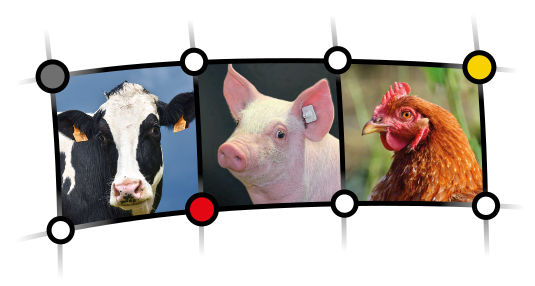
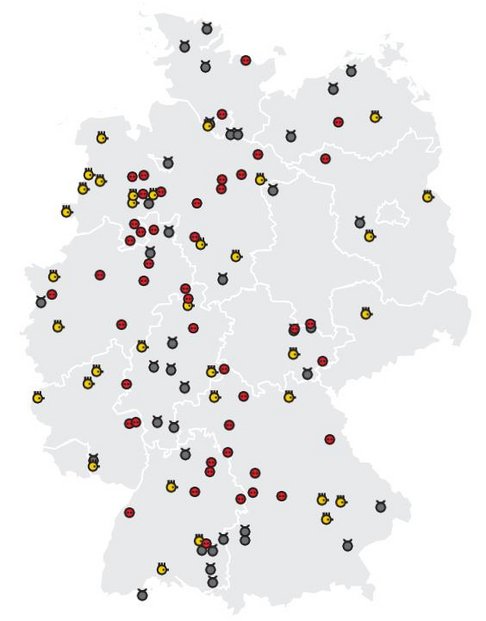
The nationwide Fokus Tierwohl network was established to provide long-term support to livestock farmers in Germany and to help them prioritise animal welfare, environmental protection, production quality and market orientation. The joint project aims to improve the transfer of knowledge into practice in order to make pig, poultry and cattle farms in Germany fit for the future in terms of animal-welfare-friendly, environmentally sound and sustainable livestock farming.
News from the Animal Welfare Network and the industry
The use of darkened heating plates (“dark brooders”) in the rearing of day-old chicks and their effect on behaviour and animal welfare during the rearing period and the subsequent fattening and laying periods. A collaborative project between the “Thünen Institute” and “FOUR PAWS International” is investigating the use of dark brooders (DB, darkened heating plates) during the first six weeks of life of organic chicks with regard to behaviour, animal welfare, stress levels, practicality and economic viability.
Hoof health is a key factor in the welfare and performance of sows. Poor hoof health within a herd is also considered a welfare issue and necessitates the implementation of appropriate, targeted measures. Numerous factors relating to housing, breeding, management and feeding, as well as other animal-related factors, influence the health and resilience of the hooves. A systematic analysis of these influencing factors forms the basis for the rapid identification of problem areas and the implementation of targeted preventive measures, thereby enabling the long-term improvement of hoof health in the sow herd.
On 26 and 27 February 2025, the pig farms participating in the ‘Fokus Tierwohl’ network’s pilot scheme met in Borgentreich, North Rhine-Westphalia. The meeting once again provided a valuable platform for professional exchange and practical insights into current developments in animal welfare in pig farming.
The Federal Office for Agriculture and Food (BLE) is seeking demonstration farms in the model regions on behalf of the Federal Ministry of Agriculture, Food and Rural Affairs to participate in the model and demonstration project (MuD) ‘Location- and climate-adapted, sustainable grassland farming’ (short title: MuD GLAKTIV).
Cattle are transported for a wide variety of reasons throughout their lives. The transport of animals is subject to legal requirements and industry standards, which have been repeatedly updated over the years. The aim of these requirements is to ensure the protection of animals during transport and to improve animal welfare.
Germany aims to become climate-neutral by 2045 and to significantly reduce its greenhouse gas emissions, including those from the agricultural sector. As a first interim target, ammonia emissions in Germany are to be reduced by 29% by 2030 compared with the reference year 2005. For existing, larger older facilities, the TA Luft also sets out requirements to bring the facilities up to the latest standards from an emissions perspective, known as the refurbishment of older facilities. Existing poultry facilities requiring a permit (under the Federal Immission Control Act (BImSchG)) must, like other livestock facilities, demonstrably reduce their emissions in accordance with the TA Luft requirements. Emissions of ammonia, dust and odours are particularly relevant for poultry farming in closed and forced-ventilated houses.
A report by the Poultry Animal Welfare Competence Centre aims to provide an overview of the already recognised mitigation measures for the various facility sizes in pullet and laying hen farming, as well as an outlook on possible future options.
Germany aims to become climate-neutral by 2045 and to significantly reduce its greenhouse gas emissions, including those from the agricultural sector. As a first interim target, ammonia emissions in Germany are to be reduced by 29% by 2030 compared with the reference year 2005. For existing, larger older facilities, the TA Luft also sets out requirements to bring the facilities up to the latest standards from an emissions perspective, known as the refurbishment of older facilities. Existing poultry facilities requiring a permit (under the Federal Immission Control Act (BImSchG)) must, like other livestock facilities, demonstrably reduce their emissions in accordance with the TA Luft requirements. Emissions of ammonia, dust and odours are particularly relevant for poultry farming in closed and forced-ventilated houses.
A report by the Poultry Animal Welfare Competence Centre aims to provide an overview of the already recognised mitigation measures for the various facility sizes in pullet and laying hen farming, as well as an outlook on possible future options.
InnoRind is a nationwide innovation network that brings together research institutions and commercial farms to promote the sustainable development of cattle farming in Germany. Its aim is to pool the country’s existing expertise in livestock farming and to establish a network for cattle farming that draws on the expertise of project participants to develop innovative approaches for sustainable cattle farming in Germany.
How can the farrowing unit be designed to meet the required 5 m² per sow in a way that benefits animal welfare, work efficiency and fertility in equal measure? In the 16th podcast from the Focus on Animal Welfare network, Susanne Gäckler, DLG, and Dr Christian Lambertz, FiBL, explore this question in depth together with their interviewees: Dr Veronika Drexl from the Schleswig-Holstein Pig Advisory Service and farm manager Michael Ostkotte, who rebuilt his mating centre a few years ago and adapted it to the new requirements.
All major diseases affecting young calves (diarrhoea, pneumonia, umbilical or joint inflammation) are classic multifactorial diseases. This means that, in addition to pathogens commonly found in all cattle farms, environmental or management factors are always involved in the onset of the disease. The fundamental principle of rearing healthy calves is therefore to maintain the calf’s immune defences as high as possible whilst keeping the pathogen load as low as possible.


agra - Die Landwirtschaftsausstellung in Mitteldeutschland
Dies ist eine externe Veranstaltung ausserhalb des Netzwerk Fokus Tierwohl
9. Apr. 2026 09:00 - 12. Apr. 2026 17:00,
Neue Messe Leipzig, Messe-Allee 1, 04356 Leipzig
Vom 9. bis 12. April 2026 wird Leipzig erneut zum Treffpunkt der Land-, Forst- und Ernährungswirtschaft in Ost- und Mitteldeutschland.-Landtechnik und…
Wiederkäuergerechte Fütterung von Milchkühen - Basis für gesunde und langlebige …
Rinderfütterung,
Wiederkäuer,
Fütterung
9. Apr. 2026 09:30 - 16:00,
Hochwälder Wohlfühlhotel, Zum Stausee 192, 66679 Losheim am See
Eine wiederkäuergerechte Fütterung legt die Basis für jede gesunde und langlebige Milchkuh. Rund um dieses Thema soll es im Rahmen von sowohl…
Wolfsabweisender Herdenschutz zur Sicherung des Tierwohls von Weidetieren
Wolf und Weidetierhaltung,
Wolfschutz,
Wolfsschutz Haltung,
Tierwohl
14. Apr. 2026 09:30 - 15:40,
Iden
Wolfsabweisender Herdenschutz schützt Weidetiere wie Schafe oder Ziegen vor Wolfsangriffen und sichert ihr Wohl. Dabei kommen Maßnahmen wie Herdenschutzhunde, elektrische Zäune und Schutznetze zum Einsatz.…

Webinar-Reihe: Die Sau im Blick – Die Zukunft im Sinn: Praxisgerechte Gestaltung…
Abferkelbuchten,
Bewegungsbuchten,
Rechtliche Rahmenbedingungen
7. Apr. 2026 18:00 - 20:00,
Online
Programm18:00 Uhr Begrüßung mit Hinweisen zum AblaufTierwohl-Multiplikator:in Netzwerk Fokus Tierwohl18:10 Uhr Impulse zur Buchtenstruktur und BodengestaltungDr. Werner Hagmüller| Schweinekompetenz Dr.…
agra - Die Landwirtschaftsausstellung in Mitteldeutschland
Dies ist eine externe Veranstaltung ausserhalb des Netzwerk Fokus Tierwohl
9. Apr. 2026 09:00 - 12. Apr. 2026 17:00,
Neue Messe Leipzig, Messe-Allee 1, 04356 Leipzig
Vom 9. bis 12. April 2026 wird Leipzig erneut zum Treffpunkt der Land-, Forst- und Ernährungswirtschaft in Ost- und Mitteldeutschland.-Landtechnik und…
Webinar-Reihe: Die Sau im Blick – Die Zukunft im Sinn: Klauengesundheit als Schl…
Klauengesundheit,
Klauenpflege
14. Apr. 2026 18:00 - 20:00,
Online
Programm18:00 Uhr Begrüßung mit Hinweisen zum AblaufTierwohl-Multiplikator:in Netzwerk Fokus Tierwohl18:10 Uhr Grundlagen der Klauengesundheit bei SauenDr. Theodor Schulze-Horsel | Haus Düsse LWK NRW18:50…

agra - Die Landwirtschaftsausstellung in Mitteldeutschland
Dies ist eine externe Veranstaltung ausserhalb des Netzwerk Fokus Tierwohl
9. Apr. 2026 09:00 - 12. Apr. 2026 17:00,
Neue Messe Leipzig, Messe-Allee 1, 04356 Leipzig
Vom 9. bis 12. April 2026 wird Leipzig erneut zum Treffpunkt der Land-, Forst- und Ernährungswirtschaft in Ost- und Mitteldeutschland.-Landtechnik und…
Online-Kongress "Wissenschaft trifft Landwirtschaft"
Mastgeflügel,
Antibiotikareduzierung,
Hygiene,
Biosicherheit,
Tiergesundheit,
Management,
Dies ist eine externe Veranstaltung ausserhalb des Netzwerk Fokus Tierwohl
13. Apr. 2026 10:00 - 16:00,
Online
Im Rahmen des Modell- und Demonstrationsvorhabens (MuD) Tierschutz „Antibiotikaminimierung in der Masthühnerhaltung durch Hygienemaßnahmen sowie Optimierung von Biosicherheit, Tiergesundheit und…
Verlängerung der Haltungsdauer von Legehennen
Verlängerung Nutzungsdauer,
Legehennen,
Legehennenfütterung
14. Apr. 2026 09:00 - 14:00,
Institut für Tierproduktion – Wilhelm-Stahl-Allee 2 – 18196 Dummerstorf (Haus 9)
Um das Tierwohl in der Legehennenhaltung zu erhöhen, gibt es viele Stellschrauben, an denen Tierhalterinnen und Tierhalter drehen…