
- Detlef May, Teaching and Research Institute for Animal Breeding and Animal Husbandry, Groß Kreutz
- Prof. Dr. Heiko Scholz, Anhalt University of Applied Sciences
- Prof. Dr. Ralf Waßmuth, Osnabrück University of Applied Sciences
- Guest: Angela Mögel, State Agricultural Agency of Hesse
- Dr. Rebecca Simon, Landesbetrieb Landwirtschaft Hessen
- Leonie Schnecker, Landesbetrieb Landwirtschaft Hessen
- Dr Ingrid Lorenz, Veterinary Surgeon, Bavarian Animal Health Service
Funding information
This document was developed as part of the joint project Network Focus Animal Welfare, funding code 28N419TA01 to 28N419TA17, by the "Suckler Cow" working group of the Animal Welfare Competence Centre for Cattle and prepared methodologically and didactically by DLG e.V.
The joint project of the chambers of agriculture and agricultural institutions of all federal states aims to improve the transfer of knowledge into practice in order to make cattle, pig and poultry farms sustainable in terms of animal welfare, environmental protection and sustainable livestock farming.
The project is funded by the Federal Ministry of Agriculture, Food and Rural Affairs on the basis of a resolution of the German Bundestag.
All information and notes are provided without any guarantee or liability.
Publisher
DLG e.V.
Fachzentrum Landwirtschaft
Eschborner Landstraße 122
60489 Frankfurt am Main
Reproduction and transmission of individual sections of text, drawings or images (including for teaching purposes) and provision of the information sheet in whole or in part for viewing or downloading by third parties is only permitted with the prior approval of the relevant office of the Animal Welfare Competence Centre for Cattle and DLG e.V., Marketing Department, Tel. +49 69 24788-209, [email protected].
Introduction
Endoparasites and ectoparasites play a major role in grazing cattle and can cause serious health problems, particularly in young animals, but also in older animals, which can result in economic losses. However, cattle farming with grazing or year-round outdoor rearing always involves parasites. Parasite management is therefore of great importance.
Parasites are organisms that live temporarily or permanently on (ecto = outside) or in (endo = inside) another, usually larger, organism of a different species. They feed on the affected organisms and have potentially disease-causing properties.
Diseases caused by parasite infestation are classified as factor-dependent diseases: whether parasites have the opportunity to infest a herd of cattle and take advantage of it depends on various factors. Favourable factors are primarily found in husbandry and feeding. In order to minimise these factors, prevention is a crucial factor in parasite control.16
Part of the parasite control strategy is therefore pasture management adapted to the location and husbandry conditions. The natural defences of cattle should be strengthened through appropriate feeding, responsible husbandry, care and maintenance. With a view to sustainable parasite management, the different life cycles of parasites offer opportunities for suitable prophylaxis. Only then should treatments with antiparasitic agents be carried out on an individual farm basis, responsibly and in consultation with the vet.
Endoparasites
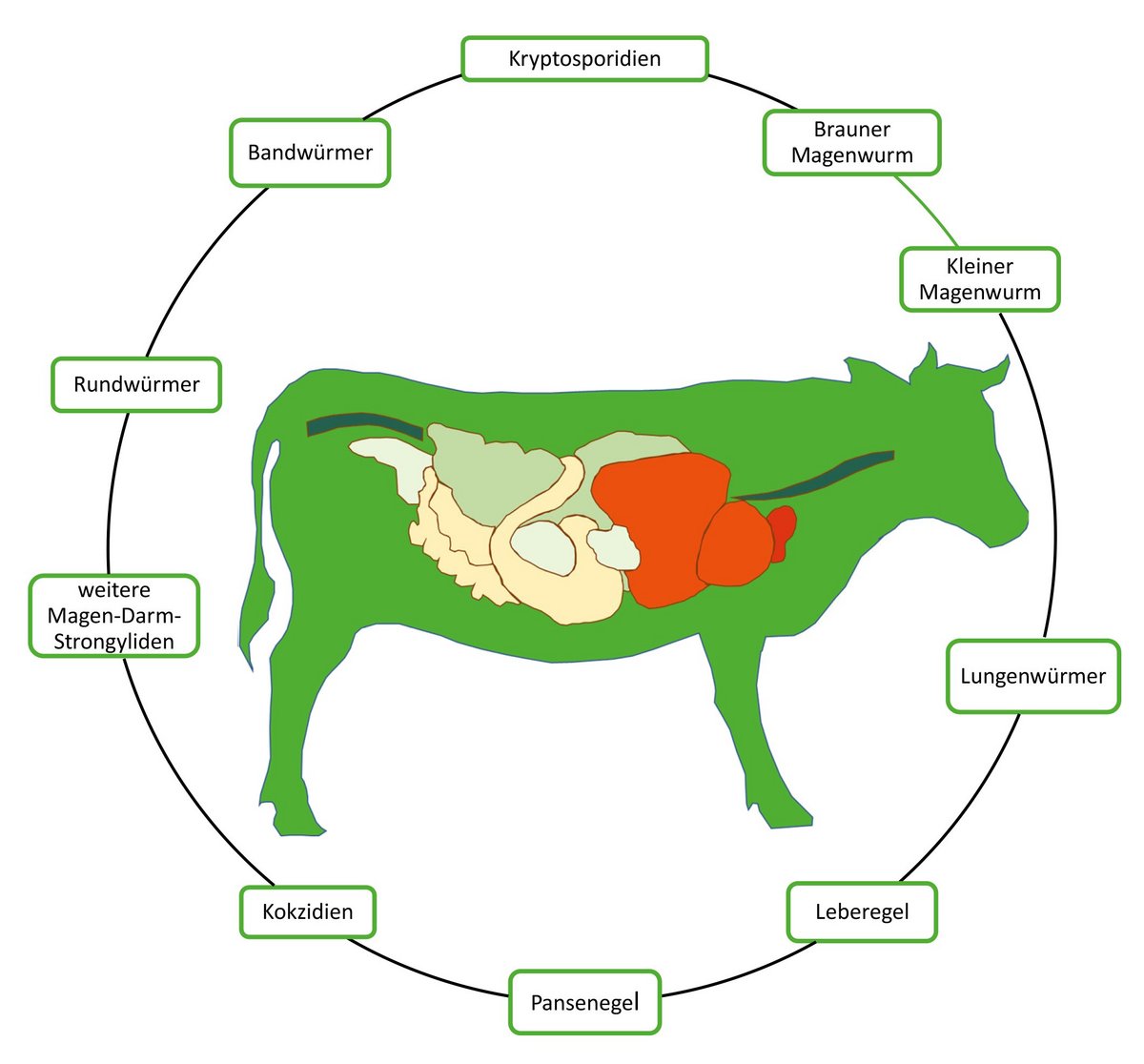
Endoparasites are one of the two main groups of parasites. They feed within the host’s body, where they cause various symptoms, some of which can be severe.
Possible symptoms of an endoparasite infestation
To summarise the wealth of information available, only the most common endoparasites are examined in detail below.
An endoparasite infestation is primarily noticeable through symptoms such as diarrhoea, a rough coat, weight loss and loss of appetite. Gastrointestinal strongyles (MDS) (worms) occur in suckler cows and their calves when they are kept on pasture. The risk of infection is greatest for calves and young cattle during their first grazing season. The worms damage, for example, the mucous membranes in the gut. As a result, infected cattle can no longer utilise their feed adequately. Depending on the severity of the worm infestation and the state of the immune system, this can lead to significant weight loss and diarrhoea. Caution: Even without visible symptoms, a decline in performance can occur in second-calf heifers or cows; therefore, monitoring and prevention are important.
Over the course of the year, the larvae of the most significant member of the MDS – the brown stomach worm of grazing animals – are ingested by cattle after they are turned out to pasture in the spring. The larvae attach themselves to green plants, for example. The larvae ingested in the spring develop into adult worms within the cattle, which in turn can produce eggs. Cattle usually fall ill between mid- and late July, exhibiting diarrhoea, weight loss, a rough coat and excreting new worm eggs. After overwintering in cow dung on the pasture (where the egg develops into a larva), the cycle begins anew the following year. In addition to overwintering on the pasture, overwintering within the animal in the form of ‘hypobiosis’ is also possible, which can likewise pose a risk of infection or disease as early as late winter or early spring.
Unlike MDS larvae, lungworm larvae do not overwinter in the pasture but within their host, in older cattle and cows. As the immune system is not yet fully developed, calves on their first outing to pasture and young cattle are particularly at risk of infection, especially if they graze a pasture shortly after older cattle. In the case of lungworms, the next generation develops within approximately four weeks inside the host into the first larva, which is excreted in the faeces. After further development over about a week, the infectious larvae are dispersed across the pasture with the help of a fungus, but also through runoff during rain. Coughing is a sign of lungworms. This usually occurs in the second half of the grazing season and ranges from a mild cough to severe breathing difficulties. If symptoms appear in a herd, treatment must be carried out. If left untreated, severe infestation carries the risk of pneumonia.
The giant liver fluke migrates within the host’s body from the intestines to the liver and bile ducts. This can cause a drop in fattening performance or even fertility problems. Cattle ingest the liver fluke larvae with the grass. It takes six to eight weeks from ingestion to development into an adult fluke. A key factor in infestation is grazing cattle’s access to wetlands, the natural habitat of the intermediate host required by the liver fluke: the dwarf mud snail. Pasture management measures can be used for prevention here; see tips on pasture management23, 24, 25
| Parasite | Particularly at risk | Infection period | Disease period / symptoms in the animal | Testing recommendation* |
| Worms (MDS) | Calves and young cattle | After turnout in spring | From the end of July Diarrhoea, rough coat, weight loss, loss of appetite | From the middle of the grazing season, then every 4 weeks |
| Lungworm larvae | Calves and young cattle | After turnout in spring | second half of the grazing season Mild cough to > severe breathing difficulties, pneumonia | Onset: Six weeks after turnout; recurrence every 4–6 weeks |
| Liver fluke | Calves, young cattle and adult animals | Spring and early summer | Towards the end of the grazing season e.g. weight loss, fertility problems | In the second half of the grazing period or after bringing the animals indoors |
Further information on various worm species and their life cycles
Decision-making guide: Grazing parasites: Gastrointestinal strongyles (MDS)
Pasture parasites in suckler cow husbandry
Decision aid for pasture parasites: lungworms
Preventive and therapeutic measures
Controlling pasture parasites is a key component of pasture management. The growing development of resistance to anthelmintics makes successful treatment more difficult and highlights the importance of prevention through appropriate pasture management. Risk factors such as high stocking densities, permanent pastures, damp pastures or pastures used for young stock significantly increase the risk of infection and should be avoided.1,2
Regular monitoring should be carried out to control worm infestation in animals. This is usually done by examining faecal samples from a section of the herd or from individual animals showing signs of infection, which are specifically selected. For gastrointestinal strongyles (MDS), this involves examining faecal samples from around 10–15 animals (regardless of herd size). The faecal samples from the animals tested should be sent to the laboratory within 48 hours. If the EPG (number of eggs per gram of fresh faeces) exceeds 100, the animals should be treated in consultation with the vet. A faecal examination is also necessary for the diagnosis and control of lungworm larvae. If an infection with liver flukes is suspected, faecal samples from individual groups of animals can be helpful for diagnosis. Egg excretion is highest in autumn/winter but not constant, so at least 5 animals from a group should be sampled.3, 13, 23
For suckler cow husbandry, the Thünen Institute’s decision tree can be used to determine, on a farm-by-farm basis, when faecal samples should be taken and when treatment should be discussed with the attending veterinarian. Calves and first-calf heifers are particularly at risk, especially upon their first contact with pasture forage. However, contact between grazing animals and parasites is also an important prerequisite for immunisation (preparation of the immune system) against endoparasites (e.g. MDS). Therefore, targeted deworming in line with the developmental stages of the endoparasites is a promising long-term measure to reduce the need for future deworming.4,5
When keeping cattle on pasture, it is important to avoid additional stress (e.g. excessive heat or cold) in the event of a parasite infestation. Sick animals should not be left to overwinter on pasture, given the strain this places on their immune system.
Further information
Managing cold stress in suckler cows
Managing heat stress in suckler cows
| Which faecal sample? | Why? | Advantages | Disadvantages |
| Pooled faecal samples |
|
|
|
| Individual faecal samples |
|
|
|
An egg count reduction test can be carried out to monitor success. This is not considered a routine measure for cattle. If necessary, the farm’s attending vet can be consulted.
Further information
Sustainable parasite management
Sustainably controlling internal parasites in cattle through pasture management
Tips on pasture management
- Choosing pastures with low levels of contamination can reduce the risk
- Continuous monitoring of the young animals’ development
- Pasture diary: document the pastures used, the animals’ exposure, treatments and any abnormalities
- Mow or cut the vegetation, or harvest hay/silage instead of mulching
- Ensure optimal care of the animals to strengthen the immune system
- Spring turnout onto dried-out areas
- If possible, drive herds with calves out only after the first cut (June)
- Reserve safe and clean pasture for young animals
- Using pasture land for silage and hay production beforehand reduces parasite levels
- Do not apply fresh slurry to the pasture
- Use newly sown pasture or land not grazed in the previous year
- Ensure drinking areas are clean and dry
- Take into account differences in location and seasonal factors!
- Incorporate rest periods for pastures to interrupt parasite cycles: 5-pasture system
- Mixed grazing systems with sheep or horses can help reduce parasite numbers
- Note: the large liver fluke, for example, is not very host-specific and also infects horses, sheep or goats 1,5,25,32,33
Faecal samples are well suited for diagnosis, but depend heavily on the quality of the sample material. Sample collection and dispatch are crucial factors for the reliability of the result.
General guidance on collecting a stool sample
- Faecal sample of fresh faeces (30–40 g)
- Packaging: break-proof and leak-proof, in accordance with (postal) transport regulations: Please contact your vet
- Until dispatch: store the sample in a cool place if possible; in summer months, have a cooling pack ready
- Choose a dispatch date so that the sample arrives at the laboratory as quickly as possible (preferably at the start of the week, not on Fridays or at the weekend)17/18
Specific instructions for sample collection can be found on the respective websites of the relevant laboratories.
Further information
If necessary: advice on treatment with antiparasitic drugs
- Key guidelines for parasite control in pasture-based husbandry: Use deworming products as required and follow the dosage instructions!
- Please note: The weight of the animals must not be underestimated! This is a particular problem when all animals are given the same dose across the board
- To minimise adverse effects on nature and the environment, deworming agents should not be used prophylactically, but rather in a targeted manner and, where possible, on an individual animal basis. Important: in organic farming, the preventive use of antiparasitic agents is generally not permitted
- Treatment for gastrointestinal strongylid (MDS) infection:
- Calves and young cattle in their first grazing season are most at risk
- The need for deworming should be determined by faecal examination and the animals’ general condition. To prevent resistance, it is also advisable to leave animals that show no impairment in growth or weight gain untreated (further information on the refuge strategy)
-
- If necessary, consult a vet to select a suitable antiparasitic agent
- Various active ingredients and administration methods with differing durations of action are available (bolus, injection, liquid preparations)
- Treatment for lungworm infestation:
- Antiparasitic drugs effective against MDS are also effective against lungworms
- Please note: However, not all preparations combat both adult and juvenile stages of the parasite
- If initial symptoms appear in a herd (usually in the second half of the grazing season), treatment should be carried out
- Antiparasitic drugs effective against MDS are also effective against lungworms
- Treatment for liver fluke infection:
- In winter, a preventive treatment can be carried out to avoid contamination on at-risk pastures the following spring
- Important: At the start of the indoor period, only preparations that kill all stages of the liver fluke may be used
- These products may only be used on young cattle and heifers up to six weeks before calving
- Towards the end of the indoor period, products may be used that kill23,24,25 only adult liver flukes
- In winter, a preventive treatment can be carried out to avoid contamination on at-risk pastures the following spring
Ectoparasites
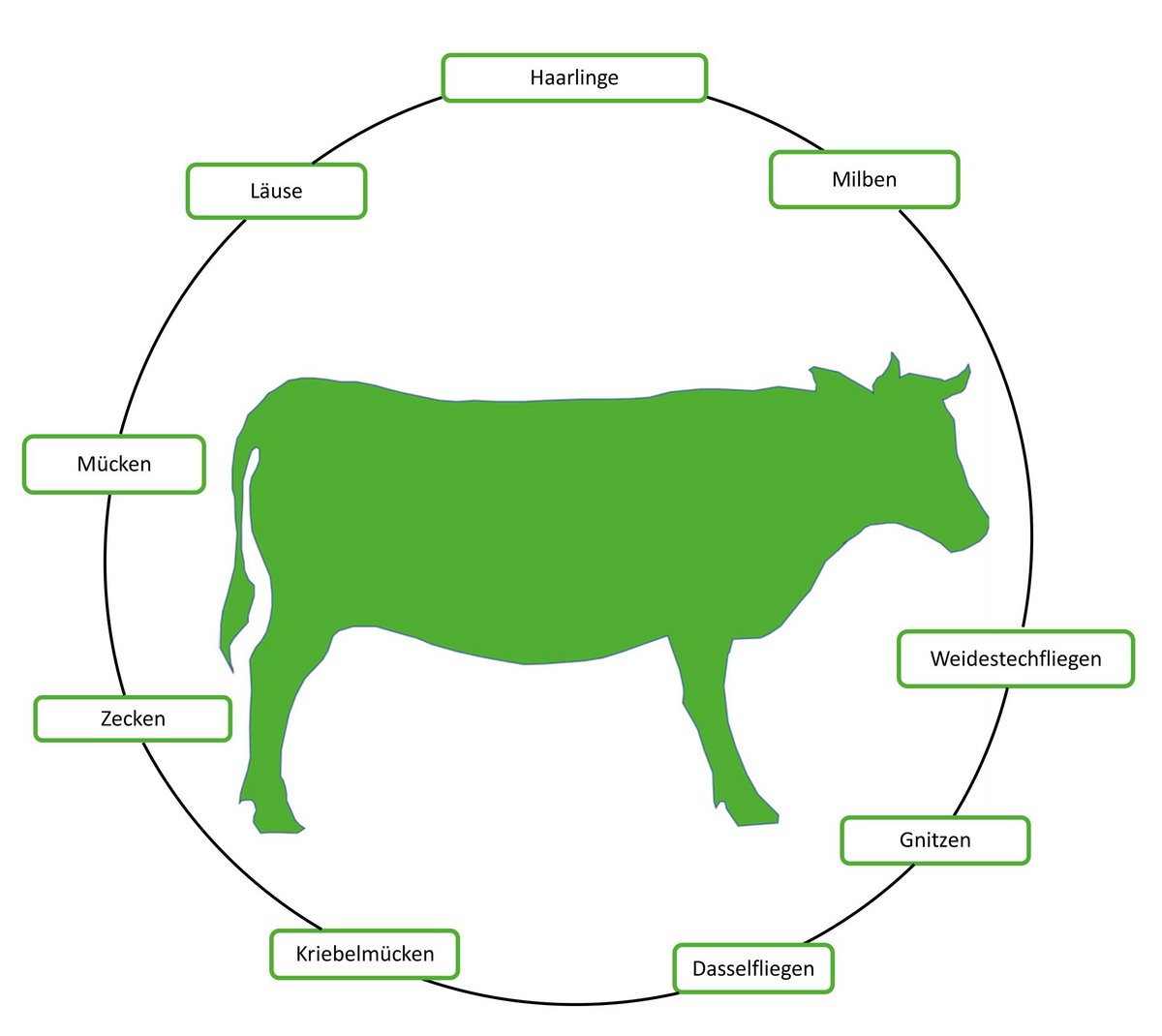
Ectoparasites feed on the host’s skin. For suckler cows, they are primarily a source of stress. In young cattle, they can lead to growth disorders and reduced performance. Their bites or stings are painful, can transmit pathogens and cause disease.8
Possible symptoms of an infestation with ectoparasites
An infestation with ectoparasites can usually be detected quickly by observing the animals’ behaviour. Particularly noticeable signs include jerky movements of the tail, head and ears, as well as stamping, general restlessness and stress within the herd. Whilst grazing, the animals often stand closer together than usual. Changes in the coat may indicate an ectoparasite infestation. In the case of hair lice and body lice, for example, these manifest as hair loss or chafing. The dense coat provides ideal, warm and moist conditions for the parasites to multiply. Sticky patches in the coat indicate where eggs have been laid on the cattle. With some ectoparasites, other diseases may follow the actual infestation. Black flies, for example, can transmit serious infections such as bluetongue virus (BTV) or Schmallenberg virus. The only way to prevent harm to the animals in this case is to vaccinate them. Ticks can also cause indirect harm to cattle: babesiosis, also known as ‘pasture fever’, which is transmitted by ticks, is becoming more common again; it infects red blood cells and causes anaemia by destroying them.
Various pasture flies prefer different parts of a cow’s body. For instance, the eye fly sits on the cow’s eyes and can cause the eye condition known as ‘pink eye’. The udder fly can cause what is known as summer mastitis. The pasture biting fly, which sometimes sits in their thousands upside down on the cows’ backs and horns, feeds on the host animal’s blood 20–40 times a day per fly and causes painful bites.5,12,15
Preventive and therapeutic measures
In the event of an ectoparasite infestation, the entire herd is often affected. It is essential to closely observe all animals for signs of infestation. If skin changes caused by an infestation are visible, a skin scraping can be examined under a microscope to identify the specific type of mite. Lice and chiggers can be easily identified and distinguished with the naked eye. The burden on animals caused by flies in the pasture can be reduced using pyrethroid-containing fly ear tags/ear clips, garlic-containing mineral supplements, or, in the case of a severe infestation with other ectoparasites, infusions. In addition to treatment with insecticides, it is advisable to adjust the grazing schedule: for example, the animals can be allowed to graze only during the early, cooler hours of the day, or alternatively, grazing can be switched from daytime to night-time grazing. It should be noted here that whilst this is helpful for controlling pasture biting flies, midges are crepuscular and nocturnal. If necessary, there should be the option of bringing the animals indoors. In the event of a severe fly infestation on the pasture, potential breeding sites for the ectoparasites (e.g. damp areas around water troughs) on the pasture should also be dried out. To alleviate itching caused by an ectoparasite infestation, rubbing posts may be provided; however, these must be cleaned and disinfected after use by an infested herd and replaced if necessary to interrupt transmission routes. Particular caution is required with regard to tail mange (caused by biting mites): this mite can survive in the environment for 2–3 weeks and uses the cow brush to infest other animals. The same applies to lice and hair lice.
It is also important to ensure an adequate supply of trace elements for cattle, as trace elements play a significant role in building the immune system. A deficiency leads to increased susceptibility to infection; for example, inflammation and disease may occur more frequently in the event of a parasite infestation. Reduced performance and fertility problems may also result.5,8,9,10,12,15
Further information
Cows, wasps, chickens – what can be done about flies?
Factsheet on parasites: Beef cattle rearing and young cattle rearing on pasture
If required: Tips on how to use herbal infusions
- To ensure the products are effective, it is important to administer the correct dose of the antiparasitic treatment based on the animal’s actual live weight. If no scales are available, a measuring tape can help to estimate the weight more accurately
- After application to the base of the skull and the base of the tail, the cattle must not come into contact with rain for 24 hours to prevent the risk of the product being washed off
- Cattle should be kept away from water bodies for as long as possible after application, as the product may8 be toxic to aquatic organisms
To minimise the risk of infection in the pasture, the following points should be observed:
| Do's | Don’ts |
|
|
|
|
|
|
|
|
| |
|
<figcaption>Table 3: Preventing infections</figcaption>
Further information on the refuge strategy
Bibliography
- 1Bystron, S., March, S., Brinkmann, J. (2018): Decision-making guide to pasture parasites. Sustainable parasite management. Decision trees for ruminants: Recommendations from science and practical experience. Published by: Thünen Institute, as of 03. URL: https://www.weide-parasiten.de/mutterkuhhaltung/nachhaltiges-parasitenmanagement (accessed on 23 April 2025)
- 2Heckedorn, F., Frutschi, V. (2014): Internal parasites in cattle and pasture management. Factsheet. URL: https://www.bioland.de/fileadmin/user_upload/Erzeuger/Fachinfos/Merkblaetter/Weideparasiten.pdf (accessed on 23 April 2025)
- 3Bystron, S., March, S., Brinkmann, J. (2018): Decision-making guide: pasture parasites. Monitoring. Decision trees for ruminants: recommendations from science and practical experience. Published by: Thünen Institute, as of 03. URL: https://www.weide-parasiten.de/jungrinder/monitoring (accessed on 23 April 2025)
- 4Bystron, S., March, S., Brinkmann, J. (2018): Decision-making guide: pasture parasites. Decision tree: ‘Suckler cow husbandry’. Decision trees for ruminants: Recommendations from science and practical experience. Edited by: Thünen Institute, version 03. https://www.weide-parasiten.de/mutterkuhhaltung/entscheidungsbaum (accessed on 23 April 2025)
- 5Lower Saxony Grassland Centre (2024): Grazing Guide. Parasites. URL: https://www.gruenlandzentrum.org/weideleitfaden/#14_Parasiten (accessed on 23 April 2025)
- 7Cattle parasites and their control. Published by: Boehringer Ingelheim. URL: www.bovikalc.de/html/epaper-parasiten_des_rindes/index.html
- 8Humer, M., et al. (2020): Factsheet: Parasites. Beef cattle rearing and young cattle rearing on pasture. URL: https://www.tiergesundheitundmehr.de/merkblatt-parasiten-ansicht-i26.pdfx (accessed on 23 April 2025)
- 9Stracke, C. (2024): Fly control on pasture. In: ELITE. Magazine for dairy farmers. URL: https://www.elite-magazin.de/herdenmanagement/fliegenbekampfung-auf-der-weide-13436.html (accessed on 23 April 2025)
- 10Keeping an eye on trace elements in pasture-based farming (2022) In: Milchpur. URL: https://www.milchpur.de/gruenland/weide-gruenland/bei-weidehaltung-die-spurenelemente-im-blick-haben/ (accessed on 23 April 2025)
- 11Grazing season is parasite season (2014). In: Animal Health and More. URL: https://www.tiergesundheitundmehr.de/weidezeit-ist-parasitenzeit.pdfx (accessed on 23 April 2025)
- 12Parasite control in cattle. In: Animal Health and More. URL: www.tiergesundheitundmehr.de/parasitenbekaempfung (accessed on: 19 March 2025)
- 13Bystron, S., March, S., Brinkmann, J. (2018): Decision-making guide: Pasture parasites. Gastrointestinal strongyles. Suckler cow management. Decision trees for ruminants: Recommendations from science and practical experience. Edited by: Thünen Institute, as of 03. URL: https://www.weide-parasiten.de/mutterkuhhaltung/wurmarten/magen-darm-strongyliden (accessed on 23 April 2025)
-
14Bauer, Prof. Dr Ch. (2014): Parasite-free – it doesn’t exist. Management and treatment strategies against pasture parasites. In: Landwirtschaftliches Wochenblatt, 26/2014.
- 15Mögel, A. (2016): When it itches and bites. LLH Pasture Working Group, Topic: Parasite control. In: Landwirtschaftliches Wochenblatt, 12/2016.
- 16Lorenz, Dr I. (2024): Parasite problems in livestock farming. Presentation by the Bavarian Animal Health Service (Tiergesundheitsdienst Bayern e.V.).
- 17Ministry of Rural Affairs and Consumer Protection, State Veterinary Investigation Office Aulendorf – Diagnostic Centre (2017): Collection and dispatch of faecal samples. URL: https://www.stua-aulendorf.de/pdf/Merkblatt-Kotprobenentnahme.pdf (accessed on 23 April 2025)
- 18Questions regarding sample submission. Published by: Institute of Parasitology, Justus Liebig University. URL: www.uni giessen.de/de/fbz/fb10/institute_klinikum/institute/parasitologie/diagnostik/antworten-auf-haeufig-von-tierbesitzerinnen-gestellte-fragen-vor-bei-nach-einsendung-von-untersuchungsproben (accessed on 19 March 2025)
- 19Berchtold, J. (2024): Cow dung promotes insects. Pasture farming: One tonne of insect biomass per hectare. In: Braunvieh cattle breeding in Agrarheute. URL: https://www.agrarheute.com/braunvieh/wirtschaft-politik/weidehaltung-tonne-insektenmasse-pro-hektar-625815 (accessed on 23 April 2025)
- 20Urban, J. (2022): Biodiversity. If the cows disappear, the insects go, the swallows go . . .. In: Bavarian Agricultural Weekly. URL: https://www.wochenblatt-dlv.de/feld-stall/tierhaltung/verschwinden-kuehe-gehen-insekten-gehen-schwalben-557948 (accessed on 23 April 2025)
- 21Schoof, N.; Luick, R. (2019): Antiparasitic agents in grazing livestock farming. An underestimated factor in insect decline? In: Nature Conservation and Landscape Planning | 51 (10) | 2019, pp. 486–492
- 22Federal Environment Agency (2024): Environmental impacts of veterinary medicines. URL: https://www.umweltbundesamt.de/umweltwirkungen-von-tierarzneimitteln (accessed on 23 April 2025)
- 23Lorenz, Dr Ingrid (2020): Pasture. Keeping an eye on parasites. In: Milchpur. URL: https://www.milchpur.de/gruenland/weide-gruenland/die-parasiten-im-blick/ (accessed on 23 April 2025)
- 24Bystron, S., March, S.; Brinkmann, J. (2018): Pasture parasite management. Decision trees for ruminants. Recommendations from science and practical experience. Ed.: Thünen Institute, as of 03. URL: https://www.thuenen.de/media/publikationen/thuenen-ratgeber/ThuenenRatgeber3_Weideparasiten-Management.pdf (accessed on 23 April 2025)
- 25Resch, K. (2023): Gastrointestinal strongyles (MDS), In: Milchpraxis. Dairy Cow Specialist Portal. URL: https://www.milchpraxis.com/magen-darm-strongyliden/ (accessed on 23 April 2025)
- 26Koopmann, R., Rahmann, G. (2008): Endoparasite research for organic pasture farming. Departmental research for organic farming. Ed.: Thünen Institute – Federal Research Institute for Rural Areas, Forestry and Fisheries, Trenthorst. URL: https://literatur.thuenen.de/digbib_extern/dk041468.pdf#page=3 (accessed on 23 April 2025)
- 27Lorenz, Dr I. (2021): Not just a nuisance. Ectoparasites such as lice, hair lice, scab mites and ticks not only cause suffering to cattle but also result in economic losses that should not be underestimated. In: Fleckvieh 3/2021. URL: https://www.tgd-bayern.de/Downloads/Fachbeitr%C3%A4ge/Rinder/F213-48-49-Man-Ektoparasiten-Flechte_MH.pdf (accessed on 23 April 2025)
- 28Sorge, Dr U. (2021): Cows, wasps, chickens – what can be done about flies? Published by: Bavarian Animal Health Service. URL: https://www.tgd-bayern.de/Downloads/Fachbeitr%C3%A4ge/Rinder/Sorge._2021._Effektive_Fliegenbek%C3%A4mpfung.pdf (accessed on 23 April 2025)
- 29Heckendorn, F. (2016): Pasture parasites in suckler cow husbandry. In: How to. URL: https://www.mutterkuh.ch/files/content/Downloads-Deutsch/05-DE-Produzenten-Service/DE-Fachinfos/03-DE-Tiergesundheit/16_2_Weideparasiten_in_der_Mutterkuhhaltung_d.pdf (accessed on 23 April 2025)
- 30Bystron, S., March, S.; Brinkmann, J. (2018): Pasture parasite management. Lungworms in young cattle. Recommendations from science and practical experience. Published by: Thünen Institute, as of 03.URL: https://www.weide-parasiten.de/jungrinder/wurmarten/lungenwuermer/kuehe (accessed on 23 April 2025)
- 31Research Institute of Organic Agriculture, FiBL (2025): Monitoring Cattle: Parasitological Diagnostics. URL: https://www.fibl.org/fileadmin/documents/de/services/Monitoring_Rinder_Information_DE_01-2025.pdf (accessed on 23 April 2025)
- 32Meisser, Marco (2012): The importance of mixed grazing with cattle and sheep. In forum 5/2012 URL: https://www.bioaktuell.ch/fileadmin/documents/ba/tierhaltung/kleinwiederkaeuer/Mischweide-2012-ACW.pdf (accessed on 23 April 2025)
- 33Sladky, Pamela (2021): Pasture management: Horses and cattle keep each other free of worms. In: Pferderevue, the Austrian horse magazine. URL: https://www.pferderevue.at/aktuelles/haltung/2021/weidemanagement--pferde-und-rinder-halten-sich-gegenseitig-wuerm.html (accessed on 23 April 2025)