

- Jörg Böhmfeld, Rhineland-Palatinate Chamber of Agriculture
- Dr. Klaus Damme, Bavarian State Institute for Agriculture
- Christina Gaio, Board of Trustees for Technology and Construction in Agriculture
- Dr. Peter Hiller, Lower Saxony Chamber of Agriculture
- Bernd Kästner, Thuringian State Institute for Agriculture
- Dr. Christiane Keppler, Hesse State Agricultural Agency
- Jörn Menning, Saxony-Anhalt State Institute for Agriculture and Horticulture
- Antonia Nette, Brandenburg State Office for Rural Development, Agriculture and Land Consolidation
- Silke Schierhold, Lower Saxony Chamber of Agriculture
- Dr. Stephan Schneider, Bavarian State Institute for Agriculture
- Dr. Sophia Schulze-Geisthövel, North Rhine-Westphalia Chamber of Agriculture
- Svea Sievers, German Agricultural Society
- Gertrud Werner, Rhineland-Palatinate Chamber of Agriculture
- Dr. Marc-Alexander Lieboldt, Lower Saxony Chamber of Agriculture
- Jule Schättler, Lower Saxony Chamber of Agriculture
In search of holistic housing concepts with a future
How should housing systems be designed so that they are animal-friendly, environmentally sound and climate-friendly, whilst also being consumer-oriented and competitive? Numerous experts from state institutes, state offices and chambers of agriculture across Germany, as well as other specialist organisations such as the DLG and KTBL, have dedicated themselves to this challenging task and continue to do so today. The Poultry Working Group also includes representatives from the Foundation of the University of Veterinary Medicine, the Centre for Applied Research and Technology e.V. at Dresden University of Applied Sciences, Nürtingen-Geislingen University of Applied Sciences, and the Thuringian Animal Disease Fund. Since the end of 2018, this group has been meeting regularly to develop possible concepts for the ‘house of the future’ for the various types of use and production stages.
As a first step, the poultry working group focused on the challenging area of pullet rearing. Through their work, the experts aim to demonstrate under which housing conditions and management factors chicks and pullets can exhibit their species-specific behaviours almost fully whilst being reared to achieve optimal biological performance. This is because the rearing of chicks and pullets lays the foundation for subsequent laying hen management. To achieve good biological performance and balanced animal behaviour, the rearing system and management must be optimised when keeping hens with intact beaks.
Two housing models were therefore developed based on the premise of animal-friendly and welfare-oriented husbandry. The working group identifies prerequisites for this, including regulated stocking density, engagement of the chicks from day one, and feeding adapted to the animals’ needs. To enable pullets to express their species-specific behaviours, the functional areas within the rearing system must be clearly defined. With the help of these and other measures, attempts are made to prevent the development of feather pecking and cannibalism during the rearing phase.
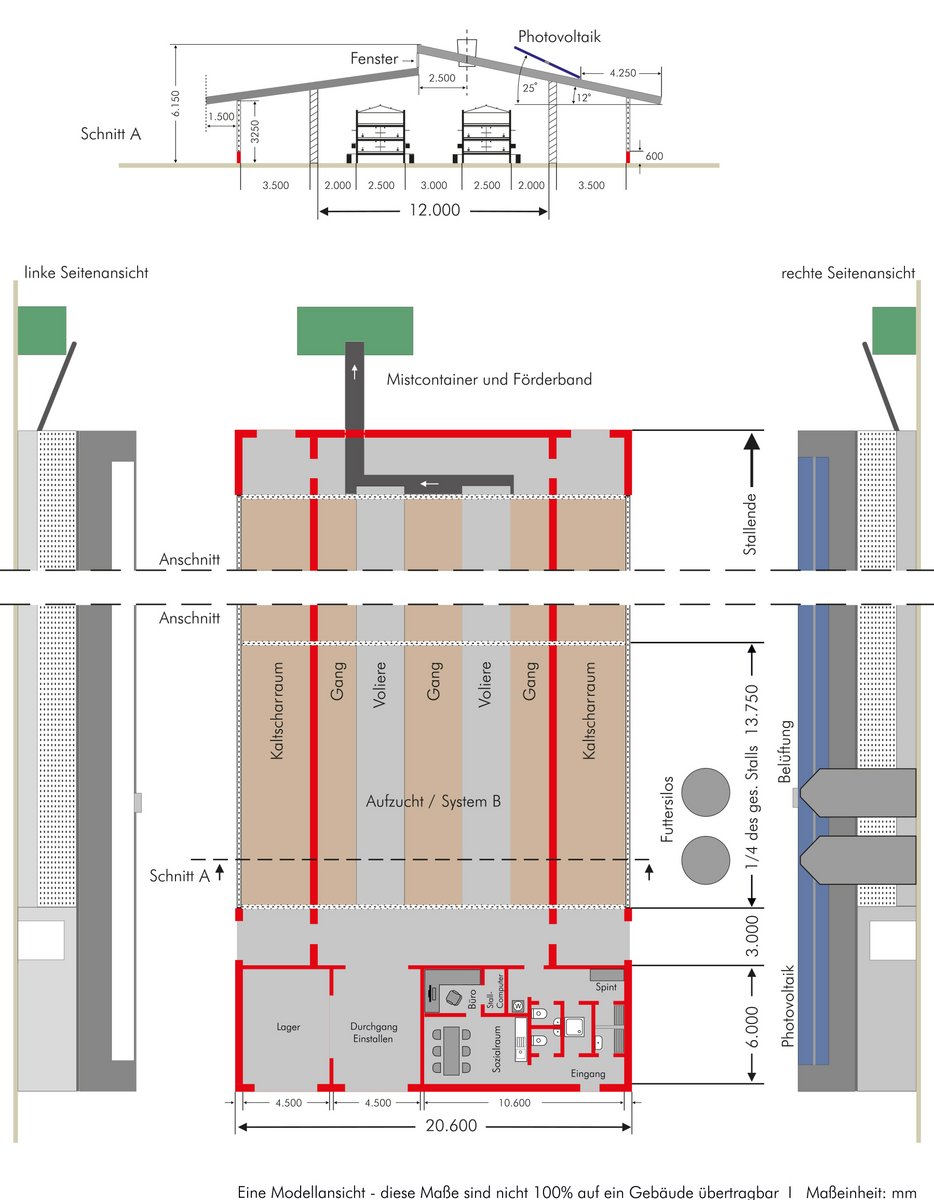
In housing model 1, pullets from a single age group are reared in aviary systems that meet animal welfare standards, using the ‘all-in, all-out’ method. This system enhances biosecurity standards at the rearing farm. The aviary system provides the birds with sufficient space to engage in their natural behaviours.

To increase the number of cycles per year, two different age groups are kept on the same farm in barn model 2. Following the pre-rearing phase, the animals are moved at six or seven weeks of age to the directly adjoining ‘cold barns’ equipped with aviary systems. In the pre-rearing barn of barn model 2, the rearing system grows in tandem with the animals as they age. In this housing system, the platforms, which initially stand vertically, can be laid flat. These then serve as an additional, height-adjustable raised level within the rearing system.
Stable design
- One housing unit
- Production cycle: All-in/all-out system (from day 1 to week 18)
- Inner barn area: two external runs: as wide as possible (2.0 m each) + central aisle: as wide as possible (3 m) + 2 aviary systems, each 2.50 m ➞ Width of the inner barn: 12 m + 3.5 m outdoor climate area on each side + roof overhang (1.5 m each)
Animal welfare aspect: Aisles as wide as possible for scratching
Length of the indoor housing area depends on group units (as per the Animal Welfare Ordinance):
for 4 x 6,000 animals: 61 m
+ Anteroom: 6 x 20 m (including hygiene rooms, storage for enrichment materials etc., housing technology, social area)
+ internal corridors
➞ Barn length: 67 m
Animal welfare aspect: Groups as small as possible with visual and physical separation; reduced stocking density
- Can also be implemented in existing buildings
Interior layout:
- Aviary system (raised) with climbing aids and/or staggered perches
Advantages:
- Higher biosecurity through the all-in/all-out system
Additional facilities for animal welfare, including:
- natural daylight entering the house
- Minimisation of stress when handling the birds during the vaccination process through the provision of catching facilities
- Additional scratching area, daylight, fresh air, environmental stimuli, acclimatisation to the outdoor area and disturbances from the outdoor climate zone
Housing concept
- three housing units, two to three age groups (rotational system) ➞ Cleaning and disinfection are particularly important
- Production cycle: 1st day of life to 6th week of life
- Rearing in the inner warm barn + weeks 7 to 18 in the left/right (simultaneously or in stages) rearing barn (cold barn) + 1 week of cleaning + disinfection
Economic advantage: More batches on existing space, lower energy costs
- Indoor barn area: two external exits: as wide as possible (2.0 metres each) + central aisle: as wide as possible (3 m) + 2 aviary systems, each 2.50 m ➞ Width of the indoor barn: 12 m + 3.5 m outdoor climate area on each side + roof overhang (1.5 m each)
Animal welfare aspect: Aisles as wide as possible for scratching areas; better adaptation to the animals’ needs at each stage of life
Left / right rearing shed: 30.5 m long each
+ Warm house: 13 m long (variable depending on the re-housing procedure)
+ internal corridors
➞ Length of the inner house: approx. 79 m
- Single entry of day-old chicks via the antechamber
- Single entry into the cold house via roller doors between the warm and cold houses
- Upstream antechamber (including storage for enrichment materials etc., house equipment, staff area) + one hygiene airlock per house unit
- Can also be implemented in existing buildings
- Transverse manure removal axes
Interior layout:
- Pre-rearing: Semi-aviary with wide central aisle and manure belt or flexible levels
- Later rearing: Aviary system (raised) with climbing aids and/or staggered balconies
Advantages:
- More passages per year
- Greater energy efficiency
Additional facilities for animal welfare, including:
- natural daylight entering the house
- Minimisation of stress when handling the animals during the vaccination process through the provision of catching facilities
- Additional scratching area, daylight, fresh air, environmental stimuli, acclimatisation to the outdoor area and disturbances from the outdoor climate zone