

- Dr. Thomas Bauer, Thuringian State Institute for Agriculture, Jena, Head of the Livestock Farming Division
- Jörg Böhmfeld, Rhineland-Palatinate Chamber of Agriculture, Trier, Construction Advisory Service for Pig and Poultry Farming
- Sebastian Bönsch, Lower Saxony Chamber of Agriculture, Head of the Sulingen Branch
- Bernhard Feller, North Rhine-Westphalia Chamber of Agriculture, Münster, Specialist in Processing Technology
- Dr. Beate Formowitz, Hesse State Agricultural Agency, Ebsdorfergrund, Deputy Head of the Rauischholzhausen Training Seminar
- Gerd Franke, Hesse State Agricultural Agency, Kassel, Department 31, Economics
- Stephan Fritzsche, KTBL, Darmstadt, Animal Husbandry Team, Site Development, Pollution Control
- Ewald Grimm, KTBL, Darmstadt, Animal Husbandry Team, Site Development, Pollution Control
- Sven Häuser, DLG e.V., Frankfurt, Agricultural Centre, Head of Animal Husbandry and Domestic Economy
- Dr. Christina Jais, Bavarian State Institute for Agriculture, Grub, Institute for Agricultural Engineering and Animal Husbandry
- Dr. Heiko Janssen, Lower Saxony Chamber of Agriculture, Oldenburg, Specialist Advisor on Pig Breeding and Pig Farming
- Dr. Dorothea Lösel, State Research Institute for Agriculture and Fisheries of Mecklenburg-Western Pomerania, Institute for Animal Production
- Jörn Menning, State Institute for Agriculture and Horticulture of Saxony-Anhalt, Iden, Technology and Construction
- Dr. Eckhard Meyer, Saxon State Office for the Environment, Agriculture and Geology, Köllitsch, Department of Agriculture, Animal Husbandry and Animal Feeding Unit
- Dr. Stefan Neser, Bavarian State Institute for Agriculture, Freising, Environmental Technology in Land Use Division
- Dr. Thomas Paulke, State Office for Rural Development, Agriculture and Land Consolidation, Brandenburg, Teltow, Rühlsdorf district, Pig Breeding and Husbandry Division
- Dr. Wolfgang Preißinger, Bavarian State Institute for Agriculture, Teaching, Research and Specialist Centre for Pig Husbandry, Schwarzenau, Department of Pig Nutrition
- Andreas Sandhäger, Director of the State Agricultural Agency of Hesse, Kassel
- Hansjörg Schrade, Head of the Education and Knowledge Centre for Pig Farming and Pig Breeding, Boxberg
- Dr. Tanja Zacharias, Education and Knowledge Centre for Pig Husbandry and Breeding, Boxberg, Specialist in Animal Behaviour and Feeding
- Dr. Thomas Bauer, Thuringian State Institute for Agriculture, Jena, Head of the Livestock Farming Division
- Jörg Böhmfeld, Rhineland-Palatinate Chamber of Agriculture, Trier, Construction Consultant for Pig and Poultry Farming
- Bernhard Feller, North Rhine-Westphalia Chamber of Agriculture, Münster, Specialist in Processing Technology
- Dr. Beate Formowitz, Hesse State Agricultural Agency, Ebsdorfergrund, Deputy Head of the Rauischholzhausen Training Seminar
- Gerd Franke, Hesse State Agricultural Agency, Kassel, Department 31, Economics
- Stephan Fritzsche, KTBL, Darmstadt, Animal Husbandry Team, Site Development, Pollution Control
- Ewald Grimm, KTBL, Darmstadt, Animal Husbandry Team, Site Development, Pollution Control
- Sven Häuser, DLG e.V., Frankfurt, Agricultural Centre, Head of Animal Husbandry and Domestic Economy
- Dr. Christina Jais, Bavarian State Institute for Agriculture, Grub, Institute for Agricultural Engineering and Animal Husbandry
- Dr. Heiko Janssen, Lower Saxony Chamber of Agriculture, Oldenburg, Specialist Advisor on Pig Breeding and Pig Farming
- Dr. Dorothea Lösel, State Research Institute for Agriculture and Fisheries of Mecklenburg-Western Pomerania, Institute for Animal Production
- Christian Meyer, Schleswig-Holstein Chamber of Agriculture, Futterkamp Teaching and Research Centre, Production Advisory Services, Training, Pig Husbandry and Feeding Technology
- Jörn Menning, State Institute for Agriculture and Horticulture of Saxony-Anhalt, Iden, Technology and Construction
- Dr. Eckhard Meyer, Saxon State Office for the Environment, Agriculture and Geology, Köllitsch, Department of Agriculture, Animal Husbandry and Animal Feeding Unit
- Dr. Sophie Meyer-Hamme, KTBL, Darmstadt, Animal Husbandry Team, Site Development, Pollution Control
- Dr. Stefan Neser, Bavarian State Institute for Agriculture, Freising, Environmental Technology in Land Use Division
- Dr. Thomas Paulke, Brandenburg State Office for Rural Development, Agriculture and Land Consolidation, Teltow, Rühlsdorf district, Pig Breeding and Husbandry Unit
- Karin Peperkorn, Lower Saxony Chamber of Agriculture, Nienburg District Office, Energy, Construction and Technical Advisory Services in Pig Farming
- Dr. Wolfgang Preißinger, Bavarian State Institute for Agriculture, Teaching, Research and Specialist Centre for Pig Farming, Schwarzenau, Department of Pig Nutrition
- Andreas Sandhäger, Director of the State Agricultural Agency of Hesse, Kassel
- Andrea Scholz, Education and Knowledge Centre for Pig Farming and Breeding, Boxberg, Specialist in Piglet Production
- Hansjörg Schrade, Head of the Education and Knowledge Centre for Pig Farming and Pig Breeding, Boxberg
- Dr. Manfred Weber, Saxony-Anhalt State Institute for Agriculture and Horticulture, Centre for Animal Husbandry and Technology, Iden, Head of the Department of Pig Farming and Breeding
- Dr. Tanja Zacharias, Education and Knowledge Centre for Pig Farming and Breeding, Boxberg, Specialist in Animal Behaviour and Feeding
- Gerd Franke, Hesse State Agricultural Agency
- Bernhard Feller, North Rhine-Westphalia Chamber of Agriculture
Since autumn 2016, experts from state agencies, state offices and chambers of agriculture across Germany, supported by specialist advisers from the KTBL and the DLG and coordinated by the State Agricultural Agency of Hesse, have been developing holistic concepts for pig farming. The main objective is to gather ideas from experts across various disciplines for sustainable pig farming in Germany and to develop potential solutions. In particular, with regard to improving housing conditions and animal behaviour, both an increase in pen space per animal and the provision of organic enrichment materials are considered of central importance. Key areas of focus for sustainable housing systems lead to the following proposed solutions:
- Development of sustainable housing models, taking into account pen layout, space provision and the design of lying areas
- Process engineering solutions for feeding, manure removal and housing climate control
- Requirements for the introduction of organic material in the context of feeding, enrichment and bedding
- Assessment of the suitability of feedstuffs and organic enrichment materials as sources of crude fibre to promote animal health.
Furthermore, the developed models were evaluated in two sub-groups with regard to veterinary and environmental protection requirements. The economic assessment of the proposed alternatives has demonstrated the impact that changes in husbandry practices will have on the profitability of pig farming. The results have been incorporated into the overall assessment.
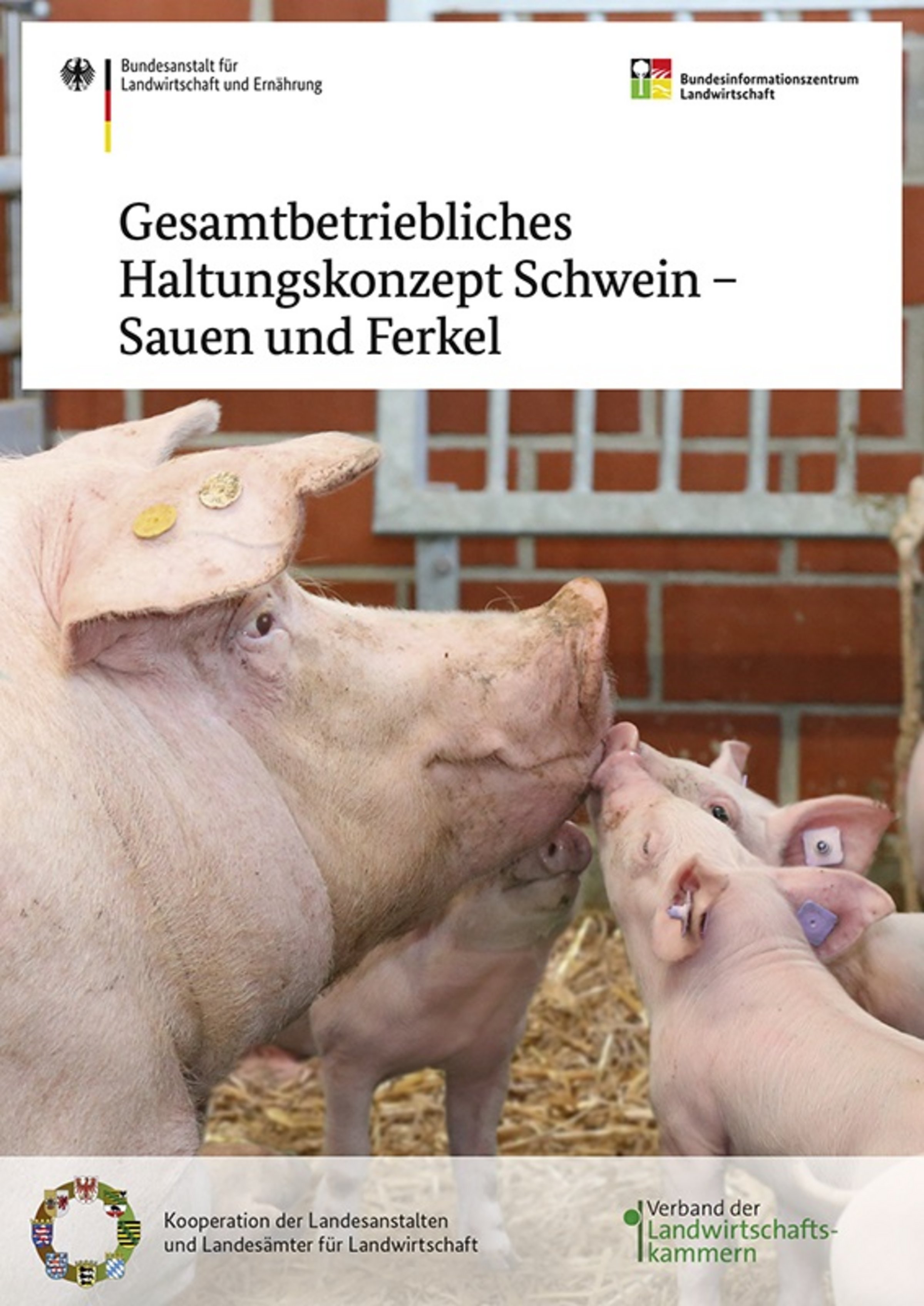
Go to the brochure: Comprehensive Farm-Wide Pig Husbandry Concept – Sows and Piglets
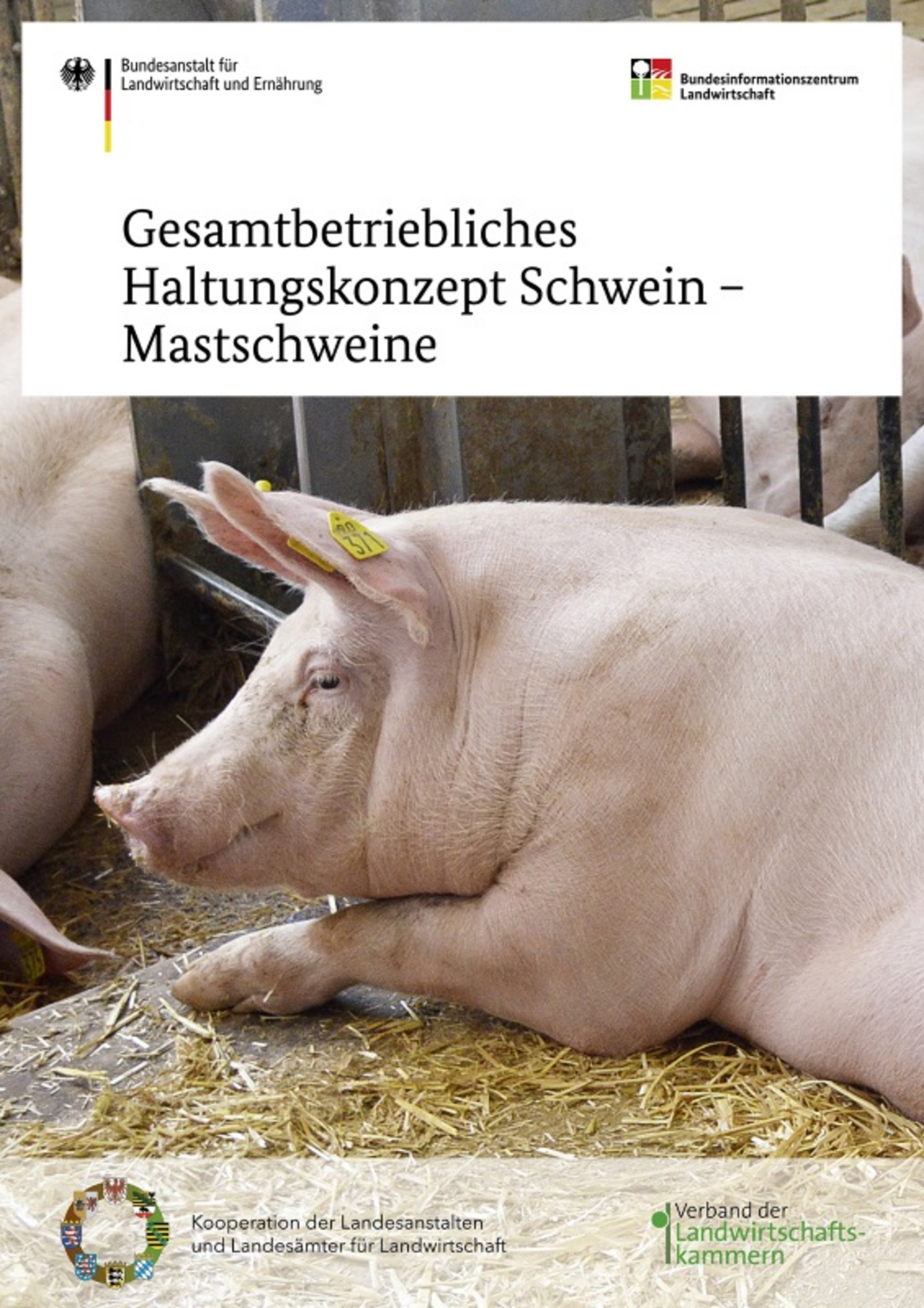
Go to the brochure: Comprehensive Farm-Level Housing Concept for Pigs – Fattening Pigs
New building solution: sow house with group housing and outdoor climate
Planning example 4
Objective
- Compartmentalisation of the resting area, activity and feeding area, and dunging area
- The pen layout is supplemented by partition walls with mesh in the manure area to support territorial behaviour.
- Lying areas can be bedded with varying amounts of straw.
- Movement and nest-building behaviour possible in the farrowing pen
- In the mating centre, mating is possible in the insemination pen, with resting and activity in the relevant areas of the barn; sufficient space for hierarchy-establishing fights and oestrus behaviour, as well as engagement and distraction through bedding and enrichment feed.
Space and functional layout
- 252 productive sows, groups of 36 sows on a 3-week cycle, 28–35 days of lactation
- Feeding options in the mating and waiting pens: dry or liquid
- Animal-feeding-place ratio (AFPR): 1:1 in farrowing and mating pens; on-demand feeding stations or feeding stalls possible in the waiting pen
- Farrowing house with exercise/free-range pens as a warm house; fully under-floor or partially perforated with slurry collection channels or underfloor sliders
- Waiting pen as a three-section pen with internal exercise area; lying area with solid flooring, activity and feeding areas with slatted floors, manure removal via underfloor scrapers
- Mating centre as a warm barn with group housing; under-floor slatted, structured with varying degrees of perforation, various manure removal systems possible
- Gilt integration as a warm barn with small groups
- Lying area with a small amount of bedding
- Natural ventilation in the waiting area; negative pressure ventilation in the warm housing areas
Key figures:
- Pen area in farrowing pen: approx. 6.7 m² per animal
- Piglet nest: approx. 0.80 m²
- Labour input: 12.7 man-hours per productive sow per year
- Straw requirements for bedding: low, approx. 300 g per animal per day in the mating and waiting areas, 80 kg per productive sow per year
- Farm manure production: 4 m³ per productive sow per year
- Emissions values: in accordance with VDI 3894; Sheet 1
Special features:
- Clear layout
- Short working distances
- Low slurry volumes in the barn
- Outdoor climate stimulation
New building design: Piglet rearing unit with minimal straw bedding and an outdoor run
Planning example 3
Objective
- Compartmentalisation into resting, activity and feeding areas, as well as a dunging area.
- The pen layout is strictly defined by the arrangement of the dung and lying areas. In the dung area, mesh panels are fitted on one side to the neighbouring pens to encourage review behaviour. The dung area is located against the outer wall.
- Enrichment through bedding and enrichment feed
Layout and functional programme
- 1,512 piglet rearing places; 28-piglet rearing pens; 504 piglets per compartment, e.g. for a 3-week cycle
- Feeding options: dry or slurry
- Animal-feeding-place ratio (AFPR): 1:1 to 4:1
- Layout of the pen into lying, activity and manure areas, as well as an exercise area
- Manure area on both sides of the pen and in the exercise area
- Manure removal via underfloor scrapers or similar systems; slurry collection channels where the building is fully basemented
- Resting and feeding areas can be designed as a heated barn with forced ventilation or as a cold barn without forced ventilation
- Lying area with a small amount of bedding
- Different climate zones possible
- Covering possible
Key figures:
- Pen area: approx. 0.5 to 0.6 m² per animal
- if covered: approx. 0.2 m² per space
- if outdoor run: approx. 0.3 m² per pen
- Labour requirements: 1.3 man-hours per pen with perforated outdoor run
- Straw requirements for bedding: moderate, approx. 150 g per animal per day, 40 kg per pen per year
- Manure production: 0.5 m³ per pen per year
- Emission values: in accordance with VDI 3894; Sheet 1
Special features:
- Clear layout
- Run-out area can be designed in various ways
- Meets the requirements of the various labelling categories
New housing solution: sow house with group housing and outdoor access
Planning example 6
Objective
- Compartmentalisation of the resting area, activity and feeding area, and toilet area.
- The pen layout involves separating the lying and exercise areas, with the manure area situated outside.
- Lying areas can be bedded with varying amounts of straw.
- Movement and nest-building behaviour possible within the farrowing pen.
- In the breeding centre, insemination is possible in the insemination pen, with lying and movement in the appropriate areas of the barn.
- Enrichment through bedding and enrichment feed.
Layout and functional programme
- 252 productive sows, groups of 36 sows on a 3-week cycle, 28–35 days of lactation
- Feeding options in the mating and waiting pens: dry or liquid; animal-feeding-place ratio (AFP): 1:1 in the farrowing and mating pens; on-demand feeding stations or feeding stalls possible in the waiting pen; farrowing pen with exercise/free-range pens; fully slatted or partially slatted with slurry collection channels or underfloor sliders
- Waiting pen with on-demand feeding and outdoor access
- Mating centre as a warm barn with group housing; outdoor access possible
- In the outdoor exercise areas, either on a solid floor with bedding or with a slatted floor;
- Manure removal via underfloor slides
- Forced ventilation in the enclosed housing areas
- Lying area with a small amount of bedding
- Integration or gilts’ rearing barn
Key figures:
- Pen area in farrowing pen: approx. 6.7 m² per animal
- Piglet nest: approx. 0.80 m²
- Labour input: 12.7 man-hours per sow per year
- Straw requirements for bedding: low, approx. 300 g per animal per day, 80 kg per pen per year
- Manure production: 4 m³ per productive sow per year
- Emission values: in accordance with VDI 3894; Sheet 1
Special features:
- Two variants with different group sizes in the waiting pen: variant 6A with a large group, variant 6B with a split waiting group
- Clear layout
- Outdoor climate stimulation in the waiting pen
- Supply air conditioning possible in summer
New housing solution: a closed sow house, group housing with an outdoor run and exposure to the outdoor climate
Planning example 7
Objective
- Compartmentalisation into resting, activity and feeding areas, as well as a dunging area.
- The pen layout in the waiting area involves separating the lying and exercise areas, with the manure area situated outside.
- Lying areas can be bedded with varying amounts of straw.
- Movement and nest-building behaviour possible in the farrowing pen.
- In the mating centre, mating is possible in the insemination stall, with lying and movement in the relevant areas of the barn; an outdoor run with exposure to the outdoor climate is possible.
- Enrichment through bedding and enrichment feed.
Layout and functional programme
- 252 productive sows, groups of 36 sows on a 3-week cycle, 28–35 days of lactation
- Feeding options in the mating and waiting barn: dry or liquid
- Farrowing barn with exercise/free-range pens; fully slatted or partially perforated with slurry collection channels or underfloor valves
- Waiting pen with on-demand feeding and side access to outdoor area with the option of roughage provision or self-catching feeding/lying pens as three-sided pens with access to outdoor area
- Mating centre as a warm barn with group housing; outdoor access possible
- In the exercise areas, either on a solid floor with bedding or with a slatted floor;
- Manure removal via underfloor slides
- Forced ventilation in the enclosed barn areas
- Lying area with a small amount of bedding
- Integration or gilts’ rearing barn
Key figures:
- Pen area in farrowing pen: approx. 6.7 m² per animal
- Piglet nest: approx. 0.80 m²
- Labour input: 12.7 man-hours per sow per year with roughage in feeders
- Straw requirements for bedding: low, approx. 300 g per animal per day, 80 kg per pen per year
- Farm manure production: 4 m³ per productive sow per year
- Emission values: in accordance with VDI 3894; Sheet 1
Special features:
- Clear layout
- Outdoor climate stimulation in the waiting pen
- Supply air conditioning possible in summer
New housing solution: outdoor climate barn with straw bedding and a manure passage, without an outdoor run
Planning example 1
Objective
- Compartmentalisation of the resting area, activity and feeding area, and toilet area.
- The pen layout is supplemented by short, approx. 1.2 m long partitions in the lying area. In the manure area, mesh screens are fitted on one side to the neighbouring pens to support territorial behaviour. The drinking troughs are positioned above the slatted floor on the closed side of the pen, above the manure passage. The manure passage is separated from the rest of the pen by an additional closed partition.
- Enrichment through bedding and enrichment feed.
Layout and functional programme
- 30-head fattening pens
- Feeding options: dry or slurry
- Animal-feeding area ratio (TFV): 1:1 to 4:1
- Lying, activity and manure areas with solid flooring
- Central manure passage, mechanical manure removal
- Eaves-to-ridge ventilation with curtains
- Lying area with bedding
- Covering possible
Key figures:
- Pen area: approx. 1.3 m² per animal
- if covered: approx. 0.4 m² per space
- Labour required: 1.5 man-hours per pen
- Straw requirements for bedding: high; approx. 300 kg per pen per year
- Emission values: in accordance with VDI 3894
Special features:
- Simple construction
- Cost-effective barn
- suitable for self-build
New building solution: open-air barn with straw bedding and outdoor run
Planning example 10
Objective
- Compartmentalisation of the resting area, activity and feeding area, and dunging area
- The pen layout is supplemented by short, approx. 1.2 m long partitions in the lying area. In the manure area, mesh screens are fitted on one side to the neighbouring pens to support territorial behaviour. The drinkers are positioned above the slatted floor on the wall facing the enclosed housing area above the manure passage. The manure area is located outside.
- Enrichment through bedding and enrichment feed.
Layout and functional programme
- 25 fattening pens
- Feeding options: dry or slurry
- Animal-to-feeding-place ratio (TFV): 1:1 to 4:1
- Lying and activity area with fixed flooring
- Partially basement-level design with slatted flooring made of concrete or triangular steel,
- Underfloor slide-gate manure removal
- Eaves-to-ridge ventilation with curtains
- Lying area with bedding
Key figures:
- Pen area approx. 1.56 m² per animal
- Labour required: 1.1 man-hours per pen
- Straw requirements for bedding: high, approx. 150 kg per pen per year
- Emission values: in accordance with VDI 3894
Special features:
- Clear layout
- cost-effective barn
- suitable for self-build
New building solution: open-air barn with straw bedding, without outdoor run; optional with outdoor run
Planning example 12
Objective
- Compartmentalisation of the resting area, activity and feeding area, and dunging area
- The pen layout is supplemented by short, approx. 1.2 m long partitions in the lying area. In the manure area, mesh screens are fitted on one side to the neighbouring pens to support territorial behaviour. The drinkers are positioned above the slatted floor on the solid wall above the manure passage. The manure area is located against the outer wall.
- Enrichment through bedding and enrichment feed.
Layout and functional programme
- 30-pig fattening pens
- Feeding options: dry or slurry
- Animal-to-feeding-place ratio (TFV): 1:1 to 4:1
- Lying and activity areas with solid flooring
- Partially slatted floor, lying area with a slight slope (sloping floor housing)
- Underfloor scraper manure removal
- Covering of the lying area possible
- Outdoor climate barn with controlled blinds
Key figures:
- Pen area approx. 1.3 m² per animal
- Labour requirements: 1.2 man-hours per pen
- Straw requirements for bedding: low, approx. 100 kg per space per year
- Emissions: in accordance with VDI 3894
Special features:
- Clear layout
- Cost-effective barn
- Suitable for self-build
- Outdoor run possible
Solution for new builds and conversions: Enclosed barn without straw bedding, without an outdoor run; optional outdoor run
Planning example 17
Objective
- Compartmentalisation of the resting area, activity and feeding area, and dunging area
- The pen layout is supplemented by short, approx. 1.2 m long partitions in the lying area. In the manure area, mesh screens are fitted on one side to the neighbouring pens to support territorial behaviour. The drinkers are positioned above the slatted floor on the solid wall above the manure passage.
- Enrichment through bedding and enrichment feed.
- Air supply via jet ventilation systems
Layout and functional programme
- 30-head fattening pens
- Feeding options: dry, mash or liquid
- Animal-feeding-place ratio (AFPR): 1:1 to 8:1
- Fully basemented barn with varying degrees of perforation
- Underfloor scraper manure removal
- Fully air-conditioned barn with targeted exhaust air management
- Single-sided feeding passage, deep pens
Key figures:
- Pen area approx. 1.3 m² per animal
- Labour requirements: 0.9 man-hours per pen
- Straw requirements for bedding: low, approx. 50 kg per pen per year
- Emission values: in accordance with VDI 3894
Special features:
- Easy to integrate into existing barn buildings
- Depending on the slurry system, different amounts of bedding or organic enrichment materials are possible
- Design with horizontal barn ceiling or roof = ceiling structure
- Outdoor run possible