

- Andreas Pelzer, North Rhine-Westphalia Chamber of Agriculture
- Anna-Lena Ahring, North Rhine-Westphalia Chamber of Agriculture
- Dirk Albers, Lower Saxony Chamber of Agriculture
- Anna-Lena Ahring, North Rhine-Westphalia Chamber of Agriculture
- Werner Baumgarten, Rural Service Centre Rhineland-Palatinate
- Dr. Ariane Boldt, State Research Institute for Agriculture and Fisheries Mecklenburg-Western Pomerania
- Ulrike Drews, State Office for Rural Development, Agriculture and Land Consolidation Brandenburg
- Uwe Eilers, Agricultural Centre of Baden-Württemberg
- Dr. Wilfried Hartmann, Board of Trustees for Technology and Construction in Agriculture
- Dr. Peter Heimberg, North Rhine-Westphalia Chamber of Agriculture
- Hanna Kothenschulte, Hamburg Chamber of Agriculture
- Christopher Kneip, North Rhine-Westphalia Chamber of Agriculture
- Beate Möntenich, Rhineland-Palatinate Chamber of Agriculture
- Dr. Anna Rauen, Federal Information Centre for Agriculture at the Federal Agency for Agriculture and Food
- Annette Reiners, Bremen Chamber of Agriculture
- Prof. Dr. Klaus Reiter, Bavarian State Institute for Agriculture
- Olaf Tober, State Research Institute for Agriculture and Fisheries Mecklenburg-Western Pomerania
- Jochen Simon, Bavarian State Institute for Agriculture
- Dr. Ilka Steinhöfel, Saxony State Office for Environment, Agriculture and Geology
- Olaf Tober, State Research Institute for Agriculture and Fisheries Mecklenburg-Western Pomerania
- Marieke Wijn, German Agricultural Society
- Johanna Ahmann, North Rhine-Westphalia Chamber of Agriculture
- Dr. Sandra Erdmann, Edeka Nord GmbH
- Prof. Dr. agr. habil. Steffen Maak, Research Institute for Farm Animal Biology
- Gunnar Rohwäder, Tönnies Rind GmbH & Co. KG
- Kathrin Tiemann, North Rhine-Westphalia Chamber of Agriculture
- Maria Trilling, North Rhine-Westphalia Chamber of Agriculture
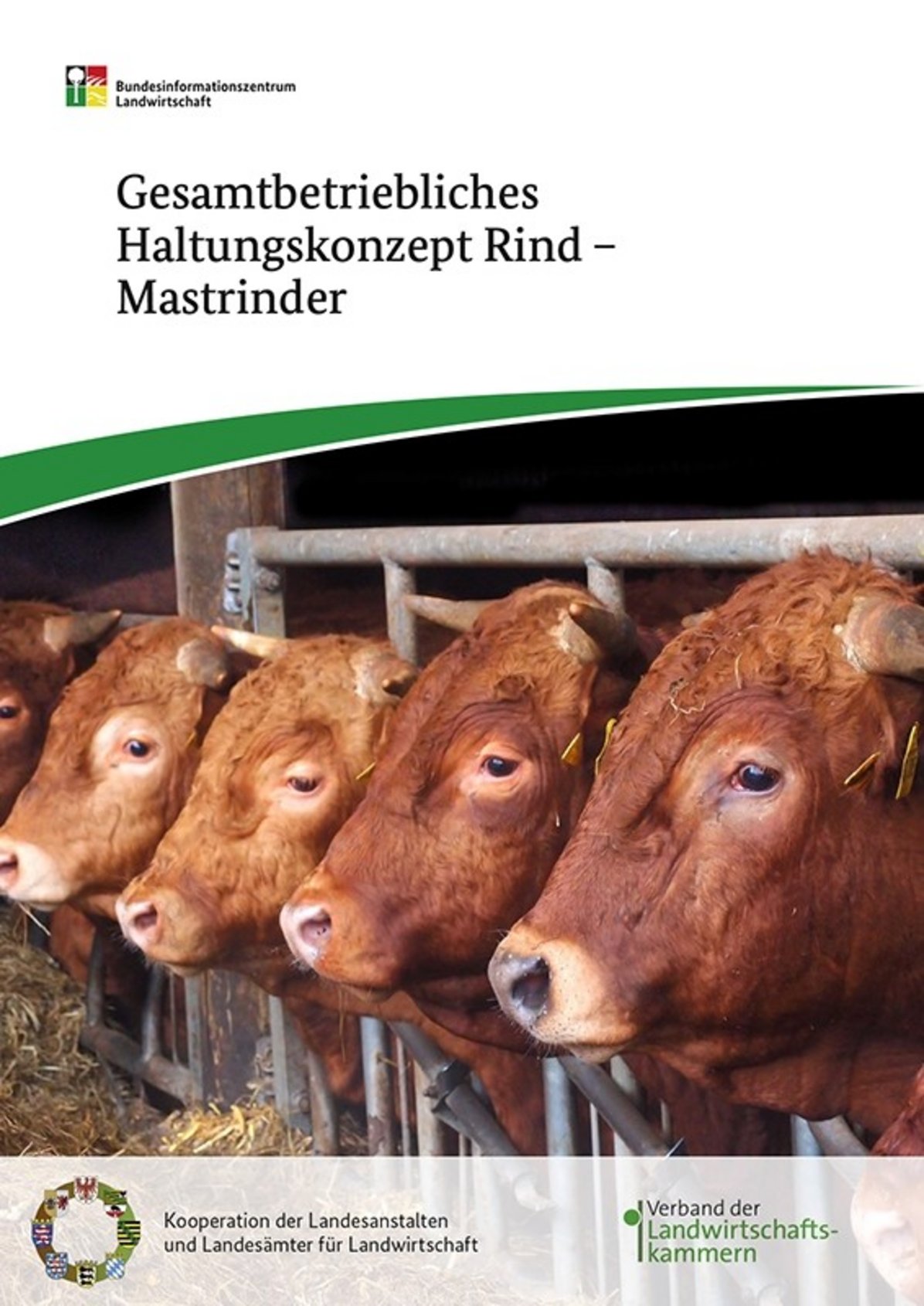
For practical application, consultation and education, this brochure covers aspects of future-oriented beef cattle farming, considering animal ethology, breed characteristics and marketing channels with a focus on the special situation of male dairy calves, sustainable feeding strategies and the concerns of various stakeholders along the value chain. On this basis, the working group developed a sustainable housing model and refers to similar housing practices already in use. The overall farm assessment is carried out with a view to sustainable agricultural animal husbandry. Sustainable animal husbandry is recognised by society as economically viable and environmentally friendly in terms of natural resources and environmental impact. The solutions presented here are intended to stimulate discussion on sustainable beef cattle farming with all the institutions, social groups and politicians involved.
To the brochure "Overall Farming Concept for Cattle – Beef Cattle"
As part of the project, a concept for the rearing of beef cattle was developed, which primarily serves to develop and define innovative aspects and ideas for cattle rearing and to combine these in an exemplary rearing concept within the framework of sustainable and future-oriented animal husbandry. In addition to the classic pillars of sustainability – economy, ecology and social issues – the ethological requirements of beef cattle for an animal-friendly environment were taken into account and integrated into the husbandry concept.
Key aspects:
- Group size 599 animals
- Multi-house construction
- Based on classic deep litter housing
- Integrated outdoor area for exposure to outdoor climate
- Automated cleaning of walking areas
- Selection pens
- Central feed kitchen and straw storage
- Simple and safe animal transport
- Biogas and PV modules for emission reduction and energy generation
Further information from the Federal Information Centre for Agriculture (BZL) on this topic
BZL brochure provides inspiration for fattening bulls
Bull fattening: Which housing system is sustainable?
What are the requirements for the housing environment of fattening bulls?