
- Ludger Cordes, Rothkötter Mischfutterwerk GmbH
- Inke Drossé, German Animal Welfare Association
- Dr. Andreas Hemme, Die Praxis für Geflügel GbR
- Marie-Louise Hentschel, BWE-Brüterei Weser-Ems GmbH & Co. KG
- Prof. Helen Louton, University of Rostock
- Steffi Ropel, Biofino Ltd.
- Silke Schierhold, Lower Saxony Chamber of Agriculture
- Dr. Birgit Spindler, University of Veterinary Medicine Hannover Foundation
- Arnd von Hugo, farmer
- Felix Wesjohann, BWE-Brüterei Weser-Ems Ltd.
- Dr. Katja Kulke, Lower Saxony Chamber of Agriculture
Funding information
This document was produced as part of the joint project Network Focus Animal Welfare, funding code 28N-4-013-01 to 28N-4-013-17, by the "Broiler Chickens" working group of the Animal Welfare Competence Centre for Poultry and methodologically and didactically prepared by DLG e.V. and FiBL
Deutschland e.V. The joint project of the chambers of agriculture and agricultural institutions of all federal states aims to improve the transfer of knowledge into practice in order to make cattle, pig and poultry farms sustainable in terms of animal welfare, environmental protection and sustainable livestock farming.
The project is funded by the Federal Ministry of Food and Agriculture on the basis of a resolution of the German Bundestag.
All information and notes are provided without any guarantee or liability.
Publisher
DLG e.V.
Fachzentrum Landwirtschaft
Eschborner Landstraße 122
60489 Frankfurt am Main
FiBL Deutschland e.V.
Bereich Tierwohl
Kasseler Straße 1a
60486 Frankfurt am Main
Reproduction and transmission of individual sections of text, drawings or images (including for teaching purposes) and provision of the information sheet in whole or in part for viewing or downloading by third parties is only permitted with the prior approval of the relevant office of the Animal Welfare Competence Centre and DLG e.V., Marketing Service Department, Tel. +49 69 24788-209, [email protected]

The term animal welfare encompasses not only animal health, but also the absence of negative emotions such as fear and stress, as well as the ability to express species-specific behaviour (Fig. 1).
Under natural conditions, chickens spend most of the day feeding, exploring and dust bathing.1 However, in pure barn housing, the animals have easy access to feed and therefore show less exploratory behaviour.
In addition, pure floor housing does not offer any opportunity for perching. This means that species-specific resting behaviour can only be pursued to a limited extent.
For this reason, a wide variety of approaches have been tested in recent years to enrich the animals' housing environment. The use of enrichment materials is intended to stimulate the exploratory behaviour of broiler chickens, while structural elements allow them to perch. The aim of enrichment is therefore to improve the welfare of the animals. These approaches are presented below.


What is the broiler chicken interested in?
In nature,1 chickens perform up to 15,000 pecking movements per day in connection with feeding and foraging behaviour. In addition to actual pecking, scratching the ground and pecking with their beaks are also part of their foraging behaviour.3 However, broiler chickens and laying hens differ in their motivation to actively forage for food. This should be taken into account when selecting the enrichment materials offered.4
Studies have shown that broilers will occupy themselves even with plastic chains or string.4 However, enrichment materials should be changeable, manipulable and consumable, and ideally made of organic material in order to remain attractive in the long term. Pick stones (Fig. 2), alfalfa bales, alfalfa briquettes or straw pellets (Fig. 3) are suitable for this purpose. The hardness of pick stones should be taken into account. Softer pick blocks are more attractive to the animals, but are also consumed more quickly.1 To a certain extent, the cost-effectiveness of the various materials must be taken into account here.

Scientific studies have shown that scattering wheat from the third week of life onwards has proven effective in extensive genetics.5 In practice, a maximum of 2 g of wheat per animal per day is usually offered. The wheat stimulates the animals' exploratory behaviour. The relatively small amount of wheat reduces the risk of some of the animals starting to select their feed and eating their fill of wheat.
Experimental approaches to offering grain via pipe conveyor systems, grain spreaders and PickPucks (a system used in laying hen husbandry, Fig. 4) have shown in conventional genetics that all these methods are accepted by broilers throughout the entire fattening period.6
The pipe conveyor system can also be used to offer mixtures of litter material and wheat to keep the animals occupied. Depending on the material offered, this not only encourages foraging behaviour in the form of pecking and scratching, but also dust bathing.6
However, from a hygiene perspective, the consumption of cereal grains from the litter poses a certain risk to animal health. In terms of animal hygiene, it is therefore preferable to offer pure litter material via appropriate conveyor systems. In addition, compared to the pecking blocks and pellets, the enrichment material is not continuously available to the animals in the conveyor systems and grain spreaders listed here.
Hay and alfalfa, which are increasingly offered in nets or metal baskets in laying hen husbandry, are mainly used in organic broiler chicken husbandry, but are also recommended for conventional husbandry. When using hay, however, it should be noted that, especially when offering long-cut hay, there is a risk of crop blockages due to the formation of crop worms.
There is little experience with the use of succulent feed in the form of carrots, apples and potatoes, for example, as is offered to laying hens, in broilers. It is therefore not known how excessive intake would affect the performance of the animals. In principle, however, succulent feed carries the risk that its shelf life is limited and that the material spoils quickly under unfavourable environmental conditions.1
In general, hygiene aspects should always be taken into account when offering organic enrichment material. During storage, it is important to ensure that contact with harmful rodents or other vectors that could introduce pathogens is prevented. Due to the manufacturing process, straw pellets, thermally treated alfalfa bales or briquettes and pick stones have hygiene advantages over straw and hay.
The Animal Welfare Initiative requires that broiler chickens be provided with enrichment material on a floor area of 150 m², which corresponds to 2500 - 3000 animals / enrichment material. Other label programmes require that animals be provided with straw bales as well as pick stones. One pick stone is required for every 1000 broiler chickens.

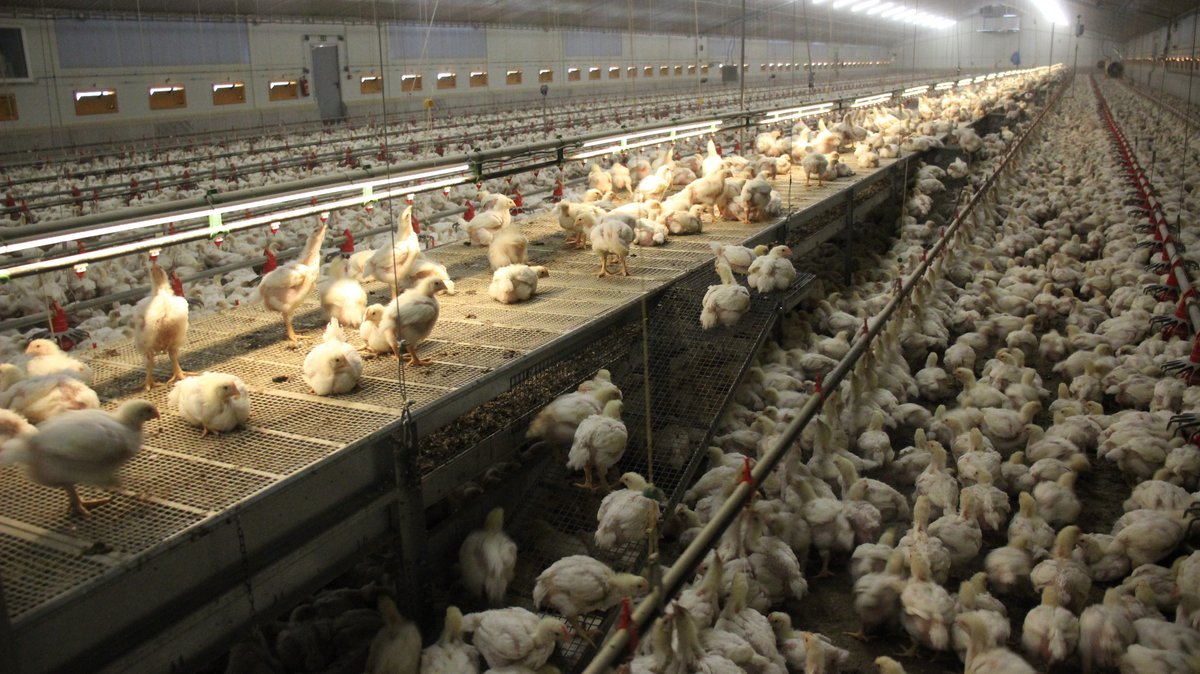
Perches or raised platforms provide opportunities for rearing up
Before nightfall, chickens seek out elevated perches to rest.3 Although laying hens readily accept perches, broiler chickens prefer elevated platforms.7,8 Providing elevated platforms can help support the animals' natural comfort and resting behaviour while also offering them the opportunity to avoid other chickens.10
In recent years, there has been an increase in research into the provision of elevated levels. Both levels with perforated floors and levels with closed surfaces have been investigated.
It was found that both perforated platforms and platforms with closed aluminium panels were used throughout the entire fattening period by conventional genetics, such as Ross 308.6, 11, 12 The broilers used the raised seating options not only at night, but also during the rest of the day.6,11,12 However, the intensity of use varied from flock to flock.12
In a direct comparison, perforated levels were preferred in the first four weeks of life, while towards the end of the fattening period, levels with closed surfaces were increasingly sought out.11

In addition to the actual seating area, the animals also used the ramps for elevated resting. The area under the platform also seemed to be particularly attractive to the animals as a place of retreat.6, 13
In addition to the positive effects on animal behaviour, there are also initial indications that the provision of elevated levels can have an additional positive effect on the health of the musculoskeletal system.8, 9 However, this effect could not be consistently demonstrated in various studies, so further research is needed.10
As the platforms can be cleaned after each pass during the service period, their use can be considered safe from an animal hygiene perspective.
However, various factors should be taken into account when choosing the right platform for use in your own barn:
- It is important that sufficient ramps are provided. These should have a flat angle of ascent of 20-30° and be wide enough for the animals to pass each other.6,12
- The ramps should also end in an upper plateau, which the animals can easily use to access the platform.
- If perforated ramps are used, the degree of perforation must be such that even young animals can walk on the ramps easily.11 A mesh size of 19x19 mm, for example, has proven to be effective here.6
- When participating in programmes that offer animals more space than specified in the Animal Welfare Livestock Farming Ordinance (e.g. Animal Welfare Initiative), the area of the raised level can be counted as usable space. However, this is subject to the condition that the levels are not perforated and are covered with litter (Fig. 6).11
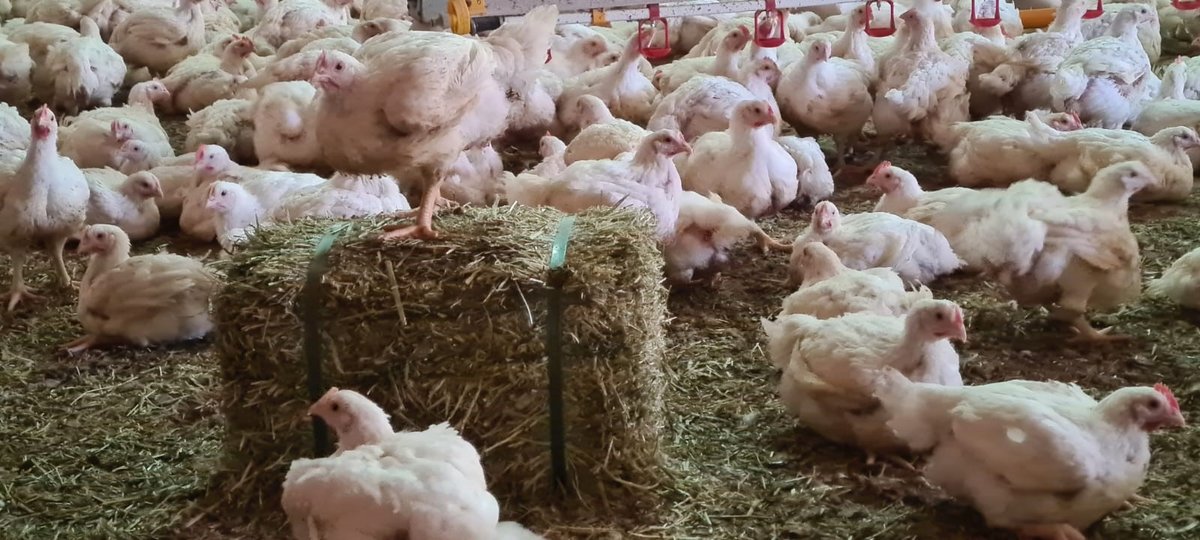
In label programmes, small, high-pressure compressed straw bales are also sometimes used as structural elements. While the chicks initially prefer to rest on the straw bales, the animals also perch on them as they get older. This applies to extensive genetics such as Ranger Classic, Hubbard JA57 and Cobb Sasso, but also to conventional genetics such as Ross 308.14
In addition, the bales are increasingly pecked at, although this behaviour becomes less common with age.14 Straw bales therefore have a dual purpose. They also contribute to a certain extent to improving the quality of the litter when the animals distribute the straw by scratching and pecking. Most label programmes offer straw bales in addition to perches, usually 1.5 to 2 bales per 1,000 animals. However, when using straw bales, it should be noted that they pose a certain risk from a hygiene perspective. For example, there is a risk that type I zoonotic pathogens could be introduced into the barn. If positive evidence is found, this will have disadvantages for subsequent utilisation.
Instead of straw bales, some farms now use alfalfa bales (Fig. 7). Although alfalfa bales are more expensive to purchase, they pose a lower hygienic risk. In addition, alfalfa bales, like straw bales, not only contribute to the structure of the barn, but also serve as enrichment material.

Another way of providing broiler chickens with more seating options is to introduce cellulose sacks filled with spelt husks (Fig. 8). Unlike straw and alfalfa bales, these are only about 10–15 cm high, which is particularly advantageous for young animals. However, as the birds get older, they start pecking at the bags more and more, making holes in them. Once the broilers get to the spelt husks, the bags become more of a toy and can't be used for perching anymore. In terms of biosecurity, the risk of introducing pathogens into the barn via sacks of spelt husks is considered low.
Clean plumage thanks to dust baths
The term "comfort behaviour" encompasses various behaviours in chickens: in addition to stretching their legs and wings and flapping their wings, body and plumage care are also particularly important aspects of comfort behaviour. The animals keep their plumage clean and functional by preening their feathers and dust bathing. Comfort behaviour is particularly noticeable in chickens during rest periods when the animals are3 undisturbed.
Dust bathing begins with pecking at the litter, followed by powdering the plumage by shaking the wings and body in a sitting position. In addition, the head and neck are rubbed in the litter. This behaviour is repeated several times with intermittent rest periods until the animal finally stands up and shakes itself.3 Dust bathing behaviour is observed from the first week of life, albeit initially incomplete. The behaviour is observed in both laying hens and broilers, although the dust bathing sequences are significantly shorter in broilers than in laying hens.3
In order for the animals to be able to spread the litter over their bodies when dust bathing, the litter must be loose and dry. This is a basic requirement for the animals to dust bathe in the litter.
In organic animal husbandry, outdoor areas often offer the animals an additional opportunity for dust bathing. Nevertheless, the associations now require that dust bathing facilities be provided from the first week of life.

Offer dust baths, but how?
Experimental choice trials have shown that broiler chickens prefer to dust bat15he in sand rather than loose wood shavings. Other materials that have already been tested include oat husks, peat and straw pellets. Peat was very well accepted, followed by oat husks. Straw pellets and wood shavings proved to be less attractive for dust bathing16. Even though peat was highly accepted by the animals, its use is not recommended from a hygiene perspective, but also due to its low sustainability. The increased use of sand also has disadvantages for broiler chicken farmers, as increased entry into the litter can mean that the manure can no longer be used in biogas plants after the passage is complete.
In the MaVeTi project, comparative studies were carried out with sawdust, rock dust and spelt husk pellets. The animals were observed more frequently in the dust bath where sawdust was provided. It was also found that the reintroduction of material in particular encouraged the animals to dust bathe. Although the rock dust was well accepted by the broiler chickens, the project showed that the dust exposure associated with the very fine material is not insignificant and that subsequent disposal proves problematic.
In organic animal husbandry, some associations impose specific requirements on the dust bath material, such as certain proportions of sand and grit.
The substrate for dust bathing can be offered to the broilers directly in the litter. With this form of offering, however, the material is distributed relatively quickly by the animals. To reduce the need for refilling, it may be advantageous to offer the material in containers instead.
Round masonry buckets can serve as boundaries. They also provide the broilers with places to retreat (Figure 9) and are sometimes used for perching. Due to their limited space, they are particularly suitable for the first phase of fattening. The tubs should have 2-3 openings. These prevent too many broilers from gathering in the tubs, which in the worst case could lead1 to heat stress or animals being crushed.
By using wooden, metal or plastic frames (diameter 1 m), dust baths with increased space can be created for older animals. Metal and plastic rings are1, 16 easier to clean and disinfect and are therefore preferable to wooden frames. However, a disadvantage of such frames is that they can be an obstacle, for example when reaching forward.
Outdoor climate areas – different climate zones offer variety
Access to outdoor climate areas also represents a form of enrichment, as it provides additional variety for the broilers.
Initial studies on the provision of covered outdoor climate areas have shown that these are accepted by both extensive and conventional genetics.14, 17 The animals are usually only given access to the outdoor climate area at the beginning of their fourth week of life.5, 14 The reason for this is that the chicks still have a high need for warmth in the first few weeks. Sufficiently high temperatures can only be achieved inside the house.
Behavioural observations have shown that broilers are generally more active in the outdoor climate area than inside the barn.14, 18 The use of outdoor climate areas also appears to depend on the outdoor climate, with these areas tending to be more readily accepted when outdoor temperatures are warmer.14, 18
Outdoor climate areas are attractive to broilers and are accepted accordingly. With regard to animal hygiene, the risk of introducing pathogens such as avian influenza and salmonella must be taken into account.
Conclusion
The breeding of specialised lines for egg and meat production has led to significant differences in the expression of various behaviours in broilers and laying hens. This is due in part to physical differences, but also to the fact that laying hens live significantly longer than broilers, which are slaughtered as young birds. Previous experience with laying hen husbandry cannot therefore be transferred 1:1 to broilers. Broilers are generally less active than laying hens. Slow-growing broilers are comparatively more4 active.
Nevertheless, it has been shown that enrichment measures such as raised perches, enrichment materials or dust baths are also accepted by broilers. However, there are differences between the various genetics. Structural elements are more readily accepted19 by extensive genetics than by conventional genetics.
Overall, the various enrichment measures help the animals to engage in species-specific behaviour. They can therefore be considered positive from an animal welfare perspective. However, providing enrichment materials and structural elements also entails significant additional costs for the farmer. At present, farmers can mainly pass these additional costs on to consumers by participating in label programmes.
Literature
- Spindler, B. and C. Gaio (2019): Employment opportunities for chickens and turkeys – solutions – evaluations – costs, Darmstadt, Board of Trustees for Technology and Construction in Agriculture (KTBL).
- Fraser, D. (2008): Understanding animal welfare. Acta Veterinaria Scandinavica 50, S1; https://doi.org/10.1186/1751-0147-50-S1-S1.
- Bessei, W. and K. Reiter (2009): Behaviour of chickens – in Hoy, Livestock Ethology, Stuttgart, Eugen Ulmer KG
- Eurogroup for animals (2020): The Welfare of Broiler Chickens in The EU – From Science to Action, available at: 2020_11_19_eurogroup_for_animals_broiler_report.pdf (eurogroupforanimals.org)
- Engels, H. (2021): Fresh air after eating, DGS Magazine 01/2022
- Müsse, J., F. May, M. Tillmanns, P. Hiller, S. Sagkob, L. Diekmann, N. Kemper, B. Spindler, J. Stracke (2022): Model and demonstration project Animal welfare – Options for structuring broiler houses, published by: Lower Saxony Chamber of Agriculture, University of Veterinary Medicine Hannover Foundation, Federal Ministry of Food and Agriculture and Federal Agency for Food and Agriculture.
- Malchow, J., J. Berk, B. Puppe and L. Schrader (2018): Perches or grids? What do rearing chickens differing in growth performance prefer for roosting?, Poultry Science 0:1–10.
- Kaukonen, E., M. Norring and A. Valros (2017): Perches and elevated platforms in commercial broiler farms: use and affect on walking ability, incidence of tibia sychondroplasia and bone mineral content, Animal, 11(5), 864-871.
- Mocz, F., Michel, V., Janvrot, M., Moysan, J.P, Keita, A., Riber, A.B. and M. Guinebretière (2022): Positive effects of elevated platforms and straw bales on the welfare of fast-growing broiler chickens reared at two different stocking densities, Animals, 12, 542.
- Malchow, J. and L. Schrader (2021): Effects of an elevated platform on welfare aspects in male conventional broilers and dual-purpose chickens, Frontiers in Veterinary Science 8:660602.
- Malchow, J. (2022): On slatted floors or smooth surfaces, DGS Magazine 03/2022
- Malchow, J. (2022): Fit through fattening on elevated levels, DGS Magazine, 3, 22-24.
- Vodcast "Improved animal welfare for broiler chickens" Interview with Birgit Schiller available at Improving the welfare of broiler chickens – Focus on animal welfare (fokus-tierwohl.de)
- Bergmann, S., A. Schwarzer, K. Wilutzky, H. Louton, J. Bachmeier, P. Schmidt, M. Erhardt and E. Rauch (2017): Behaviour as a welfare indicator for the rearing of broilers in an enriched husbandry environment – A field study, Journal of Veterinary Behaviour, 19, 90-101.
- Shields, S.J.; Garner, J.P. and J. A. Mench (2004): Dustbathing by broiler chickens: A comparison of preference for four different substrates, Applied Animal Behaviour Science, Volume 87, Issues 1-2, 69-82.
- Baxter, M., C. L. Bailie and N.E. O'Connell (2017): An evaluation of potential dustbathing substrates for commercial broiler chickens, Animal, 12:9,1933–1941.
- Rodenburg, T.B., E. Coenen, J. van Harn, P. Lenskens, and M.A.W. Ruis (2004): Effect of an outdoor run and natural light on welfare of fast growing broilers. In: Proceedings of the 38th ISAE Congress, Helsinki, Finland, 3-7 August 2004, 93.
- Ruis, M.A.W., E. Coenen, J. van Harn, P. Lenskens, and T.B, Rodenburg (2004): Effect of an outdoor run and natural light on welfare of fast growing broilers. In: Proceedings of the 38th ISAE Congress, Helsinki, Finland, 3-7 August 2004, 255.
- Dawson, L.C., Widowski, T.M., Liu, Z., Edwards, A.M., and S. Torrey (2021): In pursuit of a better broiler: a comparison of the inactivity, behaviour, and enrichment use of fast- and slower growing broiler chickens, Poultry Science, 100:101451, 1-15.