
- Prof. Dr. Thomas Amon, ATB Potsdam
- Lars Broer, LUFA North-West
- Dr. sc. agr. Gürbüz Daş, FBN Dummerstorf
- Dr. Frauke Deerberg, University of Kassel
- Dr. Stephanie Dorandt, ZDG
- Susanne Gäckler, DLG e.V.
- Michael Herdt, Michael Herdt Engineering Office
- Prof. Dr. Jürgen Heß, University of Kassel
- Katja Krebelder, LfL
- Dr. Jochen Krieg, North Rhine-Westphalia Chamber of Agriculture
- Theresa Liegsalz, Technical University of Munich
- Stefan Linke, Thünen Institute
- Dr. Pia Münster, University of Vechta
- Dieter Oltmann, NGW-Niedersächsische Geflügelwirtschaft Landesverband e.V.
- Prof. Dr. Reinhard Puntigam, South Westphalia University of Applied Sciences
- Dr. Stephanie Schäfers, University of Veterinary Medicine Hannover
- Dr. Jochen Schulz, University of Veterinary Medicine Hannover
- Prof. Christian Visscher, University of Veterinary Medicine Hannover
- Prof. Dr. Wilhelm Windisch, Technical University of Munich
- Hannah Kanwischer, Lower Saxony Chamber of Agriculture
- Constanze Lüntzel, Lower Saxony Chamber of Agriculture
Introduction
A current draft bill (as of 09/2025) from the Federal Ministry for the Environment, Climate Protection, Nature Conservation and Nuclear Safety (BMUKN) proposes a general deadline extension for measures in G and V facilities to 31 December 2029. This text (as of 03/2026) is based on the deadlines that were previously in force.
The immission guidelines are currently being revised. The information mentioned in the text refers to the currently applicable requirements.
Livestock farming in Germany is undergoing constant and profound change. Consumers, and consequently also food retailers, are increasingly demanding higher standards in the area of animal welfare. This places greater demands on agriculture and often necessitates conversions or new buildings in order to meet the associated requirements, e.g. for increased space per animal and, where applicable, outdoor climate stimulation.
In addition to the increasingly important aspects of animal welfare, there is a parallel focus on ecological sustainability along the value chain of animal products. Germany aims to become climate neutral by 2045 and to significantly reduce its greenhouse gas emissions, including in the agricultural sector. As a first interim target, ammonia emissions in Germany are to be reduced by 29% by 2030 compared to the reference year 2005. Ammonia is not one of the greenhouse gases regulated by the Climate Protection Act, but it has an indirect impact on the climate and can influence animal health and the climate in livestock housing. It also contributes to odour pollution, among other things. In the atmosphere, ammonia (NH3) can be converted into nitrous oxide (N2O), which is approximately 300 times more climate-impacting than carbon dioxide equivalents². According to the literature, 70% of agricultural ammonia emissions come from animal husbandry. In 2021, poultry farming contributed around 8% to ammonia emissions from animal husbandry. Mineral fertilisers and fermentation residues accounted for a further 25%⁴. However,
emission-free animal husbandry is not possible, as many climate-impacting gases are produced by the decomposition of excrement, so efforts must be made to reduce emissions to a minimum.
When constructing or significantly modifying livestock housing of any size, emission requirements must be met. This is primarily regulated by the "Technical Instructions on Clean Air" (TA Luft, 20215).
The TA Luft also contains specifications for existing, larger old facilities to bring them up to date in terms of emissions, known as old facility refurbishment. Existing poultry facilities that require approval (according to the Federal Immission Control Act (BImSchG30)), like other animal husbandry facilities, must demonstrably reduce their emissions in accordance with the requirements of TA Luft. Emissions of ammonia, dust and odours are particularly relevant for poultry farming in closed and forced-ventilation housing.
This text is intended to provide an overview of the already recognised reduction measures for the various plant sizes and also to give an outlook on possible future options.
Legal framework and affected installations
The TA Luft regulates the basic requirements for reducing emissions. This applies to livestock facilities that require approval and exceed a certain number of animal places in accordance with Annex 1 of the 4th BImSchV6 (see Fig. 1). The transition period for retrofitting exhaust air purification systems in existing facilities requiring approval (so-called "G facilities") ends on 1 December 2026. Measures in accordance with Annex 11 of the TA Luft must be implemented in livestock housing facilities of V facilities by 1 January 2029 if the facility is to continue operating (see Fig. 1).
G-systems
The application of BAT ("Best Available Techniques") is based on European environmental standards, which, since the 2024 revision, apply not only to large animal husbandry facilities within the meaning of the Federal Immission Control Act (G facilities), but also to smaller facilities (V facilities), depending on the type of animal. The aim is to reduce environmental pollution from emissions such as ammonia, odours or nutrient inputs. BATs are based on the Industrial Emissions Directive (IED) and define technical and organisational measures that are considered particularly effective and economically feasible. These include, for example, technical installations or adapted feeding to reduce nitrogen and phosphorus excretion. The BATs for livestock facilities are currently being revised.
Newly constructed, mechanically ventilated facilities with 40,000 or more places for young and laying hens ("G facilities") must currently be built and operated from 1 December 2026 onwards with recognised or certified exhaust air purification systems (ARA) or equivalent quality-assured reduction techniques and procedures for emission reduction. Dust and ammonia emissions must be reduced by at least 70% in accordance with TA Luft (emission reduction ≥ 70% (NH3/N/PM, ≤ 500 GE/m³ + no raw gas odour in the clean gas) (see Annex 11 of TA Luft, Table 29). Techniques for treating emissions from livestock buildings can be found in BAT, among other places, under point 4.1121. The operator must ensure that the exhaust air purification system is serviced regularly, at least once a year, in a professional manner and provide evidence of this to the competent authority (see TA Luft, 5.4.7.1). When
installing an ARA, it should be borne in mind that it is very energy-intensive and that its operation generates waste materials that must be disposed of separately.
The KTBL has published a web application (InKalkTier22) in which various husbandry methods are evaluated in terms of animal welfare, emission potential and investment costs. In some cases, individual adjustments are possible to help estimate the emission potential of your own plant.
Existing G-systems are currently subject to a retrofitting obligation until 1 December 2026, provided that they are to continue operating beyond this date. The authorities are obliged to hold a hearing with the operator of the system. Participation in this hearing is not mandatory, but the operator can explain why retrofitting would be economically or technically disproportionate (see Fig. 1). While cost-benefit analyses for the construction and operation of ARA already exist for pig farming, this remains open for poultry farming. According to the current statement by the LAI (Federal/State Working Group on Immission Control), it is proposed that the use of an exhaust air purification system is not required for facilities that are approved or significantly modified by 31 December 2029. This applies to the rearing of laying hens in aviaries with ventilated manure belts and frequent manure removal at least twice a week. The emission reduction is to be supplemented by requirements for barn climate control (climate computer)29.
Furthermore, the KTBL guidelines11 propose that only housing units in G-operations should be considered for an ARA if they exceed the requirements of building law, i.e. for pullets with 30,000 housing places and laying hens with 15,000 housing places (comparable to the number of animal places in a V-system). If it is technically and/or economically disproportionate for the farm, no exhaust air purification system should generally have to be retrofitted. If this were to be officially recognised by the authorities, the same requirements as for small installations ("V installations") would apply, with an implementation deadline currently set at 1 December 2026 (i.e. ammonia reduction of at least 40%11). The KTBL's "Guidelines for the implementation of the requirements of TA Luft for the renovation of old plants No. 5.4.7.1 letter h) Exhaust air purification" provide support for interpreting the question of proportionality. According to these guidelines, proportionality is determined both by structural conditions and by the cost-benefit ratio. However, it is not the current economic situation of the business that is decisive here, but whether the costs of a retrofitted system of the required size are economically reasonable. According to the KTBL, the retrofitting of an ARA is considered proportionate if the additional costs amount to a maximum of 20% of the investment costs of the exhaust air purification system (cf. OVG Saxony-Anhalt, decision of 16 December 2010 2 L 246/09). The operating costs of exhaust air purification are not taken into account. According to the Higher Administrative Court of Lüneburg (judgment of 18 May 2020 – 12 LB 113/19), only the additional costs for the retrofitting, but not the costs for operating the exhaust air purification system, are to be taken into account when assessing the proportionality of a retrofit.
In its paper "Guidelines for the implementation of the requirements of TA Luft for the renovation of old plants – No. 5.4.7.1 letter h) Exhaust air purification 24", which can serve as a guide for questions regarding the assessment of proportionality.
V-systems
V-facilities (15,000–39,999 places for laying hens and 30,000–39,999 for pullets) must currently reduce their ammonia emissions by at least 40% compared to the values in Annex 11, Table 29, from 1 January 2029. The installation of an exhaust air purification system (ARA) to achieve the required 40% reduction instead of other technologies is voluntary.
Farms for keeping laying hens or pullets with fewer than the approved animal places mentioned for V-facilities are currently not required to take any reduction measures under TA Luft.
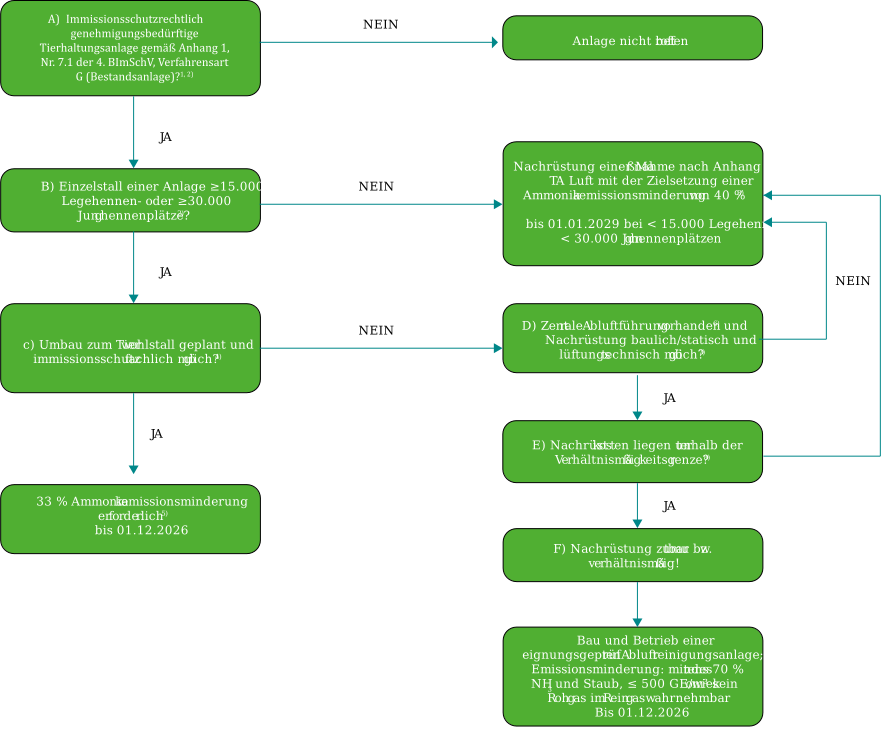
1) Retrofitting obligation only for forced-ventilation, thermally insulated housing buildings in facilities with ≥ 40,000 laying hens or pullets, as well as mixed flocks.
2) General proportionality threshold for individual housing size based on an analogy with fattening pigs (Hahne et al. 2016) and taking into account the development of the construction cost price index since 2015. Adjacent barns may be considered as a single unit if they are ≤ 12 m apart, together exceed the above-mentioned barn capacities and can be retrofitted in terms of fire safety and hygiene. If "no", the facility is subject to the requirements of Annex 11 TA Luft.
3) In this case, it may also be possible to install an exhaust air purification system with partial flow treatment (60% of the total volume flow with at least 70% emission reduction for ammonia) in accordance with Section 5.4.7.1(i) of the TA Luft.
4) The requirements of a planned LAI enforcement aid regarding quality-assured husbandry practices that promote animal welfare must be observed; conversion is only possible if appropriate husbandry practices are defined and the protection requirements according to No. 4 TA Luft are met.
5) Only for quality-assured husbandry practices that are demonstrably conducive to animal welfare (outdoor climate barn); see 5.4.7.1 letter h).
6) A distinction must be made between existing decentralised and centralised exhaust air ducts. In the case of decentralised exhaust air ducts, retrofitting a centralised exhaust air purification system involves considerable structural work.
7) Verification by a recognised expert or ventilation specialist company. If retrofitting is not possible, the requirements of Annex 11 TA Luft must be met.
8) In principle, the purpose of the legal requirement for precautionary measures must be weighed against the additional costs for the operator. Extensive structural alterations to the building structure of the livestock building result in high retrofitting costs. According to the Higher Administrative Court of Lüneburg (judgment of 18 May 2020 – 12 LB 113/19), the additional costs for the retrofitting of the exhaust air purification system, taking into account the costs of the exhaust air purification system, are primarily relevant for assessing the proportionality of retrofitting. Additional costs of up to 20% of the investment costs of the exhaust air purification system can be considered reasonable (cf. OVG Saxony-Anhalt, decision of 16 December 2010 2 l 246/09). If the retrofitting costs are disproportionate, the requirements of Annex 11 must be met.
Separating faeces and urine, as is done with pigs, is not possible in poultry farming due to the biology of birds (faeces and urine are excreted together). In laying hen farming, manure belt drying (dry content min. 55%, ventilation rate of 0.4–0.5 m³/animal/h15) and regular removal of excrement from the barn are the most effective means of reducing emissions due to the lack of alternative mitigation measures (see Table 1). Drying reduces the conversion of uric acid to ammonia.
| Housing method | Ref. value TA Luft kg NH3/(TP a) | Measure | Emission factor according to number 5.4.7.1 letter h of TA Luft reduction: 70 per cent | Emission factor according to Section 5.4.7.1(i) of TA Luft Reduction: 40 per cent | Status |
|---|---|---|---|---|---|
| Aviary system with unventilated manure belt, manure removal twice a week | 0.050 | Exhaust air purification system 12, 13, 14 | 0.015 | 0.03 | Approved by TA Luft |
| Aviary system with ventilated manure belt, (0.4-0.5 m³/animal per hour without supply air conditioning, manure removal once per week, dry matter content (DM) in manure 55%) | 0.04 | Exhaust air purification system 12, 13, 14 | 0.01 | 0.02 | Approved by TA Luft |
| Aviary system with manure ventilation using outside air (0.7 m3/TP per hour, 17°C air temperature with 55 per cent dry matter in manure, 80 per cent dry matter in litter) | 0.033 | Exhaust air purification system 12, 13, 14 | 0.009 | 0.01 | Approved by TA Luft |
| Aviary housing/outdoor access Manure removal 1x/pass | 0.28 | Exhaust air purification system 12, 13, 14 | 0.085 | 0.17 | Approved by TA Luft |
| Young hens up to 18 weeks old, aviary housing, unventilated manure belt, manure removal twice a week | 0.035 | Exhaust air purification system 12, 13, 14 | 0.01 | 0.02 | Approved by TA Luft |
| Young hens up to 18 weeks old, aviary housing, ventilated manure belt, 0.1 m³/(TP•h), manure removal once a week | 0.0289 | Exhaust air purification system 12, 13, 14 | 0.0087 | 0.01 | Approved by TA Luft |
Table 1: Abatement techniques in conventional young/laying hen husbandry. The reference values according to Annex 11, Table 29 of TA Luft take into account a reduction in ammonia emissions through nutrient-adjusted feeding in accordance with Section 5.4.7.1(c). kg NH₃ / (TP a) = kilograms of ammonia per animal place per year. The table contains reduction techniques from Table 29, Annex 11.
Feeding measures and mass balance
An important area of reduction measures concerns the plant-related mass balance of nutrients (primarily nitrogen (N) and phosphate (P)) of a farm in accordance with Annex 10 of the TA-Luft. As part of the balancing process, farms must demonstrate that they comply with the maximum nutrient excretion levels for N and P2O5 specified in Table 10 of the TA Luft. Based on the N and P input via feed and the nutrient input of the animals (growth, eggs), as well as the N and P excretion calculated from this, N/P-reduced feeding can be demonstrated. In practice, a significant and precise reduction in crude protein and phosphorus while maintaining performance requires the use of free amino acids and microbial phytase. Due to the legal restrictions on the use of free amino acids and phytases in EU Organic Regulation 2018/848, the maximum nutrient excretion levels specified in TA Luft cannot be mandatorily implemented there. However, from a technical point of view, a reduction in nutrient excretion should be aimed for within the legally permissible options.
For plausibility checks, a plant-related stable balance7,8 (TA Luft: mass balance according to Annex 10) over a continuous 12-month period is required. This records all nitrogen and phosphorus flows at plant level9 and serves as proof that the requirements (according to Table 10 of the TA Luft) for emission reduction are being met. In addition to the excretion values shown in Table 10, alternative values of the same N/P reduction level from the publications of the DLG Working Group on Feed and Feeding10 can also be used, provided that they reflect the actual feeding and husbandry conditions on the farm more accurately than the flat-rate values of the TA Luft.
Furthermore, closed nutrient cycles can further reduce emissions and increase the sustainability of farms. This includes, for example, the efficient use of feed (e.g. reducing feed losses) and the recycling of nutrients into the farm cycle.
Alternative ways of reducing emissions from livestock farming and innovative approaches
An acidic litter environment (< pH 4) in the litter area appears to reduce ammonia emissions in addition to reducing germ pressure. At a pH < 4, less ammonium (NH4+) is converted into climate-impacting ammonia (NH3)16. One option for this is the DLG-certified litter additive based on sodium hydrogen sulphate (trade name "ImproBed®17") for broilers, which has been proven to lower the pH value in the litter. Approval for poultry other than broilers, e.g. for laying hens, is currently being worked on. However, based on experience, when using ImproBed, attention must be paid to the ventilation systems in place on the farm. ImproBed is most effective in dry houses with low humidity. In high humidity, the house must be ventilated more intensively, which can lead to a sharp increase in heating costs, especially in the winter months. The product is recognised by many districts as a mitigation measure for chicken fattening to reduce ammonia emissions. However, it is not yet listed in Annex 11 of the TA Luft (Technical Instructions on Air Quality Control) as an approved mitigation measure. Legal recognition as a mitigation measure in accordance with TA Luft for laying hen housing must also be clarified with the relevant immission control authority. Furthermore, the best possible hygiene status18,19 and appropriate management should always prevail in the farm in order to reduce performance losses and thus higher excretion values in percentage terms. Cleaning and disinfection adapted to the farm can be helpful here20.
Facilities in accordance with the EU Organic Regulation and "animal welfare" facilities
So-called "animal welfare stables" (quality-assured husbandry methods that are proven to promote animal welfare) within the meaning of TA Luft with outdoor climate stables that promote animal welfare, presumably farms with free-range and organic animal husbandry, must currently reduce their NH3 emissions by at least 33% by 1 December 2026. To date (as of March 2026), the authorities have not yet clarified how animal welfare stables are defined in poultry farming (see below).
In the area of pig fattening, a 33% reduction is already associated with animal welfare-friendly outdoor climate stables. Since, in contrast to pig farming, no measures recognised as improving animal welfare have yet been specified in Annex 11 of the TA Luft for poultry farming, the design guidelines of the AMK/UMK ad hoc expert group "Immission Control and Animal Welfare25" convened by the federal and state governments must be observed. These describe the essential criteria for open and closed stables with outdoor access. As of March 2026, corresponding implementation guidelines and reference works26 are only available for fattening pigs, as only these husbandry methods are regulated in the Animal Husbandry Labelling Act. Implementation guidelines for poultry farming are currently being developed.
When considering emission reduction in free-range farming, the facility and the associated outdoor areas must be dimensioned and designed in such a way that nutrient inputs from manure deposits do not lead to harmful environmental impacts. Particular attention must be paid to nitrogen inputs in areas close to the housing27. At the same time, attention must be paid to the disease control situation, according to which different materials pose different risks. In case of uncertainty, it is advisable to contact a consultant or veterinarian. If the outdoor areas near the barn are covered with gravel and grit, the input is particularly high. Neither material binds nitrogen, which means that it is washed into the soil unfiltered. Instead, a study on laying hens concludes that straw pellets and wood chips in particular have good nitrogen-binding properties. It is important to replace these materials regularly, at least before and after the winter seepage period, otherwise high rainfall can cause nutrients to leach out of the substrate. The sometimes conflicting requirements of the TA-Luft (Technical Instructions on Air Quality Control) and building regulations make it difficult for many farmers to convert their stables to meet animal welfare standards. The KTBL recommends that livestock farms consult with the veterinary authorities if necessary and base their regulations on area requirements and stocking density from animal welfare labels. However, this procedure does not protect against subsequent conversion requirements, as the official specifications have not yet been specified in the implementation guidelines (see above).
As organic farms operated in accordance with Regulation (EC) 889/2008 currently do not allow microbial phytases and free amino acids in feed, and therefore nutrient-adjusted feeding as specified in Table 10 of the TA Luft is not feasible for them, they do not have to comply with the excretion values in Table 10, which makes it obsolete to check compliance with these values by means of a balance sheet. However, a reference value for the degree of emission reduction for ammonia must be determined on the basis of the feed plan (TA Luft, 5.4.7.1 h). However, it is still unclear how this is to be done. The requirements only apply if they do not contradict the Organic Regulation.
Other poultry species
For parent stock, turkeys and ducks, there are currently no quality-assured exhaust air purification technologies in Germany that meet the requirements of TA Luft No. 5.4.7.1 h and Annex 12, which is why these poultry species are exempt from the regulations. Nutrient-reduced feeding (multi-phase feeding) and specifications for litter, drinking troughs and manure removal in particular should be observed in order to ensure dry litter (see BAT 33 and 34 of the implementing provisions21). Measures include regular replenishment of litter in sufficient quantities (odour control) and, in the case of fattening poultry, e.g. thermal insulation of the floor or the installation of underfloor heating.
Literature
- Federal Environment Agency (2025). Germany's greenhouse gas reduction targets. Retrieved from: https://www.umweltbundesamt.de/daten/klima/treibhausgasminderungsziele-deutschlands#internationale-vereinbarungen-weisen-den-weg
- Federal Information Centre for Agriculture (2023). Ammonia emissions: Agriculture must take action. Retrieved from: https://www.praxis-agrar.de/umwelt/klima/ammoniak-emissionen
- Saxon State Ministry for the Environment and Agriculture. GV key and emission factors for animal husbandry. Retrieved from: https://www.luft.sachsen.de/gv-schlussel-und-emissionsfaktoren-tierhaltung-14458.html
- Federal Environment Agency (2025). Ammonia, odour and dust. Retrieved from: Ammonia, odour and dust | Federal Environment Agency
- Federal Ministry for the Environment, Nature Conservation and Nuclear Safety (2021). Revised version of the First General Administrative Regulation to the Federal Immission Control Act (Technical Instructions on Air Quality Control – TA Luft). Retrieved from: https://www.verwaltungsvorschriften-im-internet.de/bsvwvbund_18082021_IGI25025005.htm
- Federal Office of Justice and Consumer Protection (2013). Fourth Ordinance Implementing the Federal Immission Control Act (Ordinance on Installations Requiring Approval – 4. BImSchV) Annex 1. Retrieved from: https://www.gesetze-im-internet.de/bimschv_4_2013/anhang_1.html
- DLG – German Agricultural Society (2024). Stable balancing made easy. Validating nutrient-adjusted feeding for pigs and poultry. Retrieved from: https://www.dlg.org/mediacenter/dlg-merkblaetter/dlg-kompakt-03-2024-stallsaldierung-leicht-gemacht
- DLG – German Agricultural Society. Stable balance in pig and poultry farms according to emissions law (BVT). Stable balancing for the Technical Instructions on Air Quality Control (TA Luft). Retrieved from: https://www.dlg.org/landwirtschaft/tierhaltung/futtermittelnet/stallbilanz-rechner-fuer-schweinehaltende-betriebe-nach-duengerecht/stallbilanz-in-schweine-und-gefluegelhaltende-n-betrieben-nach-emissionsrecht-bvt
- Saxon State Ministry for the Environment and Agriculture (2024). The amended Industrial Emissions Directive (IE-RL) – consequences for animal husbandry. Specialist colloquium on construction and technology – implementation of IE-RL and TA Luft in animal husbandry facilities. Retrieved from: https://landwirtschaft.sachsen.de/download/1_2024-12-03_Fritsche_IED.pdf
- DLG – German Agricultural Society (2023). Consideration of N- and P-reduced feeding methods in the nutrient excretion of broilers, pullets and laying hens. DLG information sheet 457. Retrieved from: https://www.dlg.org/dlg-merkblatt-457-wwwdlgorg-beruecksichtigung-n-und-p-reduzierter-fuetterungsverfahren-bei-den-naehrstofausscheidungen
- Board of Trustees for Technology and Construction in Agriculture (KTBL) (2024). Renovation of old plants in accordance with TA Luft. Guidelines. Retrieved from: https://www.ktbl.de/fileadmin/user_upload/Artikel/TA_Luft/TALuft-2024.pdf
- DLG – German Agricultural Society. Test report database. Agricultural technology and operating resources. Retrieved from: www.dlg.org/tests/landtechnik-betriebsmittel/pruefberichte/
- DLG – German Agricultural Society (2023). Information on the operation of exhaust air purification systems for pig farming. Part 1: Fundamentals and overview of procedures. Leaflet 483. Retrieved from: www.dlg.org/mediacenter/dlg-merkblaetter/dlg-merkblatt-483-hinweise-zum-betrieb-von-abluftreinigungsanlagen-fuer-die-schweinehaltung-teil-1
- DLG – German Agricultural Society (2023). Information on the operation of exhaust air purification systems for pig farming. Part 2: Operating data and consumption values. Information sheet 484. Retrieved from: https://www.dlg.org/mediacenter/dlg-merkblaetter/dlg-merkblatt-484-hinweise-zum-betrieb-von-abluftreinigungsanlagen-fuer-die-schweinehaltung-teil-2
- Federal Environment Agency (2021). Reducing ammonia emissions in agriculture. Retrieved from: https://www.umweltbundesamt.de/publikationen/ammoniakemissionen-in-der-landwirtschaft-mindern#:~:text=Reducing%20ammonia%20emissions%20is%20an%20important%20task%20in%20air%20pollution%20control%2C%20as%20it%20causes%20most%20ammonia%20emissions%20in%20Germany
- DGS – Magazine for the Poultry Industry (2024). MiniAbeR project – Litter in poultry farming: the key to animal health. Retrieved from: https://www.dgs-magazin.de/themen/fuetterung-tiergesundheit/article-7878854-175625/einstreu-in-der-gefluegelmast-schluessel-zur-tiergesundheit-.html?UID=119EF0016DD22F90FF5EDEE5B47A133F44E4BFA3BAF8A9B7CC
- DLG-approved in individual criteria "InDoor method for emission reduction" (2023). Test report 7440. Grillo-Werke ImproBed. Retrieved from: https://www.dlg.org/tests/landtechnik-betriebsmittel/pruefberichte/test-grillo-werke-improbed
- Friedrich Loeffler Institute (2016). Protective measures against avian influenza in small-scale poultry farming. Retrieved from: www.openagrar.de/servlets/MCRFileNodeServlet/openagrar_derivate_00000891/Merkblatt-AI_2016-11-25.pdf
- Friedrich Loeffler Institute (2017). Protecting farm poultry. Retrieved from: https://www.openagrar.de/servlets/MCRFileNodeServlet/openagrar_derivate_00001778/Merkblatt-Nutzgefluegel_schuetzen-2017-02-15.pdf
- Research Note: Tracing pathways of entry and persistence of facultative pathogenic and antibiotic-resistant bacteria in a commercial broiler farm with substantial health problems. Poult Sci. (2020). Heinemann C, Leubner CD, Savin M, Sib E, Schmithausen RM, Steinhoff-Wagner J. Nov;99(11):5481-5486. Retrieved from: doi: 10.1016/j.psj.2020.08.050.
- COMMISSION IMPLEMENTING DECISION (EU) 2017/302 on the best available techniques (BAT) conclusions under Directive 2010/75/EU of the European Parliament and of the Council as regards the intensive rearing or breeding of poultry or pigs (2017). Retrieved from: https://eur-lex.europa.eu/legal-content/DE/TXT/PDF/?uri=CELEX%3A32017D0302&from=EN
- Board of Trustees for Technology and Construction in Agriculture (KTBL). INKALKTIER. Retrieved from: https://ktbl.inkalktier.de/app/
- Board of Trustees for Technology and Construction in Agriculture (2016). Current developments, cost-benefit analysis and implementation recommendations for the use of exhaust air purification systems in animal husbandry. UBA TEXTE 61/2016, Dessau-Roßlau
Spandau, P.; Sauer, N. Economic evaluation of exhaust air purification systems in pig farming. In: 13th KTBL Conference "Current legal framework for animal husbandry" - Board of Trustees for Technology and Construction in Agriculture (2024). Guidelines for implementing the requirements of TA Luft for the renovation of old plants No. 5.4.7.1 Letter h) Exhaust air purification. Retrieved from: https://www.ktbl.de/fileadmin/user_upload/Artikel/TA_Luft/TA-Luft_bf_2.pdf
- Federal/State Working Group on Emission Control (LAI). Enforcement issues relating to TA Luft (2025). Retrieved from: www.lai-immissionsschutz.de/documents/ta-luft-gesamtkatalog-stand-10-2025_1763019762.pdf
- Network Focus Animal Welfare (2023). Exhaust air purification systems for pigsties – what needs to be considered? Retrieved from: https://www.fokus-tierwohl.de/de/schwein/fachinformationen-schwein/abluftreinigungsanlagen-1
- Eco-laying hens: Resource efficiency and environmental protection versus outdoor access management and space allocation (2017). Deerberg, F., Heß, J. Retrieved from: core.ac.uk/download/pdf/84253908.pdf
- Final report "Optimisation of free-range rearing of laying hens to reduce nutrient inputs in outdoor areas using a participatory approach with practitioners" (OPAL) (2023). Deerberg, Fr., Deerberg, Dr. F, Heß, Prof. Dr. J. Retrieved from: https://opac.dbu.de/ab/DBU-Abschlussbericht-AZ-33974_01-Hauptbericht.pdf
- BMUKN draft bill for a general administrative regulation implementing Implementing Decision (EU) 2023/2749 on conclusions on best available techniques for slaughterhouses (09/2025). Retrieved from: https://www.bundesumweltministerium.de/law/draft-bill-by-the-bmukn-for-a-general-administrative-regulation-implementing-implementing-decision-eu-2023-2749-on-conclusions-on-best-available-techniques-relating-to-slaughterhouses
- Federal Office of Justice and Consumer Protection (2013). Act on Protection against Harmful Environmental Impacts from Air Pollution, Noise, Vibration and Similar Processes. Retrieved from: https://www.gesetze-im-internet.de/bimschg/BJNR007210974.html#BJNR007210974BJNG000103360
- Science of The Total Environment. Volume 803. (2022). Strategies to mitigate ammonia and nitrous oxide losses across the manure management chain for intensive laying hen farms. Rosa, E., Arriaga, H., Merino, P. Retrieved from: www.sciencedirect.com/science/article/abs/pii/S0048969721050920