
- Ludger Cordes, Rothkötter Mischfutterwerk GmbH
- Inke Drossé, German Animal Welfare Association
- Dr. Andreas Hemme, Die Praxis für Geflügel GbR
- Marie-Louise Hentschel, BWE-Brüterei Weser-Ems GmbH & Co. KG
- Prof. Helen Louton, University of Rostock
- Steffi Ropel, Biofino Ltd.
- Silke Schierhold, Lower Saxony Chamber of Agriculture
- Dr. Birgit Spindler, University of Veterinary Medicine Hannover Foundation
- Arnd von Hugo, farmer
- Felix Wesjohann, BWE-Brüterei Weser-Ems Ltd.
- Dr. Katja Kulke, Lower Saxony Chamber of Agriculture
Funding information
This document was developed as part of the joint project Network Focus Animal Welfare, funding code 28N-4-013-01 to 28N-4-013-17, by the "Broiler Chickens" working group of the Animal Welfare Competence Centre for Poultry and prepared methodologically and
didactically by DLG e.V. The joint project of the chambers of agriculture and agricultural institutions of all federal states aims to improve the transfer of knowledge into practice in order to make cattle, pig and poultry farms fit for the future in terms of animal welfare, environmental protection and sustainable livestock farming.
The project is funded by the Federal Ministry of Food and Agriculture on the basis of a resolution of the German Bundestag.
All information and notes are provided without any guarantee or liability.
Publisher
DLG e.V.
Fachzentrum Landwirtschaft
Eschborner Landstraße 122
60489 Frankfurt am Main
Reproduction and transmission of individual sections of text, drawings or images (including for teaching purposes) and the provision of the information sheet in whole or in part for viewing or downloading by third parties is only permitted with the prior approval of the relevant office of the Animal Welfare Competence Centre and DLG e.V., Marketing Department, tel. +49 69 24788-209, [email protected]
Introduction
Vaccinations are an important tool for maintaining and improving animal health. They are a prophylactic measure to prevent infection with pathogens.
In addition, regular vaccinations help to reduce the spread of zoonotic pathogens. They also remain an important part of animal disease control. For example, vaccination against Newcastle disease is mandatory in broiler chicken farming.
(Further information on Newcastle disease and strategies for combating it can be found here: tierseucheninfo.niedersachsen.de/anzeigepflichtige_tierseuchen/gefluegelseuchen/newcastle_krankheit/newcastle-disease-21656.html)
Looking ahead to the coming years, it can be assumed that vaccination programmes will become increasingly important. The use of antibiotics to treat infectious diseases is being discussed in relation to the production of residue-free food and is also being criticised in connection with the development of highly resistant germs.1
The European Union is therefore calling for the targeted implementation of vaccination strategies in order to reduce the number of therapeutic treatments.1
However, it is generally true that vaccinations alone are not sufficient to ensure animal health and thus animal welfare. Vaccinations should rather be seen as part of an overall concept in which hygiene and management also play an important role. Vaccination strategies must therefore be tailored to the specific situation of each individual farm and should be developed in close consultation with the veterinarian responsible for the herd.
Against which diseases are broiler chickens vaccinated?
Table 1 lists the diseases for which vaccination is usually carried out to protect animals from infection. Newcastle disease is the only disease for which vaccination is mandatory.
| Diseases | Time of vaccination | Form of administration | Comments |
| Newcastle disease (ND) |
|
| In the hatchery, vaccination is also carried out in combination with Marek's disease. |
| Avian rhinotracheitis (ART) |
|
| In practice, spray vaccination has proven to be the better form of administration. ART vaccination is not carried out routinely, but only in consultation with the veterinarian responsible for the flock and only if the infection has already occurred repeatedly in the flock on the farm. |
| Infectious bronchitis (IB) |
|
| In practice, spray vaccination has proven to be the better form of administration. Many different vaccine strains are available. The vaccination is very commonly carried out in broiler flocks. |
| Infectious laryngotracheitis (ILT) |
|
| The vaccination is usually given in combination with the Marek's disease vaccination. It is only given if a farm has already had problems with ILT or if, in connection with a longer rearing period, vaccination against Marek's disease is also given. |
| Gumboro = Infectious bursitis (IBD) |
|
| Vaccination can be carried out in the hatchery in combination with a Marek's vaccination. Weak to strong vaccines can be used. The timing of vaccination depends on the titre of maternal antibodies** and the vaccine used. |
| E. coli |
|
| The success of the vaccination often only becomes apparent after several consecutive rounds of vaccination. |
| Coccidiosis |
|
| The success of the vaccination often only becomes apparent after use in the 2nd to 3rd consecutive cycle. In spray vaccination, the vaccine is sprayed onto the animals' plumage so that they ingest the vaccine from the plumage of others. Some of the oocysts applied also end up in the environment. Vaccination in the barn offers the advantage that these oocysts can also be absorbed at a later stage. |
| Marek's disease |
|
| The Marek's vaccine is often administered in combination with other vaccines. Unlike other vaccines, this vaccine must be stored using liquid nitrogen. As symptoms of Marek's disease usually only appear after the 7th week of life, the vaccination is only carried out on animals that are to be kept for longer (e.g. organic animal husbandry). |
* The information provided here is based on practical experience. As the timing of vaccination and the form of administration also depend in part on the vaccine used, you should always consult with the veterinarian responsible for your livestock.
** Maternal antibodies are antibodies produced by the hen and absorbed by the chick in the egg before hatching. They provide protection against infection for a certain period of time after hatching. However, maternal antibodies are broken down over time, so the animal must produce new antibodies to be protected against infection. This antibody production is stimulated with the help of the vaccine.
Vaccination completed – herd protected?
The aim of any vaccination is to build up vaccine protection in as many animals in a herd as possible. However, it should not be assumed that 100% of the herd will be protected against infection after a single vaccination. In every herd, there will always be animals that do not show an immune response after proper vaccination. These animals are referred to as "non-responders".
Multiple vaccinations can help to reduce the proportion of non-responders. However, broiler chickens are usually only vaccinated once due to the relatively short rearing period. Depending on the farm situation, multiple vaccinations may also be advisable.
Even when vaccination is successful, there are various situations that can lead to disease in the flock despite vaccination. In this case, we refer to a so-called vaccine breakthrough. The different scenarios are explained below:
The basic principle of vaccination is based on administering antigens of a pathogen to the animals in order to stimulate an immune response. After administration, the animal's body produces antibodies against the corresponding antigens, among other things.
However, pathogens can mutate in the field. If this adaptation of the field pathogen is accompanied by a change in the antigen structure, a vaccine breakthrough can occur despite vaccination. In this case, the vaccine antibodies can no longer bind to the surface of the field pathogen. They are therefore not neutralised and the animals fall ill despite vaccination.3
Vaccine breakthrough can also occur if a flock comes into contact with a field pathogen before the development of robust immunity is complete.3
In unfavourable cases, broiler chickens can fall ill even after successful immunisation. Stress caused by both infectious and non-infectious factors leads to a general weakening of the immune system.3 In this case, the neutralisation of infectious agents may be insufficient or fail to occur, resulting in the animals still showing symptoms. In addition to vaccination, stress avoidance is therefore an important factor in ensuring that animal health is maintained.
How are vaccines administered?
Depending on the properties of the vaccine used, it is administered in different ways:
- Live vaccines ⇒ Live vaccines contain pathogens that are capable of reproducing. However, these pathogens have had their disease-causing properties greatly reduced, so that the animals do not become ill after vaccination. Live vaccines are usually administered via drinking water or as a spray.2 An exception to this is the Marek's disease vaccine, which is administered either under the skin or into the muscle (needle vaccination).
- Inactivated vaccines ⇒ Vaccines that contain inactivated pathogens that are unable to reproduce. They usually have to be administered by needle vaccination.2 However, inactivated vaccines are not used in broiler chickens.
- In ovo vaccinations ⇒ In ovo vaccinations involve administering the vaccine directly into the egg around the 18th/19th day of incubation. This form of vaccine administration is becoming increasingly important in the rearing of slow-growing genetics. In addition to needle vaccination, Marek's vaccination can also be carried out as an in ovo vaccination before hatching.

Drinking water vaccines – the most common form of vaccine administration
In broilers, vaccines are mainly administered via drinking water. Stress factors such as feed changes should be avoided as far as possible around the time of vaccination.4 However, in certain cases, e.g. vaccination against Gumboro, this requirement cannot always be met.
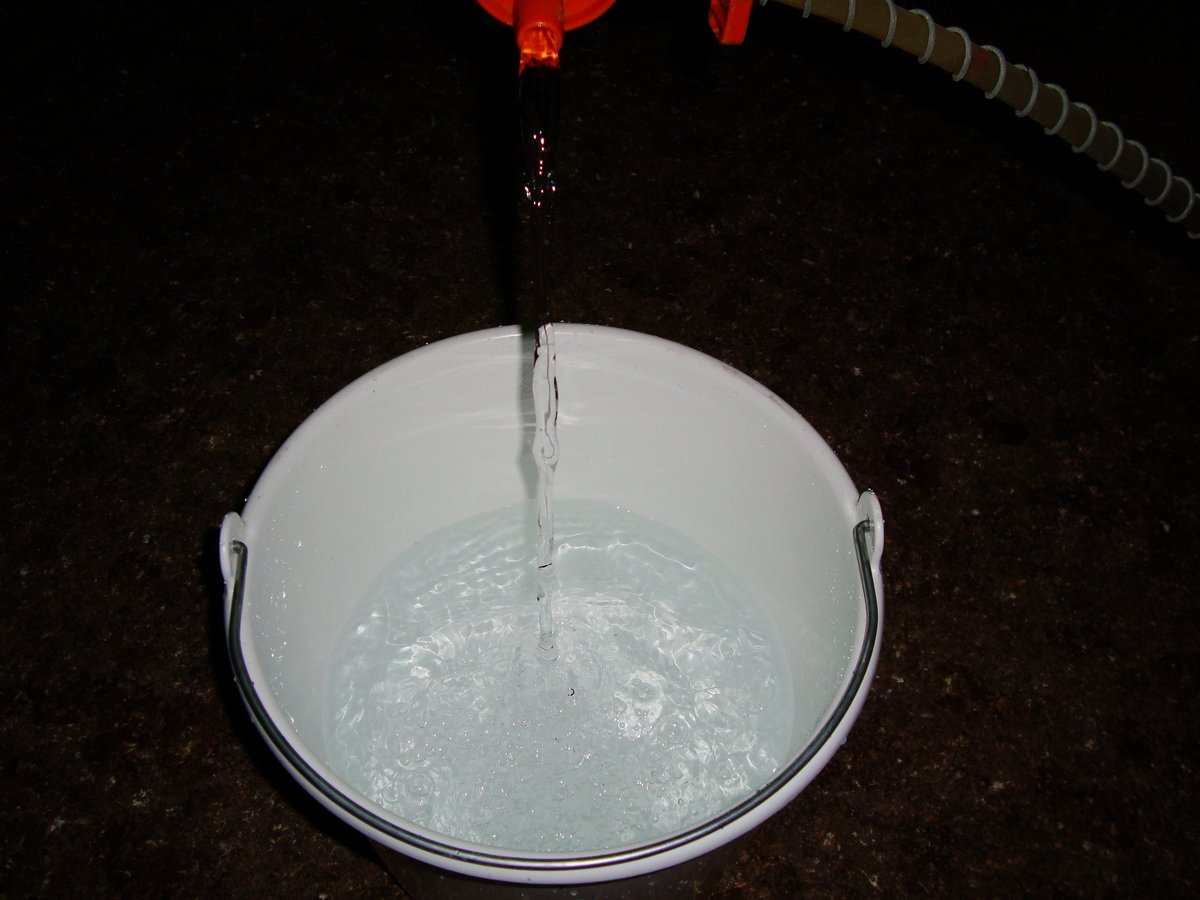
To avoid damaging the vaccine, it is important to ensure that the water quality is very good (Figure 1). It is therefore advisable to dissolve the vaccine in drinking-quality water or, if necessary, even in distilled water. The vaccine must be mixed immediately before administration, as vaccines have a limited shelf life of only a few hours after preparation.4 In addition, mixing must be carried out in a clean container (vaccination bucket).
Live vaccines administered via drinking water are particularly sensitive to1:
- High temperatures – the drinking lines should therefore be filled with fresh, cool water. The heating loops must be switched off before administering the vaccine.
- Drinking water additives such as chlorine and organic acids – if used regularly, these should be discontinued 2 days before using the vaccine.
- High ion content (nitrite/nitrate/iron/manganese) – the water composition should be checked at regular intervals. For more information, see the drinking water guidelines.
- Contaminants such as biofilms and algae2 – good drinking water hygiene should prevent the formation of biofilms and algae colonisation. Before vaccination, the pipes should be flushed to remove any contaminants.
According to the Animal Welfare Livestock Farming Ordinance, broiler chickens must have access to water throughout the day (24 hours). Water deprivation is only permitted on veterinary advice. If the thirst period is too short, not all animals will go to the drinking trough or will consume too little vaccine. This would result in uneven immunity in the flock, which can lead to vaccine breakthroughs. However, a thirst period that is too long restricts the animals' well-being.
The vaccine should be consumed within 2 hours of mixing. To ensure that the animals consume sufficient water during this period, water deprivation should already be carried out during the dark phase. The vaccine is then administered at the start of the light phase.
The length of the required thirst period and the amount of water used vary depending on climatic conditions. For example, at high temperatures, the animals absorb the required amount of vaccine more quickly through the water. Both factors should therefore always be agreed in advance with the veterinarian responsible for the herd.
To ensure that the animals consume the vaccine within 2 hours of mixing, the amount of water consumed should be determined at the same time of day on the previous day. When preparing the vaccine, it should be taken into account that the animals are already thirsty prior to vaccination. The amount of water used for vaccination therefore corresponds to the animals' water consumption during the thirst period plus their water consumption within the 2-hour window after vaccination.
To determine the amount to be used, it may be helpful to carry out a so-called trial vaccination. For this, the amount of water intended for mixing is filled into a separate container. The speed at which this amount of water is consumed by the animals is then observed. When carrying out the trial vaccination, the broilers must also be thirsty beforehand in order to be able to transfer the result to the actual vaccination.
Based on the water consumption determined on the previous day or the result of the trial vaccination, the optimal amount of water for dissolving the vaccine and the duration of the thirst period should then be determined in consultation with the veterinarian responsible for the flock.
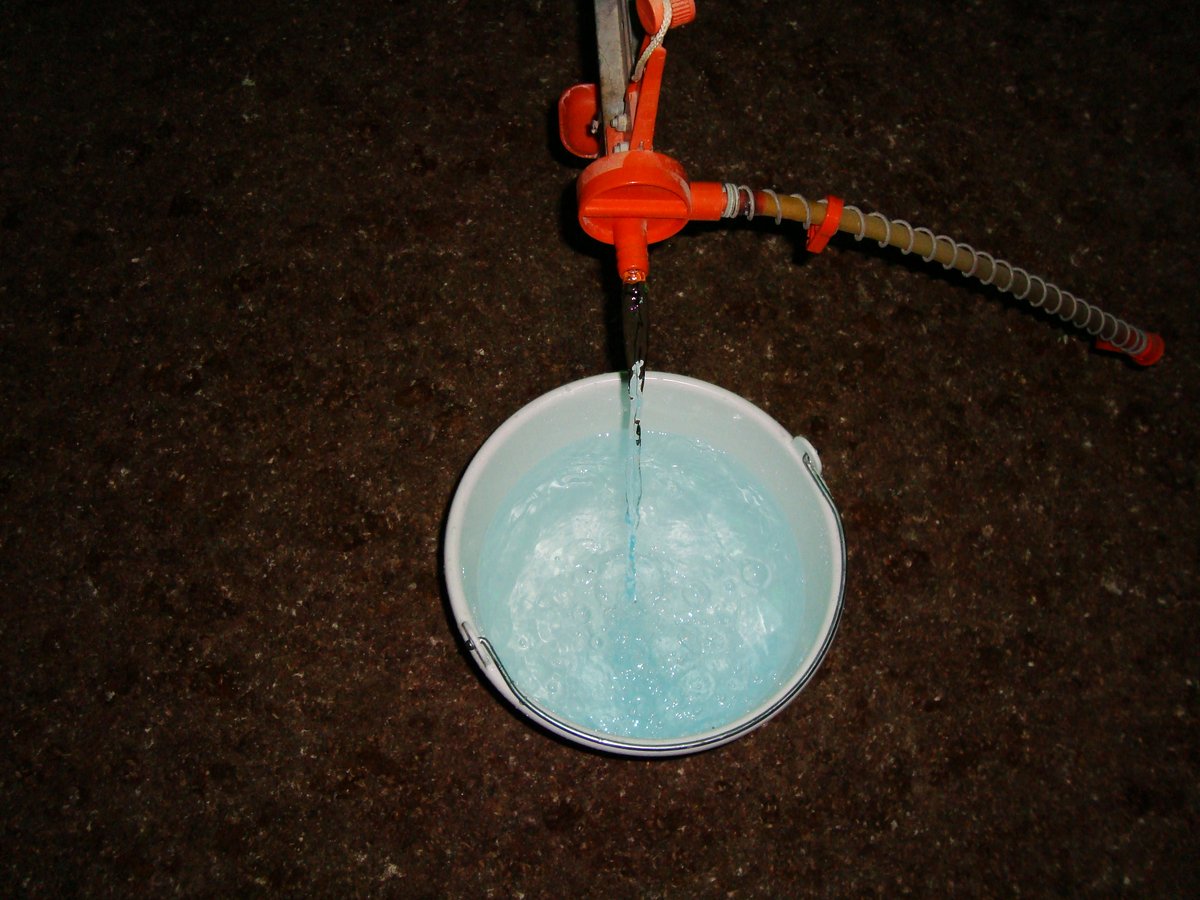
In addition to the actual vaccine, stabilisers can be added to the drinking water. These substances are intended to help ensure that the vaccine is not damaged during administration and that the animals thus absorb enough vaccine to build up stable immunity. In addition, the stabilisers often contain dyes to facilitate the vaccination process (Figure 3). The colouring agent can be used to check whether the drinking lines are completely filled with vaccine solution at the start of vaccination. In addition, if the broilers absorb sufficient amounts of the colouring agent, their tongues will turn blue. This makes it easy to check whether sufficient vaccine has been absorbed.
The colouring of the tongue can also be used as an indicator during the trial vaccination. If the stabiliser is added to the drinking water here as well, the colouring of the tongue can be checked in addition to water consumption.
However, not all stabilisers are approved for organic animal husbandry, so approval should be checked in advance. In addition to the stabilisers listed, skimmed milk powder, for example, can also be used as a stabiliser.
During the actual vaccination, regular inspections of the stalls should be carried out. This encourages resting animals to get up and visit the drinking troughs.4 Increasing the light intensity can also help to encourage the animals to drink water. Vaccine uptake should be monitored by observing animal behaviour and water consumption.
After vaccination, the water pipes should be flushed thoroughly again. This removes any vaccine residues from the pipes that could promote the formation of biofilms.
Successful vaccination through correct implementation – "Good vaccination practice"
In order to achieve good vaccination success, the following factors must always be taken into account:
- The herd should be healthy at the time of vaccination.
- The veterinarian responsible for the herd must certify that the animals are fit for vaccination before the vaccination is carried out.
- Vaccines must be stored in a cool place (at 2–8°C) and protected from light before use. An exception to this is the vaccine against Marek's disease, which must be stored using liquid nitrogen.
- Care must be taken to ensure that the expiry date of the vaccine is not exceeded.
- Vaccinations must be carried out in accordance with the enclosed instructions for use.
- To avoid contamination of the vaccine, a container (vaccination bucket) should be available for mixing the vaccine, which is only used for carrying out vaccinations.
Furthermore, any stress factors should be avoided as far as possible after administration of the vaccine. Only in this way will the broilers have the opportunity to develop stable immunity and be sufficiently protected against disease during the rest of the fattening period.4
What mistakes should be avoided?
If vaccination is not carried out properly, there is a risk that the broiler chickens will only develop incomplete immunity. The following sources of error should therefore be3 ruled out in advance:
- Improper storage, e.g. the vaccine must not be allowed to freeze. Care must be taken to ensure that the cool bags containing the vaccine are not placed too close to the back wall of the refrigerator.
- Inadequate cooling during transport of the vaccine
- Failure to observe the expiry date
- Incorrect and/or unclean vaccine preparation in stock
- Incorrect dosage of the vaccine
- Insufficient drinking water quality – the vaccine can be damaged by various factors: It must therefore be ensured that the physical and chemical parameters of the drinking water correspond to the target values and that the water does not contain any contaminants or algae. To ensure good water quality, the use of distilled water is recommended.
- The distances between the supply tank and the drinking troughs must not be too long.
- The drinking water must be free of cleaning, disinfectant or medicinal residues. Therefore, these should not be used two days before and immediately after vaccination.
Conclusion
In addition to animal hygiene and herd management, farm-specific vaccination programmes contribute to maintaining animal health and thus also to a higher level of animal welfare in broiler farming. However, the guidelines regarding storage and administration must be strictly observed. Only with correct handling can the animals build up sufficient immunity and thus achieve good vaccination success.
Literature
- 1 Arnold, T. (2022): Protective vaccinations. Poultry Yearbook, 246-257.
- 2 Rautenschlein, S. and M. Ryll (2014): Diseases of Farm Poultry, Eugen Ulmer Publishing House, Stuttgart
- 3 Siegmann, O. and U. Neumann (2012): Compendium of Poultry Diseases, Schlütersche Verlagsgesellschaft mbH & Co. KG, Hanover
- 4 DGS Special Issue 8/2022 Focus on Animal Health: A Small Step for Great Protection, pp. 4-7.