
- Dr. Henrike Glawatz, Moorgut Kartzfehn Turkey Breeder GmbH
- Dr. Hartmut Meyer, Moorgut Kartzfehn Turkey Breeder GmbH
- Franziska Müller, Naturland – Association for Organic Farming
- Sandra Reidenbach, German Animal Welfare Association
- Dr. Kathrin Toppel, Osnabrück University of Applied Sciences
- Jens von Seggern, farmer
- Bettina Countess von Spee, Association of German Turkey Producers
- Dr. Heinrich Windhaus, Die Praxis für Geflügel GbR
- Dr. Katja Kulke, Lower Saxony Chamber of Agriculture
This document was developed as part of the joint project ‘Netzwerk Fokus Tierwohl’ (Animal Welfare Network), grant reference numbers 28N-4-013-01 to 28N-4-013-17, by the ‘Turkey’ working group of the Poultry Animal Welfare Competence Centre, and was adapted for methodological and
educational purposes by DLG e.V. and FiBL Deutschland e.V. The joint project of the Chambers of Agriculture and agricultural institutions from all federal states aims to improve the transfer of knowledge into practice in order to make cattle, pig and poultry farms fit for the future in terms of animal-welfare-friendly, environmentally sound and sustainable livestock farming.
The project is funded by the Federal Ministry of Food and Agriculture pursuant to a resolution of the German Bundestag.
All information and advice is provided without any warranty or liability.
Publisher
DLG e.V. Agricultural
Centre
Eschborner Landstraße 122
60489 Frankfurt am Main
FiBL Deutschland e.V. Animal Welfare
Division
Kasseler Straße 1a
60486 Frankfurt am Main
Reproduction and transmission of individual text sections, drawings or images (including for the purpose of lesson planning), as well as the provision of the information sheet in whole or in part for viewing or downloading by third parties, is permitted only with the prior approval of the relevant office of the Animal Welfare Competence Centre and DLG e.V., Marketing Department, Tel. +49 69 24788-209, [email protected]

The liver is an organ involved in a wide range of metabolic processes in mammals and birds (Fig. 1). However, compared to mammals, fat synthesis in birds takes place largely in the liver and only to a relatively small extent in adipose tissue. This is due to anatomical differences between mammals and birds and promotes fat accumulation in the liver in birds, and thus also in turkeys.1
Increased fat accumulation in the liver can lead to damage to the liver tissue. This condition is referred to as fatty liver or hepatic lipidosis.
First hyperactive – then apathetic
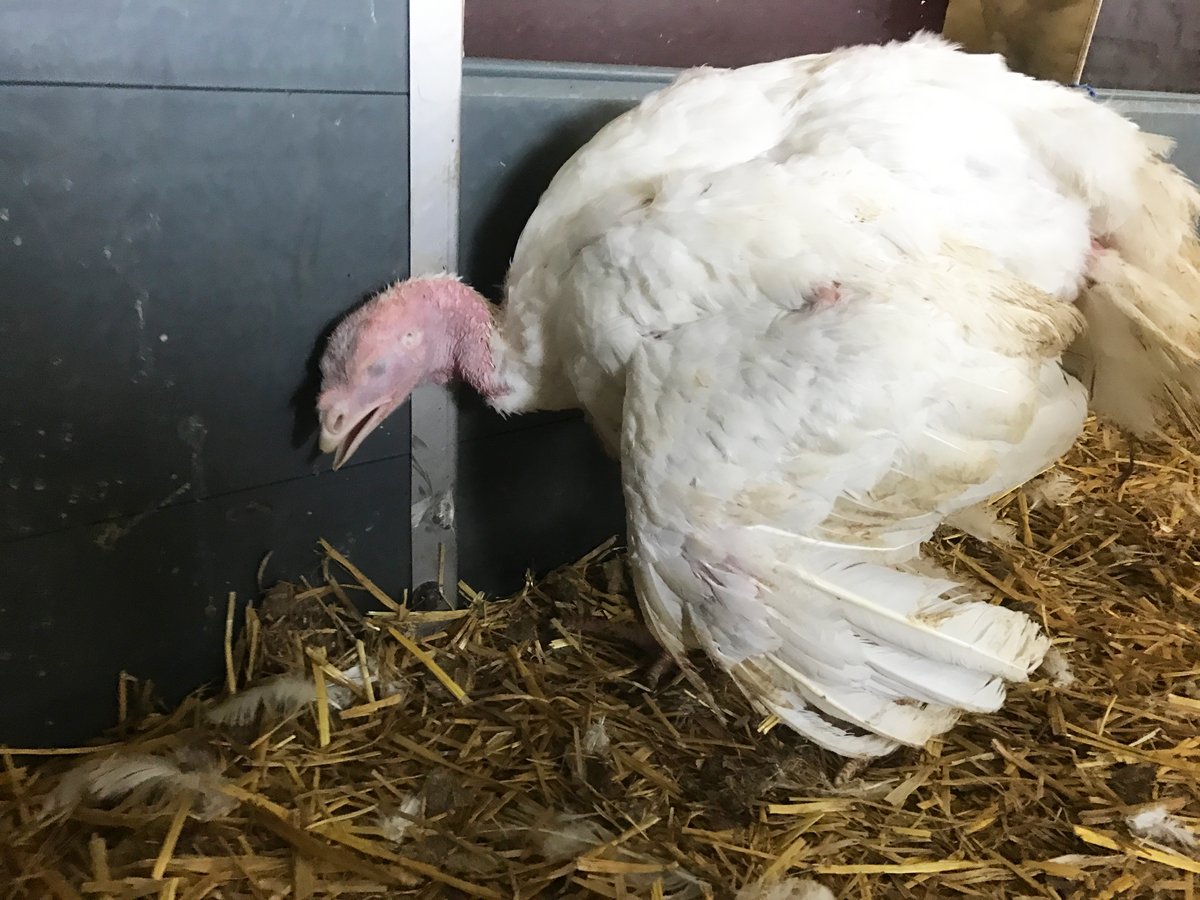
Where there is an increased incidence of fatty liver disease in a flock, the turkeys initially display hyperactive and nervous behaviour.2 After two to three days, however, the picture changes: the birds lie listlessly in the shed and barely move.3
Some severely affected turkeys find it difficult to breathe. In conjunction with the breathing difficulties, some of the birds may exhibit a bluish discolouration of the head and neck (Fig. 2).2 (This bluish discolouration is also known as cyanosis.) In addition to the turkeys’ listless behaviour, mortality rates also rise. Depending on the severity of the outbreak, mortality can reach up to 20%.3
However, there are differences in the course of the disease between male and female turkeys. The course of the disease in male turkeys is generally milder, with losses of up to 4%.4
The phase of increased mortality lasts only a few days.3 Mortality usually peaks on the third day. Thereafter, it declines significantly within three to four days.4 Although the dead turkeys may be scattered across the entire house, carcasses are increasingly found near the feeding troughs and also along the side walls.3
In addition to the clinical course described, longer disease courses occasionally occur, but relapses are generally rare.5

How can hepatic lipidosis be identified during a post-mortem examination?
On post-mortem examination, affected turkeys often appear to be in good physical condition. The animals simply have increased fat deposits in the abdominal cavity (Fig. 3).1 The liver is enlarged overall. Due to haemorrhages and further fat deposits, dark and light discolouration of the tissue can be seen on the liver.2 However, it is not only the liver where the tissue is damaged. Occasionally, pinhead-sized haemorrhages can also be seen on the heart, and the pericardium contains a yellowish, clear fluid.3 Whitish areas of necrosis may also occur in the pancreas.4 Furthermore, the blood that flows out when the animal is opened does not clot.3, 5 Examination of the stomach often reveals that the affected animals have ingested increased amounts of litter and feathers.3 Moreover, it is not uncommon for both E. coli and Clostridia to be detected during bacteriological examination.3, 4 However, it should be noted that some turkeys show no apparent changes to the liver despite clinical symptoms. In these animals, no chemical abnormalities have yet been detected in the blood either.2
Which herds are affected?
Affected flocks generally show high daily weight gains, exceed the breeding companies’ target weights and remain clinically unremarkable until the onset of the disease. The clinical picture is observed across different genetic lines.4 Not only does the course of the disease differ between male and female turkeys, but the timing of onset also varies: whilst females typically fall2 ill between the 10th and 14th week of life, symptoms in males usually appear later, between the 12th and 18th week of life.
What causes hepatic lipidosis?
To date, the exact aetiology of the disease remains unclear.2 Various factors are being discussed as possible triggers for the development of fatty liver:
- Influence of the sex hormone oestrogen: Given the differing disease progression in male and female turkeys, the influence of oestrogen is being discussed, as oestrogen promotes fat formation in the body.3
- Stress: High temperatures, as well as altered lighting regimes, can lead to changes in feeding behaviour. In conjunction with reduced feed intake, fat is mobilised more extensively in the body and consequently stored in the liver.2 In practice, it has been shown that many cases of hepatic lipidosis occurred in connection with stressful situations.4 Farmers report that the increased incidence of fatty livers is often preceded by a disruption in feed supply. Similarly, cases have been reported where a shift in feeding phases may have been a trigger.4 Thus, bringing forward the feeding phases appears to increase the risk of fatty liver disease.5
- Protein content of the feed: A further possible cause under discussion is a deficiency in essential amino acids such as methionine and lysine in conjunction with diets low in protein. Furthermore, the absence of certain branched-chain amino acids can lead to insulin resistance, which promotes the development of fatty liver.2
- Deficiency in polyunsaturated fatty acids: Polyunsaturated fatty acids suppress fat formation and promote fat breakdown. It is therefore debated whether an insufficient supply of polyunsaturated fatty acids promotes the development of fatty liver. 2
- Ingestion of mycotoxins: It is known that mycotoxins can affect the gastrointestinal tract, the liver and the immune system. The toxicity of the mycotoxin depends on the amount ingested and the duration of the turkey’s exposure to the toxin.2
- Infection with picornaviruses: Picornaviruses are known to cause avian encephalitis (AE) and turkey viral hepatitis (TVH). Whilst AE affects the brain and spinal cord and can lead to high mortality rates, TVH tends to be subclinical.4 Initial trials on farms that had previously experienced increased problems with fatty liver disease have shown that losses associated with hepatic lipidosis were reduced following the use of an AE vaccine.4 Vaccination can be administered via the drinking water. However, AE vaccines are only authorised5 for chickens, so a reclassification is required in advance.
How can hepatic lipidosis be prevented?
It is essential to ensure good feed hygiene in order to prevent contamination with mycotoxins. Any adjustments to the feeding regime should be agreed in advance with the feed advisor or the vet responsible for the flock. Particular attention should be paid to observing the birds, especially between the 10th and 14th week of life for hens (and the 12th to 18th week for roosters). If the flock appears more nervous and skittish, treatment must be initiated immediately in consultation with the attending veterinarian.5
In addition, a continuous supply of feed must be ensured. Should a period of starvation nevertheless occur, even if only brief, liver metabolism should be supported during this critical window of opportunity with regard to fatty liver disease.5 In this context, a 7-day course of vitamin E can help to reduce losses.2 Similarly, the administration of vitamin B can relieve the liver, and vitamin K can reduce the occurrence of bleeding.3
Other preparations that can5 help support liver metabolism include:
- Choline chloride
- Betaine
- Silymarin (milk thistle)
- Artichoke
In cases of severe dysbiosis, antibiotic treatment against Cl5ostridia or E. coli may also be necessary.
For farms that regularly experience problems with hepatic lipidosis, the use of special feed mixtures is recommended. These contain
- a modified energy-protein ratio
- a modified fatty acid profile
- additional vitamins
to support the liver in its function as the central metabolic organ during this critical phase of life.4, 5
Bibliography
- 1 Zaefarian, F., Abdollahi, M.R., Cowieson, A. and Ravindran, V. (2019): Avian Liver: The Forgotten Organ. Animals, 9, 63; doi:10.3390/ani9020063
- 2 Abd El-Wahab, A, Chuppava, B., Dimitri, R. and Visscher, C. (2021): Hepatic lipidosis in fattening turkeys: A review. Ger. J. Vet. Res. 1(3): 48-66.
- 3 Sieverding, E. (2015): Keeping fat metabolism in balance. DGS Magazine, 10:18-21
- 4 Möhle, H. and Windhaus, H. (2016): A new vaccination approach under trial, DGS Magazine, 22:33-35.
- 5 Weier, S. and Freytag, S. (2017): When the liver goes haywire, DGS Magazine, 22: 38-41.