
- Ewald Grimm, Board of Trustees for Agricultural Engineering and Construction (KTBL)
- Dr. Sabrina Hempel, Leibniz Institute for Agricultural Engineering and Bioeconomy (ATB Potsdam)
- Martin Kamp, North Rhine-Westphalia Chamber of Agriculture
- Prof. Stephan Schneider, Nürtingen-Geislingen University of Applied Sciences
- Sandra Terletzki, North Rhine-Westphalia Chamber of Agriculture
- Dr. Sabine Schütze, North Rhine-Westphalia Chamber of Agriculture
Introduction
Are you a farmer looking to build new facilities or renovate existing ones, and do you want to switch to an alternative housing system? If so, you should start your planning carefully. As pollution control is a key part of the planning permission process and determines the likelihood of success, it makes sense to involve specialist construction consultants and experts, particularly in the field of pollution control. The following section, prepared by the ‘Emissions Reduction’ working group of the Animal Welfare Competence Centre for Pigs within the Fokus Tierwohl network, explains what needs to be taken into account. A key question for planning is: What should be built, where and how? (Table 1)
| What? |
|
| Where? |
|
| How? |
|
| Who? |
|
What needs to be considered and clarified before making an investment decision?
Given the complexity of a construction project, it is essential to consult specialists for the planning and construction phases. Suitable professionals include staff from engineering firms, public bodies or agricultural authorities – such as chambers of agriculture or producer organisations – as well as architects. Depending on the federal state, there are various points of contact for farmers. The consultants can, for example, explain to those interested in building which documents are required for the approval process and how the process works, what is required and possible in terms of state-of-the-art emission reduction technology, and which information and forms must be submitted to which authority. Once the nature and scope of the construction project have been clarified, it is advisable to seek advice on the suitability of the site before an architect begins detailed work, so that no futile planning is undertaken.
Once the outline of the project has been largely determined, the financing, marketing and work organisation must be clarified before the first steps of the construction project are taken. It should be established how economically viable the conversion or new-build project is, and whether a bank – possibly in conjunction with any available funding – will grant a loan. An expert or specialist advice from the agricultural authorities can assist with a feasibility study of the planned construction project.
Depending on the federal state, there are various funding options available, such as the Agricultural Investment Promotion Programme (AFP). The AFP also subsidises ‘specific investments in climate and environmental protection’, known as SIUK measures. These include investments in emission-reducing measures such as feeding systems for N/P-reduced feeding or manure-urine separation. The ‘Emissions Reduction’ working group has summarised various measures here.
In addition, it must be established which marketing concept is to be adopted. It is important that there are sufficient reliable buyers in prospect for all animals, thereby ensuring that marketing is secured as far as possible and in the long term. To this end, all marketing opportunities in the region should be examined and weighed up in terms of requirements or criteria and the prospects for revenue. One should bear in mind the type of husbandry under which the products are legally labelled in accordance with the Animal Husbandry Labelling Act (TierHaltKennzG) and what this may mean for marketing. If a regional marketer with a private label is planned as a contractual partner, it must be discussed with them what is relevant regarding the new barn and whether one’s own ideas align with this.
A fundamental decision is the choice of manure removal method, although combinations of liquid and solid manure systems are now also practised. In general, there are practically no fixed housing systems, but only framework conditions which are then individually met through the combination of different elements (modules). Ultimately, the method – i.e. the chosen combination – must be consistent with the desired marketing requirements or, where applicable, labelling requirements.
It must be determined how many animals are to be kept or produced and whether the required barn size is actually feasible. Depending on the manure removal method, ancillary facilities such as slurry and solid manure storage areas may also be required, as well as the appropriate storage areas for systems using bedding. If existing buildings are unsuitable, the construction of these new facilities must be included in the planning. The fact that alternative housing systems, such as a barn with an outdoor run, involve a higher workload – which can be as much as twice that of conventional housing – must be taken into account in the planning before any conversion or new construction. Given the many different elements that come into play, particularly for the more advanced housing systems, it is advisable to consult with colleagues and visit various barns before detailed planning begins. This allows farmers to gather useful suggestions and tips from colleagues to find a barn design suitable for their own objectives. EIP-Schwein has developed sample barn designs.
All farmers wishing to build new facilities or carry out conversions must be aware, before starting, that the initial stages of construction planning require an upfront investment of several thousand euros, without any guarantee that the project can be realised. Without cost-incurring preparatory work regarding the planning, not only can delays occur, but it may also turn out too late that a project is not feasible at all. Such fundamental preliminary decisions include, amongst other things, environmental impact assessments that examine the suitability of the site with regard to odour pollution affecting the neighbourhood and the impact of ammonia on the natural environment. To this end, concrete consultation meetings with the authorities should take place at an early stage, whereby it is not the building authority but the environmental protection authority that is responsible in this regard.
How do the different types of animal husbandry differ under the Animal Husbandry Identification Act*?
| Housing | Compliance with legal requirements |
| Housing + outdoor area | 12.5% more space compared to the statutory minimum standard. Additional features in the pen, e.g. various structural elements and roughage |
| Open-air housing | The outdoor climate has a significant influence; more space than in the barn + outdoor area |
| Exercise area/pasture | More extensive exercise opportunities and more space than in the open-air barn |
| Organic | Complies with the requirements of the EU Organic Regulation; larger outdoor run and even more space in the barn |
What makes a suitable location?
Once the financing and marketing are in place, the number of animals to be kept has been planned, and a rough idea of the type of housing required has been established, a suitable site must be found if a new building is to be constructed.
A suitable site for a barn is, first and foremost, a plot of land where building is permitted in principle and which allows for the desired number of animal places and the resulting barn size. In addition to the barn building itself, there must also be sufficient space for, for example, a slurry storage facility, a solid manure storage area, straw storage, or even a staff room and sanitary facilities for any employees.
In rural areas, the resulting planning law implications must be taken into account when constructing a new barn, converting an existing one, or extending an existing farm. Such building projects may only be carried out on a preferential basis in rural areas (so-called ‘agricultural preferential building in rural areas’) if
- regardless of the size of the farm, more than 50% of the feed is (or can be) produced on the farm’s own agricultural land, or
- the total capacity of the livestock facility at a single farm location in a rural area is less than 1,500 fattening pig places or 560 sow places.
If there are insufficient owned or leased forage areas available and the livestock population exceeds the aforementioned limits, the livestock farming is not granted privileged status under planning law. The building project can then only be realised with a project-specific development plan. On the one hand, this is more complex than a standard (building) planning permission procedure and, on the other hand, can only be implemented if the local authority agrees.
An exception applies to existing, non-privileged farms that wish to convert to animal-welfare-friendly systems such as open-air housing, free-range/grazing or organic farming within the meaning of the Animal Husbandry Labelling Act. However, the species of animal must not be changed, unless a higher standard of husbandry than previously is planned within the meaning of the Animal Husbandry Labelling Act. Furthermore, the number of animals must not be increased and the stables may only be enlarged to the extent necessary for the chosen housing system. Areas required for outdoor access are not included in this calculation. Subject to certain requirements, the demolition of existing stables and the construction of similar replacement buildings are also possible.
To ensure compliance with planning regulations, it is strongly recommended that specialist advice be sought.
Furthermore, environmental protection is an important factor. As pig farming generates emissions such as odour and ammonia which are released into the surrounding area, it must be assessed whether the site is suitable for these impacts. In this context, existing pollution from other farms must also be taken into account where applicable, and a distinction is made between the types of protected resources: Neighbours can only be expected to tolerate odour pollution to a limited extent, and too much nitrogen in the form of ammonia must not be released into the natural environment (biotopes, habitats in FFH areas). Consequently, environmental impacts may also argue against a site if sufficient distances from protected resources are not maintained.
Emission-reducing measures may nevertheless make an initially unsuitable site viable. However, reliable measures for open-air stables or free-range systems are available only to a much more limited extent than for stables with forced ventilation. For example, exhaust air purification systems cannot be used with natural ventilation. Furthermore, for open barns with outdoor access, the requirements for a site’s suitability are higher than for closed barns, as, for example, odours released close to the ground on sloping terrain can still cause nuisance in residential areas even at a greater distance due to cold air currents.
In the event that the farm may need to be expanded in the future, it is important to incorporate the possibilities for this into the planning from the outset. In addition to additional emissions and environmental impacts, consideration must also be given to ensuring there is sufficient space for a barn extension or new build, as well as, subsequently, for example, an expandable slurry, manure or bedding storage facility.
For a new build, the site must also have the necessary infrastructure in place (access roads, energy supply, water/sewage). This may add to the actual construction costs. You can check with the relevant building authority to see if a plot of land has the necessary infrastructure.
What is the process for finalising the building project and submitting the application?
Once a suitable site has been found and the investment requirements clarified, the next step following this planning phase is to finalise the project by compiling the application. It is advisable to contact the relevant planning authority at this stage. The consultants consulted at the outset can also assist, for example, in taking into account regional regulations and specific local requirements.
The building authorities are responsible for the planning application. If the facility requires approval under the Federal Immission Control Act (commonly referred to as a ‘BImSchG facility’), the building authority will refer the applicant to the immission control authority. The authority ultimately responsible of the two will submit the application to the various specialist authorities, such as the nature conservation authority, the veterinary office and others, for their comments. These authorities may also visit the site to assess the situation and issue an evaluation, which may include requests for additional information regarding the application documents, as well as requirements for any potential approval (conditions or stipulations).
As already mentioned in relation to the suitability of the site, expert reports must generally be commissioned as part of the application documents, covering at least the effects of ammonia and odours. Whether other atmospheric constituents might be relevant should be discussed and weighed up with the consultant. On the one hand, unnecessary consultancy work should be avoided; on the other hand, aspects initially set aside could later prove to be problematic. This also applies to the level of detail in the reports, e.g. whether the selection of the necessary weather data should be carried out by the consultant themselves or by another specialist firm. With regard to the expert reports, there are various differences between the federal states, the nature of the project, the size of the plant and also the site conditions.
What exactly is an expert report?
In the context of an application for animal husbandry, an expert report is generally understood to mean an assessment of emissions and their dispersion in the environment – in particular odours and ammonia – as well as potential impacts on protected resources (see below) and mitigation measures. Such an expert report is drawn up by an expert and serves as proof that the emission limit values set out in the TA Luft (Technical Instructions on Air Quality Control) are being complied with. Two different methods may be used: distance calculations or forecast calculations. The latter are considerably more complex, but also more accurate. The method is often specified by the authority or at least agreed with it.
What do ‘protection’ and ‘prevention’ mean, and what is the difference between them?
Protection and prevention are requirements set out in the TA Luft. Under the protection requirements, pollution caused by air pollutants in the environment (immissions) must not exceed certain limit values. These limit values apply to all installations, regardless of their size. Compliance is demonstrated through the aforementioned expert reports.
Precautionary measures are requirements designed to minimise the generation and release of emissions from the outset – regardless of whether this would actually be necessary at the site in question. The emission-reducing measures employed for this purpose (e.g. nutrient-reduced feeding, exhaust air purification) are referred to as ‘state of the art’. They can only be required across the board for BImSchG facilities, i.e. livestock holdings above a certain size.
What is a protected subject matter?
Depending on the type of emission (particularly ammonia and odours), different aspects of the environment are affected. For example, ammonia emissions can have an adverse effect on sensitive plants or specific plant communities (biotopes, habitat types) due to the nitrogen they contain and the resulting fertilising effect. However, due to the low emission concentrations, these do not have an adverse effect on humans. Odours, on the other hand, are not a classic pollutant; at high concentrations and frequency, they can be a nuisance but are not harmful to human health. Both biotopes and habitat types (nature) and humans are protected interests.
How does the approval process work?
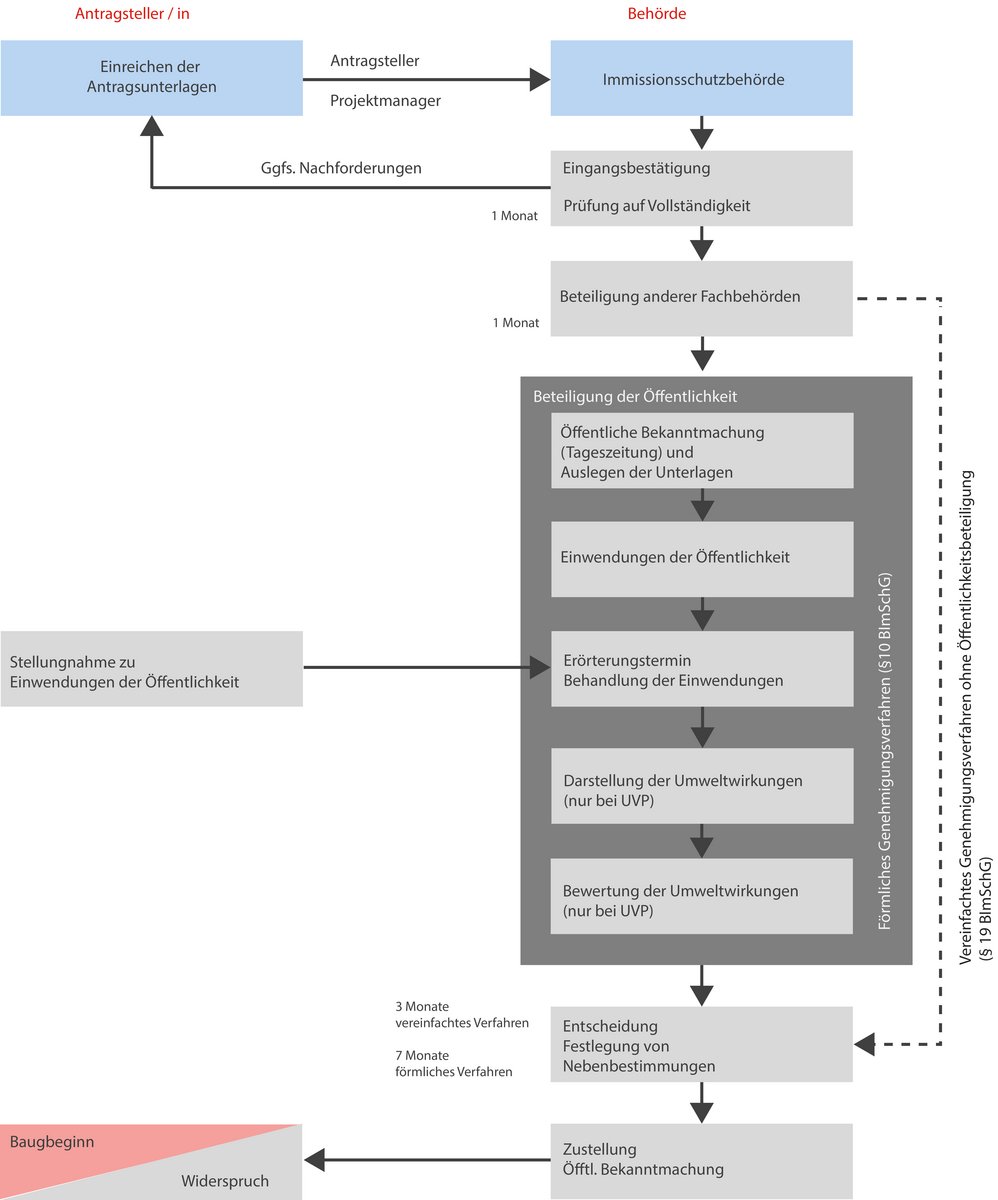
There are two different approval procedures for animal husbandry, each with its own processes and requirements regarding the scope of the application:
- the procedure under building law (building permit procedure; Fig. 1) and
- the procedure under immission control law (Fig. 2), which includes the building permit.
In addition, an environmental impact assessment (EIA) may be required, which ultimately only involves more extensive documentation of the project and its environmental impacts with public participation (see Step 5). The type of procedure depends on the animal species and the size of the facility, i.e. the number of animal places. The relevant animal capacity figures are set out in Table 2. The KTBL has summarised in detail when which procedure applies to which farm and how the individual procedures are conducted.

| Approval procedure under the BImSchG (threshold values of the 4th BImSchV) | without public participation (V Annex) | with public participation (G-Anlage) | |
| Environmental Impact Assessment (EIA) | where applicable, following a site-specific preliminary assessment of the individual case | where applicable, following a general preliminary assessment of the individual case | mandatory |
| Animal category | |||
| Hens | ≥ 15,000 | ≥ 40,000 | ≥ 60,000 |
| Young hens | ≥ 30,000 | ≥ 40,000 | ≥ 85,000 |
| Broiler poultry | ≥ 30,000 | ≥ 40,000 | ≥ 85,000 |
| Turkeys | ≥ 15,000 | ≥ 40,000 | ≥ 60,000 |
Cattle Excluding places for suckler cow rearing with more than 6 months of grazing per calendar year | ≥ 600 | ≥ 800 Approval procedure with public participation only if the preliminary EIA for the individual case is positive | - |
| Calves | ≥ 500 | ≥ 1,000 Approval procedure with public participation only if the preliminary EIA assessment of the individual case is positive | - |
| Fattening pigs (≥ 30 kg) | ≥ 1,500 | ≥ 2,000 | ≥ 3,000 |
| Sows (including piglet rearing places < 30 kg) | ≥ 560 | ≥ 750 | ≥ 900 |
Piglets (separate rearing 10 to 30 kg) Specialised piglet rearing only | ≥ 4,500 | ≥ 6,000 | ≥ 9,000 |
<figcaption>Table 2: Number of animal places requiring an authorisation procedure under the Federal Immission Control Act (BImSchG) or an EIA or preliminary EIA (not shown: mixed herds; adapted from KTBL)</figcaption>
What is public participation, and is it mandatory?
Public consultation prior to the granting of a planning permission is a process designed to act as a safeguard, during which the public – that is, all individuals, including citizens and organisations – can raise objections to the development. This does not mean that they have a say in whether or not planning permission is granted, but rather that they are permitted to express their concerns about the development in advance, which are then (once again) examined by the authorities. Whilst this process may delay the application procedure, it can save on legal action and hassle once construction has begun, as concerns can be clarified and, ideally, resolved during this public consultation phase prior to the granting of a permit – rather than having to resort to legal action only after the permit has been granted. This is also the reason why it can be sensible to apply for a voluntary public consultation. If objections are submitted in the required written form, these are discussed verbally at a hearing; otherwise, the hearing can be cancelled, thereby saving time and costs.
For construction projects under the Federal Immission Control Act (BImSchG), public participation is mandatory for so-called G-installations. For V-installations, it is voluntary. Table 2 sets out the animal capacity figures that determine whether an installation is classified as G or V, and thus whether public participation in conjunction with the EIA is required.
The date for public participation is scheduled and published by the lead authority. In the meantime, the application documents are made available for public inspection.
What is a consultation meeting?
If objections are submitted in the required written form, the hearing provides objectors with an opportunity to explain their objections in more detail, whilst also allowing the applicant and the authorities to clarify any misunderstandings and, where appropriate, address the concerns raised. No decision regarding the eligibility for approval is made at the hearing.
What happens once you have received the building permit? How does the construction project proceed?
Once a planning permission decision (under building regulations or environmental protection legislation) has been issued, the applicant must review the conditions that have been imposed. With regard to emission reduction, for example, conditions relating to structural and technical measures for emission reduction, management or monitoring must be assessed for their feasibility. Furthermore, it must be checked whether the conditions are set out in the approval documents as they were agreed or announced.
In some cases, the authorities send draft documents to applicants prior to granting planning permission so that the content can be checked for feasibility and against prior agreements. If there are errors in the wording, these can be discussed and amended or corrected in the case of drafts without the need for legal action. In the case of a building permit issued without a prior draft, however, any discrepancies may require a legal challenge or an appeal, depending on the federal state. It is not uncommon for requirements to be reused in a standardised text block from other permits, which may refer to outdated guidelines or other regulations and therefore necessitate a correction.
If construction is not yet due to commence, it is necessary to check how long the permit remains valid. If necessary, an extension must be applied for. Both the period of validity and the options for extension vary depending on the type of permit.
What are the differences between building an open-air barn or a barn with an outdoor run and building a forced-ventilation barn?
For the most part, there are no differences between the planning process for a barn with natural ventilation and one with forced ventilation. However, the site options and the size of the farm must be taken into account. Pig farming generates emissions, of which ammonia and odours are the most relevant. Whether the reduction of these emissions is necessary depends on the size of the farm and also on whether and how close protected areas are to the site and to what extent they could be affected.
For V and G systems (Table 2), certain requirements of the TA Luft (No. 5.4.7.1) regarding emission reduction are mandatory, such as the use of feed with significantly reduced N and P content and proof thereof, or the covering of slurry tanks or solid manure storage areas.
Furthermore, for G-facilities, the use of exhaust air purification with a 70% reduction in ammonia and odour is mandatory as state-of-the-art technology. Unless it is a so-called ‘quality-assured husbandry method that demonstrably serves animal welfare’, i.e. an open-air barn (so-called fresh-air barn under the Animal Husbandry Classification Act), an open-air barn or a closed barn with an outdoor run, which imposes certain minimum requirements, particularly regarding the available space per animal, pen layout and management. In such cases, a lower reduction in ammonia emissions of 33% or 40% is sufficient as a concession in view of the associated additional improvement in animal welfare.
Retrofitting an exhaust air purification system to an existing barn is not necessary if it is technically impossible due to structural conditions (e.g. open-air barn) or disproportionate due to the high (cost) expenditure involved in converting the ventilation system. In this case, emission-reducing measures must be retrofitted as required for V-systems (see below).
For V-systems, the measures listed in Annex 11 of the TA Luft (or quality-assured equivalents) are mandatory as state-of-the-art technology for ammonia reduction (odours do not need to be reduced). Reduction levels are specified for the listed techniques (e.g. slurry channel reduction, slurry cooling, slurry acidification), so combinations are also possible. A total reduction of 40% must be achieved. However, as with exhaust air purification in G-type systems, these techniques apply to barns with forced ventilation, meaning that the same requirements apply here for retrofitting: proportionality and forced ventilation. A special case here is ‘animal-friendly outdoor climate stables with cubicle or hut systems’, for which a specified ammonia reduction of 33% is stated and – instead of the 40% – is sufficient as a concession for the associated additional improvement in animal welfare.
Further reading
- KTBL (2009): Steps towards a new livestock building. From the initial project idea through the planning permission process to the new livestock building – a guide to successful livestock building projects. KTBL Booklet 85. https://www.ktbl.de/fileadmin/produkte/leseprobe/40085excerpt.pdf (subscription required)
- KTBL (2018): Application of the impact assessment regulations under nature conservation law. Guidance for livestock housing construction projects. KTBL Booklet 123. https://www.ktbl.de/shop/produktkatalog/alle-kategorien/40123/ (fee applies)
- KTBL (2018): Application of planning law. Implications for livestock housing projects. KTBL Issue 122. https://www.ktbl.de/shop/produktkatalog/40122 (fee applies)
- KTBL (2021): Current legal framework for livestock farming. 17th KTBL Conference on 18 June 2021. https://www.ktbl.de/fileadmin/user_upload/Allgemeines/Download/Tagungen_2021/ARR/ARR_2021.pdf
- KTBL (n.d.): Approval procedures for construction projects. Types of approval procedures. https://www.ktbl.de/themen/genehmigungsverfahren
- KTBL (n.d.): Finalising construction projects. What do I need to consider when planning a construction project? https://www.ktbl.de/themen/bauprojekt
- KTBL (2014): Urban and regional planning for farmers. KTBL booklet 102. https://www.ktbl.de/shop/produktkatalog/40102 (fee applies)
- KTBL (n.d.): Systematics of building law. https://www.ktbl.de/themen/baurecht
- KTBL (n.d.): Site selection for construction projects. https://www.ktbl.de/themen/standort
- Grimm E. (2021): Conversion in animal husbandry. https://www.bildungsserveragrar.de/fachzeitschrift/umbau-in-der-tierhaltung/
- LfL (2014): Successful Construction of Livestock Buildings. A Guide for the Agricultural Sector. https://www.lfl.bayern.de/mam/cms07/publikationen/daten/informationen/stallgebaeude-erfolgreich-errichten_lfl-information.pdf