
- Dominik Jacobs, Lower Saxony Chamber of Agriculture
- Hannah Kanwischer, Lower Saxony Chamber of Agriculture
- Alisha Trilling, Lower Saxony Chamber of Agriculture
- Prof. Dr. Robby Andersson, Osnabrück University of Applied Sciences
- Dr. Friedhelm Deerberg, Consulting & Project Management Organic Farming
- Dr. Peter Hiller, Lower Saxony Chamber of Agriculture
- Dr. Christiane Keppler, Hesse State Agricultural Agency
- Dr. Annika Lange, German Animal Welfare Association
- Prof. Dr. Stephan Schneider, Nürtingen-Geislingen University of Applied Sciences
- Dr. Dieter Schulze, Praxis am Bergweg GmbH
Funding information
This document was developed as part of the joint project Network Focus Animal Welfare, funding code 28N419TA01-17, by the Animal Welfare Competence Centre for Poultry and methodologically and didactically prepared by DLG
e.V. The joint project of the chambers of agriculture and agricultural institutions of all federal states aims to improve the transfer of knowledge into practice in order to make cattle, pig and poultry farms fit for the future in terms of animal welfare, environmental protection and sustainable livestock farming.
The project is funded by the Federal Ministry of Agriculture, Food and Rural Affairs on the basis of a resolution of the German Bundestag.
All information and advice is provided without any guarantee or liability.

Introduction
Recently, there has been a trend towards increasingly longer rearing periods in laying hen farming. Among other things, increased rearing costs, the additional financial burden resulting from the ban on killing male day-old chicks, as well as ethical and sustainability considerations have led to a target laying period of more than 85 weeks for brown-egg layers and more than 95 weeks for white-egg layers. More detailed information on the extended rearing period for laying hens can be found here.
With the longer utilisation period, an optimal calcium supply is becoming increasingly important. Calcium is the most important mineral in terms of quantity in laying hen feed for eggshell formation. From the start of laying, a hen needs about 4.8 g of calcium per day, which corresponds to 12 g of lime (calcium carbonate (CaCO3)). Although birds can store and mobilise calcium in their skeleton (medullary bone system), their ability to absorb calcium decreases with age, while their need for calcium increases due to larger eggs. An adequate calcium supply through feed is therefore essential for animal health and shell stability. Other factors can also influence shell stability. These must be taken into account and checked in case of problems (Fig. 1).
Medullary bone system
This is a special adaptation of bird bone that enables animals to efficiently mobilise calcium for eggshell formation. In laying hens, it develops 10 to 14 days before the start of laying. It can store approx. 5 g of calcium. Up to 30% of the calcium required for eggshell formation can be obtained from the medullary bone system.


Process of egg formation
There are several egg follicles in the hen's ovary (Fig. 2). The egg yolk begins as a small, yellow structure and grows through the deposition of yolk material derived from the hen's blood. The egg yolk consists mainly of proteins, fats, minerals and vitamins, which are produced by the liver and transported to the egg cell via the blood. The deposition takes place in layers that become visible during development. Feeding influences the composition and colour of the egg yolk. Egg formation begins with the maturation of the follicles in the ovary.
After three to five weeks, the follicle bursts and the egg yolk is released into the oviduct (ovulation). There, the egg white, membranes and finally the shell are formed one after the other (Fig. 3). The time between ovulation and egg laying varies depending on the breed or breeding line and between individual animals, but is usually around 24 hours.
The timing and duration of egg laying are flock-specific and genetically determined. Factors such as season and light management also influence the timing and duration of egg laying. The main daily laying phase is usually three to five hours after the start of light. It should be monitored regularly so that feeding management and, if possible, light management can be adjusted accordingly.
recording
As mentioned above, calcium is the most important mineral in laying hen feed. It is involved in many physiological processes. Together with phosphorus, it forms the main component of bones and is also needed for muscle contraction, including egg laying. However, most of the calcium consumed by laying hens is needed for eggshell formation.
Most of the calcium required is absorbed directly from the gastrointestinal tract; up to 75% of this can be used for eggshell formation. However, up to 30% can also be obtained from the medullary bone. An adequate calcium intake is therefore essential to replenish bone reserves on a daily basis and prevent excessive bone loss. An imbalance between calcium intake and storage leads to reduced bone mineralisation, accompanied by fragility and possibly osteoporosis.
The calcium requirement of a laying hen can be roughly estimated as follows:
- A 60 g egg has a shell content of approx. 10 % (see Figure 4), i.e. a shell weight of 6 g.
- The shell consists of calcium carbonate, which is composed of 60% carbonate and 40% calcium.
- The formation of an eggshell therefore requires 6 g eggshell x 40% calcium content of the shell = 2.4 g calcium.
The usability of the calcium absorbed is assumed to be approximately 50% with normal intestinal passage; it can be higher in young animals in particular and lower in older animals. In this example, this means that the feed must contain twice as much calcium or lime as is required, which corresponds to 4.8 g of calcium or 12 g of lime per animal per day in the ration. It is important to note that this is only an example calculation. However, in the case of accelerated passage, for example in the case of diarrhoea, utilisation is significantly reduced. Egg weight, shell content and calcium utilisation vary depending on breed or breeding line, age, feed composition and individual predisposition of the animals. Consultation with external advisors is recommended.

Regulation of calcium metabolism
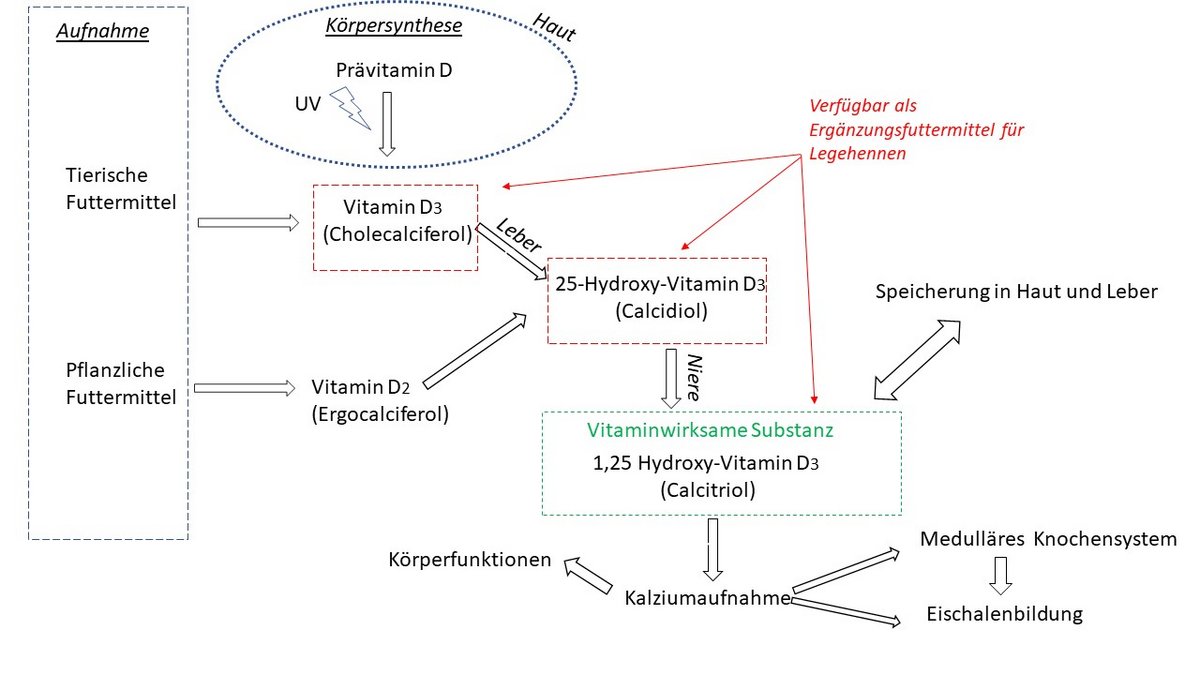
The absorption, storage, mobilisation and excretion of calcium and phosphorus are regulated by various hormones such as parathyroid hormone and calcitonin, as well as vitamin D (Fig. 5).
vitamin D
Vitamin D is the central control element in calcium metabolism. A deficiency can lead to rickets in growing animals and osteomalacia (soft bones) and disorders of eggshell formation in adult animals. Therefore, a needs-based supply of vitamin D in laying hen feed is of great importance.
Vitamin D2 (ergocalciferol) and D3 (cholecalciferol/calcidiol) are nutritionally relevant. Both can be converted into the active form of vitamin D (Fig. 5). Vitamin D2 is absorbed through plant-based feed. However, it has 15 to 30 times lower biological availability in poultry than vitamin D3 and is therefore of little importance in poultry feed.
Vitamin D3 can also be obtained from feed. It is contained in animal feed, but plays a minor role due to the low proportion of animal components in the ration. However, vitamin D3 can also be synthesised by the animal itself. The prerequisite for this, however, is skin contact with UV radiation and thus, for example, access to the outdoor climate area and/or the outdoors. However, the use of the outdoor area in free-range farming varies from animal to animal; some animals therefore have little or no contact with UV radiation.
A vitamin D deficiency can be caused by insufficient amounts in the feed, for example as a result of improper or excessive storage of the feed. Other causes can be infectious diseases and lack of sunlight. This is particularly relevant in barn systems due to the lack of outdoor access, which is why special attention must be paid to adequate supplementation via the feed. This must also be taken into account in free-range systems, especially in the winter months or when housing is mandatory.
It should be noted that an adequate supply of vitamin D is crucial for good shell stability. An adequate supply must therefore be ensured, especially in the later laying period. Approved feed additives such as vitamin D3 (cholecalciferol), 25-hydroxy vitamin D3 (calcidiol) and 1,25 dihydroxy vitamin D3 (calcitriol) are available on the market. Calcidiol has a higher biological value but is more expensive. For economic reasons, vitamin D3 is therefore predominantly used at the beginning of the laying phase, while up to 50% can be replaced by calcidiol in the later phase. In severe cases, calcitriol can also be administered as a directly vitamin-active substance; one example of such a preparation is Panbonis®. For all vitamin D preparations, the legal maximum values specified in Implementing Regulation (EU) 2017/1492 – 3,200 IU or 0.080 mg vitamin D per kg of complete feed (at 12% moisture content) – must be observed in order to avoid accumulation in the egg.
Factors promoting calcium absorption
- Solubility of the calcium compound: The better the calcium dissolves in the gastrointestinal tract, the better its absorption.
- If acute calcium deficiency is suspected, calcium gluconate can also be offered in the drinking water as a quick source of calcium and energy, after consulting a vet.
- Low pH value in feed and gastrointestinal tract: An acidic environment improves the conversion of lime (calcium carbonate) into usable calcium. Acidifying the feed, for example with organic acids, can improve solubility. However, it should be noted that this can damage the conveyor technology. Alternatively, an acid additive can be added to the drinking water. The maximum values specified in feed legislation and the requirements for organic animal husbandry must also be observed (see Implementing Regulations (EU) 2022/415 and 2021/1165).
- Adequate supply of vitamin D: An adequate supply of vitamin D is essential for the regulation of calcium metabolism. When using a vitamin D supplement, care must be taken to select the right product and achieve the right balance (see section on "Vitamin D"). In addition, feed should be stored in a dry, cool and dark place to minimise loss of effectiveness.
- Gizzard stones: It is important to provide sufficient acid-insoluble gizzard stones for feed grinding and coarse shell limestone components. Gizzard stones promote the natural behaviour of the animals and aid digestion. Early habituation is advisable and necessary when using green outdoor areas, as the vegetation is highly acceptable, at least initially. If they cannot be added to the feed for technical reasons, they should be placed manually in the scratching area. Direct provision via dispensers should be viewed critically, as individual animals could consume excessive amounts of stones, which can lead to nutrient deficiencies. When housing animals that are otherwise free-range, the provision of stomach stones combined with additional coarse feed such as hay can serve to keep the animals occupied.
- Balanced calcium:phosphorus ratio in feed: The intake and metabolism of calcium is closely linked to phosphorus supply. The optimal ratio for laying hens is 3-4:1 (calcium to phosphorus in feed). A shift in either direction has a negative effect on absorption. Particular attention should be paid to the proportion of available phosphorus, which is not usually directly indicated in the feed declaration.
- Appropriate sodium:chloride ratio in feed: This should be around 1:0.8 in the total ration. Shifts have a negative effect on the acid-base balance and impair shell mineralisation.
- Time of calcium administration: Chickens prefer to absorb calcium in the afternoon/evening, which is then available for eggshell formation during the night and the following day.
Factors inhibiting calcium absorption
- Phytate-rich feed: In addition to impairing phosphorus absorption, phytate can bind calcium and other trace elements, making them unavailable to animals. This must be taken into account when designing rations and may need to be compensated for by adding phytase.
- Unbalanced calcium:phosphorus ratio: The absorption and metabolism of calcium is closely linked to phosphorus. A shift in either direction therefore has a negative effect on absorption. The proportion of available phosphorus must be taken into account.
- Unfavourable particle size distribution: Nutrient absorption is not efficient. Crop blockage due to growth and/or litter (material): The animals do not absorb enough calcium for eggshell formation.
- Too much crude fibre: Excessive crude fibre content reduces feed intake and thus also calcium absorption.
- Excessive fat and fatty acid content in feed: This can lead to the formation of calcium soaps, which can no longer be utilised by the animal. A maximum fat content of 6% in the ration is recommended.
- Oxalic acid: Oxalic acid binds calcium to form poorly soluble calcium salts. This is not usually a problem. Only when feeding very leafy, young green fodder or in contact with fruit, such as in an apple orchard.
- High protein content in feed: Protein buffers the acidification of the feed, inhibiting the availability of calcium.
lime feeding
The calcium supply provided by traditional feed components (e.g. grain, soybean meal) is far below the requirements of a laying hen. Therefore, calcium supplementation in the ration is essential to support the animals in shell formation and bone stability. Even before the start of laying, the feed ration should contain approximately 0.9 to 1% calcium in order to prepare the animals for calcium intake.
The start of laying depends on the development of the laying organs and the weight development of the animals, but is usually between the 18th and 19th week of life; however, this may be later, especially in organic farming. From this point onwards, a pre-laying feed should be given, which should already contain 2 to 2.5% calcium. During the laying period, the complete feed should then have a calcium content of 3.5 to 4%. As the animals' absorption capacity decreases during the laying period, the calcium content in the ration should be increased accordingly. However, the content should not exceed 4.2%, as calcium has a negative effect on feed intake and the animals could then be supplied with too little energy and nutrients. It should be noted that there are differences in calcium requirements between different genetics; brown-shelled layers have a slightly higher requirement than white-shelled layers due to their larger eggs. Here, too, it is helpful to consult with the breeding company or feed consultant.
In terms of structure, a distinction can be made between finely structured (0 to 0.5 mm particles) and coarsely structured (1.5 to 3.5 mm particles) lime. Coarse particles remain in the crop and gizzard for longer and are only slowly dissolved. They therefore provide a longer-lasting source of calcium for eggshell formation at night. However, especially in young flocks, excessively large lime particles in the feed can cause burns in the gastrointestinal tract and, as a result, stomach perforations.
Fine particles are absorbed quickly and are readily available, but cannot be fully utilised due to their rapid passage through the digestive tract.
It is therefore important to maintain a balanced ratio between coarse and fine lime in order to utilise both the rapidly soluble and the slowly available sources. As absorption capacity decreases with age, it is advisable to increase the relative proportion of coarse to fine lime in the ration during the laying period (Table 1).
| Feed type | Finely structured lime 0-0.5 mm | Coarse-structured lime* 1.5–3.5 mm |
| Laying hens phase 1 | 30 | 70 |
| Laying hens phase 2 | 25 | 75 |
| Laying hens phase 3 | 15 | 85 |
The coarse structure of the lime must be matched to the flour structure of the mixed feed, otherwise segregation may occur; in addition, care must be taken to ensure a sufficient supply of stomach stones to enable the animals to grind the lime.
In addition to adding feed lime to the feed, laying hens can also be provided with additional feed lime for their own consumption. One option is to manually add crushed mussel shells to the litter; 1-3 grams per animal per day can be calculated for this. Crushed mussel shells can also be offered to the animals via dispensers. However, this carries the risk of overfeeding individual animals with calcium; therefore, this should be done slowly and under supervision at the beginning. Furthermore, calcium particles can be contained in pecking blocks. This promotes activity and therefore carries no risk of overfeeding with calcium.
However, additional feeding is only recommended from the beginning of the 40th week of life. At this point, the tendency to overfeed is lower and the animals have a high requirement. Egg production and daily feed intake should be monitored constantly and the calcium supply adjusted if necessary.

Feed management to optimise calcium intake
As shown in Fig. 3, the different egg fractions are formed at different times. Accordingly, the nutritional requirements of the animals vary throughout the day. Feeding that is adapted to nutritional requirements throughout the day can compensate for this.
On-top feeding
Since eggshell formation takes place from the afternoon until the next morning, when the calcium requirement is highest, calcium can be added to the afternoon ration via a separate silo (Fig. 7). The basic ration thus remains the same in the morning and afternoon. The added calcium is relatively coarse and is therefore absorbed slowly by the animal; vitamin D3 can also be added to the drinking water to improve absorption. This method is relatively simple and requires little work and management effort. The basic prerequisite is a high degree of uniformity in the flock. However, this does not result in any savings in feed costs.
Split feeding
Split feeding is even more specifically geared towards the egg formation process and the nutrient requirements that vary throughout the day (see Fig. 3). Two different feed mixtures are used – one in the morning and one in the afternoon.
During the morning hours, the shell is completed before laying. Fine, readily available lime can be used in the mixture here. Even after laying, fine lime can support the reconstruction of the medullary bones. Overall, calcium requirements are lower in the morning than in the afternoon, so a lower calcium content is sufficient in the morning ration. Contents of approx. 2.5% Ca are sufficient. After laying, the synthesis of the egg white for the next egg takes place, for which protein is primarily required. Therefore, the concentration of protein or amino acids can be set higher than in the afternoon.
As the majority of the eggshell is produced at night, the hens should be provided with the best possible supply of calcium during this period. However, no feed is consumed during the dark phase, so instead, a calcium buffer should be created by feeding coarse-structured lime in the afternoon. Coarse lime dissolves slowly and therefore ensures a long-lasting supply of calcium. In addition, the calcium content of 4.5% in a split feed ration can be set considerably higher than in conventional feed mixtures. Since less protein is needed for egg formation, the concentration of protein or amino acids can be set lower than in the morning.
For the split feeding method, it is essential to invest in two feed silos for the two feed variants. This allows the adjusted rations of calcium, protein and amino acids to be used optimally. In order to avoid mixing the two feed variants, it is necessary to estimate feed intake as accurately as possible; otherwise, this method is not recommended due to the risk of malnutrition. During the light phase, this can be achieved by emptying the trough shortly before the feed change. The daily feed allocation should be organised so that 40% is allocated to the morning feed and 60% to the afternoon feed. This must be ensured by the feed management system.
Split feeding can also improve shell quality in the late laying phase and reduce feed costs and nitrogen and phosphorus excretion. However, it is essential to have accurate knowledge of the feed consumption and feed costs of the flock. If this information is not sufficiently known or cannot be recorded, split feeding is not recommended. Another risk associated with this feeding method is the accidental mixing up of feed mixtures or technical errors in feed allocation. This can have a significant impact on the performance of the flock. Care must also be taken to ensure that the animals consume the right amount of feed to meet their energy and nutrient requirements.
In practice, the split-feeding method has been used very differently from region to region, but it is tending to gain in importance. There have been varying degrees of success in terms of feed intake, feed costs, laying performance and egg weights. However, a reduction in feed costs can only be achieved through good feed management and investment in infrastructure.
Literature
- Bain, M. M., Nys, Y., Dunn, I. C. (2016): Increasing persistency in lay and stabilising egg quality in longer laying cycles. What are the challenges? British Poultry Science, 57, 3, pp. 330-338.
- Damme, K., Grashorn, M., Hofmann, P., Pottgüter., Schmutz, M., Schreiter., Spindler, B. (2023): Extending the rearing period for laying hens. DLG Merkblatt 492, DLG e. V., Fachzentrum Landwirtschaft, Frankfurt am Main.
- Implementing Regulation (EU) 2015/2307 concerning the authorisation of menadione sodium bisulphite and menadione nicotinamide bisulphite as feed additives for all animal species
- Commission Implementing Regulation (EU) 2017/1492 of 21 August 2017 concerning the authorisation of cholecalciferol as a feed additive for all animal species.
- Grashorn, M. (2008): Egg quality. In: Brade, W., Flachowsky, G., Schrader, L. (2008): Laying hen breeding and egg production – recommendations for practice. Agricultural Research vTI Agriculture and Forestry Research, Special Issue 322.
- Icken, W., Schmutz, M., Preisinger, R. (2012): Genotype-Environment Interaction: Breeding Layers with Different Requirements for Varying Housing Systems. In: Alternative systems for poultry: health, welfare and productivity. CAB International Vol. 30 – Poultry Science Symposium Series.
- Jeroch, H., Simon, A., Zentek, J. (2019): Poultry Nutrition – Nutritional Physiology, Feed and Feed Additives, Feeding Laying, Breeding and Broiler Poultry. Eugen Ulmer KG, 2nd edition, Stuttgart.
- Kirchgeßner, M. (2014): Animal nutrition. DLG Verlag, 14th edition, Frankfurt am Main.
- Leentfaar, E. (2020): Nutrition Guide. Hendrix Genetics, Boxmeer, The Netherlands.
- Lohmann Breeders (2021): Management Guide – Alternative Housing. Alternative Housing DOWNLOAD - Lohmann Breeders (lohmann-breeders.com) (18 June 2025)
- Molnár, A., Maertens, L., Buyse J., Zoons J., Delezie E. (2016): Effect of split feeding on performance and egg quality of aged laying hens.
- Molnár, A., Hamelin, C., Delezie, E., NYS, Y. (2018): Sequential and choice feeding in laying hens: adapting nutrient supply to requirements during the egg formation cycle. World's Poultry Science Journal, 74, 2, pp. 199-210.
- Molnár, A., Kempen, I., Sleeckx, N., Zoons, J., Maertens, L., Ampe, B., Buyse, J., Delezie, E. (2018): Effects of split feeding on performance, egg quality, and bone strength in brown laying hens in aviary system. Journal of Applied Poultry Research, 27,3, pp. 401-415.
- Molnár, A., Maertens, L., Ampe, B., Buyse J., Zoons J., Delezie E. (2018): Effect of different split-feeding treatments on performance, egg quality, and bone quality of individually housed aged laying hens. Poultry Science 97, pp. 88-101.
- Nickel, R., Schummer, A., Seiferle, E., Sinowatz, F., Frewein, J., Waibl, H. (2004): Textbook of Domestic Animal Anatomy, Volume V, Anatomy of Birds. Parey Verlag, 3rd edition, Stuttgart.
- Piet Simons (2017): Egg Signals – Practical Guide to Improving Egg Quality. Roodbont Publishers B.V. The Eggshell | Structure & Shell Formation (gefluegelnews.de)
- Poudel, I., McDaniel C.D., Schilling M.W., Pflugrath, D., Adhikari, P.A (2022): Role of conventional and split feeding of various limestone particle size ratios on the performance and egg quality of Hy-Line® W-36 hens in the late production phase. Animal Feed Science and Technology, 283.
- Schreiter, R., Damme, K. (2017): Laying hen feeding – use of domestic feed, feeding of uncut-beaked laying hens. Bavarian State Farms.
- Souzam C., Santos, T. C., Murakami A. E., Iwaki, L. C. V., Mello, J. F. (2016): Influence of graded levels of calcium and vitamin K in the diets of laying hens during the growing phase and their effects on the laying phase. Journal of Animal Physiology and Animal Nutrition, Vol. 101/5, pp. 974-983.