
- Johannes Bünger, Moorgut Kartzfehn Turkey Breeder Ltd
- Dr. Henrike Glawatz, Best 3 Poultry Nutrition
- Franziska Hagen, German Animal Welfare Association
- Franziska Müller, Naturland – Association for Organic Farming
- Annette Alpers, Naturland – Association for Organic Farming
- Dr. Kathrin Toppel, Osnabrück University of Applied Sciences
- Jens von Seggern, farmer
- Bettina Gräfin von Spee, Association of German Turkey Producers
- Dr. Heinrich Windhaus, Die Praxis für Geflügel GbR
- Silke Schierhold, Lower Saxony Chamber of Agriculture
- Dr Isa Kernberger-Fischer, Lower Saxony Chamber of Agriculture
- Dr Katja Kulke, University of Veterinary Medicine Hannover
- Marc-Andre Kruse-Friedrich, DLG e.V.
- Marc Schneeweis, medianet Electronic Communication & Marketing GmbH
- Oliver Sahner, medianet Electronic Communication & Marketing GmbH
This document was developed as part of the joint project ‘Netzwerk Fokus Tierwohl’ by the ‘Turkey’ working group of the Poultry Animal Welfare Competence Centre and edited for methodological and educational purposes by DLG e.V.
All information and advice is provided without any warranty or liability.
Publisher
DLG e.V.
Centre for Agriculture
Eschborner Landstraße 122
60489 Frankfurt am Main
Reproduction and transmission of individual sections of text, drawings or images (including for teaching purposes), as well as the provision of the guide in whole or in part for viewing or downloading by third parties, is permitted only with the prior authorisation of the relevant department of the Animal Welfare Competence Centre and DLG e.V., Marketing Department, Tel. +49 69 24788-209, [email protected]
Introduction
Providing enrichment materials is regarded as a key factor in ensuring animal welfare in the rearing of broiler turkeys. But why do turkeys need sufficient opportunities for enrichment?
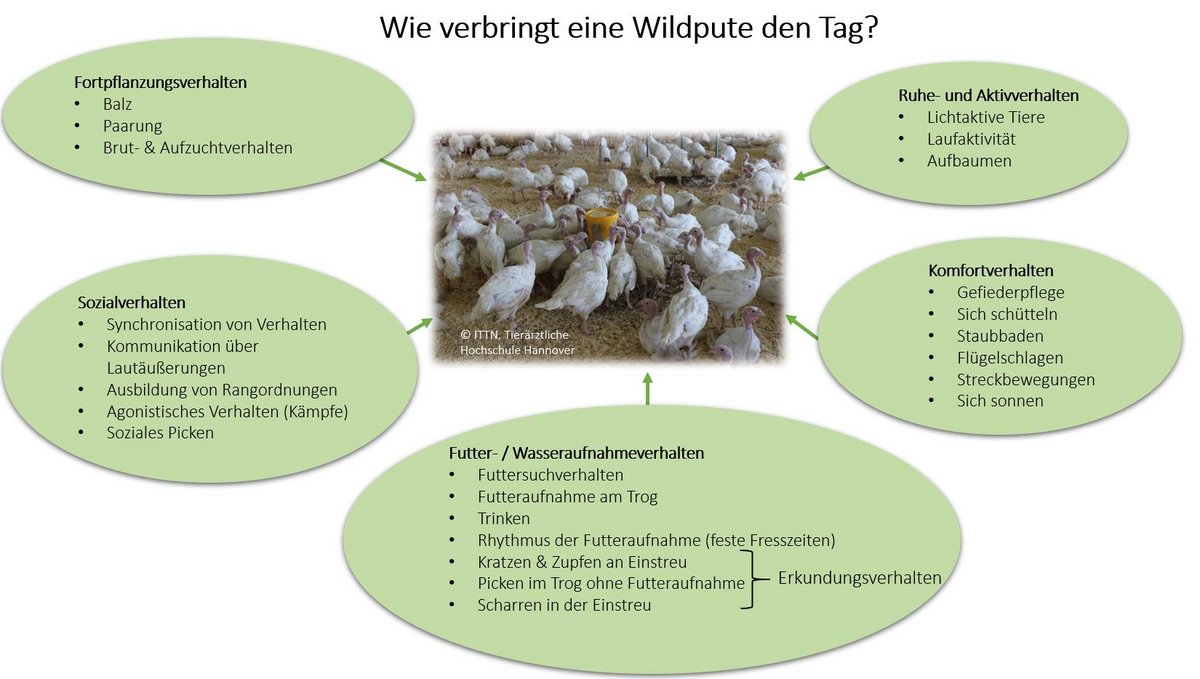
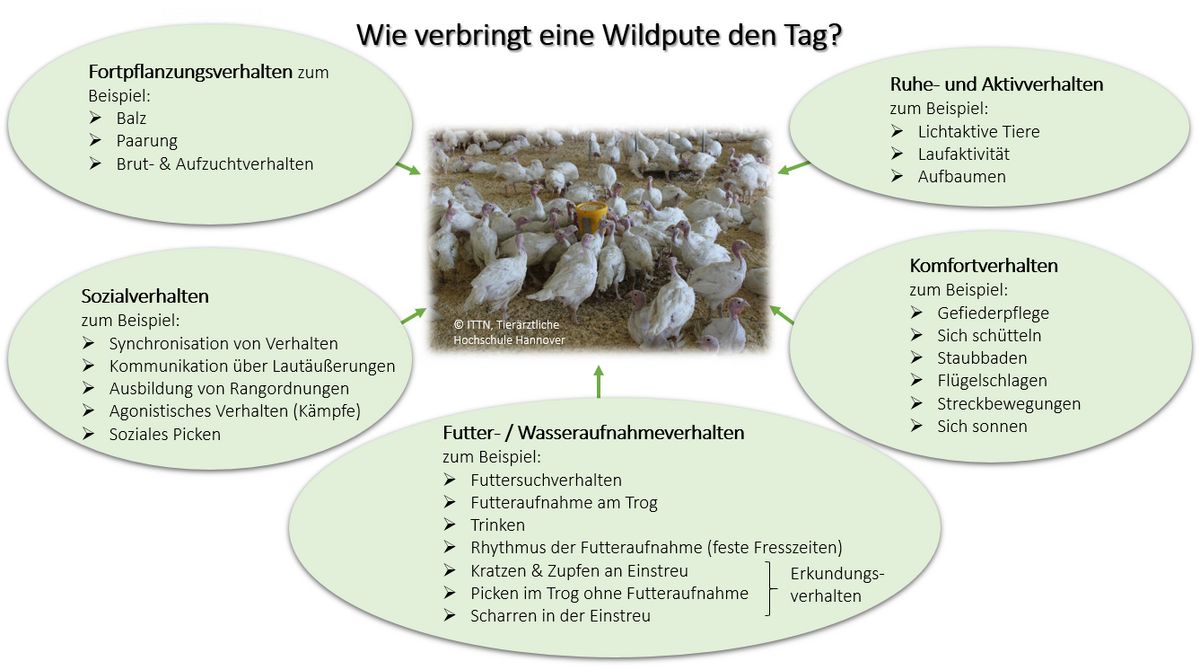
To get to the bottom of this question, it helps to first look at the behaviour of the turkey (Fig. 1). From observations of wild turkeys, it is known that turkeys spend a large part of the day foraging for and consuming food. The birds are constantly on the move1 whilst feeding and display2 a high level of pecking activity.
In turkey rearing and fattening, feed is continuously provided to the birds via feed troughs. Consequently, the turkeys spend less time on actual foraging. Nevertheless, fattening turkeys also have a need to exhibit exploratory behaviour and to satisfy the high pecking activity described for wild turkeys.
Based on current knowledge, it can be assumed that a low-stimulus housing environment is one of several factors that contribute3 to the occurrence of behavioural disorders, such as feather pecking and damage pecking.
It is therefore important to provide the birds with an opportunity to engage in exploratory behaviour combined with increased pecking, using attractive enrichment materials. Positive effects associated with the use of enrichment materials may then manifest, for example, in the form of a reduction in feather damage and injuries. This correlation has already been4, 5 demonstrated by several scientific studies.
However, most studies conclude that the use of enrichment materials cannot reliably prevent damage pecking and that further research and changes to the housing system, such as pen design and provision of shelter, are required.
Requirements for the use of activity materials
The Council of Europe’s 2002 recommendations for turkeys cite, among other things, the enrichment of the housing environment as a means of preventing pecking.
In organic livestock farming, the use of enrichment materials is mandatory under EU regulations; roughage must be provided6 in addition to the daily ration. Access to outdoor runs encourages foraging and feeding behaviour (Fig. 2). According to EU guidelines for organic farming, outdoor areas must be designed to be attractive to the animals and should be7 covered with a variety of plants. Access to outdoor runs must be provided throughout the entire rearing period, weather and the animals’ physiological condition permitting; however, this must be guaranteed for at least one third of their lives6.
Despite access to the outdoor area, various organic associations require the provision of enrichment materials, as the associated positive effects are recognised here too.
Various labelling schemes also require the provision of additional enrichment materials.
For example, the Animal Welfare Initiative (ITW) stipulates that, in addition to dry, loose litter, the animals must be provided with another type of material – either changeable, consumable material or material they can peck at – from the second week of life onwards. The material must be chosen in such a way as to encourage the turkeys to engage with it. Furthermore, it must be replenished continuously. Further information on the ITW’s criteria catalogue can be found here: ITW Poultry Criteria Catalogue (as at 31 July 2023).
The national guidelines for a voluntary agreement on the rearing of fattening turkeys therefore state that turkeys must be provided with suitable enrichment material at all times. Freshly added litter or worked-through litter can contribute8 to the animals’ enrichment. Nevertheless, in addition to loose litter, the animals must be9 provided with another, changeable enrichment material at all times.
What should you bear in mind when choosing the right activity materials?
There are many different ways to provide animals with opportunities for greater exploration, foraging and pecking. However, there are a few basic rules that should be followed:
- The materials must be hygienically safe.
- The enrichment materials must not pose a risk of injury to the animals.
- To increase acceptance, the materials should be adaptable or movable.
- The materials must allow for species-appropriate behaviour.
- The materials must be available in sufficient quantities, be attractive to the animals and be7, 10 replenished regularly.
Different types of activity materials
Recommendations vary regarding the amount of material to be provided. Further information on this subject can be found, for example, in the ITW guidelines, in the recommendations for preventing feather pecking and cannibalism in turkeys, in the emergency measures to be taken if feather pecking and cannibalism occur, and in the Practical Handbook on Turkeys. When moving the birds between rearing and finishing farms, it is advisable to provide the birds with materials similar to those used at the rearing farm, at least initially. This makes the transition easier for the birds.
A distinction must be made between two different types of enrichment materials: organic and inorganic enrichment materials3. Organic materials are biodegradable and offer the advantage that, provided they are of good initial quality, they can be ingested by the birds without risk. Many organic materials have proven10 to be of lasting interest in practice. Table 1 provides an overview of various organic materials used in practice.

Further comments
Straw bales are used for climbing and provide opportunities for retreat and enrichment.
They therefore serve multiple purposes. From 1 July 2025, under the ITW scheme, an element may not be counted simultaneously as both an additional enrichment opportunity and a modifiable structural element. It is possible to use a certain number of bales as enrichment material and other bales as raised platforms (Handbook of Agriculture: Criteria Catalogue for Poultry Fattening). Care must be taken to provide additional grit to prevent stomach twists caused by straw ingestion.


Further comments
The feeder should be designed in such a way that the turkeys have to ‘work’ for their feed to prevent them from eating too much.9

The appeal of the material
Grain dispenser (complete feeding station set from the hunt) mounted on the ceiling
-
Further comments
The feeder should be designed in such a way that the turkeys have to ‘work’ for the grain, to prevent them from consuming too much.9
Problem: Turkeys do not work for their feed and are more likely to be startled by noises and objects coming from above. Enrichment materials should be provided at head height if they are to be attractive.

Further comments
They are particularly appealing when they are relatively soft and enriched9 with grains or feed ingredients. Extra-hard gnawing blocks should be avoided.


(Kopie 69)
It is also possible to encourage turkeys to explore more using inorganic materials. However, the following points must be borne in mind:
- The material must not pose9 any risk of injury.
- It must be ensured that the turkeys cannot9 pick up and swallow the material. Any risk of poisoning must be ruled10 out.
- In particular, materials containing plastic, even if they can provide effective relief during acute pecking episodes, must be assessed critically in light of the release of microplastics into the environment.
Inorganic materials are also particularly attractive to turkeys if they can be manipulated or altered in any way. Turkeys show particular interest in shiny surfaces.
As a general rule, when providing enrichment materials, it is important to note that the materials used are9 not accepted equally well by all flocks. Furthermore, there are materials that distract turkeys for a short time but are9 not permanently attractive to the birds. Such materials can be used as an emergency measure in the event of increased feather-pecking and damage-pecking.
In summary, it can be said that organic materials are generally used for the continuous provision of enrichment materials, whilst inorganic materials, such as those listed in Table 2, are used when there is an increased incidence of feather-pecking and damage-pecking.

Further comments
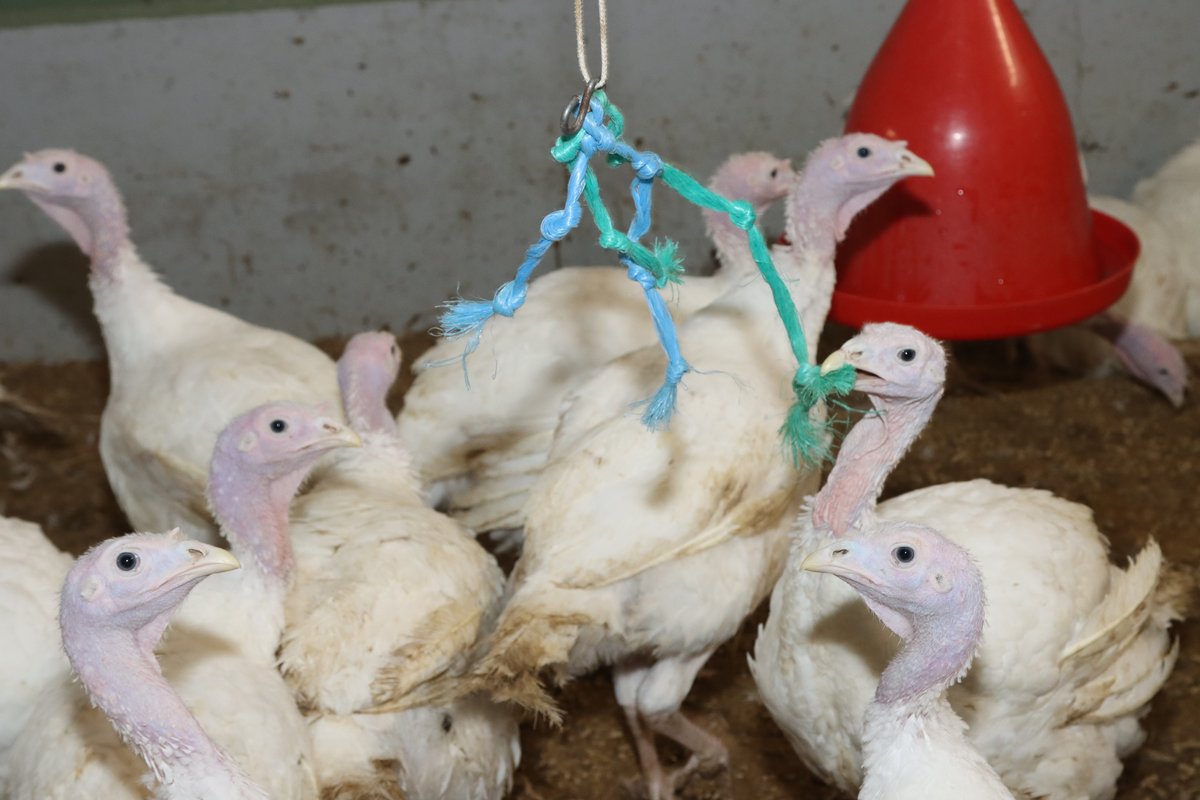
These must be tied securely to reduce the risk of loose threads becoming wrapped around the tongue; if threads do become wrapped, remove8 them.
A check must be carried out at least once a day.

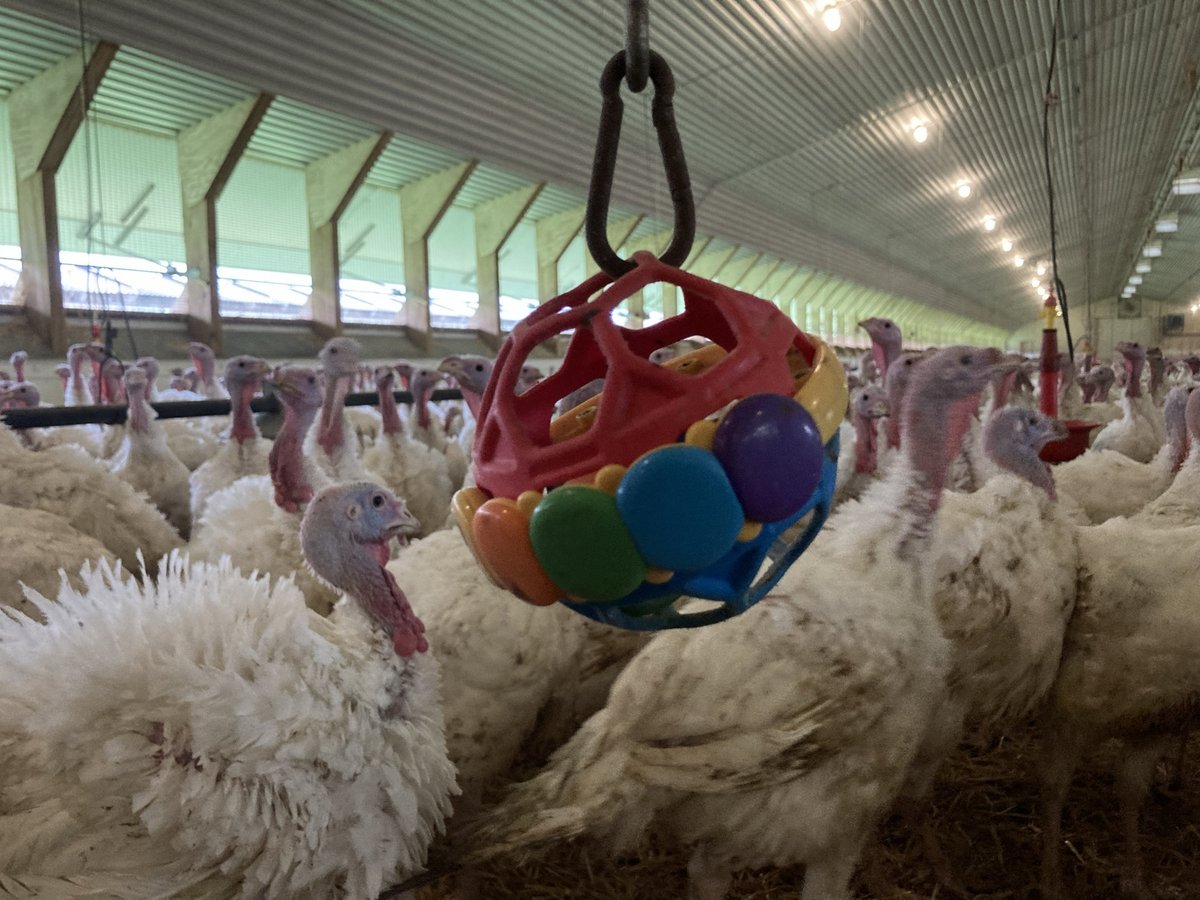


Use of enrichment materials in cases of increased incidence of injuries caused by feather-pecking and damage-pecking
At the first signs of pecking behaviour, the animals should be10 offered additional enrichment materials to distract them. Appropriate materials should therefore be available at all times so that a rapid response can8 be made in an emergency. It is also important to monitor the animals closely: as soon as a material ceases to be attractive to the animals or the animals continue to peck excessively, the material must be10 replaced or additional enrichment material provided.
Once the flock has calmed down again, the ‘emergency’ material should be removed from the barn. This ensures that these materials can be reused should pecking injuries recur, without losing8 their appeal to the animals.
In addition to the use of enrichment materials, particular emphasis should be placed on good separation management in the event of increased pecking behaviour. Further information on the emergency measures to be taken can be found, for example, in the recommendations for preventing the occurrence of feather pecking and cannibalism in turkeys, as well as in the emergency measures to be taken when feather pecking and cannibalism occur, and in the Practical Handbook on Turkeys.
Conclusion
Providing enrichment materials helps turkeys to express their natural behaviours. Furthermore, the use of enrichment materials can help to reduce the incidence of behavioural disorders and injuries. Organic materials must be continuously available in the house, whilst inorganic materials are more suitable for use in emergencies to distract the birds from their conspecifics.
However, the effect of enrichment materials on preventing damage-causing pecking is limited and uncertain. Further measures and research are therefore needed on topics such as house design through lighting or provision of retreat areas, in order to continue to curb the issue of damage-causing pecking in the future.
Further approaches to providing enrichment materials for the rearing of female turkeys with intact beaks were tested in the MuD animal welfare project #Pute@Praxis.
Further information on the project:
Practical Handbook on Turkeys: For the Optimised Husbandry of Female Turkeys (#Pute@Praxis)
Bibliography
- Hurst, G.A. (1992): ‘Foods and Feeding’ in Dickson, *The Wild Turkey: Biology and Management*, Harrisburg: Stackpole Books, 66–83.
- Reiter, K. (2009): Behaviour of turkeys in Hoy, Farm Animal Behaviour, Stuttgart, Eugen Ulmer KG, 224–231.
- Kulke, K., B. Spindler and N. Kemper (2016): Abandoning beak trimming in turkeys – where do we stand in Germany? Züchtungskunde, 88, (6) 456–474, ISSN 0044-5401.
- Crowe, R. and J.M. Forbes (1999): Effects of four different environmental enrichment treatments on pecking behaviour in turkeys. Br. Poult. Sci 40, 11–12.
- Martrenchar, A., D. Huonnig and J.P. Cotte (2001): Influence of environmental enrichment on injurious pecking and perching behaviour in young turkeys. Br. Poult. Sci 42, 161-170.
- Regulation (EU) 2018/848 of the European Parliament and of the Council of 30 May 2018 on organic production and labelling of organic products and repealing Council Regulation (EC) No 834/2007. https://eur-lex.europa.eu/legal-content/DE/TXT/PDF/?uri=CELEX:32018R0848
- Commission Implementing Regulation (EU) 2020/464 laying down detailed rules for the application of Regulation (EU) 2018/848 of the European Parliament and of the Council as regards the documents required for the retroactive recognition of conversion periods, the production of organic products and the information to be provided by Member States. https://eur-lex.europa.eu/legal-content/DE/TXT/PDF/?uri=CELEX:32020R0464&from=de checked on 04.09.2022.
- National guidelines for a voluntary agreement on the rearing of fattening turkeys (2013): National guidelines (bmel.de)
- Lower Saxony Ministry of Food, Agriculture and Consumer Protection (2018): Recommendations for preventing the occurrence of feather pecking and cannibalism in turkeys, as well as emergency measures in the event of feather pecking and cannibalism (as of 17 October 2018). Developed by the Turkey Working Group of the Lower Saxony Livestock Strategy – Animal Welfare Plan 4.0
- Agriculture Handbook: Criteria Catalogue for Poultry Fattening (as of 31 July 2023)
- Niewind, P. C. Adler, D. Werner, B. Spindler, M. Kramer, K. Skiba, P. Thobe, M. Verhaagh, I. Tiemann and H. Bussmann (2021): So they don’t get any silly ideas, DGS Magazine 44, pp. 20–23.
- Meyer, H., J. Graue and H. Glawatz (2013): Entertainment and Barn Enrichment for Commercial Turkeys. Proceedings of the 7th “Hafez” International Symposium on Turkey Production, “Continuous improvement of turkey production and health: never-ending story”, Berlin, 72–79.
- Recommendations for preventing feather pecking and cannibalism in turkeys, as well as emergency measures in the event of feather pecking and cannibalism, published in 2018 by the Lower Saxony Ministry of Food, Agriculture and Consumer Protection: Turkeys | Lower Saxony Ministry of Food, Agriculture and Consumer Protection (niedersachsen.de)