
Focus on Pig Welfare – Group housing of sows at the breeding centre
A report by the ‘Construction: Sows and Fattening’ working group of the Fokus Tierwohl network
- Bernhard Feller, North Rhine-Westphalia Chamber of Agriculture
- Stefan Leuer, North Rhine-Westphalia Chamber of Agriculture
- Christian Meyer, Schleswig-Holstein Chamber of Agriculture
- Georg Silkenbömer, farmer
- Dr. Sabine Schütze, North Rhine-Westphalia Chamber of Agriculture
- Sandra Terletzki, North Rhine-Westphalia Chamber of Agriculture
- Laura Schönberg, North Rhine-Westphalia Chamber of Agriculture
Under the previous Animal Welfare and Livestock Husbandry Ordinance (TierSchNutztV), the restraint of sows in the mating centre – and thus the individual housing of the animals – was permitted from weaning until a maximum of four weeks after mating. Following the amendment of the TierSchNutztV in February 2021, sows must – after a transition period of eight years – be provided with 5 m² of space during the period between weaning and mating, and group housing must be made available. Restraint is permitted solely for the purposes of oestrus detection, the insemination process or medical treatment. Due to the high space requirements in the mating centre, some farmers will likely reduce the duration of housing in this phase in future. Consequently, oestrus detection, the mating of sows in oestrus and pregnancy checks will be partially relocated to the waiting area.1 Almost all sow-rearing farms are therefore currently faced with the decision of whether and how to make their mating area fit for the future. No later than three years after the amendment to the Animal Welfare (Livestock) Ordinance comes into force, farmers must submit an operational and conversion plan for the mating area if they intend to continue sow rearing in the future. Farmers who wish to cease sow rearing must make a binding declaration to the authorities and cease sow rearing five years after the amendment comes into force (February 2026).
As part of the MuD project ‘Improvement and Enrichment of the Housing Environment for Pregnant Sows’ and the project ‘Testing and Evaluation of New Housing Methods for Sows in the Mating Centre’, experience has been gathered on various farms regarding the construction and conversion of mating centres, which is intended to support farmers in their decision-making.
The bay structure
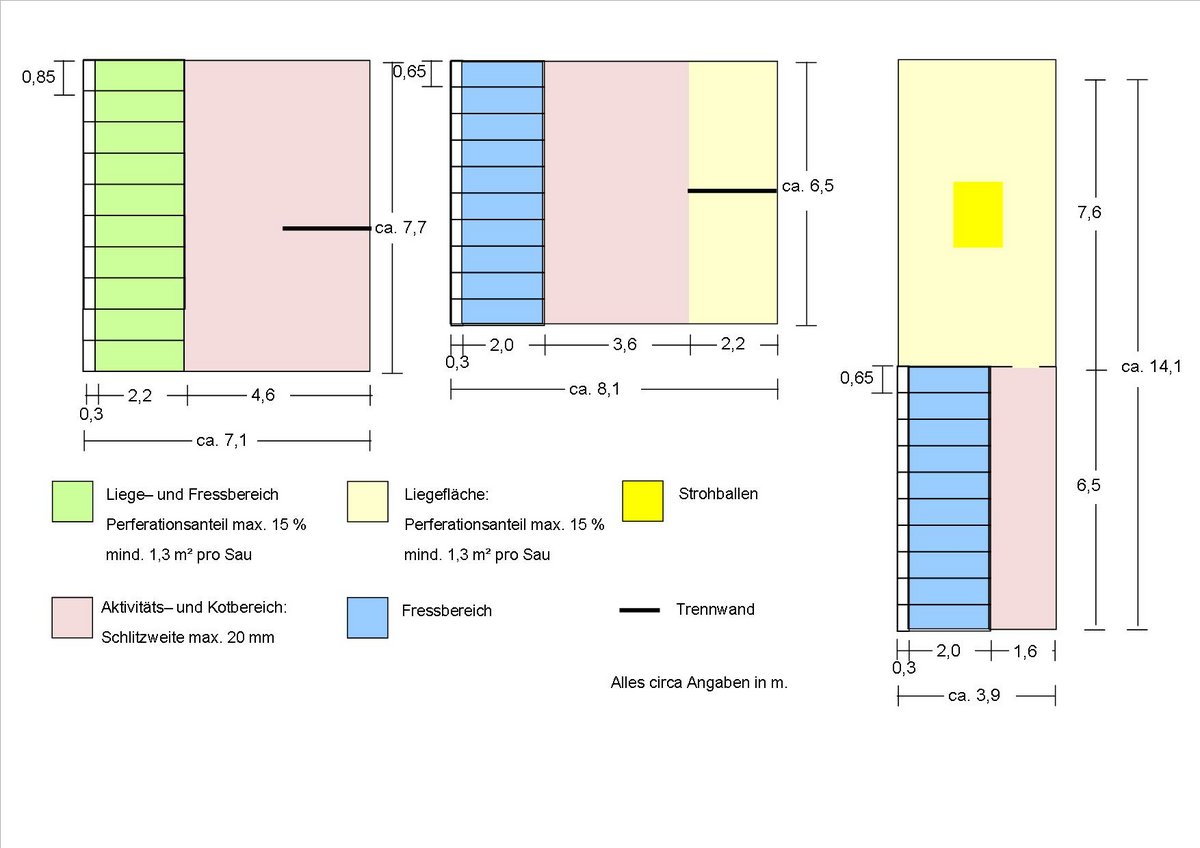
The mating centre must fulfil various functions. It is not only used for inseminating sows (with or without brief restraint), but must also allow sows to form groups through ranking battles and to express various behaviours during oestrus.2 Of the 5 m² of space required per sow in future, 1.3 m² must be available as a lying area (max. 15% perforation). When designing the pens, the primary focus is on specifications regarding usable floor area, the layout with retreat options, feed, water, roughage provision and the arrangement of the lying area.1 The functional areas ‘lying’ and ‘activity’ should be separated from one another, although the feeding area may be classified as an activity area. The pen structure may vary. For example, two- or three-area pens with short-term restraint options may be selected. Examples are shown in Figure 1. Retreat areas for sows will be necessary in future, although feeding/lying pens or other feeding areas must not be counted towards this requirement, even if the sows like to lie down in the self-restraint feeding-lying stall.3
The Arena
When sows are grouped together after weaning, fights often break out, some of which can be quite fierce. These fights serve to establish a hierarchy and may be intensified by oestrus behaviour.4 An arena pen is a suitable solution for minimising the risk of injury during fights. This allows the sows to engage in their ranking battles in a suitable housing environment before oestrus and mating.5 From the 3rd to the 8th day after weaning, the sows come into oestrus and can be mated. Subsequently, between the 11th and 21st day, the embryos implant in the uterus. During this critical phase, stress and agitation among the animals should be avoided, as fertilised eggs can die off particularly quickly. Therefore, the establishment of the hierarchy should take place immediately after weaning. The animals should then be moved to the waiting pen either shortly after mating or four weeks later.1
If sufficient space is available, the mating centre is also suitable as an arena. 5 m² per animal must be provided in this area. Certain requirements should be observed: the floor of an arena should be dry and non-slip to minimise the risk of injury. A flat, solid floor is preferable, as it is gentler on the hooves. Resting areas must be designed in such a way that they remain dry and clean. This can be influenced by the provision of resting stalls, lighting, air circulation, floor design and other factors. One way to minimise the risk of injury is to use a light layer of straw to cover any sharp edges on the floor.2 In the arena, the animals should have sufficient opportunities to move away and retreat, as well as space and bedding, ideally deep litter. Well-placed, relatively short privacy screens with an escape route or an additional second exit to the outdoor run can serve as an alternative, if such a run is available on the farm. Ideally, the arena should be round and free of corners where lower-ranking animals could become trapped. However, this is usually not feasible from a structural point of view. Therefore, a living area for the animals that is as square as possible should be selected. The aisle width should be at least 3 metres to allow the animals to avoid each other.2 The pen should be thoroughly inspected, and objects with which the animals could injure themselves should be avoided. Nipple drinkers, for example, should only be used with a protective guard to minimise the risk of injury at the drinkers. If there is insufficient space for an arena, a mobile arena can be created using plastic panels on castors. As a rule, just a few hours to a day is usually sufficient for the hierarchy to form.² However, the smaller the differences in the animals’ strength, the longer the process takes. Should further aggression occur subsequently, this must be kept to a minimum. Measures include, for example, providing additional feeding stations for grouping, offering straw and roughage, and immediately separating sows that display aggressive behaviour.6
The actual amount of space that is best for sows in group housing at the breeding centre depends on the conditions of the respective farm. It depends on whether an arena is available to the sows, whether the animals are kept on deep litter or slatted floors, and how slip-resistant the floors are. However, the minimum area in the arena should be 5 m².7 Another factor that should not be underestimated is the behaviour of individual animals during oestrus.
Breeding/holding pen
There are virtually no limits to group size in the mating centre; however, the conditions in the subsequent waiting pen must be taken into account. The sows can be moved there after mating, unless a combined mating/waiting pen is already in use. When forming the final groups in the waiting pen, it is advantageous not to introduce any unfamiliar animals to increase the group size. Where possible, therefore, the group should only be reduced in size after relocation. Due to their physical condition, gilts should be housed separately from sows until their first farrowing. The differences between the requirements in the mating and waiting pens have been aligned, so that the mating pen can also be used as a waiting pen, depending on the farm.7 However, sufficient space for each animal in the mating centre must be taken into account. To ensure that sows in group housing can find sufficient rest, opportunities for retreat should be provided. This can be achieved, for example, through privacy screens, outdoor runs, clearly separated pen areas or even straw bales.
6
(Image: LSZ Boxberg)
Fastening options
To provide a means of temporarily restraining animals during insemination in future, self-capture pens or self-capture feeding and resting pens are a suitable alternative to crates. In these, the animals can decide for themselves where they wish to stay, but can also be temporarily restrained and fed if necessary. The ratio of these pens should be chosen depending on the method of feeding and insemination. If, for example, all animals at the insemination centre are to be restrained simultaneously during insemination, a 1:1 ratio should be selected.1,7 The same ratio is recommended for feeding areas.1 These restraint options also serve as a place of refuge for the animals and, at the same time, for their own protection. The advantage is that lower-ranking animals can seek shelter there and every animal can feed undisturbed at the same time. This helps to prevent aggression to some extent, which is why the need to remove conspicuous sows can be reduced.3
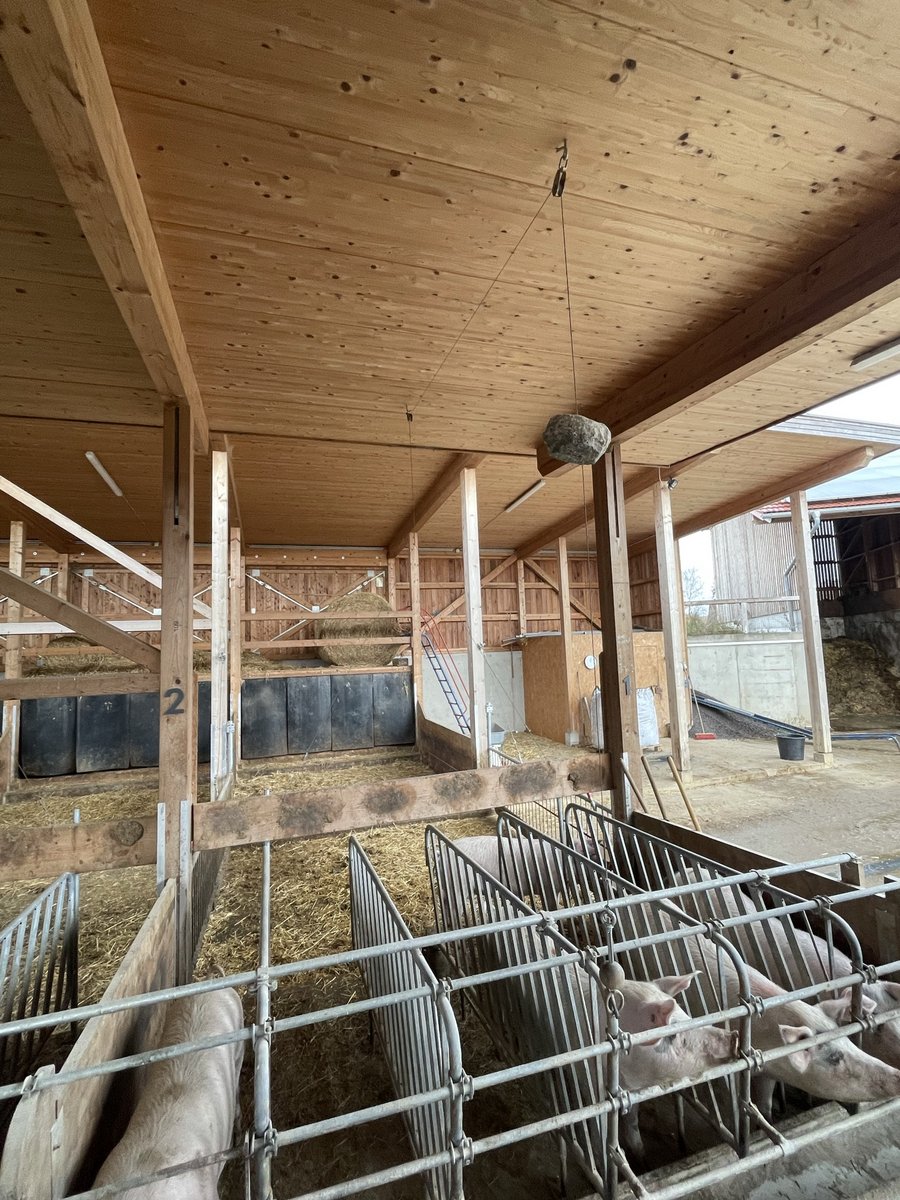
Basket pens offer the advantage that, after the insemination procedure and once opened by the farmer, the animals have more space to move around thanks to a widened walkway within the pen. They are particularly recommended for small herd sizes and narrow conversion options, as opening and closing them takes a considerable amount of time. These structural arrangements allow sows to be briefly restrained for insemination, which reduces the workload and simultaneously improves health and safety. A conversion option for briefly restraining sows is shown in Figure 2. To enable quick restraint of the sows, the old locking mechanism was removed and replaced with a board that can be lowered with a single pull of a rope. In this way, four sows are always secured at the same time.
However, the mating centre can still be used even without these securing options, which is why the crates could also be completely removed or shortened and used as feed trough dividers.5 Free mating without securing requires greater attention to animal welfare and occupational safety.² This is because not only do the sows injure one another during this sensitive phase, but farmers can also be injured by the sows.4
During the study at the LSZ Boxberg, insemination in the stall took 1.6 working minutes per animal, whilst free insemination took more than 4 working minutes per animal. Free insemination therefore takes longer than inseminating a restrained sow.
(Image: LSZ Boxberg)
(Image: LSZ Boxberg)
Artificial insemination
Sows are usually inseminated between the 3rd and 8th day after weaning, during the oestrus cycle. During the insemination procedure, it is still permitted to restrain the sows briefly. However, it is important to note that the duration of restraint should be kept as short as possible for animals that are not accustomed to being restrained. Otherwise, the animals’ attempts to break free during insemination will increase, thereby raising the risk of injury.3
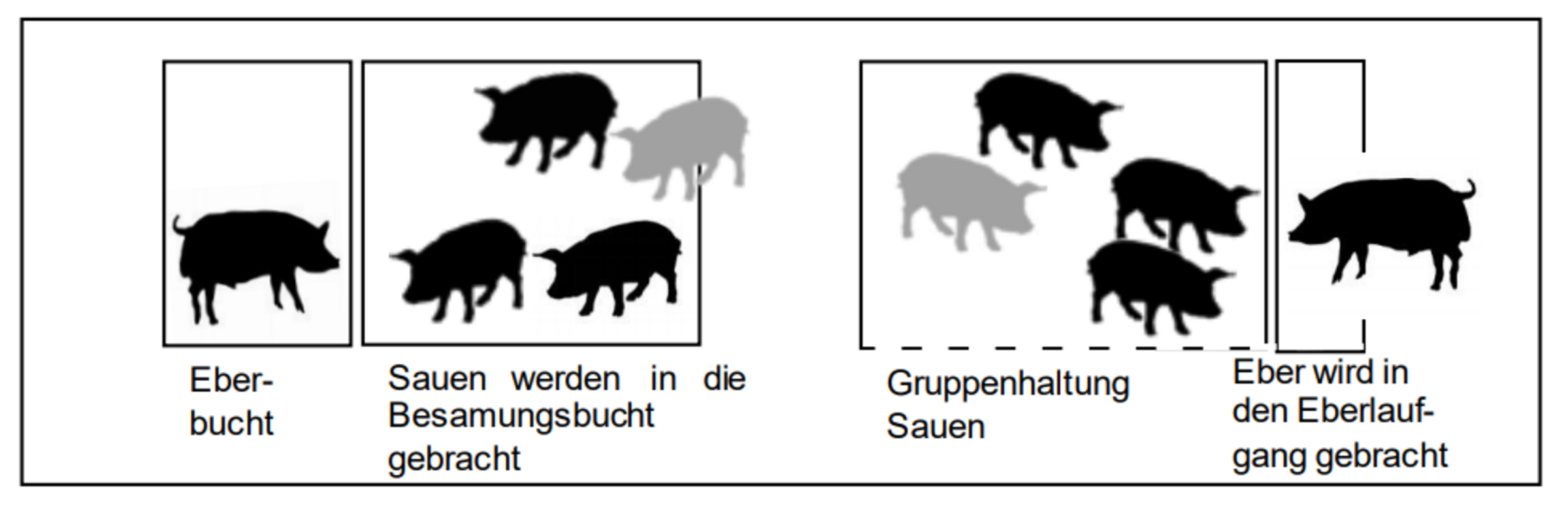
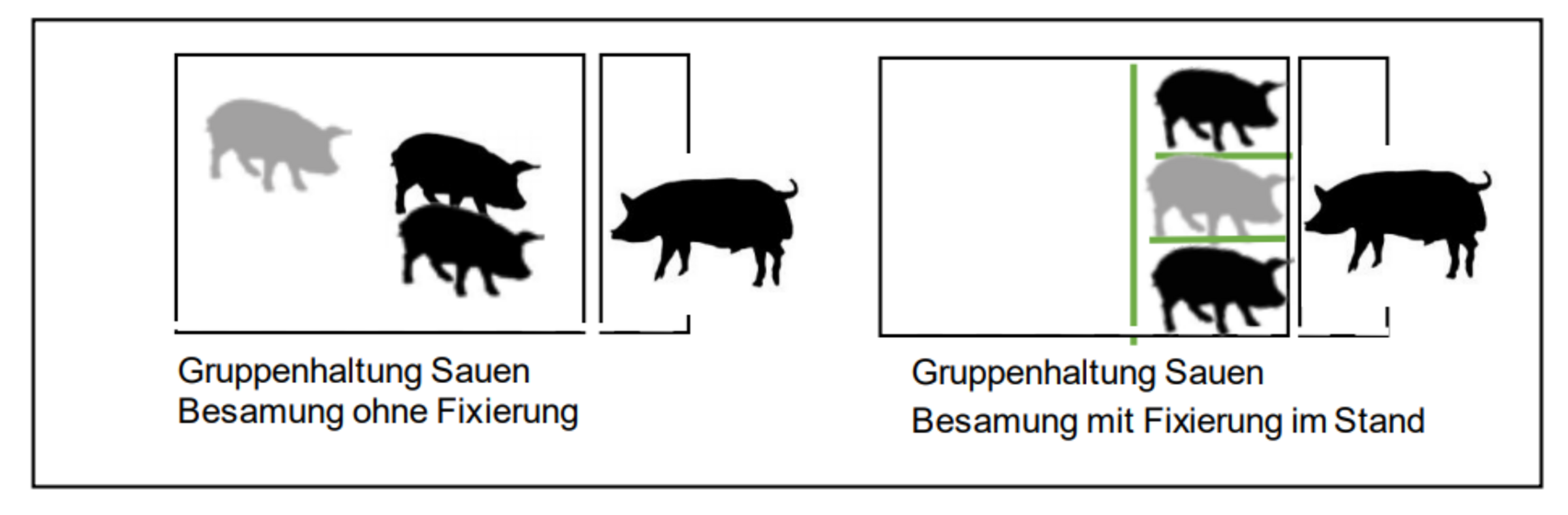
Another option is group insemination, where the sows may be restrained or left free. For this, the sows can either be moved into an insemination pen adjacent to the boar pen, or the boar can be placed in a boar run situated next to the sow group (Figure 3). If the sows are to be restrained during the insemination process, a restraint facility can be provided for the sows at the boar walkway (Figure 4). It should be noted that each sow should have contact with the boar to avoid restlessness within the sow group. If direct contact with the boar is not possible for every sow, insemination should be carried out in smaller groups.1
(Image: LSZ Boxberg)
As sows display very active sexual behaviour during group insemination – pushing and mounting one another and no longer recognising humans as such – there is an increased risk of injury to the person carrying out the insemination. They should also have sufficient experience with sows.3,8 The design of the facility should allow for escape routes to protect staff from the animals. One advantage of group insemination is that farmers can sometimes gain more information about the sows’ oestrus stage than when they are restrained in a crate. If the sows move away from the person performing the insemination, this is, on the one hand, a sign that the sow is not in peak oestrus. However, it can sometimes happen that sows moving away from the farmer only display a tolerance reflex when they are mounted by other sows. This can occur particularly with inexperienced or young sows.3 According to the LSZ Boxberg, a time-saving, reliable and safe method of insemination involves briefly restraining the sows, luring them into the crate using feed (Figure 5).
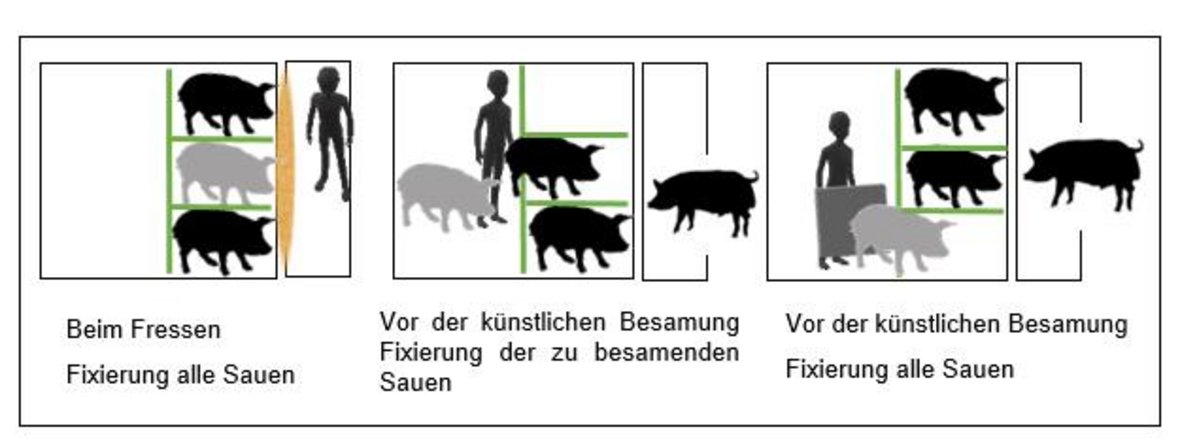
According to the Animal Welfare Ordinance (TierSchNutztV), farrowing crates must be reopened immediately after insemination, which reduces stress in sows.3 Various methods for restraining sows during insemination are listed in Table 1.
Whilst feeding Restraint of all sows in a group | Before artificial insemination Restraint of the sow to be inseminated | Before artificial insemination Restraining all sows in a group |
|
|
|
|
|
|
|
|
|
|
|
|
<figcaption>Table 1: Distinguishing features between the different restraint times for inseminating sows (Source: LSZ Boxberg)</figcaption>
reproductive capacity
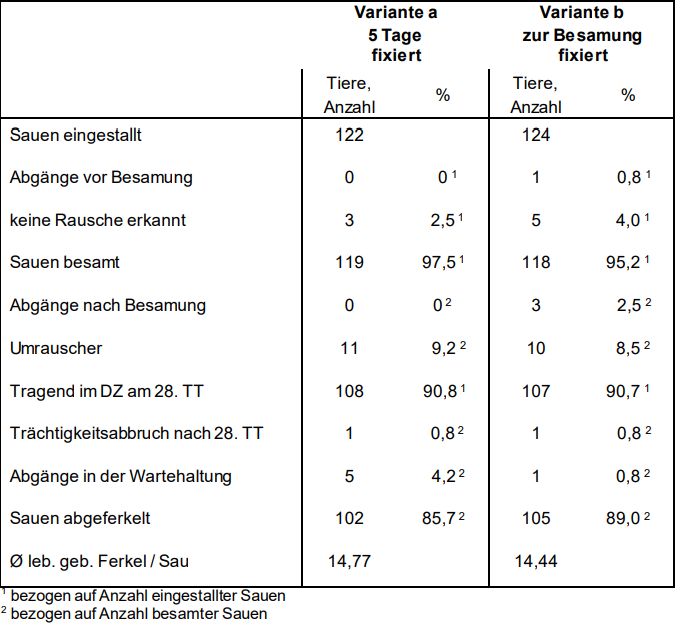
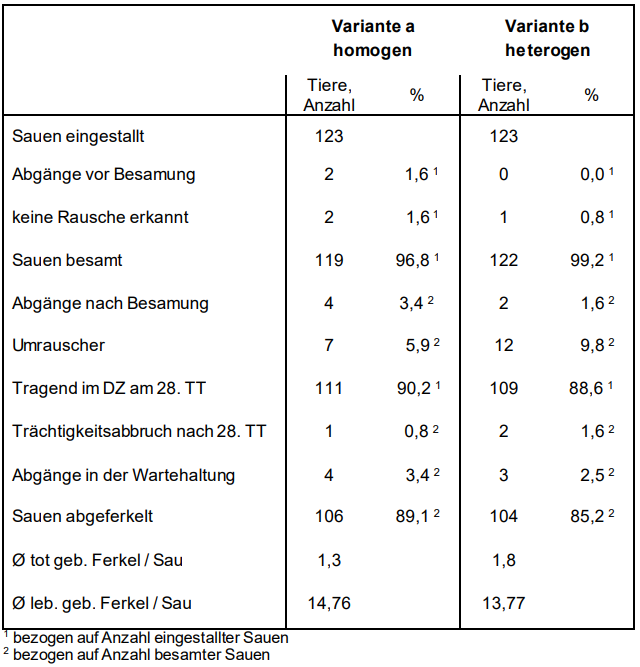
Based on the project results from the LSZ Boxberg, it cannot be concluded that there are any significant differences in reproductive performance between animals kept continuously in a group and those that are restrained for five days.3 There are no significant differences in the number of sows returning to oestrus, pregnant sows and live-born piglets (Table 2). Nevertheless, the breeding centre without restraining facilities places greater demands on herd management.9 Differences between homogeneous and heterogeneous groups in terms of animal weight are shown in Table 3.
Animal welfare
The restructuring of sow housing is intended to improve animal welfare. The sows have more space, can move around freely and express their social behaviour. However, a drawback is that the animals suffer increased physical injuries, such as skin lesions or lameness, as a result of social contact.1 Most injuries occur during the oestrus period and the establishment of the hierarchy. Skin injuries to the shoulder region and back usually occur during rank-fighting. After oestrus, however, most injuries are found on the flanks, hindquarters and back.1 It should be noted that deep scratches, open sores or bloody wounds resulting from social interactions occur only to a limited extent. Most skin injuries caused by other pigs are relatively minor.3
Due to group activity, such as pigs jumping on one another, increased lameness is also possible at the start of group housing.10 A calm group and good housing conditions, such as optimal flooring with deep litter or flat, reinforced surfaces covered with litter, can minimise this.1 When using slatted floors, care of the hind feet must be intensified. Experience from Scandinavian countries shows that stress on the sensitive feet can really only be reduced on deep litter.11 In the LSZ Boxberg project, there was no difference in lameness between animals that were restrained for five days and those that were not, although one might assume that restrained animals would spare their musculoskeletal system more than unrestrained animals. As early as after five days, the noticeable lameness in the animals subsides on its own, as the results from the LSZ Boxberg show.3 If injured or sick animals need to be removed from the group and housed in a sick pen, visual and olfactory contact with the group should be maintained to avoid renewed agitation after they are returned to the herd.
A practical recommendation is to provide sick pens for 5% of the animals kept in groups. These should measure 5 m². It is important to observe the animals closely during daily checks and, above all, during the heat period, and to separate any injured animals immediately so that minor injuries can heal quickly and the number of sows with foot and leg problems does not increase as a result of free-range housing.
Additional equipment
Anyone planning to build a new breeding centre or renovate an existing one should not overlook the installation of cooling facilities: these must be provided in accordance with the implementation guidelines of the TierSchNutztV. The design of these cooling facilities naturally depends heavily on the specific on-site conditions of each individual farm. In new buildings, ground-source heat exchangers can be an effective way of regulating the temperature of the supply air in both summer and winter. Floor cooling, CoolPads, misting systems and (micro) wallows can also be retrofitted into existing barns with varying degrees of effort. When using evaporative cooling systems in enclosed barns, attention must also be paid to humidity levels.
The amendment to the Animal Husbandry Ordinance imposes entirely new requirements on housing systems. As a result of the significantly increased space requirements, construction costs are also rising considerably. Experience shows that a new building is not necessarily required to meet future standards for sows. There are various ways to make existing buildings fit for the future. With good management, production performance can remain consistent.5
Further information
You can find more information on existing experience and farms that have already restructured their operations on the websites listed below. These sites also provide examples of conversion and pen layout, as well as information on investment cost calculations.
Overall farm management concept for pigs – sows and piglets
LfL, R. Schulte Sutrum (LWK NRW): Mating centre – which housing methods have a future?
eip-schwein. Overview of breeding centres. Farm examples with images, videos and plans.
Here you will find a fillable template for a farm and conversion concept from the North Rhine-Westphalia Chamber of Agriculture. You can fill this in on screen and then print it out and send it. The original must be signed and submitted:
Farm and conversion concept from the North Rhine-Westphalia Chamber of Agriculture
Bibliography
- 1 LSZ (2021): Group housing of sows awaiting mating. Practical experience and examples: https://lsz.landwirtschaft-bw.de/pb/site/pbs-bw-mlr/get/documents_E949947673/MLR.LEL/PB5Documents/lsz/pdf/Projekte%20und%20Versuche/Gruppenhaltung_von_zu_belegenden_Sauen_1.Auflage.pdf Accessed on: 12 July 2022
- 2 BLE (2021): Farm-wide housing concept for pigs – sows and piglets: https://www.ble-medienservice.de/0073/gesamtbetriebliches-haltungskonzept-schwein-sauen-und-ferkel Accessed on: 12 July 2022
- 3 LSZ (2022): Final report. Project: “Testing and evaluation of new husbandry methods involving group housing of sows in the mating centre – effects on animal behaviour, integumentary and footpad damage, fertility and labour efficiency”:
- https://lsz.landwirtschaft-bw.de/pb/site/pbs-bw-mlr/get/documents_E-1984162133/MLR.LEL/PB5Documents/lsz/pdf/Projekte%20und%20Versuche/Abschlussbericht_MLRDeckzentrum_Projekt-Nr.%200386%20E_11-03-2022.pdf Accessed on: 12 July 2022
- 4 LSZ (n.d.): Testing and evaluation of new housing systems. Group housing of sows at the breeding centre: https://lsz.landwirtschaft-bw.de/pb/,Lde/Startseite/Wissen/Gruppenhaltung+Deckzentrum Accessed on: 12 July 2022
- 5 Belz, T. (2022): The breeding centre in transition: https://llh.hessen.de/tier/tierwohl-allgemein/deckzentrum-im-wandel/ Accessed on: 12 July 2022
- 6 Animal Welfare and Livestock Management Ordinance – Implementation Guidelines (2021): https://www.openagrar.de/servlets/MCRFileNodeServlet/openagrar_derivate_00036346/H-2-Ausfuehrungshinweise-Schweine-2021-03.pdf Accessed on: 12 July 2022
- 7 BMEL (n.d.): Making sow husbandry more animal-welfare-oriented: https://www.mud-tierschutz.de/schweine/tragende-sauen/aufstallung-und-management/ Accessed on: 12 July 2022
- 8 Schulte Sutrum R. (2017): Mating centre – which housing systems have a future? https://www.lfl.bayern.de/mam/cms07/ilt/dateien/tagungsband_bewegungsbuchten_2017.pdf Accessed on: 12 July 2022
- 9 Lang, N., Scholz, A., LSZ Boxberg (2020): Group housing of sows to be mated – selected performance parameters in the mating area: https://lsz.landwirtschaft-bw.de/pb/site/pbs-bw-mlr/get/documents_E-1498953995/MLR.LEL/PB5Documents/lsz/pdf/Fachinformationen/Gruppenhaltung/LSZ_Gruppenhaltung_zu_belegender_Sauen_ausgew%C3%A4hlte_Leistungsparameter_Deckbereich.pdf Accessed on: 12 July 2022
- 10 Lang, N., Scholz, A., LSZ Boxberg (2020): The occurrence of lameness in a group of sows to be mated: https://lsz.landwirtschaft-bw.de/pb/site/pbs-bw-mlr/get/documents_E851611235/MLR.LEL/PB5Documents/lsz/pdf/Fachinformationen/Gruppenhaltung/LSZ_Das%20Auftreten%20von%20Lahmheiten%20%20in%20einer%20Gruppenhaltung%20von%20zu%20belegenden%20Sauen.pdf Accessed on: 12 July 2022
- 11 Meyer, E. (2020): Why does it work in Sweden? DLG-Mitteilungen 5/2020: https://www.lksh.de/fileadmin/PDF_Downloadcenter/Bauernblatt/2020/BB_11_14.03/52-54_Meyer.pdf