
- Martin Dittmar, Animal Welfare Initiative
- Prof. Dr. Isabel Henning-Pauka, University of Veterinary Medicine Hannover
- Prof. Dr .Johannes Kauffold, University of Leipzig
- Dr. Sandra Löbert, North Rhine-Westphalia Chamber of Agriculture
- Jochen Meyer, Animal Welfare Pilot Farm
- Dr. Hendrik Niehoff, LUFA North-West
- Prof. Dr. Imke Traulsen, University of Kiel
- Dr. Dirk Bornhorn, Tierärztliche Hochschule Hannover
- Dr. Maren Gerlach, North Rhine-Westphalia Chamber of Agriculture
- Imke Albers, North Rhine-Westphalia Chamber of Agriculture
- Marie Lamoth, North Rhine-Westphalia Chamber of Agriculture
Hoof health is a key factor in the welfare and performance of sows. Poor hoof health within the herd is also considered a matter of animal welfare and necessitates the implementation of appropriate, targeted measures. The culling of sows due to foot problems or hoof diseases remains a challenge in practice. In addition to premature culling, hoof diseases can also lead to reduced performance, higher piglet losses and lower fertility. Numerous factors relating to housing, breeding, management and feeding, as well as other animal-related factors, influence the health and resilience of the hooves. A systematic analysis of these influencing factors forms the basis for the rapid identification of problem areas and the implementation of targeted preventive measures, thereby enabling the long-term improvement of hoof health in the sow herd.
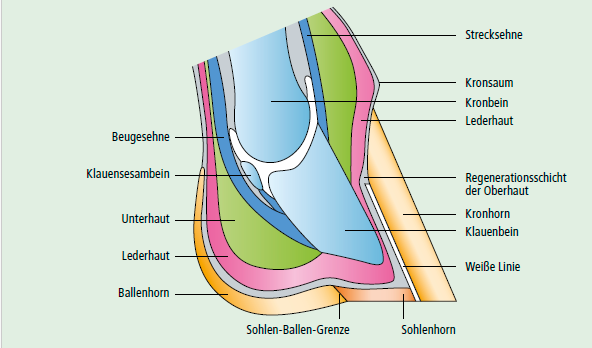
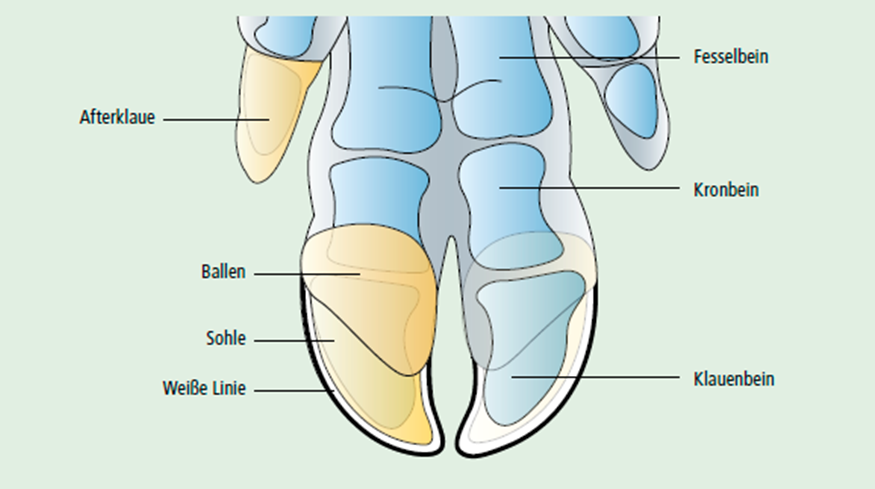
Claw structure
To improve hoof health in the barn, it is important to understand the structure of the hooves. Pigs walk on their toes, so compared to us humans, they have a very small contact area that has to bear a very high load. Pigs are even-toed ungulates: instead of five toes like humans, they have two main claws and two hind claws (see Figure 2). The hind claws do not touch the ground on firm surfaces, but only provide support when the pig sinks into soft ground.
The pig’s hoof has a very hard horn wall, a hard sole and a soft pad, which occupies a large part of the underside and the sides of the hoof. The various horn segments of the hoof have different degrees of hardness; these segments meet directly, making the hoof more susceptible to cracks and injuries at these points. For instance, the hard coronal horn borders the soft marginal segment, which marks the transition to the hairy skin. The harder sole and wall horn abuts the softer pad horn. The white line, where the wall horn meets the sole horn, also represents such a transition zone.
The rate at which the horn regrows varies depending on the pig’s age. From the age of one year, growth averages 5–6 mm per month.
The angle between the front wall and the sole surface is crucial for maintaining healthy hooves: the longer the hooves become, the sharper the angle becomes (so-called ‘stable hooves’). Normally, it should be between 50° and 60°. With a sharper angle, the pressure point of the footpad shifts to the ball area, which is not designed to withstand this level of horn hardness.
Stable floor and subfloor
The pen floor has a significant impact on hoof wear and overall hoof health. During a production cycle, sows often move across different types of flooring. Mating and waiting pens frequently feature concrete slats, whilst farrowing pens are usually fitted with metal or plastic slats. In some cases, the slats in the farrowing area are also covered with rubber mats to reduce pressure injuries. Particularly here in the farrowing area, where different materials are used, it is essential to ensure a high level of stability. Transitions between materials should be smooth – without cracks or sharp edges and with a consistent level throughout. In the breeding and waiting pens, rubber mats can have varying effects, and their impact on heel cracks, wall horn abrasions, dermal haemorrhages, horn cracks and sole defects appears to differ depending on the stage of the cycle.
The slip resistance and sure-footedness of a floor depend on the material, surface profile and degree of soiling. Rubber mats, plastic-coated expanded metal flooring (polyethylene-coated slats) and concrete have high static friction coefficients and are therefore slip-resistant. Smooth materials such as polypropylene, on the other hand, are not recommended. Floors that are too smooth also result in insufficient hoof wear and incorrect loading of the hooves. Floors that are too rough, on the other hand, can lead to excessive wear, which may cause dermal haemorrhages and overgrowth of the hoof horn.
Moisture and dirt reduce the floor’s slip resistance to varying degrees depending on the material, thereby increasing the risk of injury, particularly on smooth floors. Furthermore, the horn swells due to moisture such as urine or wet bedding. When the animals move to dry floors, the horn hardens again and becomes porous, which promotes the formation of cracks. Pathogens may penetrate through these cracks and cause infections. In this context, temperature and humidity should always be monitored and adjusted as necessary.
According to the Animal Welfare and Livestock Management Ordinance, slatted floors with a maximum slat width of 20 mm are permitted for sows, gilts and boars. Depending on the functional area, tread widths of between 80 and 200 mm and slat widths of between 17 and 20 mm are recommended.
With new concrete slatted floors, there is a risk that the risk of injury increases due to sharp burrs on the edges of the slats. If slatted floors that have not already been deburred are being installed, they should therefore be deburred before the first animals are housed, e.g. using an angle grinder. Furthermore, corrosive concrete acids can damage the hoof horn. Before the first animals are housed, these can be neutralised by applying a 10% soda solution.
Housing on dry straw tends to result in better hoof health than housing on concrete floors. However, straw also leads to minimal abrasion and may therefore promote the development of barn hooves. Particularly when animals are housed exclusively on deep litter for a long period, the hooves can grow excessively, leading to abnormal stress on the hoof. Combining concrete floors with straw-bedded areas, depending on the functional area, can promote hoof health.
Another challenge is the floor surface in the farrowing area. The sow requires a floor that is as non-slip as possible, whilst the piglets need a surface that is not too rough to prevent their joints from getting grazed when latching onto the teats.
As the foundations for good hoof health are laid as early as the piglet stage, it is particularly important for farmers rearing their own replacement stock, but also in gilts rearing, to ensure that the floor surface is appropriate for the animal’s age and body weight. Breeding gilts weighing more than 25 kg that are still kept on plastic slats tend to develop foot rot more quickly as adult sows.
Furthermore, an effective hygiene plan includes dry, easy-to-clean surfaces with sufficient slope, as well as regular removal of faeces. Equipment must be cleaned and disinfected regularly and clearly assigned to a specific area to break chains of infection. Where possible, the pens – particularly the insemination area – should be cleaned and disinfected regularly.
Spatial and bay structure
A clear separation of functional areas (resting, manure, feeding and activity areas) prevents contamination and thus reduces injuries caused by slipping and the infection of hoof lesions. Long distances to the feeding area or frequent visits to it, as occurs, for example, in systems with ad libitum on-demand feeding, place increased strain on the hooves and lead, in particular, to changes in the hoof pads. In restrictive feeding systems (e.g. drip feeding), the feeding area is visited less frequently, which shortens walking distances and, in studies, resulted in 16–17% fewer sows with severe pad changes. If increased aggression at the feeding area occurs due to unstable sow groups, more severe pad changes are also to be expected.
Wide walkways of over 3 m provide lower-ranking sows with opportunities to avoid conflict, thereby reducing hoof injuries that can occur during rank-fighting when sows move backwards or turn. Separate feeding areas with partitions reduce competitive pressure and similarly support hoof health. Self-capture pens are also suitable, as they offer protection from attacks by other sows and thus reduce stress and hoof trauma.
Management
In terms of management, the aim is also to minimise stress and the associated risk of injury.
Fixed groups, in which hierarchy-related fighting can be kept to a minimum, are recommended.
If the sow groups are very homogeneous, all animals have equal access to resources. However, hierarchy battles can last longer than in heterogeneous groups with large differences in weight. Here, gilts in particular are at risk of being unable to assert themselves against older sows in peak condition.
In particular, small groups of animals should be kept constant and the introduction of individual animals into existing groups should be avoided. Pigs recognise each other reliably in groups of 20–30 individuals, and a fixed hierarchy can establish itself. In large groups of over 60 animals, the composition can be somewhat more dynamic, as the animals maintain greater spatial distances and are better able to avoid conflicts.
For gilts, careful monitoring during and after delivery is crucial, as only healthy animals form the basis for successful piglet production. Problems often arise due to inadequately bedded quarantine pens in older buildings, as damp bedding softens the hoof horn, thereby increasing the likelihood of hoof cracks during subsequent rearing on slatted floors. A calm introduction, stable groups with appropriate stocking densities, and, where necessary, integration only after the first farrowing can effectively reduce hoof problems and injuries.
Feeding and nutrient supply
For the formation of high-quality horn, an adequate supply of amino acids (e.g. cysteine, methionine and histidine), as well as various macro- and trace elements (e.g. calcium, zinc, copper, manganese and selenium), vitamins (e.g. biotin, vitamins A, D, C and E) and fatty acids (e.g. linoleic acid). When considering a diet designed to promote hoof health, long-term, concurrent supplementation of several substances has, to date, led to an improvement in hoof health. In particular, biotin, cysteine, manganese, zinc and copper have been shown in various studies to contribute to the stabilisation of hoof health. However, in the case of biotin specifically, effects on hoof health were sometimes only achieved after a supplementation period of six months. If the trace elements are present in the ration in an organically bound form, they are metabolised more effectively. Therefore, from the rearing of gilts onwards, it is recommended that at least 50% of the trace elements be supplied in an organically bound form to ensure good hardening of the hoof horn. After integration, at least the feed for pregnant sows should be formulated accordingly.
The conditioning of gilts is also of crucial importance for subsequent hoof health. Once gilts reach a body weight of 30 kg, daily weight gains exceeding 900 g can lead to a deterioration in the stability of the feet.
The effects of Swine Inflammatory and Necrotic Syndrome (SINS) on sow hoof health are currently being discussed in scientific circles.
If the animal’s intestinal wall is damaged, e.g. due to high-energy feed with low crude fibre content, toxins from poor-quality feed, but particularly toxins of bacterial origin (so-called endotoxins), can breach the intestinal barrier and enter the pig’s bloodstream. Here, they affect the body’s immune system and trigger inflammatory processes in the sow. Other contributing factors include heat stress, water shortage, poor water quality or metabolically intensive phases such as lactation. As a result, inflammation can occur in the ears, tails, teats, vulvae or hooves of pigs.
Sows can develop laminitis, much like cattle and horses. Externally, this is visible as bulging rings on the hoof. Similar to tree rings, the number of these rings indicates the frequency of inflammatory episodes in the hoof. In severe cases, the tissue can be so badly damaged that the hoof bone rotates, causing the sows to develop lameness resistant to treatment.
A gut-friendly diet should also be fed during the rearing of gilts to avoid SINS symptoms and prevent hoof damage. Balanced rations with a good proportion of fibre-rich cereals (barley) can prevent the formation and absorption of toxins in the gut.
Animal-related factors
Body weight and age in sows are considered direct risk factors for hoof health. For example, towards the end of gestation, every additional kilogram of body weight increases the risk of wall horn lesions by three per cent. A higher body weight also leads to more horn cracks. The outer hooves bear up to 78% of the sow’s body weight and are therefore more frequently affected by hoof abnormalities.
With increasing age, particularly between the first and third litters, the incidence of hoof abnormalities rises. Longer hooves and hoof cracks are more common in older sows.
Genetic differences between breeds are also reflected in the varying incidence of hoof diseases. No differences have yet been identified between in-house replacement and purchased stock.
Caring for sick and injured animals
Sows showing signs of lameness or foot injuries must be immediately moved to a recovery pen. A soft, dry surface, such as straw bedding or a clean rubber mat, will aid healing. Pain relief should also be administered and, if necessary, further treatment should be discussed with the farm vet.
Conclusion
The main factors affecting the hoof health of sows are flooring, management, feeding, age and body weight. If any abnormalities or health issues are observed, the farm vet or the pig health service should be consulted. During a comprehensive consultation, all these factors can be assessed and, if necessary, optimised.
Bibliography
- Anil, S. S., Anil, L., Deen, J., Baidoo, S. K. & Walker, R. D. (2007). Factors associated with claw lesions in gestating sows. Journal of Swine Health and Production, 15(2), 78–83.
- Federal Information Centre for Agriculture (2021). Healthy hooves in pigs. Available at: https://www.nutztierhaltung.de/schwein/mast/gesunde-klauen-beim-schwein-1/ (Accessed on: 03/12/2025).
- Federal Information Centre for Agriculture (n.d.). Management of sows and piglets in group suckling. Available at: https://www.nutztierhaltung.de/schwein/mud-tierschutz/fokus-gruppensaeugen/management/ (Accessed on: 03/12/2025).
- German Agricultural Society (2022). Healthy hooves – healthy sows (Podcast Network Focus on Animal Welfare). In: Gäckler, S., Lambertz, C., Harlizius, J. & Meyer, E. (Eds.). Federal Agency for Agriculture and Food.
- Geyer, H. & Troxler, J. (1988). Hoof diseases resulting from poor housing floor conditions. Veterinary Practice, 3, 48–54.
- Grandjot, G., Hesse, D., Keßler, B., Landmann, D., Mader, H., Meyer, C. et al. (2011). Hoof health in pigs. aid Information Service for Nutrition, Agriculture and Consumer Protection e. V.
- Habermehl, K.-H., Wilkens, H. & Vollmerhaus, B. (1984). Textbook of Domestic Animal Anatomy. 2nd ed. Parey.
- Hoy, S. & German Agricultural Society (DLG), AfS. (2015). DLG Fact Sheet 408 – Grouping of sows. Frankfurt am Main: German Agricultural Society (DLG).
- Meyer, E. (2023). Thinking from the ground up. DLG-Mitteilungen, 3, 96–98.
- Meyer, E. (2023). Prevention with copper, zinc & co. DLG-Mitteilungen, 4, 66–68.
- von Borell, E. & Huesmann, K. (2009). Requirements for barn flooring. KTBL technical article. Darmstadt: Kuratorium für Technik und Bauwesen in der Landwirtschaft e. V. (KTBL).
- von Borell, E., Einschütz, K., Feller, B., Haidn, B., Häuser, S., Meyer, E. et al. (2008). Barn floors for pigs (KTBL Booklet 77). Darmstadt: Kuratorium für Technik und Bauwesen in der Landwirtschaft e. V. (KTBL).
- Ziron, M. (2010). DLG Fact Sheet 359 – Feeding technology in sow management. Frankfurt am Main: German Agricultural Society (DLG).
- Ziron, M. (2012). Guide to Hoof Health. South Westphalia University of Applied Sciences, Department of Agricultural Economics, Soest.