
- Philipp Heimel, Hesse State Agricultural Agency
- Dr. Ulrike Wolf, KTBL
- Dr. Anna Catrin Anker, Landesbetrieb Landwirtschaft Hessen
- Dr. Rebecca Simon, Landesbetrieb Landwirtschaft Hessen
Funding note: This document was produced by the ‘Emissions’ working group of the Centre of Excellence for Cattle Welfare as part of the joint project ‘Network Focus on Animal Welfare’, funding codes 28N419T01 to 28N419T17.
This joint project involving the Chambers of Agriculture and agricultural institutions from all federal states aims to improve the transfer of knowledge into practice in order to make cattle, pig and poultry farms fit for the future in terms of animal-welfare-friendly, environmentally sound and sustainable livestock farming.
The project is funded by the Federal Ministry of Food and Agriculture pursuant to a resolution of the German Bundestag.
All information and advice is provided without any warranty or liability.
Publisher
DLG e.V. Agricultural
Centre
Eschborner Landstraße 122
60489 Frankfurt am Main
Reproduction and transmission of individual text sections, drawings or images (including for teaching purposes), as well as the provision of fact sheets in whole or in part for viewing or downloading by third parties, is permitted only with the prior approval of the relevant department of the Animal Welfare Competence Centre for Cattle and DLG e.V., Marketing Division, Tel. +49 69 24788-209, [email protected].
Alongside methane (CH₄) and nitrous oxide (N₂O), ammonia is one of the key gaseous emissions that can be produced in cattle housing. In Germany, the majority of ammonia emissions originate from the agricultural sector, with over 70% coming from livestock farming (barns and the storage of farm manure) and approximately 25% from the soil (the application of farm manure, mineral and other organic fertilisers). Of the emissions originating from livestock farming, 43% come from cattle farming.
Ammonia, as well as the fine particulate matter formed in the air, has been proven to damage ecosystems and plants and pose a risk to human health. To avoid negative impacts on animals, humans and the environment, emissions are to be further reduced in future. According to the NEC Directive (2016), ammonia emissions in Germany must be reduced by 29% by 2030 (base year 2005).
To achieve this target, various measures can be taken in cattle farming. A number of research projects have addressed this issue and are continuing to work on finding solutions for reducing ammonia in cattle housing.
The following overview provides an insight into the formation of ammonia and outlines the measures for reducing ammonia emissions. The links allow direct access to the (research) projects.
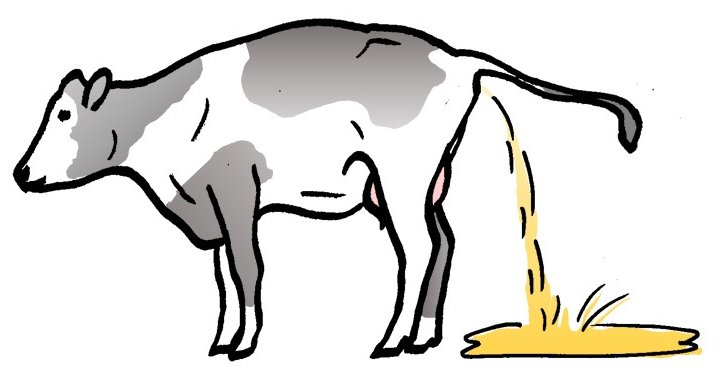
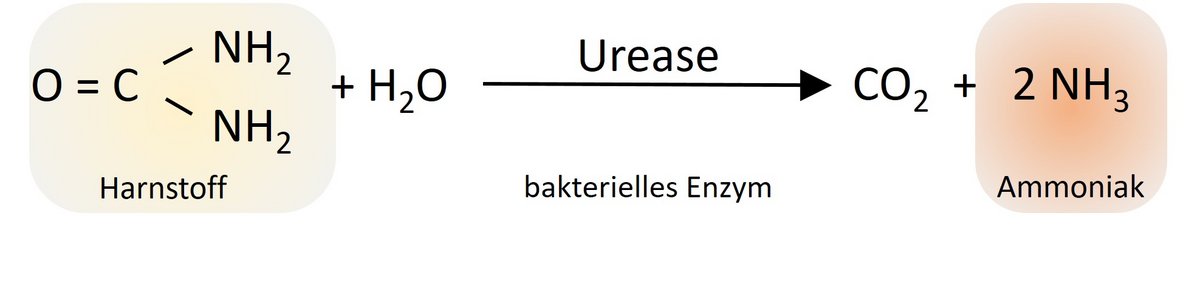

The conversion of urea to ammonia depends on:
- The size of the wet surface (it is not the absolute volume of urine that is decisive, but the area over which the urine is spread)
- Time: the majority of the breakdown takes place in the first 2 hours after urination
- Temperature: the warmer it is, the faster the chemical reaction proceeds
- Chemical factors such as pH
- Physical factors such as air velocity
This is why NH3 emissions are a problem:
- Nitrogen loss in farm manure
- Nitrogen input into the environment
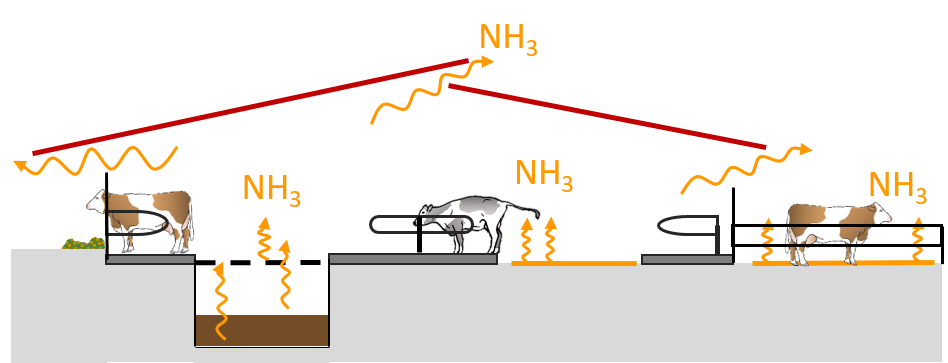
Where is ammonia (NH₃) produced?
Ammonia forms in the barn on all surfaces moistened by urine:
- on walkways in the barn (slatted floors and solid-surfaced walkways)
- in the exercise yard
and
- during the storage of slurry (slurry cellar/pit)
- during slurry application
As part of the EmiDaT project, emission levels were measured in common livestock housing systems (cubicle barns for dairy cattle with a solid-floored walkway, slatted floors in the walkway, or slatted floors in the walkway with a slurry pit) in order to quantify emission patterns. On average, ammonia emissions amount to 12 kg NH3 per animal place per year (10.0 kg NH3-N per animal place per year). In contrast to methane emissions, no significant difference was found between the housing systems investigated.
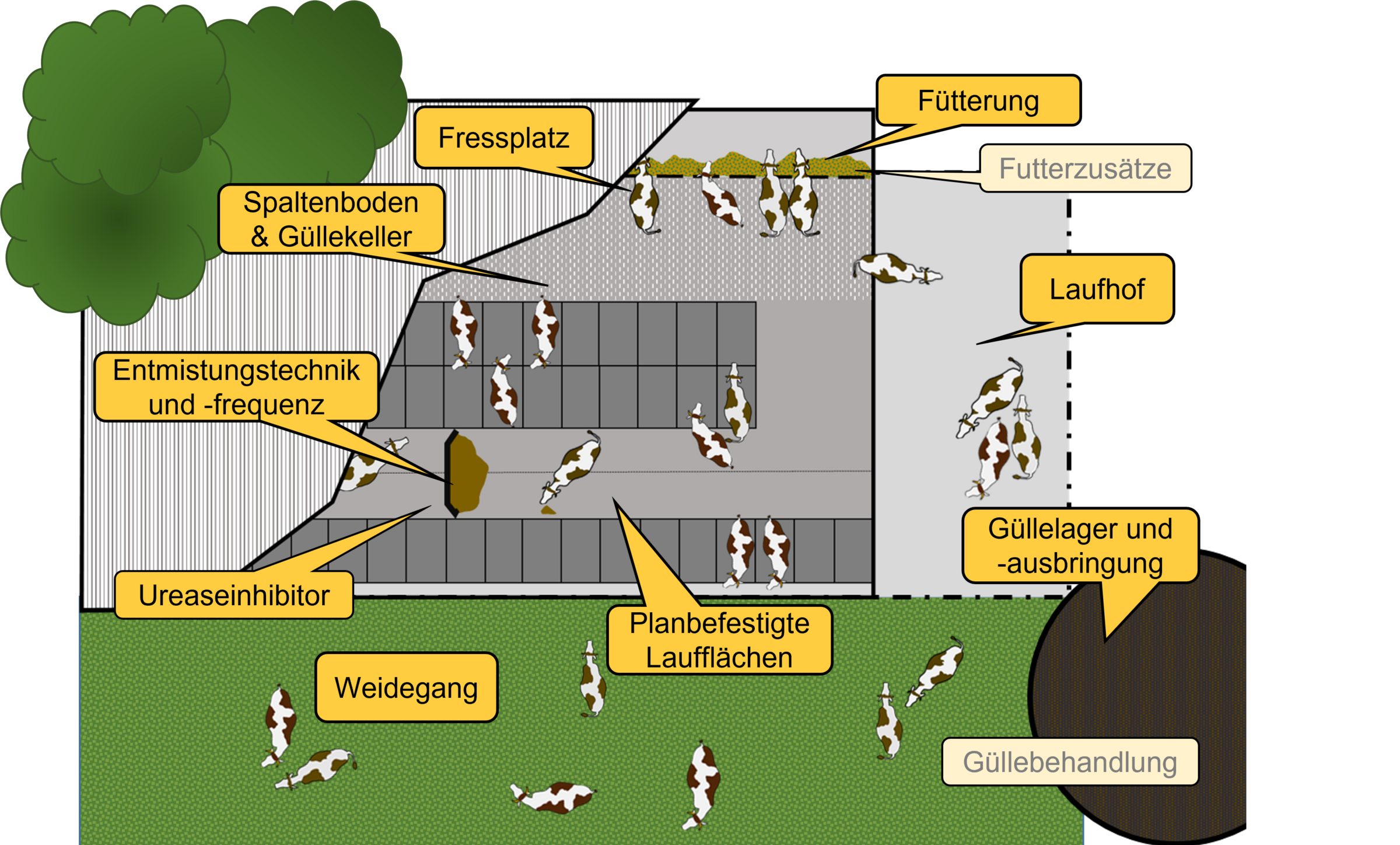
In which areas can mitigation measures be implemented?
Many measures designed to reduce ammonia formation have a positive impact on animal welfare and the health of the cows. As a rule, they improve air quality or, for example, ensure better barn hygiene and safer footing through drier walking surfaces, as well as improved hoof and udder health.
A well-known and proven measure for reducing emissions is (early) manure-urine separation. This aims to effectively reduce ammonia emissions at source by inhibiting the enzymatic breakdown of urea. Depending on the barn’s structural conditions, various measures are available for this purpose. In addition, there are other options which are also presented below.
Flat surfaces and slatted floors
To reduce ammonia emissions in paved exercise areas, it is essential that urine drains away quickly from the surface and that the area is cleaned regularly (using appropriate manure removal techniques and at appropriate intervals). In addition to reducing ammonia emissions, running surfaces must always provide slip resistance and be hoof-friendly. One possible measure here is the installation of a gradient (min. 2%) towards the urine collection channel.
In the case of slatted floors, emissions occur both from the soiled walking surface and from the liquid manure channel beneath it. Air exchange takes place between the barn and the airspace within the channel. In addition to the rapid drainage of urine from the slats (for example, through arched slats), a further mitigation approach is to minimise gas exchange between the slurry and barn areas by reducing the proportion of slats or using sealing flaps (also known as emission reduction flaps). In practice, blockages or sticking of the sealing flaps can impair their functionality and thus negate the emission reduction effect; long-term experience and corresponding evaluations in practical use are currently lacking.
A wide variety of solutions are available on the market for both new builds and retrofits. These systems are subject to ongoing development and innovation.
Sealing flaps are also well suited as a structural and technical measure for reducing methane emissions.
Further information
KTBL publication: Eligible techniques for emission reduction
EIP-Rind: Farming experiences and practical tips
Agroscope: Slatted flooring with cross-slope and urine collection channel
Manure removal technology and frequency
The maximum emission-reducing effect of low-emission stable floors can only be achieved using a cleaning method tailored to the floor (usually in combination with humidification). The cleaning method must be capable of effectively cleaning all surfaces to be cleaned at least every two hours. The actual cleaning frequency required must be determined on a farm-by-farm basis, depending on the degree of soiling of the surfaces.
As the rapid drainage of urine can lead to the formation of (slippery) sludge layers, additional humidification may be required.
Further information
KTBL publication: Eligible techniques for emission reduction in livestock buildings
Feeding area design
The raised feeding area, with feeding partitions (feeding stalls), divides the pen into a feeding area and a walking area. This provides the animals with a standing area specifically designed for feeding. This can be achieved by raising the standing area by around 10 centimetres above the walkway. If constructed correctly, this area remains clean and the manure falls onto the walkway, where it can be removed from behind the cows without disturbing them whilst they are feeding. The area where manure is deposited is thus significantly reduced.
Feeding stalls provide the cows with a safe place to eat without being disturbed by the (often) running cleaning equipment or higher-ranking cows. This has a positive effect on feeding behaviour. A side effect is the positive impact on hoof health: the walking areas are cleaned more frequently, and the cows stand on dry, clean ground whilst eating, meaning their hooves come into contact with manure less often overall.
Further information and practical tips
EIP-Cattle: Feeding area divider
EIP-Cattle: Raised feeding stalls
Agroscope: Raised feeding area with feeding stall partitions (feeding stalls) for dairy cows
Agroscope: Good for animals and the environment – feeding stalls
Cow toilet
The cow toilet is designed to separate the cow’s manure and urine, thereby reducing the formation of ammonia in the barn. Studies have shown that cattle can be trained to use the cow toilet. However, the widespread practical implementation of this measure is currently severely limited due to the costs involved.
Further information
Low-nitrogen diet
Research in recent years has shown that targeted feeding strategies, such as adjusting feed intake to the lactation cycle, can improve nitrogen utilisation and reduce the proportion of urea in the urine of dairy cows. Lower urea levels also lead to reduced ammonia emissions.
Further information
DLG Fact Sheet 417: Reduction of ammonia emissions in dairy farming
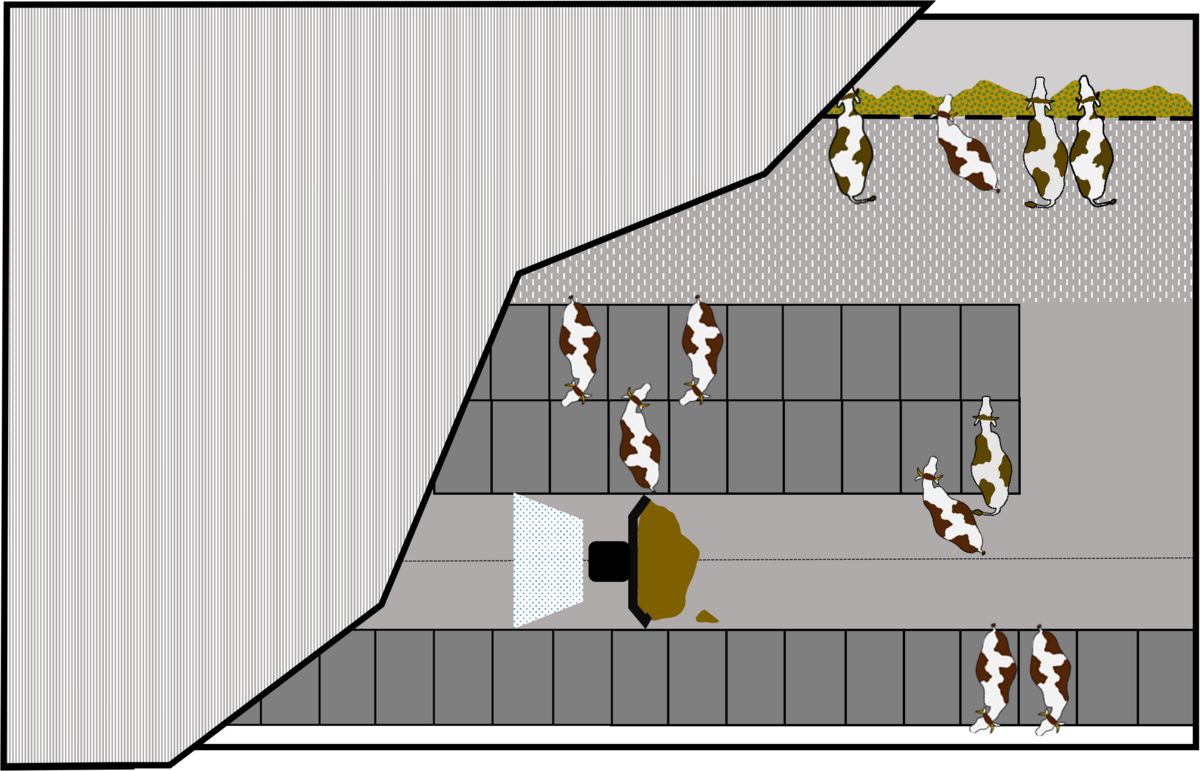
Urease inhibitor (UI)
The use of a urease inhibitor blocks the enzyme urease, which converts urea into ammonia. This promising technology was brought to market in 2024. The available application technology (for example, in combination with a manure scraper, Fig. 3) can also be retrofitted in existing buildings. Mixing and application can be automated. Regular application (at least once a day) is essential to achieve an effective reduction in ammonia emissions. Studies have found no harmful effects on users or cattle.
The Prax-REDUCE project has focused on the practical application of urease inhibitors to reduce ammonia emissions:
Prax-REDUCE: Practical application of a urease inhibitor formulation to reduce ammonia emissions in livestock housing for sustainable, animal- and environmentally-friendly cattle farming
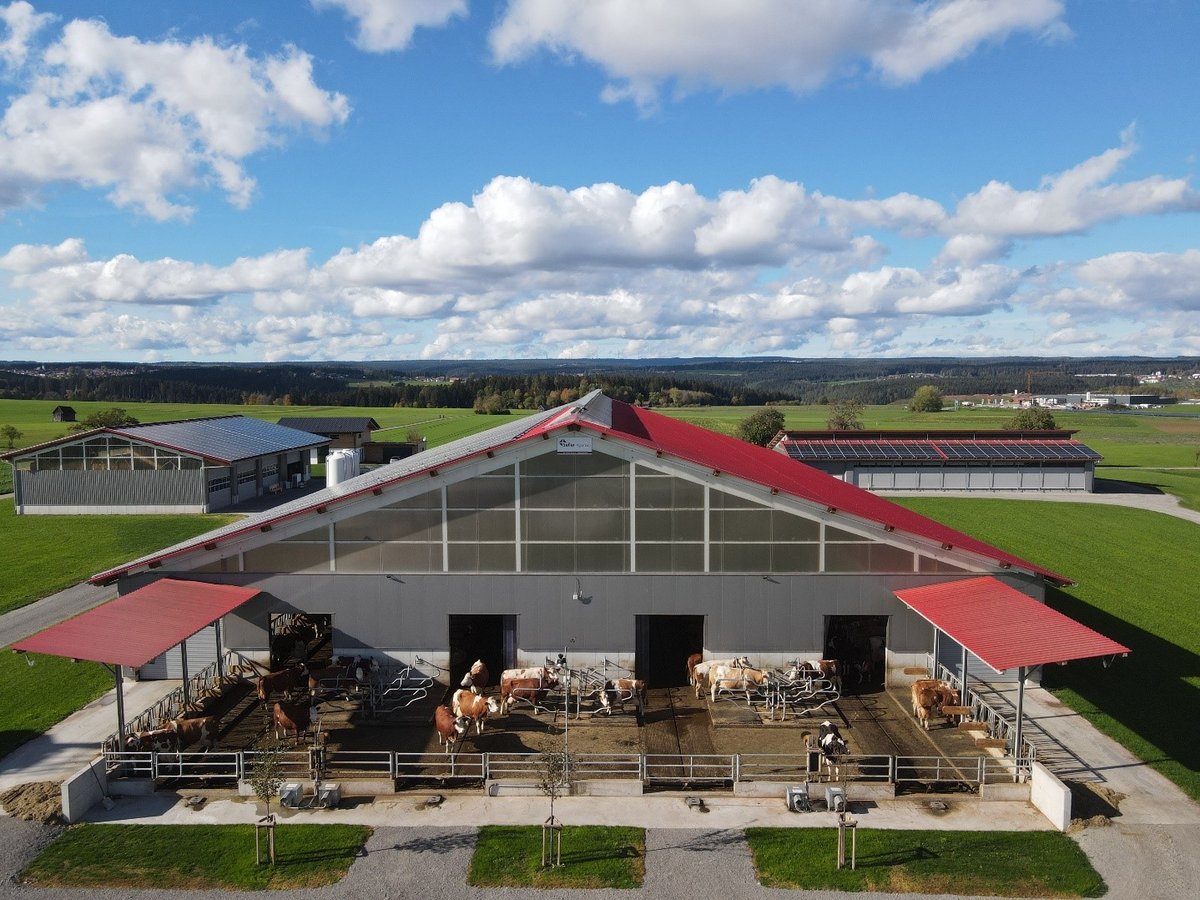
(© Dr Barbara Benz)
Courtyard
An exercise yard is primarily an extension of the existing space within the barn, designed to promote animal welfare. However, it also increases the area subject to soiling. Consequently, the exercise yard represents an additional source of emissions. Through clever design, low-emission walking areas and regular cleaning, this effect can be reduced, whilst still providing the cows with access to outdoor space for the benefit of their welfare. In this context, ‘layout’ refers to the integration of feeding and/or lying areas into the exercise yard to reduce the proportion of soiled area.
grazing
On natural ground, urine seeps quickly into the soil, causing ammonium to bind to soil particles and preventing it from being released as ammonia.
However, even an empty barn acts as a source of emissions if the walking areas are still soiled or damp. Cleaning should therefore take place immediately after the animals are turned out.
Further information
KTBL / UBA publication: Reducing ammonia emissions in agriculture. Good professional practice
External slurry storage and slurry application
Covering an external slurry storage tank with a tent roof, suitable liners or a concrete slab that can be driven over reduces NH₃ emissions during storage. This is a requirement for new installations under the Federal Immission Control Act (BImSchG).
There are other options available for retrofitting a cover to an existing slurry storage facility, such as floating sheets or floating devices (provided that no natural floating layer forms which prevents a floating cover from being used).
Slurry should be applied close to the ground using drag hoses, drag shoes or slotted applicators, and only in combination with prompt incorporation. Impact plates have been permitted on grassland since 1 February 2025 and on arable land only in exceptional cases subject to certain conditions.
Further information
KTBL / UBA publication: Reducing ammonia emissions in agriculture – Good professional practice
Manure acidification
Adding acid (usually sulphuric acid) lowers the pH of the farm manure and shifts the ammonium/ammonia balance towards ammonium. The nitrogen remains bound in the slurry, as the ammonium cannot escape as a gas. Consequently, ammonia emissions are reduced. The slurry is acidified in the barn (slurry cellar), during storage in an external slurry storage facility, or during application. Uncertainties regarding the practical implementation of this measure currently arise from issues relating to water law and structural engineering, as well as from regulations concerning the reuse of acidified slurry, which remain unclear. This measure is also suitable for reducing methane emissions.
The SAFT2cattle project is working on the development of a suitable process for the separation and acidification of liquid manure following its settling in cattle barns.
Further information
Slurry cooling
Lowering the temperature of the slurry slows down the chemical (enzymatic) processes that lead to the formation of ammonia. The aim is to achieve a slurry temperature of <15 °C, or preferably ≤ 10 °C. A positive side effect is that the waste heat can be used to heat other areas of the barn. For active slurry cooling, the use of renewable energy (directly from the farm) is recommended. To date, there are no known reports of practical implementation on cattle farms.
Further information on reducing ammonia emissions
EIP project: Innovative measures: Emission reduction
Project: National Ammonia Hub (Switzerland) – General
Project: National Ammonia Hub (Switzerland) – Measures for cattle
Bibliography
- Bobrowski, AB; Willink, D; Janke, D; Amon, T; Hagenkamp-Korth, F; Hasler, M; Hartung, E (2021): Reduction of ammonia emissions by applying a urease inhibitor in naturally ventilated dairy barns. Biosystems Engineering, Vol. 204, pp. 104–114.
- Bobrowski, AB (2020): Reduction of ammonia emissions by applying a urease inhibitor in dairy livestock systems. macau.uni-kiel.de/receive/macau_mods_00000922
- Dirksen, N; Langbein, J; Schrader L; Puppe, B; Elliffe, D; Siebert, K; Röttgen, V; Matthews, L (2021): Learned control of urinary reflexes in cattle to help reduce greenhouse gas emissions. Current Biology, Vol. 31, pp. R1033–R1034; doi.org/10.1016/j.cub.2021.07.011
- Ehmke, A; Wegener, JK; Melfsen, A; Hartung, E (2024): Development of a method for measuring dermal exposure on a lifelike cow dummy to assess the risk of using a urease inhibitor (Atmowell®) to reduce NH3 emissions in cattle farming. Environments, Vol. 11, doi.org/10.3390/environments11030047
- Hildebrand, B (2025): How farmers significantly reduce ammonia in livestock housing. Bavarian Agricultural Weekly. How farmers significantly reduce ammonia in livestock housing | Bavarian Agricultural Weekly
- Kupper (2017): Assessment of slurry acidification as a measure to reduce ammonia emissions in Switzerland – current status. agrammon.ch/assets/Documents/Bericht-Ansaeuerung-Guelle-20170123v.pdf
- KTBL (2021): Reducing ammonia emissions in agriculture. www.ktbl.de/fileadmin/user_upload/Artikel/Emissionen/Ammoniakemissionen_in_Landwirtschaft_mindern.pdf
- KTBL (2022a): Joint project on emission reduction in livestock farming (EmiMin). www.ktbl.de/themen/emimin/
- KTBL (2022b): Eligible technologies for reducing emissions in livestock housing. https://www.ktbl.de/fileadmin/user_upload/Artikel/Emissionen/Foerderfaehige_Techniken_zur_Emissionsminderung_in_Stallbauten.pdf
- KTBL (2024): Determination of emission data for the assessment of the environmental impacts of livestock farming (EmiDaT). Final report. Darmstadt, Kuratorium für Technik und Bauwesen in der Landwirtschaft e.V. (KTBL). www.ktbl.de/fileadmin/user_upload/Allgemeines/Download/EmiDaT/EmiDaT-Abschlussbericht.pdf
- Leinker, M; Reinhardt-Hanisch, A; Hartung, E; von Borell, E (2005) Reduction of ammonia emissions using urease inhibitors. Landtechnik, Vol. 6, pp. 342–343.
- Sajeev, EPM; Amon, B; Ammon, C; Zollitsch, W; Winiwarter, W (2018): Evaluating the potential of dietary crude protein manipulation in reducing ammonia emissions from cattle and pig manure: A meta-analysis. Nutrient Cycling in Agroecosystems, Vol. 110, pp. 161–175; doi.org/10.1007/ s10705-017-9893-3
- Spiekers, H; Eurich-Mender, B; Van den Weghe, H (2015) Different feeding, lower ammonia. DLG-Mitteilungen, Vol. 10, pp. 86–88.
- Federal Environment Agency (2023): Ammonia. www.umweltbundesamt.de/themen/luft/luftschadstoffe-im-ueberblick/ammoniak
- VDI/DIN Commission for Clean Air (KRdL). VDI Guidelines, VDI 3894, Sheet 1 Emissions and Immissions from Livestock Facilities – Husbandry Methods and Emissions – Pigs, Cattle, Poultry, Horses
- Yáñez-Ruiz, DR; Morgavi, D; Misselbrook, T; Melle, M; Dreijere, S; Aes, O; Sekowski, M: Mini-paper – Feeding strategies to reduce methane and ammonia emissions. ec.europa.eu/eip/agriculture/sites/default/files/fg18_mp_feeding_strategies_2017_en.pdf