
- Christoph Becker, farmer (Animal Welfare Pilot Farm)
- Dr. Veronika Drexl, SchweineSpezialBeratung Schleswig-Holstein e.V.
- Carmen Fögeling, North Rhine-Westphalia Chamber of Agriculture
- Wilhelm Schulte-Remmert, farmer (Animal Welfare Pilot Farm)
- Christoph Selhorst, farmer
- Dr. Manfred Weber, State Institute for Agriculture and Horticulture, Saxony-Anhalt
- Rudolf Wiedmann, independent consultant, Baden-Württemberg
- Dr. Sabine Schütze, North Rhine-Westphalia Chamber of Agriculture
- Laura Schönberg, North Rhine-Westphalia Chamber of Agriculture
- Sandra Terletzki, North Rhine-Westphalia Chamber of Agriculture
To ensure that sows at the breeding centre have sufficient exercise and can express their natural behaviours, changes to sow husbandry have been in place since February 2021. Under the new Animal Welfare and Livestock Husbandry Ordinance (TierSchNutztV), each sow must be provided with at least 5 m² of unrestricted floor space from weaning until the first insemination, and the animals must be kept in groups. Furthermore, following a transition period of eight years (until 9 February 2029), sow keepers may only briefly restrain the animals during insemination, treatment and oestrus monitoring. By February 2024, livestock owners wishing to continue sow husbandry were required to submit a plan to the competent authorities outlining how implementation would take place on the farm, and a corresponding building application must be submitted by February 2026. Otherwise, sow husbandry must cease in February 2026.
There are various options for group housing of sows in the mating centre. They can be inseminated either freely or whilst restrained; solid-floored pens or slatted floors can be used, and an arena can be provided upstream or an exercise area installed. Each farm must decide individually which option suits their specific operation and farmers.
Implementation is difficult for many farmers due to the costs involved, limited space on the farm and a lack of experience with this housing system. Below, the ‘Pen Structure’ working group of the Fokus Tierwohl network provides tips on how good pen design can support group housing in the breeding centre.
General tips on group housing for sows in the breeding centre, apart from pen layout, can be found here.


Figures 1 and 2 show examples of a possible pen layout, developed by the ‘Pen Layout’ working group, with illustrative dimensions for 20 animals. The elements in the pen are provided for illustrative purposes only and are not shown to scale. If the feeding stalls are not recognised by the veterinary authority for the purpose of calculating floor area, the activity and resting area must be extended by 1.2 m. Dead-end corridors for the boars should be avoided – implementation must be planned on a farm-by-farm basis depending on the structural conditions.
The ‘Pen Layout’ working group agrees that 5 m² is a suitable size for effective pen layout and the establishment of a hierarchy. It recommends avoiding slatted flooring in the centre of the pen and using bedding instead. Leave small areas unbedded so that the sows have a cool resting area available if needed.
Floor design
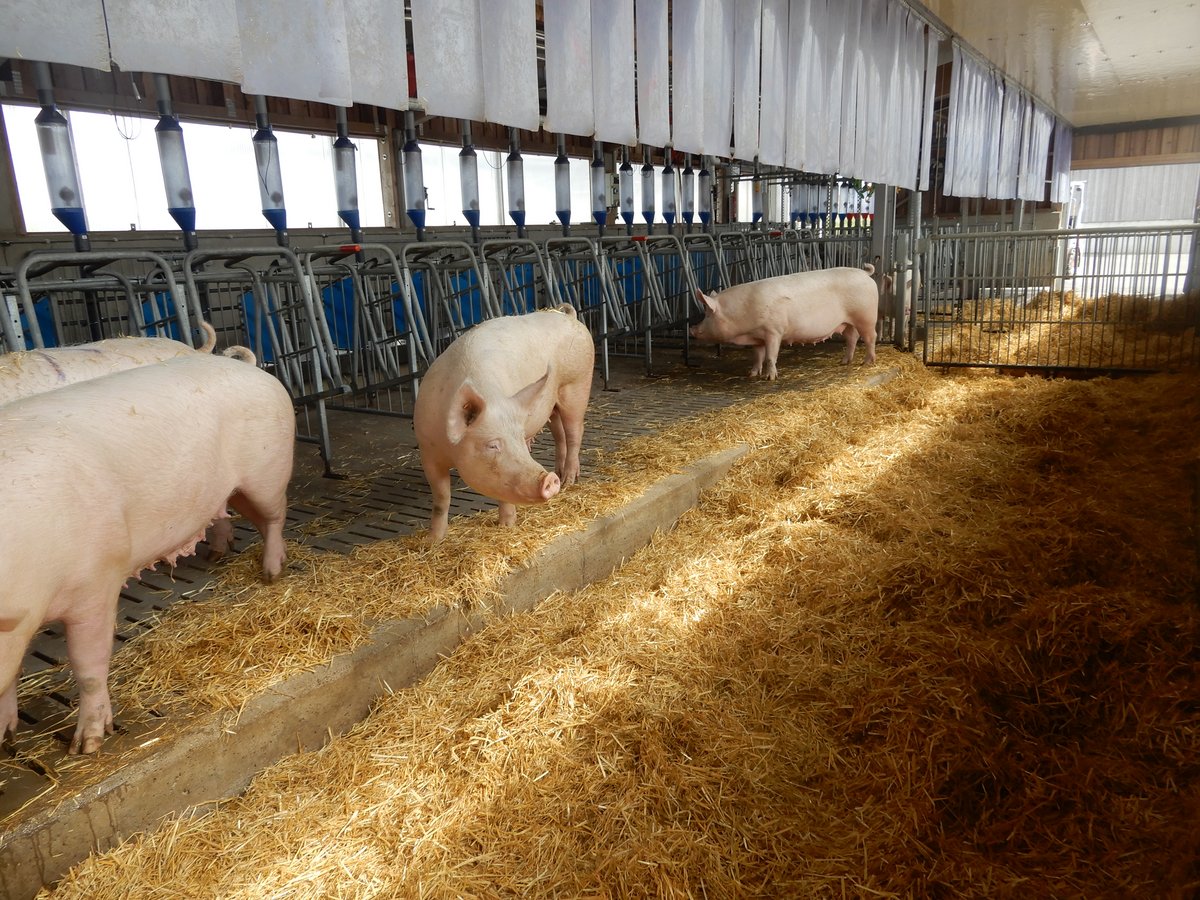
Floor design is a key factor in pen layout. A floor area of 5 m² per sow provides the animals with sufficient scope to organise their pen and establish the pecking order. A floor1 that is always dry, non-slip and bedded with straw helps prevent foot problems. In straw-bedded pens, it is advisable to include areas without straw for thermoregulation purposes, which the animals can use as cool resting areas, as the straw acts as insulation.
In the first week after weaning, slatted floors should be avoided due to the risk of injury. Retrofitting closed, soft or bedded-down lying areas is generally straightforward and reliable. Rubber mats have the disadvantage of becoming slippery quickly, so the working group only recommends them for retrofits where it is not possible to use bedding or other methods to cover the slats. When using rubber mats, it should also be borne in mind that sows tend to ‘work on’ them, thereby shortening their service life. Correct installation without edges accessible to the animals is therefore important.
If slatted floors cannot be avoided, hoof health must be monitored. Regular hoof checks and care are therefore advisable. Furthermore, due to the ample space available per animal, faeces may not pass through the slats sufficiently. Furthermore, straw bedding reduces the flow properties of the slurry, meaning that no conventional liquid manure will form in the slurry channel. If slatted floors are unavoidable, they should have a slot width of less than 20 mm with a maximum perforation rate of 14.7%.2
If there are insemination pens, a small step of approx. 20–25 cm in height can be used to create a sort of ‘insemination island’ (Fig. 3). This makes mucking out of straw-bedded pens easier, as there is a mucking-out edge.
Fixed-floor systems offer great potential. For example, providing enrichment material across the floor can be made available to all animals at the same time. This reduces competition – particularly when it comes to palatable roughage such as green fodder, clover-grass silage and hay.
Especially in areas where sows come into contact with the boar, ample bedding and a non-slip floor are essential to prevent injuries. Slatted floors should be expressly avoided in these areas.3
Before starting the conversion or new build, a decision should be made as to whether a dunging area is to be defined in advance during the planning of the mating centre, or whether the sows are to establish this themselves. With the second option, it may be necessary to accept that the animals will soil the entire mating centre, requiring it to be completely mucked out each time they are moved. However, experience shows that usually only part of the area needs to be mucked out, as the sows tend to seek out a fixed dunging corner.
To keep the workload to a minimum, areas covered with more than the minimum bedding should be designed in such a way that mechanical mucking out using a tractor is possible. If the dunging area is a hard-surfaced area, it must be scraped out approximately 2–3 times a week.
(Image: LSZ Boxberg)

(Image: Animal Welfare Network, LWK North Rhine-Westphalia)
(Image: Animal Welfare Network, LWK North Rhine-Westphalia)
Food and water
There are various recommendations regarding feeding, which is why each farm must find the best approach for itself.
Both synchronised feeding and ad libitum feeding4 generally ensure a calm atmosphere in the breeding centre and are therefore both recommended. Depending on the pen layout, feeding stations can also be used (Fig. 4). However, these require that the animals are also offered roughage to create a feeling of satiety, which reduces stress. If there are no feeding stalls due to the use of feeding stations, insemination stalls should be available in the breeding centre to briefly restrain the animals for insemination or treatment.
If round feeders are used for ad libitum feeding, there should be at least 2 m of space all around to allow other animals to pass through. The feeders must not create bottlenecks. They are also well suited for providing enrichment materials. One advantage may be that the round feeders can be used to break visual contact and provide the animals with places to retreat.
With regard to water provision, it should be noted that drinking nipples should be recessed4 into the wall or fitted with protective brackets to prevent injuries. In new builds and conversions, trough drinkers are preferable, provided they are not situated in the manure area but merely nearby. This makes it easier to keep the drinkers clean. Drinking islands are also suitable in the mating centre.
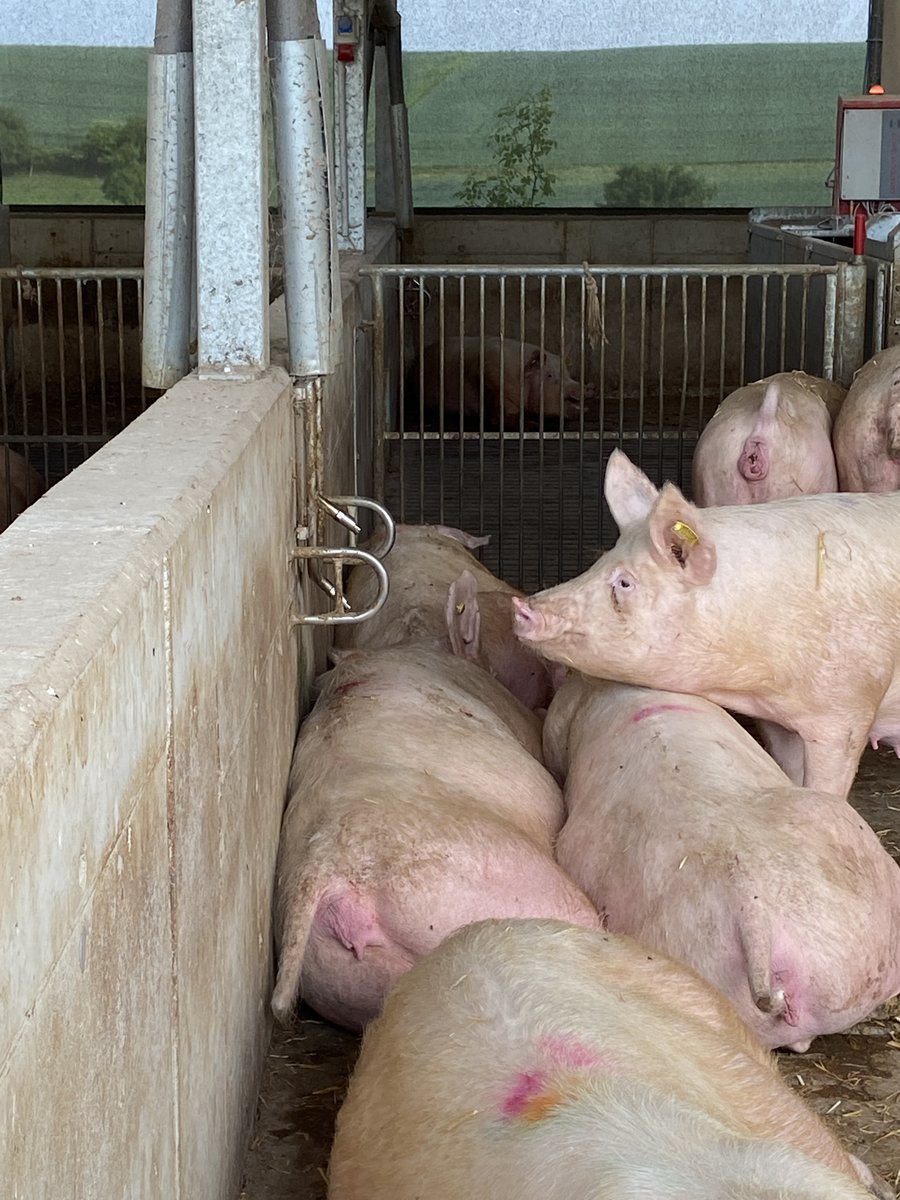
In self-catching feeding pens, drinking troughs with spray nipples and dry feeding via a volumetric feeder are possible.5 In principle, cooling facilities should be provided in new and converted buildings (implementation guidelines for the Animal Welfare Ordinance, as of 2022). Without these, high-ranking animals may, for example, block the drinkers in summer (Fig. 5). In some cases, a small amount of water on the floor is sufficient for the animals to cool down. A proper mud bath must be cleaned daily, which involves a significant amount of work. From a hygiene perspective, a deep mud bath is also a cause for concern for sows, as the genital tract is more susceptible to infection during oestrus.
The ‘Pen Layout’ working group recommends synchronised feeding. If sufficient roughage is available, a feeding station is an option. Ad libitum feeding is also suitable for sows. Provide troughs for the sows near the dunging area. However, if these are too close to or within the dunging area, they will most likely become soiled. Cooling facilities must also be available to prevent high-ranking animals from blocking the troughs in summer in order to cool down.
The ‘Enclosure Design’ working group recommends providing an outdoor run, as it enriches the animals’ environment, is a cost-effective way to create space, and can also be used as a dunging area. This helps keep indoor areas cleaner. A roof keeps the outdoor run dry, whilst insulation and sufficient roof height ensure a good climate and prevent heat build-up. Having an outdoor run could put your farm in a strong position for the future, even though it is not yet mandatory.
Mating and insemination options
Whether sows are briefly restrained or inseminated whilst free is a decision to be made on a case-by-case basis, depending on the farm and the farmer’s preference. Both methods are possible; however, the working group recommends brief restraint during insemination, as this protects the sows from being mounted by other animals and helps prevent subsequent injuries.6 In addition, restraint serves to protect people, as sows mounting others can pose a danger. A further advantage is that the duration of insemination can be significantly reduced by restraining the animals.
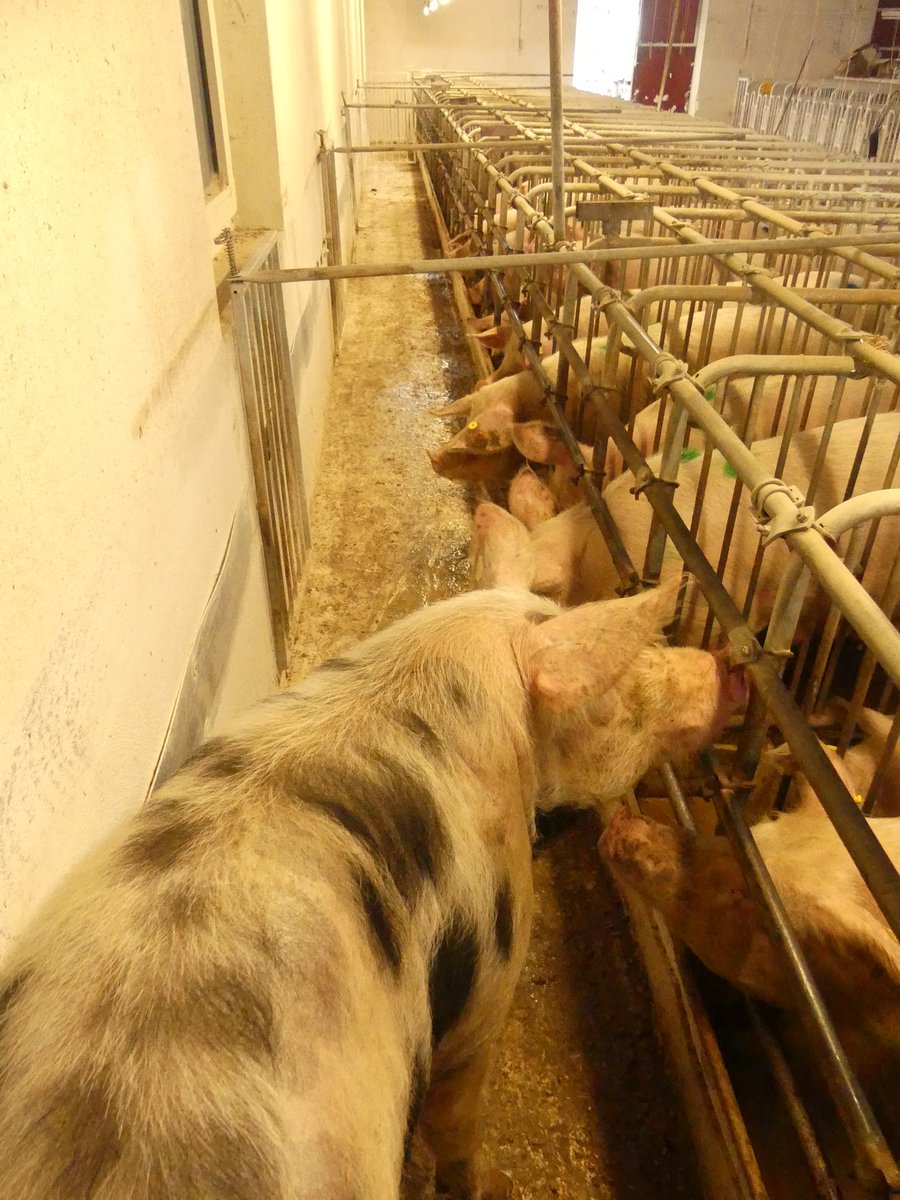
A positive aspect of free insemination is that it allows the sows unrestricted freedom of movement. To ensure occupational safety, a personnel access hatch (Fig. 6) can be provided for livestock keepers to enable them to leave the pen quickly in an emergency.
If restraint options such as feeding-resting stalls are available, which are also to be counted as resting areas, minimum widths in accordance with the implementation guidelines of the Animal Welfare Ordinance (TierSchNutztV) are recommended. The animals can thus decide whether they wish to lie down or feed freely or protected from other animals. If separate lying areas are available within the pen, a stall width of 50 cm is entirely sufficient for feeding and insemination. If restraining facilities are not available for all animals, insemination can be carried out in small groups one after the other.
Without self-caging pens, the sows no longer have a retreat area, but a hierarchy develops more quickly. It is therefore advisable to keep restraint facilities closed when not in use, such as outside feeding times, if they are also used for feeding. This promotes the rapid establishment of a hierarchy. It should be noted, however, that this area must not be counted towards the 5 m².
If basket pens are available, these may only be used as a short-term restraint option. Folding them up creates more space in the pen, the walkways become wider7 and the troughs are permanently accessible. They are a good alternative for conversions, but require more time for restraint.
In principle, the ‘Pen Structure’ Working Group recommends inseminating sows whilst they are restrained. This is safer and saves time. However, gilts can be inseminated freely in small groups, as they are not accustomed to being restrained. This helps to avoid stressful situations. If the animals are inseminated freely, there should still be a few restraining options available. This makes it easier to treat sick animals.
For health and safety reasons, the ‘Pen Design’ working group recommends inseminating sows that are restrained. This protects the animals from being mounted by other animals, ensures the safety of farmers and saves time. A walk-out door generally makes it easier to exit the pen and, even with unrestrained animals, allows for a quick exit from the pen in an emergency.
(Image: Animal Welfare Network, LWK North Rhine-Westphalia)
(Photo: R. Wiedmann)
Boar contact
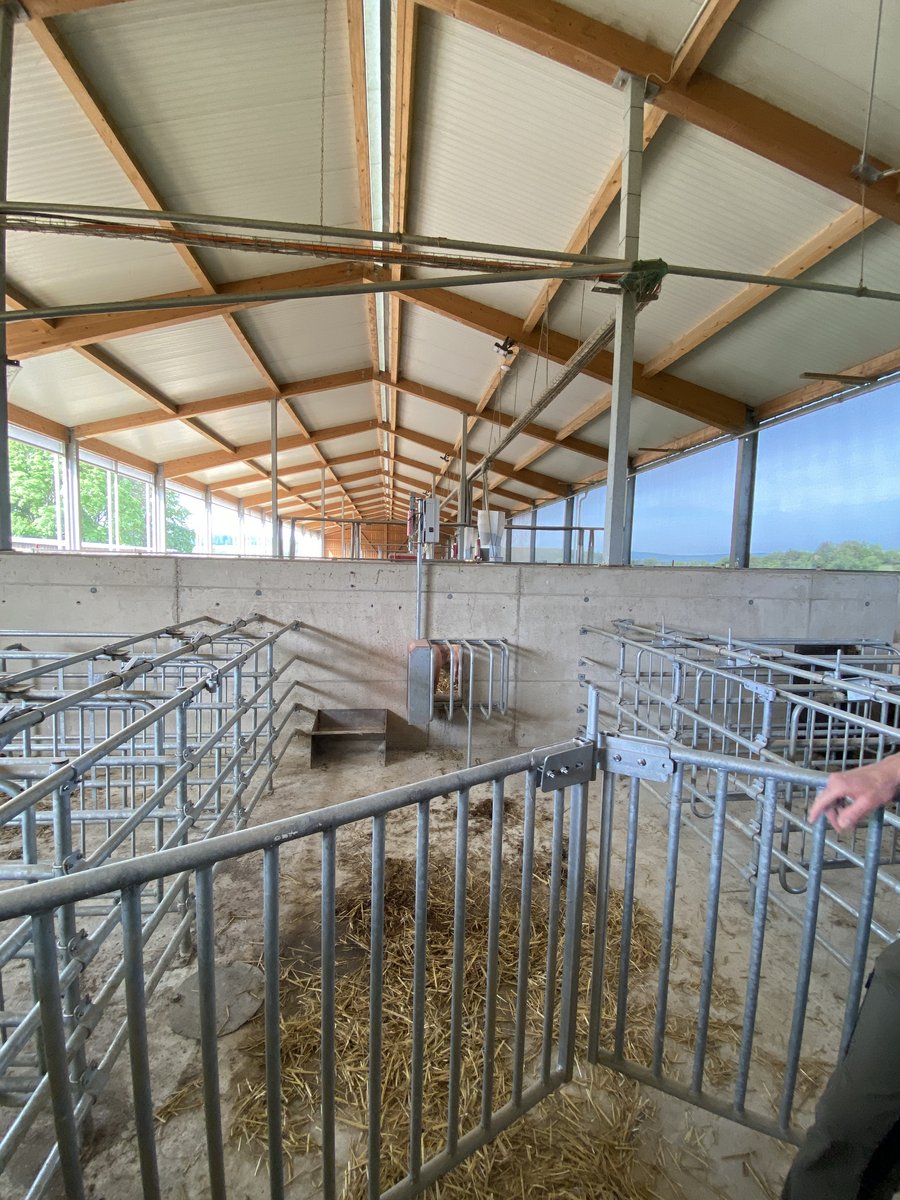
The boar plays a major role in group housing within the insemination centre, as it is important for the sows to have visual contact with him before and during insemination.4 A suitable arrangement for this, for example during restraint, is a boar pen (Fig. 7) in which the boar is kept, or a boar walkway (Fig. 8). The passage should be divisible into different sections so that the boar is always positioned in front of the sows to be inseminated during the process, in order to stimulate them. The next section of the passage can then be opened so that the boar can stimulate the animals to be inseminated next. To promote oestrus through early and intensive boar contact, a boar contact grid can also be installed in the mating centre. This should be wide enough to allow all animals to be inseminated to come into contact with the boar.2 Otherwise, stress, crowding and injuries may occur.3 Although the boar contact window has so far been established primarily in the waiting pen, there have also been positive experiences with its use in the mating pen. The windows can assist the farmer in monitoring oestrus, as sows in oestrus seek contact with the boar.
lounge area
Under the Animal Welfare Ordinance (TierSchNutztV), each sow must be provided with at least 1.3 m² of lying area. Feeding-lying stalls or other feeding areas are included in this calculation provided they meet the requirements for a feeding-lying pen. Pigs prefer darker areas for lying down. In cold housing, covers with slatted curtains2 or cubicles with two entrances and exits are suitable for this purpose. In heated housing, covers are not essential, but the lying area should still be darker than the rest of the pen. If lying boxes are used, they should be approx. 2 m wide and at least 2.20 m deep, providing space for four sows. No more than eight animals should be housed per box, as otherwise it will quickly become soiled.
Arena
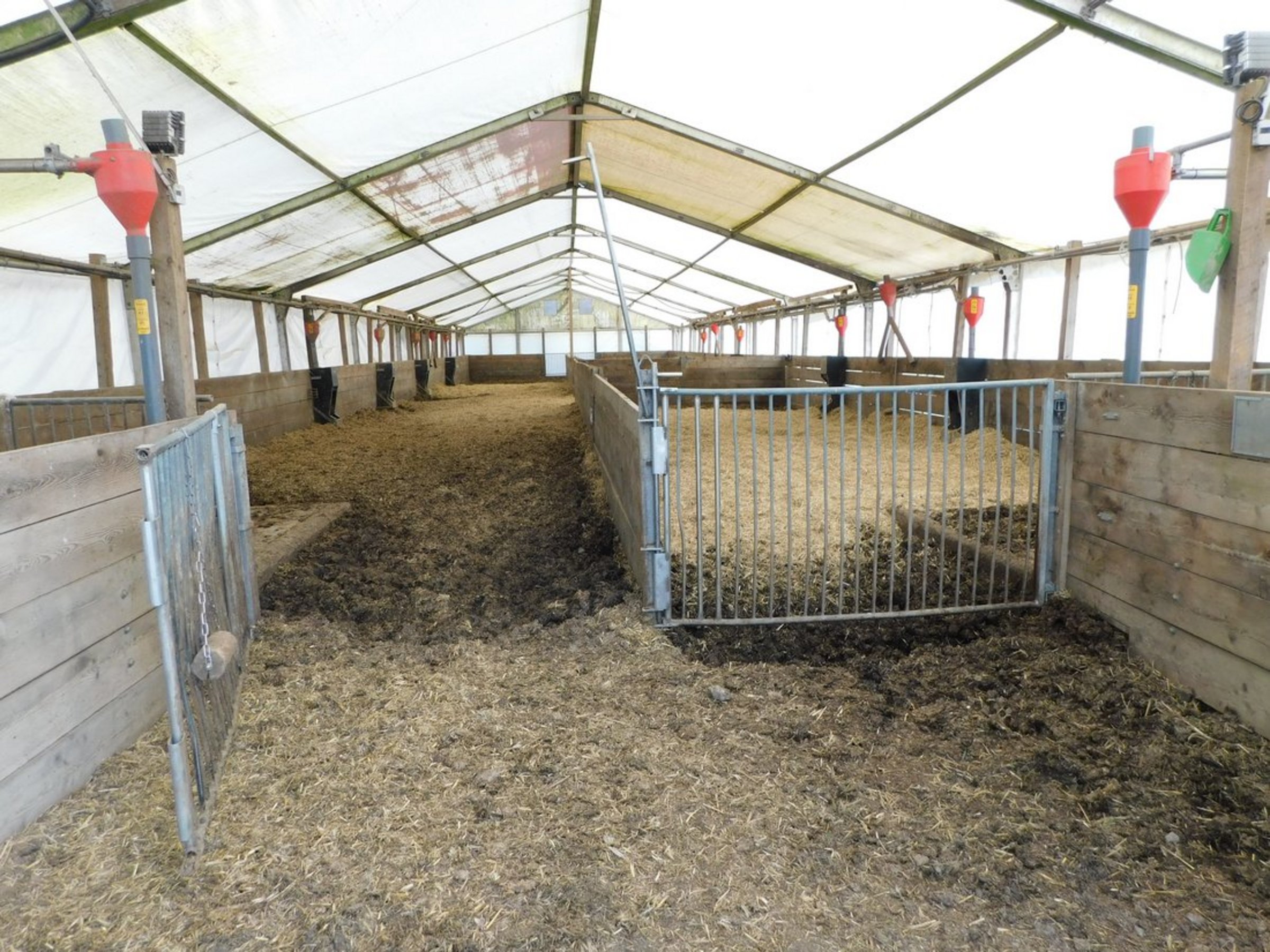
The arena (Fig. 8) should not serve as the centre of the deck, but should be situated in front of it. Care must be taken to ensure that there are no objects present with which the animals could injure themselves. There may be a high risk associated with drinking, roughhousing or opportunities for rubbing. If an arena is not feasible, the mating centre can also fulfil this function due to the ample space available, although the risk of injury should be minimised here too. At least two days in the arena are required before a hierarchy among the sows has been established. A suitable time to move the sows to the mating centre is when the first sows begin to come into heat. A suitable feeding method in the arena is, for example, dry feeding with a maximum animal-to-feeding-place ratio of 4:1 for ad libitum feeding; otherwise, a ratio of 1:1 should be used. The floor should be slatted, non-slip and bedded.8
Bibliography
- 1: BLE (2021): Farm-wide housing concept for pigs – sows and piglets: https://www.ble-medienservice.de/0073/gesamtbetriebliches-haltungskonzept-schwein-sauen-und-ferkel Accessed on: 12 July 2022
- 2: LSZ (2021): Group housing of sows to be mated. Practical experience and examples: https://lsz.landwirtschaft-bw.de/pb/site/pbs-bw-mlr/get/documents_E949947673/MLR.LEL/PB5Documents/lsz/pdf/Projekte%20und%20Versuche/Gruppenhaltung_von_zu_belegenden_Sauen_1.Auflage.pdf Accessed on: 12 July 2022
- 3: Weber R., Schiess C. (2006): Group housing of sows during the breeding season. Practical experience. ART Reports, No. 658/2006. Federal Department of Economic Affairs FDEA, Agroscope Reckenholz-Tänikon ART Research Institute.
- 4: Hoy S., DLG Committee for Pig Production (2015): DLG Fact Sheet 408. Grouping of sows. DLG e.V., Frankfurt am Main.
- 5: LSZ (2022): Final report. Project: “Testing and evaluation of new husbandry methods involving group housing of sows at the breeding centre – effects on animal behaviour, integumentary and footpad damage, fertility and labour efficiency”: https://lsz.landwirtschaft-bw.de/pb/site/pbs-bw-mlr/get/documents_E-1984162133/MLR.LEL/PB5Documents/lsz/pdf/Projekte%20und%20Versuche/Abschlussbericht_MLRDeckzentrum_Projekt-Nr.%200386%20E_11-03-2022.pdf Accessed on: 12 July 2022
- 6: DBV, ISN, BRS (2017): Current state of discussion on the housing of sows in the breeding centre. https://www.offensive-nachhaltigkeit.de/wp-content/uploads/2018/12/Diskussionsstand-zur-Haltung-von-Sauen-im-Deckzentrum.pdf
- 7: BMEL (n.d.): Making sow husbandry more animal-welfare-oriented: www.mud-tierschutz.de/schweine/tragende-sauen/aufstallung-und-management/ Accessed on: 12 July 2022
- 8: Jais, C. (2019): Making sow husbandry sustainable! LfL Annual Conference 2019, Pig Conference.