

- Dr. Alexandra Koch, Saxony-Anhalt Animal Health Service
- Dr. Christian Koch, Teaching and Research Institute for Animal Husbandry, Hofgut Neumühle
- Dr. Ingrid Lorenz, Animal Health Service Bavaria
- Prof. Dr. Anke Schuldt, Neubrandenburg University of Applied Sciences
- Julia Maischak-Dyck, Landesbetrieb Landwirtschaft Hessen
- Caroline Leubner, Landesbetrieb Landwirtschaft Hessen
- Lukas Trzebiatowski, Department of Veterinary Medicine, JLU Giessen
- Lydia Stahl, Department of Veterinary Medicine at JLU Giessen
- Stephanie Ped, Technical University of Bingen
- Rebecca Franz-Wippermann, FiBL Germany e.V.
- Marc-André Kruse-Friedrich, DLG e.V.
Introduction
Successful rearing of healthy calves forms the basis for sustainable dairy farming. The initial care of newborn calves is particularly important in this regard. Calves are born without specific immune defences because maternal antibodies do not pass through the placenta to the calf. Immunoglobulins from colostrum must therefore be absorbed by the calf via the gastrointestinal tract after birth and transferred into the bloodstream. For this reason, passive immunisation of the calf through the administration of colostrum (beest milk) has a decisive influence on the health of calves. Good colostrum management is therefore one of the main factors for good health and low mortality in calves in their first weeks of life.
The importance of early colostrum feeding for the purpose of passive immunisation is well established in agricultural practice. Nevertheless, initial calf care remains inadequate on many farms, which is reflected in high calf morbidity and mortality rates in the first weeks of life.
This raises the question of what factors are hindering the implementation of existing knowledge. Clear requirements for colostrum supply to calves and tailored specialist information should help to improve calf health in agricultural practice.
What is colostrum / beest milk?
Colostrum, or beestings, refers exclusively to the first milk produced by a cow after calving. Colostrum has a significantly higher concentration of immunoglobulin G (IgG). When consumed in sufficient quantities and at the right time, colostrum provides passive immune protection for newborn calves during the first few weeks after birth. In addition to its significantly increased IgG and total protein concentration, colostrum contains other biologically active substances. These include leukocytes, hormones, growth factors and cytokines. All these ingredients have a positive influence on the development of the gastrointestinal tract and the immune system, thus helping to optimise the development of newborn calves. Colostrum also has a very high nutrient and energy content. As calves are born with virtually no fat reserves, early colostrum intake is also extremely important for the calf's energy supply.
Focus: Quantity and timing of colostrum feeding
The combination of sufficient colostrum intake and the timing of administration are the most important factors for successful colostrum management. These statements are based on measurements of the IgG content in the blood serum of calves.
- Colostrum must be milked immediately after calving (in any case within the first hour). Shortly after birth, the immunoglobulin content in the milk decreases, as does the content in subsequent milkings.
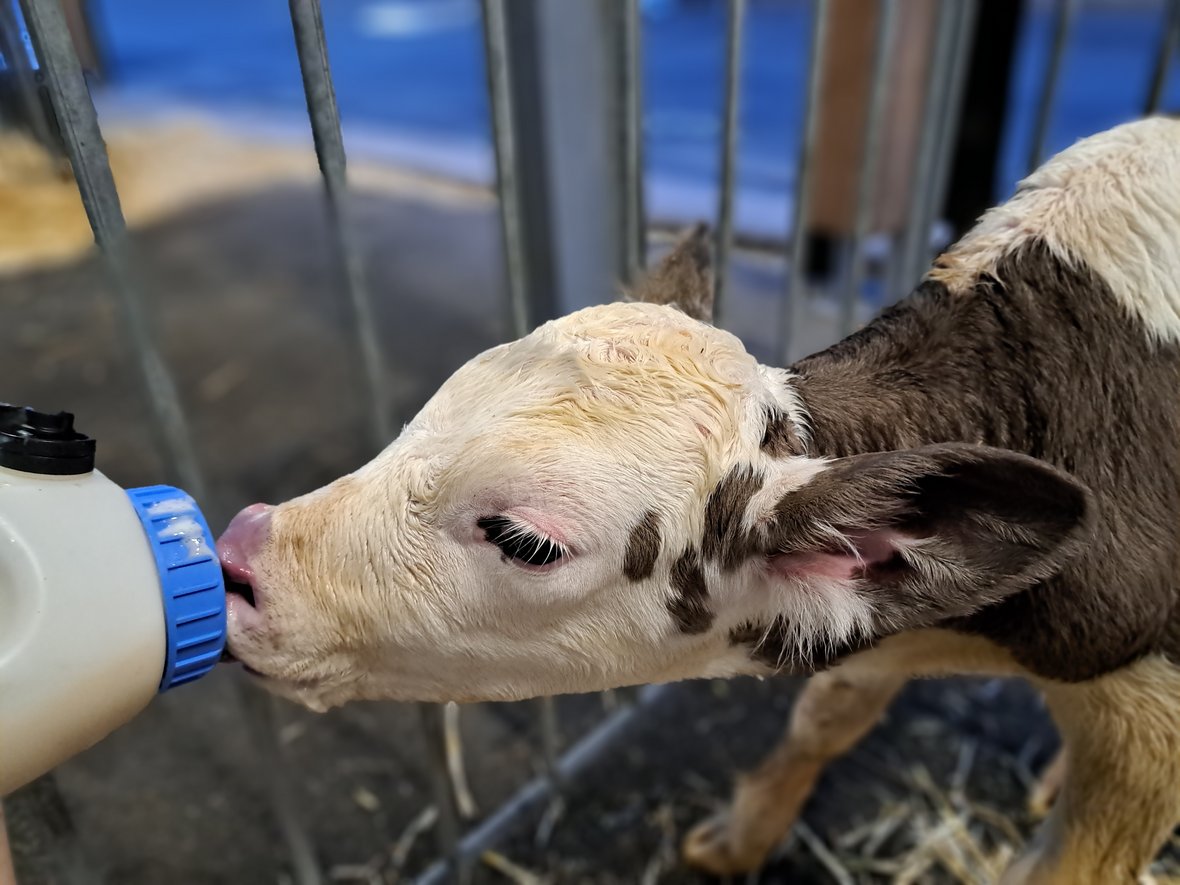
- Calves should receive at least 3 (preferably 4) litres of colostrum immediately after birth, but in any case within the first hour of life.
- In farms that do not feed the colostrum from the respective mother directly to the calves, the colostrum must also be milked within the first hour after calving.
- The recommendation is that the colostrum should be fed by the person caring for the calf, as approximately 50% of calves that consume colostrum unsupervised from the cow do not receive an adequate supply of colostrum.
Tips and tricks
If the rule of thumb – “feeding 3 to 4 litres of colostrum immediately after birth” – is followed, there is a good chance that the calf’s adrenaline levels will still be very high following birth, meaning the calf will readily and quickly consume the required amount of colostrum on its own. If it has been some time since birth, the adrenaline levels drop and the calf may be ‘too tired’ to consume sufficient colostrum.
Colostrum quality
Good colostrum should contain more than 50 g of IgG per litre, but even with lower IgG concentrations, an adequate supply for calves can be ensured with good management (see above). The prerequisite for this is that the principle of ‘feeding 3 to 4 litres of colostrum immediately after birth, and in any case within the first hour of life’ is adhered to.
- Whilst measuring colostrum quality can help optimise the supply of immunoglobulins to calves, the priority should be the rapid feeding (within the first hour of life) of a sufficient quantity (3–4 litres) of colostrum.
- If herd problems arise in the area of calf health, measuring colostrum quality can help with troubleshooting.
- Furthermore, colostrum quality can also be assessed using standard practical methods such as measurement with a refractometer or a colostrum spindle. As a rule, colostrum quality on farms is adequate.
Measurement of IgG concentration in colostrum
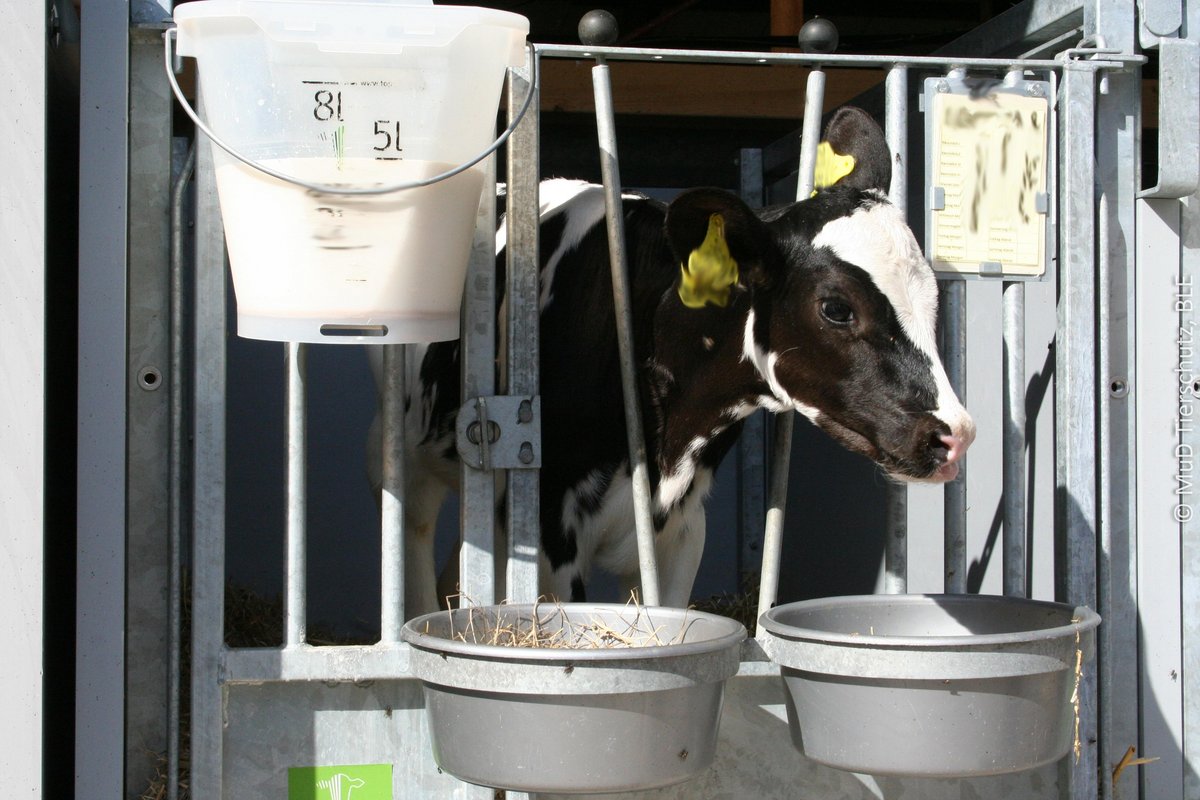
A refractometer (particularly a digital refractometer) has proven effective for measuring the IgG concentration in colostrum. The advantage of this measuring device is that it is easy to clean, requires only a small amount of colostrum, and the electronic version in particular is highly temperature-stable. The colostrum is of good quality (> 50 g IgG/l) if the measured Brix value is ≥ 22 %.
(© MuD Animal Welfare, BLE)
Management and documentation
In order to assess calf management, adequate documentation and monitoring of colostrum management are required.
Possible surveillance measures
- Determination of IgG concentration in calf blood
- Serum testing of 12 previously healthy calves between 2 and 10 days of age (see table by Goddon et al. 2019)
| Categories | Recommended serum IgG concentration (g/L) | Equivalent serum total protein (STP) (g/dL) | Equivalent serum Brix values (%) | Recommended calves in each category (%) |
| Excellent | ≥ 25.0 | ≥ 6.2 | ≥ 9.4 | > 40 |
| good | 18.0–24.9 | 5.8–6.1 | 8.9–9.3 | ~30 |
| average | 10.0–17.9 | 5.1–5.7 | 8.1–8.8 | ~20 |
| poor | < 10.0 | <5.1 | < 8.1 | < 10 |
Hygiene
When collecting and feeding colostrum, the relevant hygiene standards must be adhered to in exactly the same way as when milking cows for milk intended for human consumption. Failure to do so results in a significant increase in bacterial load as it passes from the cow to the calf. This leads to a reduction in IgG absorption in the intestine of up to 50%. Proper cleaning must also be ensured with mobile milking systems.
Good colostrum hygiene therefore means:
- Clean collection
- Clean storage
- Clean feeding
The following lists the risk points where colostrum can quickly become contaminated.
Risk factor 1: Milking colostrum
The first risk of pathogens entering colostrum is the milking process itself. It is essential to maintain the same milking hygiene standards as for milk intended for distribution. This means:
1. Put on gloves!
Preparation: Express 3 to 4 jets per teat into a pre-milking cup (!).
2. Look out for flakes, gross sensory changes and other signs of mastitis (significant warmth, redness and/or swelling of one or more udder quarters)
Important: Quarters with clinical mastitis must NOT be included in the colostrum!
1. Clean the teats – especially the teat ends – with a clean udder cloth → 1 cloth per cow, one corner of the cloth per teat
2. Milking
After milking:
3. Check the udder quarters
4. Dip the teats
5. Clean and/or disinfect the milking cups between cows. Clean the milking system
Weak point 2: The milk can
If the milk can and the feeding hoses are not thoroughly cleaned after every milking, the remaining film of milk and fat provides an ideal breeding ground for germs. The calf that is next to be fed milk from such a milk can therefore also ingests a large quantity of pathogens with its first meal. These drastically inhibit IgG absorption and can cause illnesses such as diarrhoea. The risk of transmitting potentially pathogenic pathogens is particularly high if the milk can has previously been used for cows with udder disease.
Weak point 3: The feeding bottle / feeding bucket → Accessories for the calf feeder
As with the milk can, the following applies here: if the relevant containers and teats are cleaned inadequately or not at all, the milk residues provide the ideal environment for pathogen growth and drastically increase the risk of calf diseases.
Proper cleaning is key:
In principle, all accessories should be cleaned with lukewarm water and washing-up liquid. If no technical solutions are available for this, the surfaces should be cleaned with a brush and standard washing-up liquid; wearing gloves is recommended.
When cleaning with brushes, it should be noted that plastic surfaces become increasingly roughened over time, thereby providing favourable conditions for pathogen growth. Containers that are worn in this way must be replaced. In addition, the cleaning tool (washing-up brush) must also be thoroughly cleaned regularly to prevent the transmission of pathogens between containers and accessories. The containers and accessories should also be hung up in such a way that all surfaces can dry thoroughly.
To monitor colostrum hygiene, colostrum samples can be taken for bacterial analysis. These should, for example, be collected from the drenching tube or expressed from the teat, in order to assess the bacterial load of the colostrum as it is subsequently ingested by the calf. The sample should be placed in a sterile tube and then frozen until analysis.
Guideline values for monitoring bacterial contamination are:
- Total bacterial count < 100,000 CFU/ml
- Coliform bacteria < 10,000 CFU/ml
Colostrum should be collected under hygienically impeccable conditions, as an increased bacterial load significantly reduces the absorption of immunoglobulins in the intestine. This also includes thorough cleaning of containers and equipment after each milking.
Recommendation: Wear disposable gloves, pre-milk, clean the udder, milk hygienically!
Storage
Depending on the size and structure of the farm, in addition to direct feeding of colostrum, there is also the strategy of storing colostrum.
Direct feeding
Direct feeding of colostrum, without storage, offers the advantage that, with correct management (direct feeding of colostrum within the first hour after birth), there is no time for microorganisms to proliferate significantly in the milk medium. An additional positive effect is that direct feeding generally involves the administration of maternal colostrum. This has a beneficial effect on the calf due to the maternal leukocytes, hormones, growth factors and other non-nutritive substances contained in the colostrum.
Options for housing routines
- Deep-freezing
- In this case, the colostrum should always be deep-frozen at ≤ -20 °C for a maximum of 1 year (!). To monitor the maximum storage time, it is essential to label the containers with the date of calving – and, if measured, the colostrum quality as well. In addition, the temperature in the freezer should be checked at regular intervals (especially in summer). Even when frozen colostrum is stored correctly, the effect of the immunoglobulins is reduced. For faster thawing of the colostrum, it is advisable to freeze it in portions in freezer bags, which are laid flat in the freezer compartment. Alternatively, there are numerous product systems available on the market that meet the following criteria: sufficient volume, rapid thawing, hygienic filling and, if desired, the option of pasteurisation. Thawing should take place at temperatures below 50 °C. Higher temperatures lead to further damage to the immunoglobulins.
2. Refrigerator storage
- Colostrum can be stored in the fridge for a maximum of 48 hours at ≤ 4 °C. With this storage method too, clear labelling of the colostrum is essential (see above). The performance of the fridge should be checked weekly.
Monitoring bacterial contamination in the event of herd problems:
- If health problems among calves arise as a herd issue, a bacterial analysis of the colostrum can provide insight into possible causes and systematic management errors. However, the colostrum management points described above should first be reviewed.
3. Pasteurisation
- Storage following prior pasteurisation offers a way of reducing the bacterial load in colostrum. For correct application, the manufacturer’s instructions for the respective pasteuriser must be followed, and the specified times and temperatures adhered to. In general, however, it should be noted that temperatures of 60 °C should not be exceeded for one hour when pasteurising colostrum.
Soaking colostrum
In accordance with the legal framework, it is recommended that colostrum should only be force-fed if the calf does not voluntarily drink the recommended amount of 3 litres of colostrum within the first few hours of life.
How to administer the colostrum:
- Refer to the farm vet for any questions and training on how to carry out the procedure
- here too, the container should have a capacity of 3 to 4 litres
Bibliography
- Goddon, S., Lombard, J., Woolums, A., 2019, Colostrum Management for Dairy Calves. Vet Clin Food Anim 35, pp. 535–556
- Lorenz, 2021, Calf health from birth to weaning – an update. Irish Veterinary Journal, 74:5
- Sheila McGuirk VCNA 2004 → Guidelines for bacterial contamination of colostrum
- Buczinski and Vandeweerdt, 2016, Diagnostic accuracy of refractometry for assessing bovine colostrum quality: A systematic review and meta-analysis, J. Dairy Sci. 99:7381–7394 → Refractometer