4.1 A good human-animal relationship
A good human-animal relationship is crucial for a relaxed daily routine for both the animal caretaker and the sow. Particularly around the time of farrowing, it is important for sows to feel a certain degree of trust. Fear or nervousness towards humans has a negative effect on both the farrowing process and maternal behaviour.56 If sows react nervously to the presence of humans or try to withdraw, this can lead to increased standing up and lying down during and after farrowing. This increases the risk of crushing losses.57, 58
What can animal carers do?
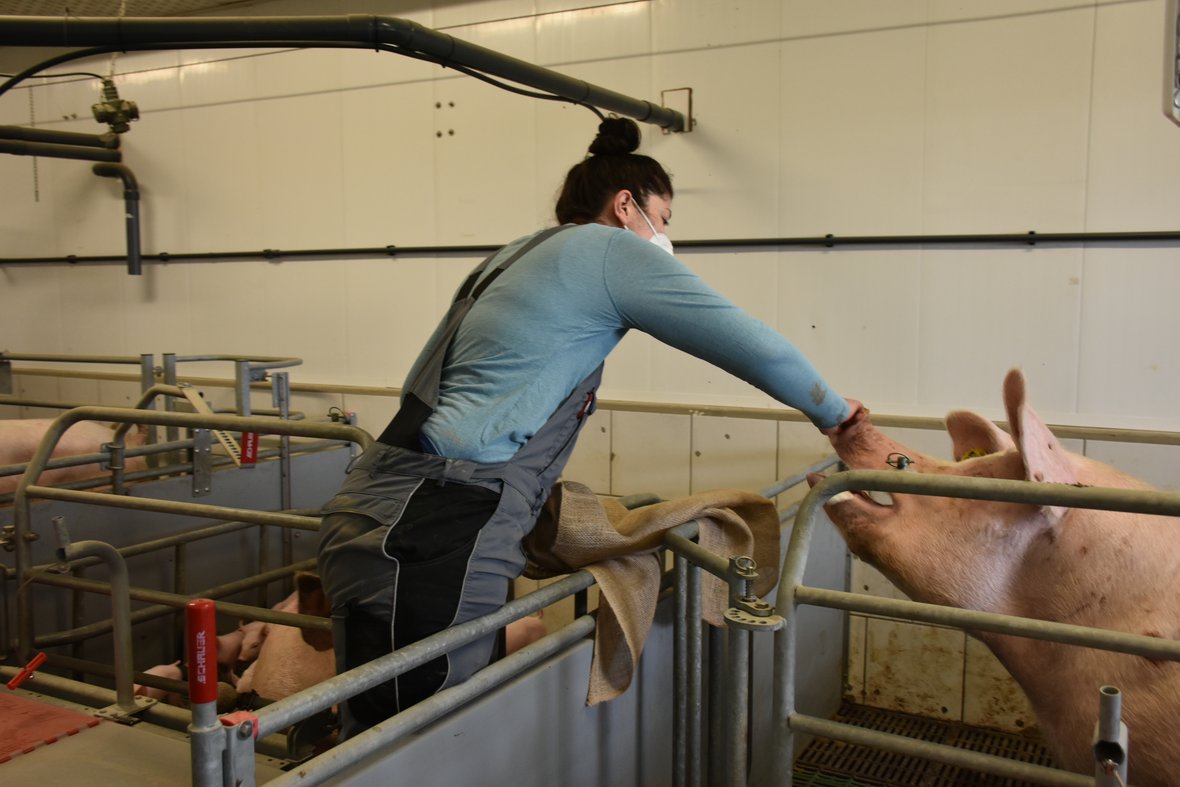
First and foremost: if you remain calm yourself, this has a direct positive effect on the sow. As both the frequency and duration of positive interactions are crucial,59 you should therefore make time for regular attention (Fig. 8). Stroking (Video 4), gentle patting – even during rest periods – speaking calmly, and playing soft, soothing music throughout the day all have a calming effect on the sow.60, 61, 62 You can also build a rapport with the sows by feeding them, for example, hay or straw by hand. Thoroughly washing the sows also promotes a direct human-animal bond and can improve subsequent handling of the sows.
Practical experience
- "A very good rapport with the herd and regular physical contact (e.g. stroking the head) make the work – especially during farrowing – much easier. If I am not perceived as a threat, the sow’s stress levels are lower. If my touch is perceived as pleasant, this makes tasks such as udder checks much easier."
- "Talk to the sow and the piglets when entering the pen."
4.2 Tips for getting started
Workplace safety is of paramount importance when the piglet protection cage is open in the exercise pen and in free farrowing systems.
Sows that fail to learn the system or display increased aggression towards humans must therefore be removed from the herd in the long term. When designing the pen, the requirements from the perspective of both the sows and the piglets must be identified and implemented. Work processes must be organised efficiently. Close observation of the animals reveals weaknesses in the system. Often, even minor adjustments lead to an improvement in the situation. Particularly in large pens, the farrowing nest should be designed to be very attractive in order to increase nest acceptance. In addition to the design of the nest, the temperature of the farrowing nest also plays a decisive role. If the nest is too warm, the piglets will simply lie down elsewhere in the pen. If the nest is too cold, they will lie down with the sow. In both cases, the risk of being crushed increases.
Furthermore, in addition to the piglet nest temperature, the pen temperature plays a significant role in terms of nest acceptance. The room temperature should be as cool as possible as quickly as possible to meet the sow’s needs and increase the piglets’ motivation to retreat to the warm nest.

4.3 The sow’s history
The so-called sow planner primarily provides production data for individual sows and the herd. Information on insemination, return to oestrus and farrowing, for example, is recorded there. With the help of such a data-recording programme, traits and behaviours during farrowing can also be noted. This information forms an important basis for selection decisions, for example. The assessment and evaluation of the udder after weaning is a further criterion for selection. Sufficiently functional teats are a prerequisite for good rearing performance in the subsequent lactation. As with the selection of breeding gilts, the target should be 15 to 16 teats.
Crush losses vary greatly from animal to animal and could also be used as a criterion for selecting sows.63, 64
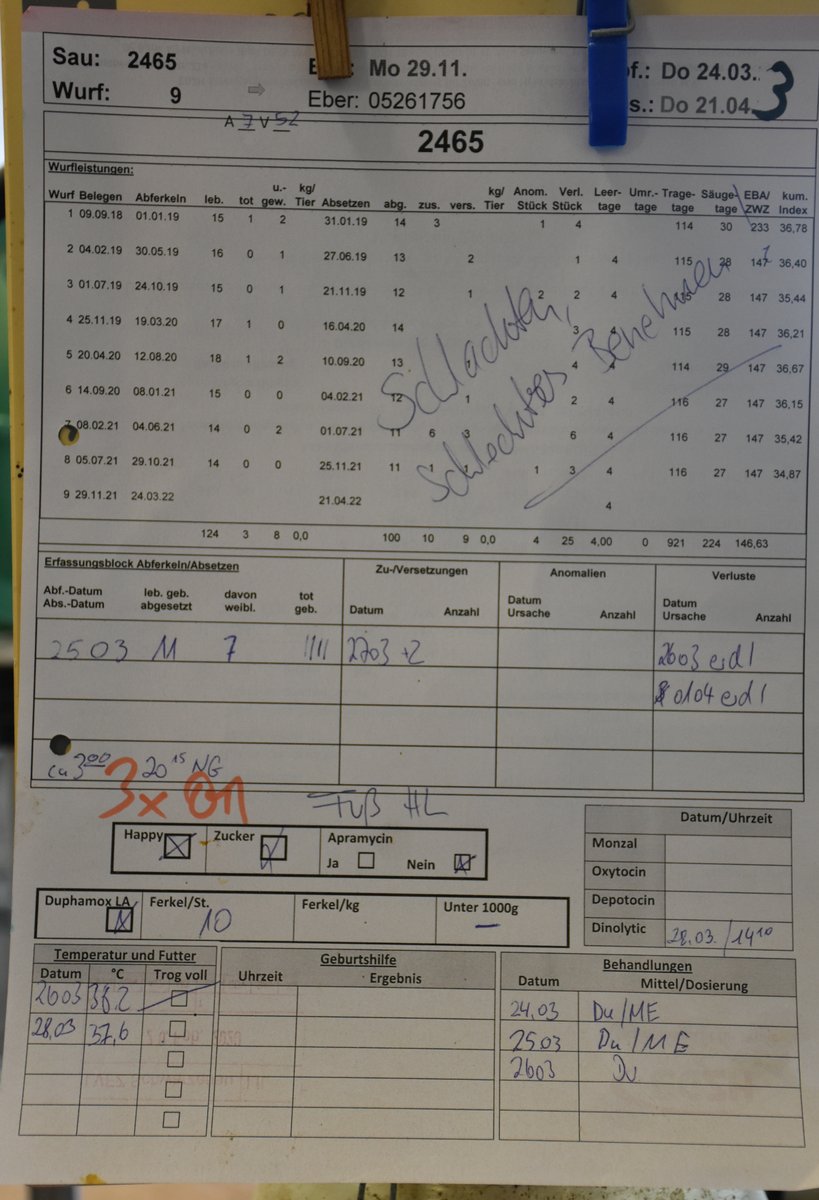
Furthermore, information regarding piglet losses and rearing performance can serve as an aid when moving piglets. A sow card is like the sow’s identity card and should always be kept in the farrowing pen (Figs. 9 and 10). Anyone wishing to obtain a specific overview of a sow’s maternal traits can, for example, create a so-called ‘maternal card’ (Video 5). This can be used to calculate a maternal index (free programme), which helps to reduce suckling piglet losses through targeted selection for good maternal traits.
Training script on the maternal ability map
Calculation of the maternal index
Which traits are included in the maternal index?
- Farrowing behaviour
- Sow health
- Litter quality
- Lying behaviour
- Friendliness towards humans
4.4.1 Deworming and treatment for mange
Deworming the sow before she is moved into the farrowing pen prevents the transmission of worms or their eggs to the piglets. It is important to note that parasite eggs adhere firmly to the coat. For this reason, in addition to medicinal deworming, showering is also part of the control measures.
Any mange mites present are also transmitted from the sow to the piglets, so medicinal treatment (by injection or as a pour-on) is also recommended before farrowing.
The farm veterinarian is responsible for implementing a deworming and mange treatment management programme tailored to the farm.
4.4.2 Showers
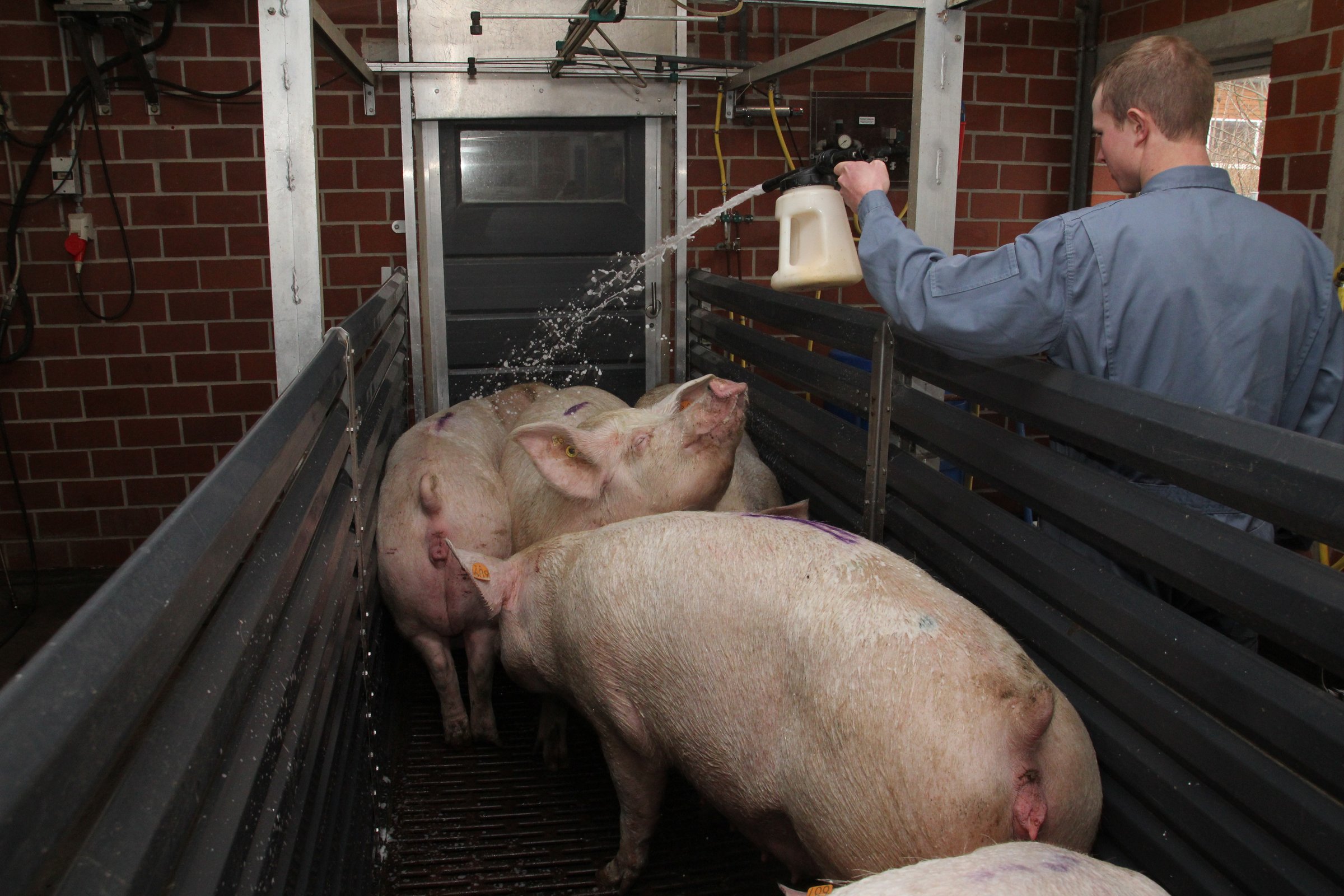
For hygiene reasons, sows should always be showered before being moved from the holding pen to the farrowing pen (Fig. 11). Even if the sow appears clean to the naked eye, any adhering germs may pose a risk of infection to the piglets. If soiling has occurred in the lying area or wallowing in the manure area during the waiting period, sows – some of which are heavily soiled – are moved from the waiting pen to the farrowing pen. A thoroughly cleaned and disinfected pen is of little benefit to the newborn suckling piglet if the mother sow herself carries in a large number of germs. It is therefore entirely appropriate to wash the sows from head to toe before moving them to the farrowing pen. In particular, the udder, head and body should be cleaned, as the suckling piglets come into direct contact with these parts of the body immediately after birth. Many farmers neglect the udder when washing. Therefore, a brush should be used to clean hard-to-reach areas of the sow’s body. Simply washing with cold water is not ideal and can also have a negative effect on the unborn piglets. The water should be at the sow’s body temperature (35–37 °C). To remove as much dirt and germs from the skin as possible, a sow wash is recommended that, where possible, has a cleansing and disinfecting effect as well as being gentle on the skin. Products designed to remove sticky roundworm eggs from the sow are also available on the market.
Similar to pen washing, the sows are first soaked, then lathered with shampoo and finally rinsed. For lathering, a foam sprayer is recommended to automatically dispense the manufacturer’s recommended amount of detergent. After washing, the clean sows are moved to the well-preheated farrowing pen. The room temperature should be set to around 20 °C so that the sows dry quickly and the risk of catching a cold remains low.
A sow shower in a room or area specifically designed for this purpose is advisable. From an operational efficiency perspective, it is advantageous for the shower to be positioned between the waiting and farrowing pens and to be sized to accommodate the farrowing group. To prevent stress in the sow shower, 1 m² per sow is recommended. However, a certain amount of physical contact between the sows is certainly desirable to achieve mechanical cleaning. With concrete slats having a slot width of 18 mm, water can drain away effectively, ensuring sufficient slip resistance and preventing injuries.65 However, care must be taken to ensure adequate ventilation so that the moist air is removed. Otherwise, the water vapour-saturated air can lead to oxygen deficiency and heat stress in the sows, which can result in circulatory failure or stillbirths.
Washing the sows only in the farrowing pen is not the ideal solution, as the sows carry dirt and germs into the farrowing pen. Nevertheless, washing in the farrowing pen is still better than not washing them at all. Another alternative is to wash the sows in the holding pen. When working in small groups, the pens can then be hosed down directly. For large groups, washing can take place in the selection pen. A central corridor can also sometimes be used for washing the sows.