
Introduction
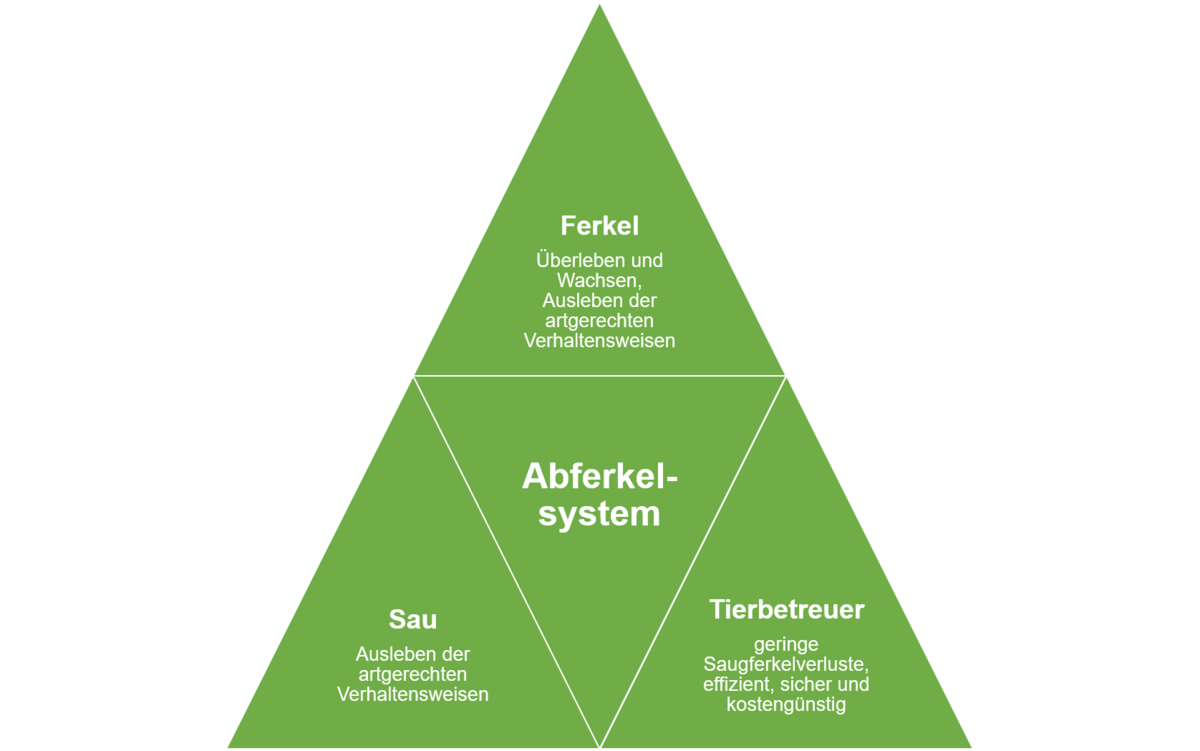
Part 2 of the guide “Focus on Pig Welfare – Alternative Farrowing Systems” focuses on the animal itself. It covers both the conditions the sow must meet and the management practices employed by the animal caretaker that influence the welfare of the sows and piglets. To create the best possible conditions for farrowing, we need to understand how the design of the farrowing pen, management practices and the sow’s maternal traits interact. An optimal combination of these three factors – that is, good pen design, good management and high maternal instincts – will then contribute to a high piglet survival rate.2 The challenge, therefore, lies in designing and managing alternative farrowing systems in such a way that they meet the needs of the sow, the piglets and the farmer (Fig. 1).
The following definitions are used in the text below:
Exercise pens allow the sow to be restrained in a farrowing crate before, during and after farrowing. In free farrowing, however, the sow’s movement is not restricted either before or during farrowing, nor during the suckling period (= free-range pen). However, a means of restraining the sow, e.g. for treatments on the sow and piglets, may be available. This is often designed in such a way that, due to the absence of a feed trough and/or water trough, restraint is only possible for a short period of time.
Most of the aspects mentioned below apply to both farrowing systems, so that the specific pen type is only explicitly mentioned where there are differences.
As it can be assumed that the two systems mentioned above are the main ones in use in Germany, other housing systems, such as get-away pens or outdoor farrowing, will not be discussed further here.
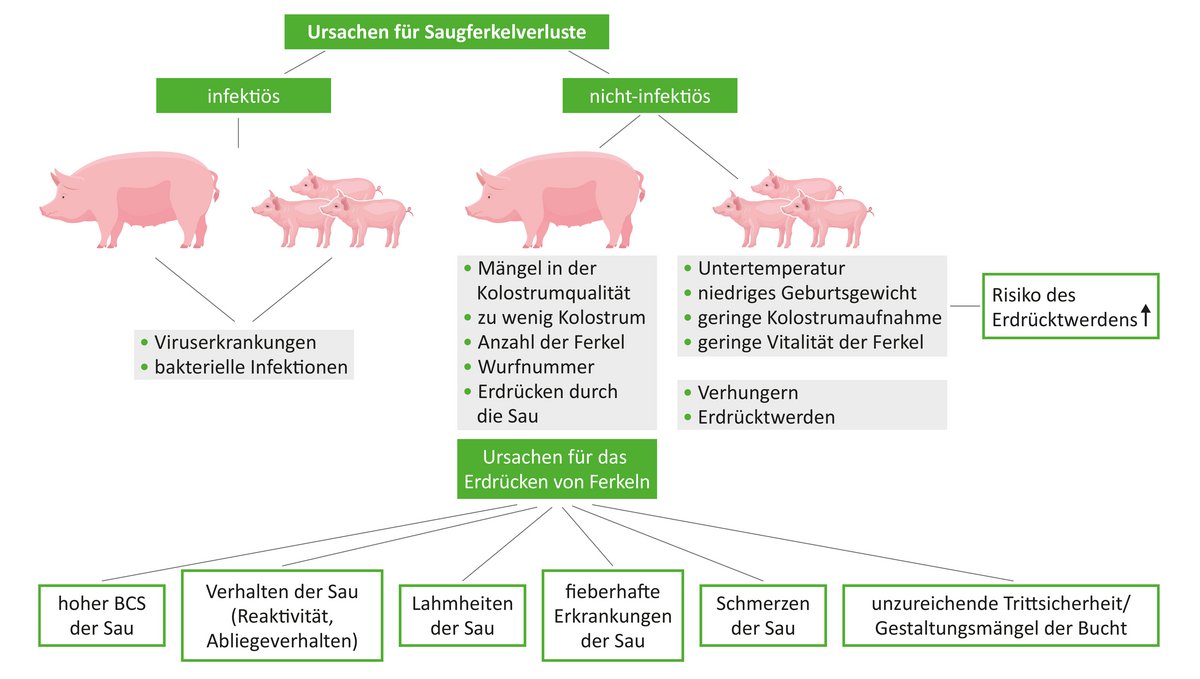
Losses of suckling piglets have a wide variety of causes and can originate from either the sow or the piglet (Fig. 2). There are thus infectious and non-infectious causes. Bacterial diarrhoea in suckling piglets or respiratory infections can lead to higher losses. Viral infections can also cause massive losses during the suckling period. In addition to infectious causes, low birth weight, poor vitality of the piglets, deficiencies in colostrum quality and quantity, litter number and crushing play a role as non-infectious factors in piglet losses during the suckling period.3, 4, 5
In this context, the timing of suckling piglet losses must be taken into account. The literature provides varying information regarding the timing of the highest suckling piglet losses and recommendations for the duration of sow confinement. The first three days of life are most commonly cited as a particularly critical period.4, 6 Heidinger et al.7 conclude from their study involving different restraint durations that restraining the sow for three days after farrowing is an effective measure for reducing losses of live-born piglets. Extending the post-birth restraint period from three to five days did not further reduce suckling piglet losses.
In the context of farrowing systems without permanent confinement in a farrowing crate, there are repeated concerns about increased suckling piglet losses. However, studies often merely compare the incidence of crushing losses when evaluating different housing systems. Other causes of loss, such as the number of stillborn piglets and total losses during the suckling period, are not presented. A genuine comparison of different housing and management systems cannot be made in this way, as crushing losses represent only a subset of the overall loss situation.6 Studies in Switzerland show that free farrowing does not result in more piglet losses than farrowing pens with crates.8 However, the genetic background of Swiss sows and the number of live-born piglets per litter must be taken into account. Both differ from most German systems.
This guide focuses primarily on measures that can reduce crushing losses.
To assess the situation within one’s own herd – not only in terms of suckling piglet losses – animal welfare indicators for sows and suckling piglets can be reviewed, for example, using the KTBL9’s guide ‘Animal Welfare Indicators: A Practical Guide for Pig Farming’. Following the survey, the farm results are compared with the target and alarm values for the farm’s own monitoring system to assess whether action is required to improve the farm’s animal welfare situation.
The target and alarm values for suckling piglet losses during the suckling phase shown in Table 1 apply regardless of which farrowing system is considered.
| Animal welfare indicator: suckling piglet losses | Unit | Target range | Alarm range |
Ongoing surveys: all suckling piglets Animal losses | |||
| Proportion of stillborn piglets out of the total number of piglets in the litter | Proportion of animals in % | ≤ 5.0 | ≥ 10.0 |
| Proportion of piglets that died or were euthanised during the suckling phase out of the total number of live-born piglets in the litter | Percentage of animals | ≤ 12.0 | ≥ 17.0 |
<figcaption>Table 1: Reference framework with target and alert values for suckling piglets for interpreting the results of on-farm self-monitoring in accordance with the KTBL practical guide “Animal Welfare Indicators: A Practical Guide – Pigs”9</figcaption>