

5.1 Time of arrival
Sows should be moved into their pens four to six days before the calculated due date; this is in line with the natural behaviour of sows, which in the wild also separate themselves from the family group a few days before giving birth. It also allows the sow time to get used to her new pen. Any stress caused by the change of environment should be ‘alleviated’ well in advance of the birth.
Unfamiliar nesting material should only be provided after the sow has been moved into the pen, as some sows may be ‘startled’ by it beforehand, making it more difficult to move her into the pen. To allow the sow to familiarise herself with the pen in advance, she should not be restrained immediately after being moved in.

Animal Welfare Ordinance
Section 24(4)
"A farrowing pen in which the gilts or sows can move freely must have a floor area of at least six and a half square metres and allow the gilts or sows to turn around unhindered. A farrowing pen must also be designed in such a way that there is sufficient space behind the resting area of the gilts or sows to allow for unhindered farrowing and obstetric procedures."
Section 30(2b)
"If gilts or sows are not kept in a group during the period from one week before the expected farrowing date until the weaning of their piglets, they may only be kept in pens that meet the requirements of Section 24(4). In this context, gilts and sows may only be kept in crates for a maximum period of five days, which includes the time during which the gilt or sow farrows."
5.2 Preparing the stable
Checkpoints
- separate footwear for the farrowing pen
- Change footwear before entering the pen or place a disinfection tray in front of the pen
- Check drinking flow rates (> 2.5–3.0 l/min) and water temperature (> 12 °C, but not too warm)
- Monitoring of piglet nest temperatures (infrared thermography of the floor slab: 39–41 °C across 40–50% of the slab’s surface)
- Sprinkle hygiene/dry powder into the piglet nest
5.3 Water supply
In warm weather, a sow in the farrowing pen can drink up to 50 litres a day. Sows in the farrowing pen must therefore have access to sufficient, clean water at all times. Pigs are siphon drinkers, which means they dip their lower jaw into the open water surface and suck the water in with a slurping motion. For this to work, the water level in the open trough must be high enough (approx. 5 cm). If Aqua Level systems are used, the troughs should ideally be tiltable and easy to clean so that feed residues and stale water can be removed regularly and easily. Good trough hygiene is essential in this area. In the case of open troughs, the bacterial load in the water must be checked regularly.
A high flow rate of 2.5 to 3.0 l/min should be provided for lactating sows (Table 4).
| Housing stage | Live weight (kg) | Water requirement (l/animal per day) | Flow rate (l/min) |
| Suckling piglets | < 9 | 0.7 – 1 | 0.4 – 0.5 |
| Weaned piglets | < 29 | 1 – 3 | 0.5 – 0.7 |
| Fattening pigs | < 50 | 3 – 6 | 0.6 – 1.0 |
| 50–80 | 5 – 8.5 | 0.8 – 1.2 | |
| 80 – 120 | 8.5 – 11 | 1.5 – 1.8 | |
| Pregnant and farrowing sows | 8 – 12 | 1.5 – 1.8 | |
| Late-gestation sows | 10–15 | 1.5 – 1.8 | |
| lactating sows | 15 + 1.5/piglet | 2.5 – 3.0 | |
| Boars | 12 – 15 | 1.0 – 1.5 |
Bite nipples and troughs must be cleaned and disinfected before the animals are brought in. Care must be taken to ensure that no traces of disinfectant remain in the trough before the animals are brought in. A mother-and-piglet drinker (Fig. 12) is recommended as an additional drinker. The piglets not only learn from the sow how to drink from a drinker, but they also ingest bacteria from the sow’s saliva and feed residues, which can have a positive effect on their health as it ‘trains’ the immune system. Furthermore, even sows lying down can drink water during farrowing.
If no mother-and-piglet drinker is available, it is advisable to set up drinking bowls (Figs. 13 and 14) in addition to the nipple drinker to support water intake by the suckling piglets. These must not be accessible to the sow. This means that they must be placed both in the exercise pen when the farrowing crate is open and in the free farrowing area outside the sow’s range of movement.
Care must be taken with positioning to keep the drinker as clean as possible and the surrounding area dry. It is preferable to install drinkers above slats so that water can drain away. This also means that the drinker should not be positioned too close to the piglet nest.

5.4 Nest-building materials
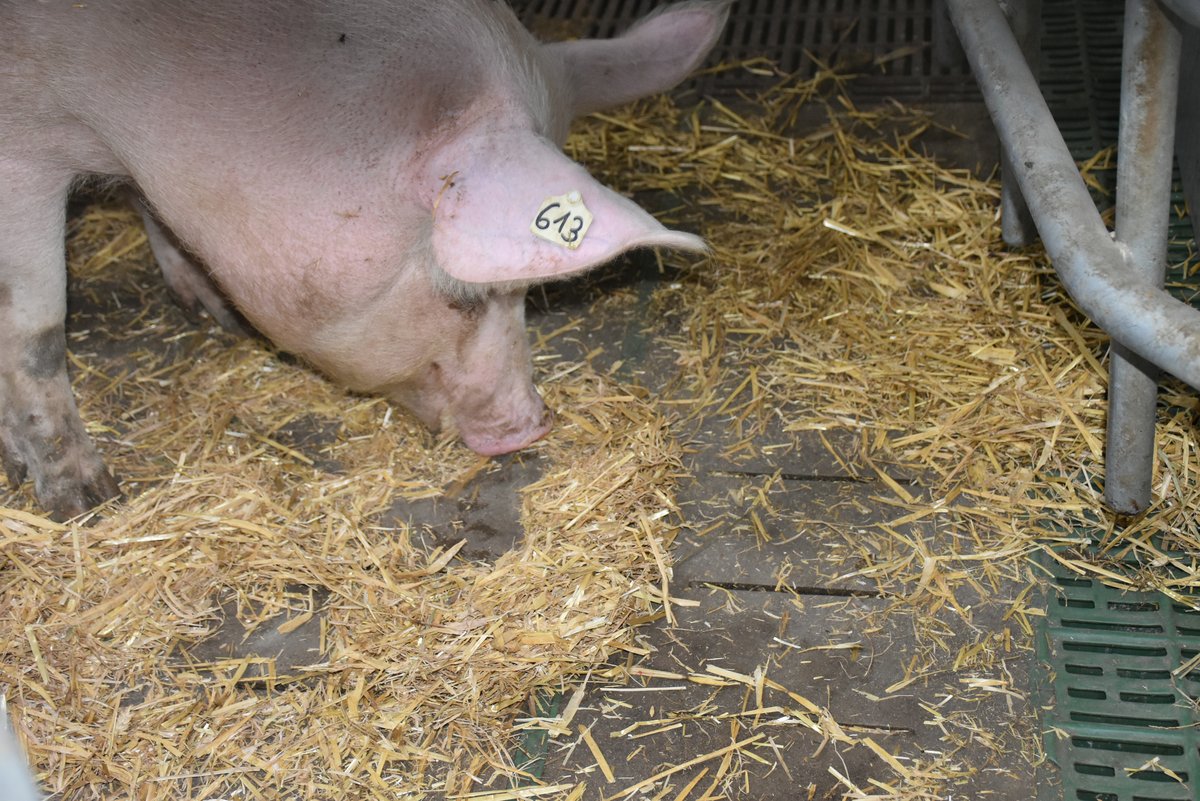
In the wild, wild boars use grass, leaves and small twigs to build their nests. As nest-building is an innate behaviour, sows kept in captivity must also be provided with suitable nesting material that they can manipulate by scratching, rooting and carrying. Suitable options include jute sacks, hay or long-stemmed straw (Fig. 15). If hay or straw is used, particular care must be taken to ensure that the material does not immediately disappear between the slats. In particular, an area with at least reduced slats (Fig. 16) or a flat surface should be provided directly beneath the hay rack. Hay and straw should be replenished several times as required.
Access to straw (Video 8) can stimulate nest-building activity.66 Damm et al.67 showed that the number of crushing losses was reduced in sows with free access to straw. When comparing straw and peat, sows using straw as nesting material exhibited significantly more nest-building activity. On most farms, a jute sack is currently often used as nesting material and later as enrichment material. This will certainly also be the case when switching to exercise pens. However, a securely tied jute sack only provides an incentive for chewing and manipulation, not for the other behaviours associated with nest-building. It is therefore not an optimal nesting material. To satisfy the nesting instinct at least partially, it should be positioned so that a good portion of it rests on the floor. Even though sows accept jute sacks readily, their suitability as nesting material should be critically assessed. They have little effect on piglet mortality and are not an equivalent substitute for long-stemmed, manipulable material.11
As a general rule, the availability of suitable nesting material always has a positive effect on nesting behaviour!
In addition to quality, the quantity of organic nesting material must also be taken into account, always bearing in mind the manure management system. Some authors conclude that providing around 2 kg of long-stemmed straw from 24 hours before farrowing is sufficient to satisfy nesting behaviour.11 In other studies, sows consumed an average of 0.5 kg of straw daily before and after farrowing, which was provided in a rack. On the day of farrowing, the sows consumed an average of 1.5 kg, ranging from less than 0.5 kg to 7.5 kg of straw.46
Note
The aim is not for the sow to build a nest, but rather to allow her to express this natural behaviour. A wild boar in the wild must build a nest. This is neither necessary nor desirable for our domestic pigs, as the piglets have a safe nest provided for them. A great deal of effort is put into ensuring that the piglets accept this.
Animal Welfare Ordinance
Section 30(7), second sentence
"In the week prior to the expected farrowing date, every gilts or sows must be provided with sufficient straw or other material to satisfy their nest-building behaviour, insofar as this is compatible with the state of the art and the existing manure and urine disposal system."
Implementation guidelines (as of 05/2023)
"Gilt and sows exhibit nest-building behaviour shortly before farrowing and require suitable material for this purpose, preferably straw. The reference to the ‘state of the art’ obliges the livestock keeper to retrofit or upgrade any available facilities or parts of the system where necessary, provided that the manure removal system as a whole thereby enables the use of nesting material (see official explanatory memorandum BR-Drucksache 119/06). Consequently, at least in new and converted buildings, housing conditions – particularly with regard to floor design and slurry management – must be arranged in such a way that the use of optimally suitable nesting materials, such as straw, is possible.
In existing housing systems where the use of straw is incompatible with the existing manure and urine disposal system, other materials, such as jute sacks, must be made available to the sow.
Nesting material should be provided from the 112th day of gestation at the latest and must be available in sufficient quantities at all times until at least the end of the birthing process. The sow must be able to pick up and carry the nesting material in her mouth. In the case of housing in a farrowing crate, it must be ensured that the nesting material is safely accessible to the sow, as inaccessible nesting material leads to avoidable agitation."
5.5 Closing the farrowing crate before birth
The exact moment at which the piglet protection pen is closed presents a dilemma. Arguments in favour of not closing it at all include, on the one hand, satisfying the sow’s nest-building behaviour and, on the other, allowing for a separation between the dunging area and the resting area. Conversely, a closed farrowing crate offers protection to the piglets and, to some extent, to the animal caretaker as well. The insufficiently satisfied nesting behaviour in sows confined prior to farrowing can only be partially compensated for by providing sufficient suitable nesting material.
The day before farrowing on which sows are confined in the exercise pen varies from farm to farm and requires several trial runs, particularly during the transition phase to exercise pens.