

3.1 Nest-building behaviour
The act of nest-building itself and its significance for the birthing process are largely unknown to many sow farmers and are rarely discussed. However, this behaviour has a significant influence on the subsequent birth. The basic processes are the same for both wild and domestic pigs.
Further information on nest-building behaviour:
Overall Farm Management Concept for Pigs – Sows and Piglets, Chapter 2
Video: Nest-building behaviour of wild boars
In the wild, a good piglet nest provides protection from predators, keeps the piglets together, allows for good thermoregulation and helps to reduce crushing losses.
An essential element and the start of nest-building is rooting and scratching. The material is then collected and carried to the nest. There it is arranged before the sow settles down to rest.38 Walking, turning and standing are therefore important elements of nest-building. These steps in nest-building are not possible when the sow is restrained.
In free farrowing systems, sows only begin to display nest-building behaviour 12 to 10 hours before the onset of labour. They reach the peak of the nest-building phase around 7.5 hours before birth and finish it on average 3 hours before the start of labour.6
Nest-building is a genetically ingrained behaviour that is also carried out in a farrowing pen. The prerequisites for this are: freedom of movement, available nesting material and a structured pen layout.6 In contrast to the conventional farrowing crate, the unrestrained sow in a free-range pen is able to keep the lying or farrowing area clean. To allow for genuine movement rather than merely turning round to a greater or lesser extent, the free-range area is more crucial for the sow than the floor area of the pen. Lack of space leads to frustration and restlessness in sows, even when ample straw bedding is provided.39, 40, 11
Restraining the sow prior to farrowing therefore prevents her from fully carrying out her nest-building behaviour. However, even with limited mobility, the sow attempts to carry out her nest-building behaviour.
The restrictions imposed by the piglet protection cage, however, lead to a significant reduction in nest-building behaviour, although it is carried out for a longer period. If nest-building behaviour is still exhibited during farrowing, this leads to an increased risk of piglets being crushed, prolonged farrowing duration and an increase in stillbirths.
It is assumed that nest-building behaviour is influenced by both internal and external stimuli and is important for maternal behaviour after birth.41 It has generally been found that high activity during nest-building is associated with a lower risk of crushing.42, 43, 44
Hansen et al.45 observed no negative effect on the duration of farrowing when the sow was confined only shortly before farrowing, provided there was sufficient suitable nesting material. In practice, the piglet protection pen is often closed three to one day before farrowing, thereby significantly restricting the opportunity for nest-building behaviour. This contradicts the central aim of keeping sows without crates: the largely unrestricted expression of nest-building behaviour.11
The problem with closing the farrowing crates immediately before birth is that the sows are not accustomed to being confined. This increases stress levels. The result is that births stall, sows attempt to free themselves, become restless, and the positive effects of nest-building are partially negated.46
There is a conflict of objectives here between allowing the sow to express her natural behaviours and protecting the piglets from being crushed.
Natural nest-building activity using suitable nesting material has a positive effect on the birthing process and the suckling period:
- shorter intervals between piglet births
- shorter duration of birth
- fewer stillbirths
- less need for assistance during birth
- fewer problems with MMA (mastitis-metritis-agalactia syndrome)
- better maternal instincts and better suckling behaviour
- fewer piglet losses (including those caused by crushing)
3.2 Lying down and changing position
Dangerous situations for suckling piglets can arise whenever the sow is active, i.e. when she stands up, walks about, lies down or, whilst lying down, makes a sudden turn of 90 to 180 degrees.6
3.2.1 Lying down
It is crucial that the sow lies down correctly to prevent crushing losses. The sow’s lying-down behaviour is divided into two phases – the pre-lying behaviour and the lying-down behaviour. The pre-lying behaviour serves to signal to the piglets that the sow intends to lie down. She begins by sniffing the floor and, if straw is present, will root around in it. The sow scrapes the ground with a front leg and turns around in the pen if possible. Sows require sufficient space to turn around unhindered.6
She moves her head to look at the piglets and nudge them with her snout. Grunting also encourages the piglets to leave the critical area around the sow and gather in a group. The whole process takes about a minute and occurs mainly during the first week of life.
This is followed by the actual lying down (Video 2). A controlled lying-down process begins with the sow bending her first front leg into a semi-kneeling position. This is followed by the bending of the second front leg, so that the sow is kneeling. After a pause, the shoulder and part of the head are lowered. After another pause, the sow turns her hindquarters to the side, bends her hind legs and then lets herself fall onto her side. If the sow does not first assume a kneeling position, the act of falling is more dangerous for the piglets.6, 47 This occurs particularly in sows with poor conformation, poor fitness and/or hoof problems. However, the lying-down behaviour also depends on the flooring, the farrowing crate and the sows’ experience. In a study by Meyer and Jähnig48, it was observed that uncontrolled and rapid lying-down movements by heavy or inexperienced sows pose a particularly high risk of crushing losses. The speed of lying down was also found to be linked to the setting of the piglet protection cage, with narrow to medium cage settings leading to faster lying-down processes. On various plastic floors, there was a tendency to observe more rapid and fewer normal lying-down movements compared to well-constructed metal floors.
During restraint, sows are unable to perform pre-laying behaviour. In studies by Baumgartner et al.49 using various farrowing crate systems, it was found that, in contrast to pens with free farrowing, it was mainly the laying processes and less the changes of position whilst lying down that proved critical.
Crush losses when sows lie down in free-range pens are often associated with sows lying down without the support of lying aids.50, 51 Marchant et al.50 further conclude in their study on free-range pens that there is an increased risk of crushing during lying-down manoeuvres in the first 24 hours after birth if this occurs in the centre of the pen, no pre-lying behaviour is performed and the piglets are distributed close to the sow’s body when she lies down.
3.2.2 Seating
Sows sit as a transitional posture (Video 3) between standing and lying down, and vice versa. Prolonged sitting can – as with all pigs – be a sign of discomfort or illness. In lactating sows, restricted movement due to confinement, combined with foot and leg problems and a usually hard – and possibly slippery – lying surface, can lead to difficulties in lying down or standing up.6 In farrowing crates, Bolhuis et al.52 found that sows exhibited ‘sitting’ behaviour more frequently than free-range animals. These tethered sows also spent more time sitting during farrowing.

3.2.3 Changing position/rolling over
When sows change position whilst lying down – a process known as ‘rolling’ – several types can be distinguished. Firstly, there are 90-degree position changes, i.e. moving from a prone position to a side-lying position and vice versa. Secondly, there are 180-degree position changes, i.e. turning or rolling from one side-lying position to the other. Unlike when sows are confined in farrowing crates, changing lying positions in free-range farrowing poses a greater risk to piglets than when they are placed in the farrowing pen. This difference between the two housing systems is attributed to the rolling movement being ‘restricted’ by the farrowing crate.51 However, crushing losses due to ‘rolling’ can also be observed in sows housed in farrowing crates.44
In the first 24 hours after birth, the risk of crushing in free-range pens due to rolling is particularly high, as the piglets remain close to the sow during this time. The more mobile and responsive the piglets are, and the more they rest away from the sow, the lower the risk of being crushed when the sow changes position. An attractive piglet nest helps here.
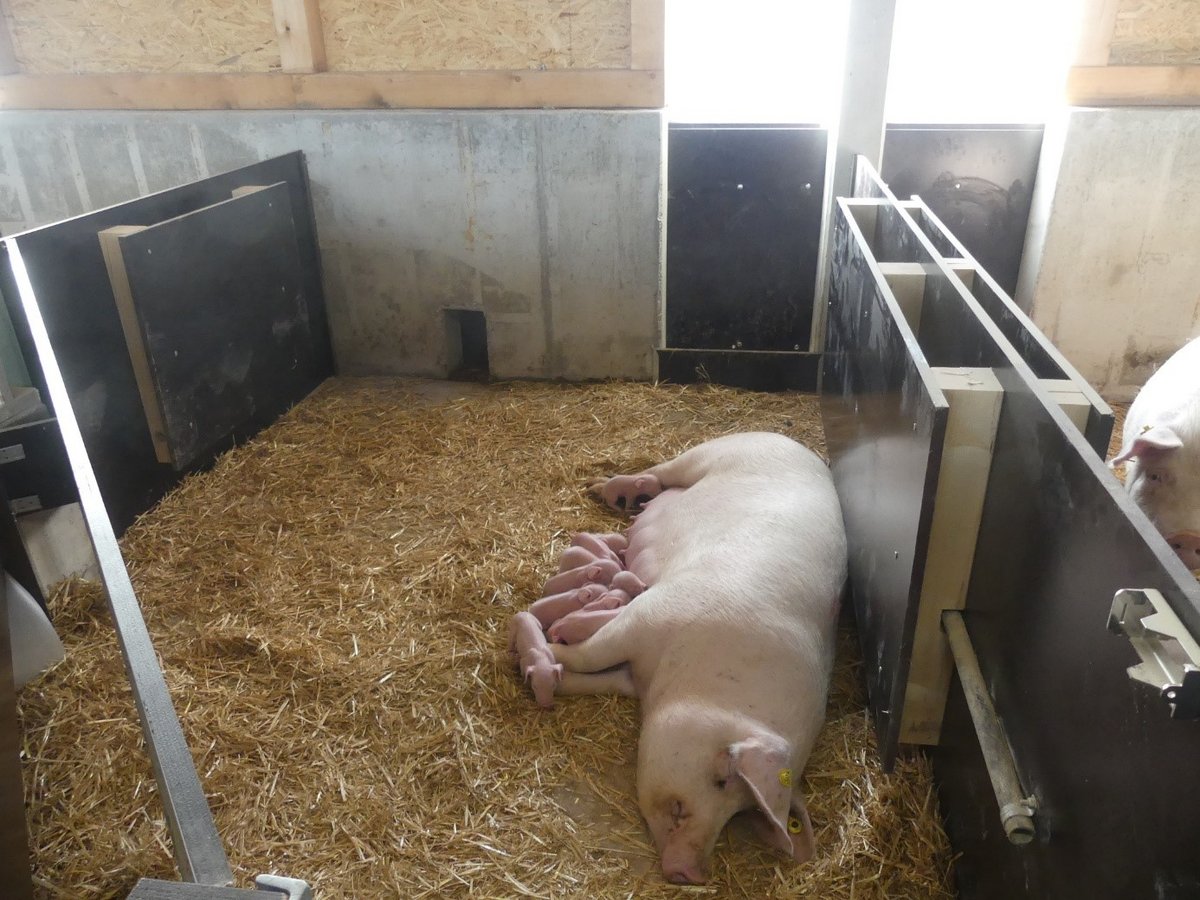
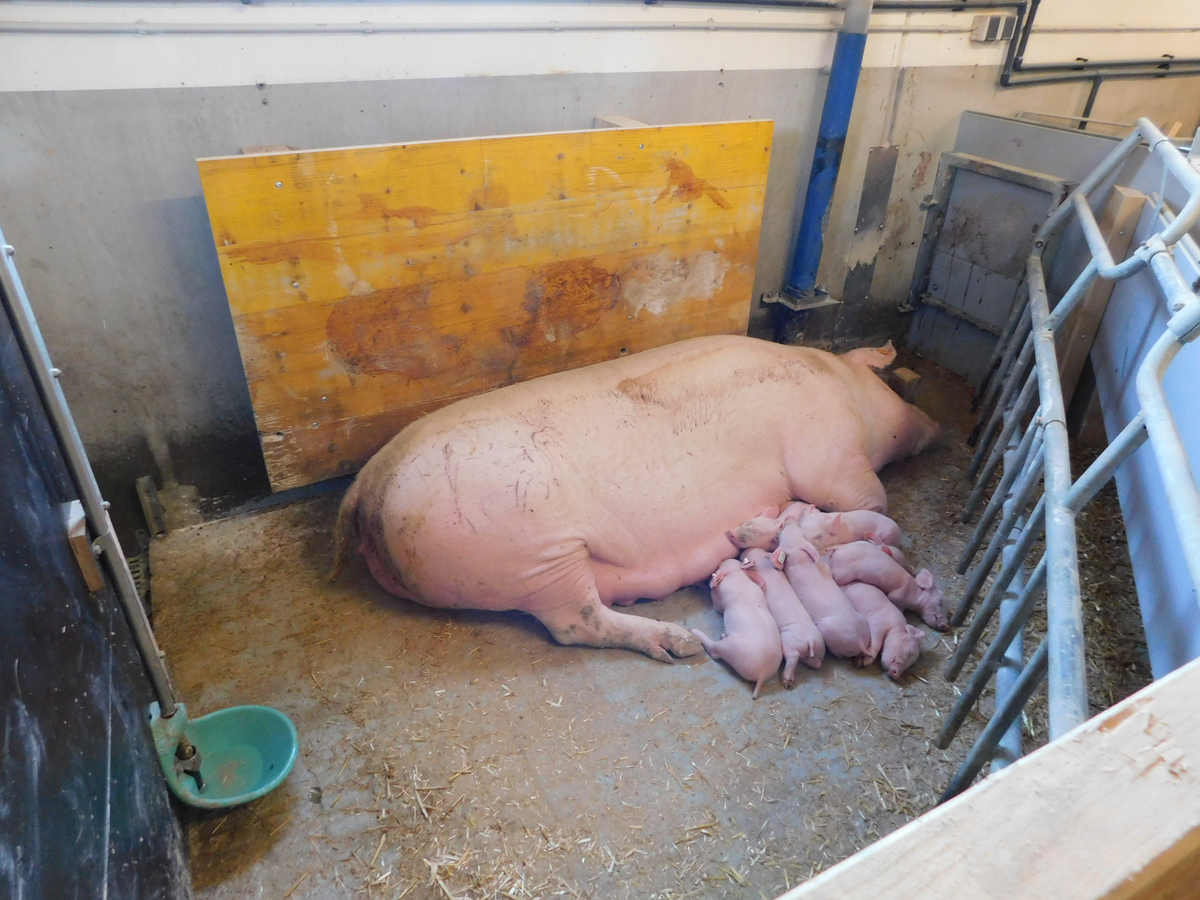
Instead of merely attempting to restrict the sow’s freedom of movement, factors that influence the frequency of changes in lying position or make these movements safer for the piglets should be taken into account. A comparison between a free-range pen with a 10% slope in the sow’s lying area and a free-range pen with a flat floor in the sow’s lying area showed that the rolling movement from the prone to the lateral position was reduced on the sloped floor, thereby lowering the number of piglets crushed. However, the trial showed that sows prefer to lie on flat floors.53 The use of (sloping) boards as a resting aid and as protection for the piglets (Figs. 4–6) can also reduce crushing losses.54, 55
3.3 Behaviour towards piglets
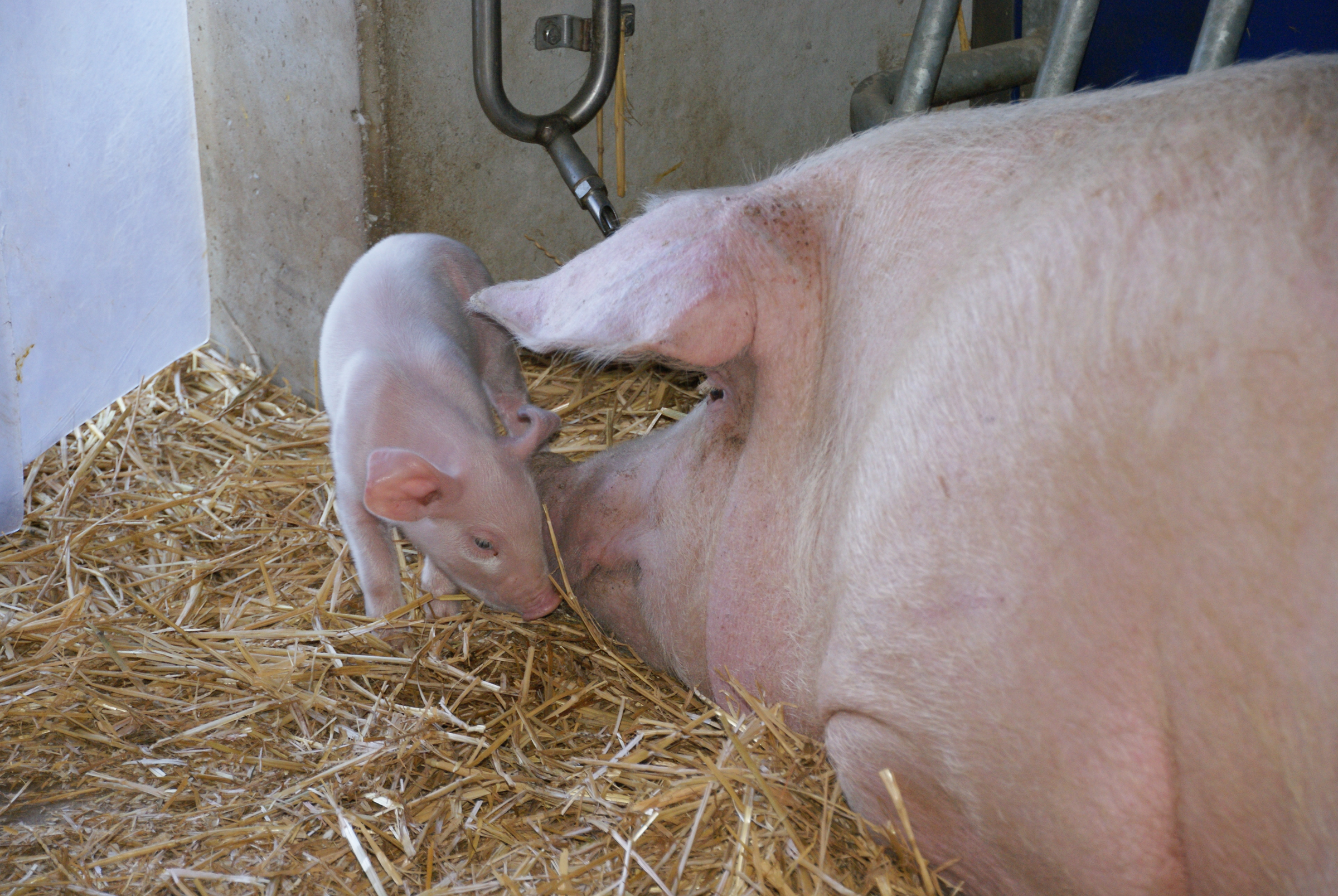
Genuine aggressive behaviour by sows towards their piglets is relatively rare. In gilts, one usually observes biting or even shaking the piglets to death. This is interpreted as a sign that they are overwhelmed by the new situation. The mother-offspring bond is based on mutual scent recognition. This requires snout-to-snout contact (Fig. 7). With the piglet guard closed, this only occurs when the piglets enter the sow’s head area. A good bond and communication between sow and piglet are also necessary for the sow to lie down carefully.
During the first 14 days of life, the piglets are called to suckle by the sow’s vocalisations. The older the piglets get, the more they independently ‘demand’ to suckle from the sow. Later in the suckling phase, from around the third week of life, or in the case of very large litters, it can also be observed that sows stand up to avoid suckling. Suckling is then also interrupted more frequently.