
The chapter ‘Post-birth’ covers the period from the expulsion of the afterbirth until the end of the suckling phase and includes all management measures for sows and piglets.
In the first few days of life, piglets develop a strongly localised suckling order and arrange themselves in a characteristic teat order during suckling.74 Sows initiate and accompany suckling with a stereotypical sequence of grunting sounds (Video 9).75, 76
7.1 Piglet care
Piglets are born with very limited energy reserves. Furthermore, they lack brown adipose tissue, which is important for heat production in newborns. When they try to generate some heat by shivering, they use up valuable energy reserves. As piglets are only able to produce new energy and regulate their body temperature to a limited extent until around the 10th day of life, the intake of energy via colostrum and milk, as well as a warm piglet nest, are vital. To prevent unnecessary cooling down or energy loss, piglets can be dried off after birth (e.g. with cellulose or dust-free, sanitised sawdust) and placed in the warm nest so that they become familiar with it as a place of refuge. With some piglets, it may also be necessary to return them to the nest several times until they have understood.
Another distinctive feature of piglets is that they are born with an iron reserve that lasts for only about three days. However, some piglets are already born with an iron deficiency. The iron content in sow’s milk is not high enough to meet their requirements. To prevent piglets from developing iron-deficiency anaemia, it is therefore essential to administer iron by the third day of life. It is crucial that the piglets have consumed sufficient milk before the iron is administered, as otherwise the iron supplementation can even be fatal. Practical studies have shown that the administration of 200 mg of iron dextran intramuscularly or subcutaneously is largely driven by operational efficiency and should therefore initially be regarded as a massive overdose. Split iron doses (100 mg on the 3rd day of life and 100 mg on the 10th day of life) proved to be gentler.77
It is recommended that the first treatment (e.g. iron administration) be carried out no earlier than 24 hours after birth, so as not to expose the piglets directly to iron as an oxidising agent. To keep the risk of injury to all parties (piglets, sow and animal caretaker) as low as possible, the sow should be restrained for the treatment of the piglets (and also for her own treatment). It is practical to close the piglet protection cage when feeding the sows. Alternatively, if possible, one can also enter the pen unobtrusively and close the piglet nest. Even if not all piglets are in the nest, catching them usually goes more quickly.
Occasionally, so-called splay-legged piglets also occur. If only the hind limbs are splayed, tying or taping the hind legs for a few days often helps, so that these piglets are mobile enough to reach the teats. If the splaying occurs at both the front and rear, the prognosis for the piglet is poor. Despite all care, there are always animals that have to be euthanised. Piglets that are obviously weak (e.g. without a suckling reflex or with deformities) must also be euthanised at an early stage. Under no circumstances should one wait until they die of their own accord!
Three methods are available for the correct emergency killing of weak suckling piglets:
- Stunning by means of a blow to the head followed by killing by bleeding
- Stunning by means of a penetrating bolt shot (“piglet bolt”) followed by killing by exsanguination or destruction of the brain and spinal cord
- Stunning and killing by CO₂ in an approved CO₂ box
Further information on this topic can be found in the guide “SchweineWohl im Fokus – Handling sick and injured animals” published by the Fokus Tierwohl network. The online guide is available following free registration.
7.2 Colostrum intake
A piglet’s gastrointestinal tract can only absorb antibodies from milk for a limited period (approx. 24 hours). These antibodies are essential for a robust immune system. Colostrum is also extremely important for energy supply and growth. It is therefore essential to ensure that all piglets consume colostrum early on. A minimum of 250 g per piglet is recommended. Each piglet should have consumed colostrum from its own mother. In large litters, briefly confining the first-born piglets to the piglet nest after they have taken in colostrum helps ensure that those born later can consume their share with less competition (= split suckling).
If a piglet has a suckling reflex but is unable to consume colostrum because it is too weak or uncoordinated to latch onto the teat, it should be placed at the teat. If necessary, colostrum can be expressed and administered orally to the piglet (e.g. using a disposable syringe without a needle). Litter balancing should ideally be carried out once, and no earlier than 12 hours after the birth of the last piglet. As many piglets as possible should remain with the mother. However, no more piglets should remain with the sow than there are functional teats available. ‘Surplus’ piglets require a foster sow or an artificial foster. The use of ‘piglet cups’ for supplementary milk feeding can also relieve the udder.
7.3 Monitoring piglet nest temperatures
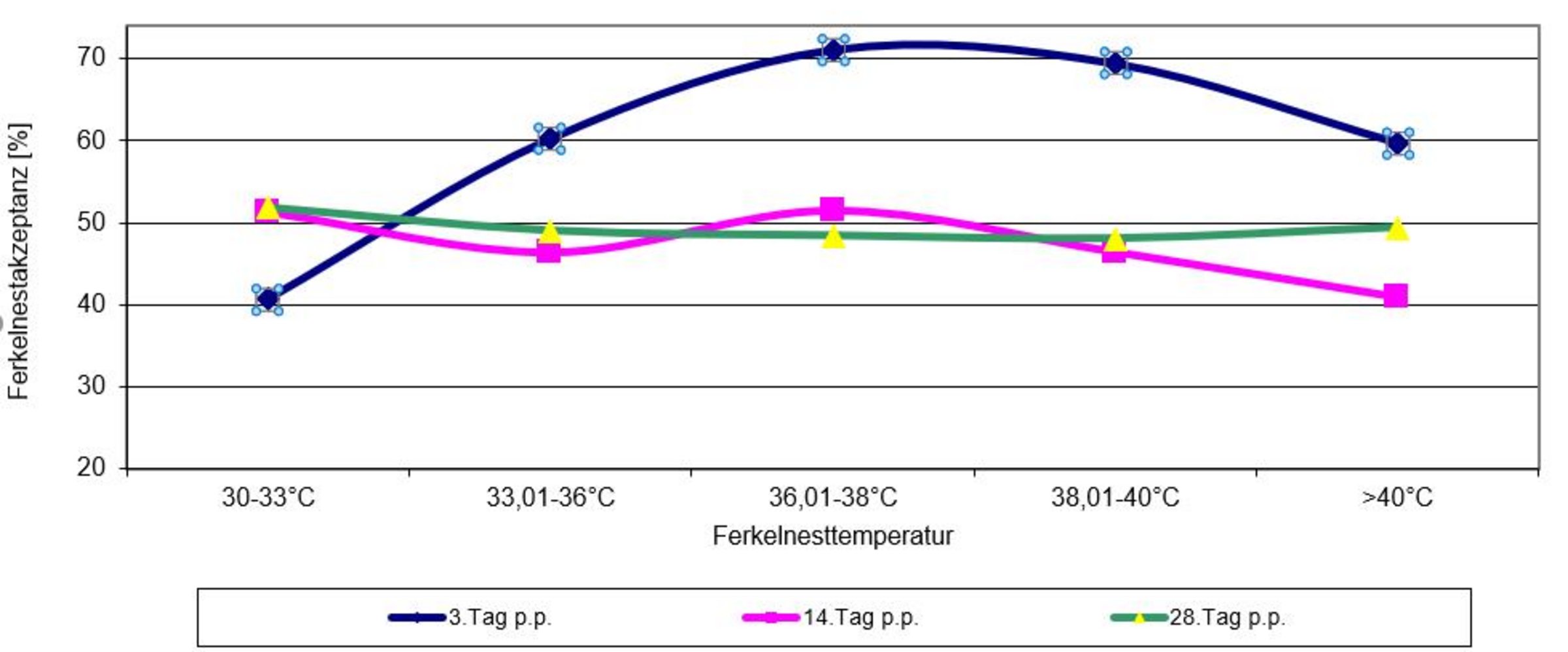
The temperature in the farrowing pen should be checked on the day of birth and the day after. This can be done, for example, using an infrared thermometer, which should be aimed at the floor. As the piglets get older, their heat requirements decrease, and it is beneficial for their lying behaviour (to prevent them from being crushed) to lower the temperatures. A study by Meyer et al.78 found the following regarding the temperature regime:
More than 80% of piglets are found on the heating pad when the temperature is 39.2 °C in the first week, 37.2 °C in the second week and 36.5 °C in the third week (Fig. 20). For older piglets, the room temperature plays a greater role.

(© W. Schulte-Remmert)
If the piglets display unusual lying behaviour later in the suckling phase (e.g. huddling together or not lying in the nest), the temperature of the piglet nest must be adjusted accordingly (Fig. 21).
7.4 Key points to check in sows
There are also a number of points to bear in mind regarding sows in the first few days after farrowing. For example, if sows do not get up to feed around two hours after farrowing, they should be encouraged to do so. Keeping the piglets separate before the first feeding helps ensure that the sow can eat undisturbed.
The daily health check of sows up to and including the third day after farrowing should include the following points:
- Check feed and water intake at the trough → top up with water
- Check faecal consistency: the faeces should be soft → hard faeces are a sign of poor bowel activity
- Udder check: Firm? Inflamed and warm? What is the condition of the piglets and is the sow producing milk? → Signs of milk deficiency: e.g. sow lying on her stomach, piglets are constantly hungry
- Measure body temperature: from 39.5 °C = fever
If sows are not eating, have discharge or an elevated temperature/fever, or show any other clinical signs, treatment or a veterinary examination may be necessary.
7.5 Daily tasks
Consistent and high-quality care for the pigs in the farrowing unit is a given and absolutely essential. It is helpful to carry out daily animal checks systematically. The following checks should form part of the routine in the farrowing unit:
- Checking the room temperature
- Target range: max. 22 °C
- Checking enrichment materials for sows and piglets
- Is there sufficient material available? → Note: one enrichment area per 12 animals
- The use of jute sacks is not generally recommended due to their tendency to become soiled → Moisture and warmth create a perfect breeding ground for germs, so change damp/soiled jute sacks
- Checking the cleanliness of the trough and water trough (including those used by the piglets)
- Checking feed intake
- Check water intake
- Remove faeces at least once a day (from the time the animals are moved into the farrowing pen until after the piglet guard has been opened; thereafter as required) (Video 10)
- Check the condition of the sow and piglets (Video 11)
If several or new people are working in the farrowing pen, it helps to have the daily checkpoints in the farrowing pen as a checklist on the farm.
7.6 Opening the piglet protection cage
The timing of when the piglet shelter is opened can also vary from farm to farm. Piglet losses due to crushing mainly occur within the first three days of life. Consequently, there have long been discussions about continuing to restrain sows in a farrowing crate during this period.47, 79, 80, 81, 82, 83, 84 In the Pro-SAU project, confining the sow for three days after birth led to a significant reduction in piglet losses. Based on the available data, extending the confinement period beyond this (up to the sixth day of life) did not result in a further reduction in the mortality rate.84 It is generally considered11 that opening the farrowing crates individually is preferable, as opening the piglet protection crates simultaneously for all sows in a pen causes considerable agitation. It is better to open the farrowing crates in the afternoon rather than in the morning.85 In the afternoon, the barn is quieter, as the sows are usually well-fed and do not get up as frequently.