
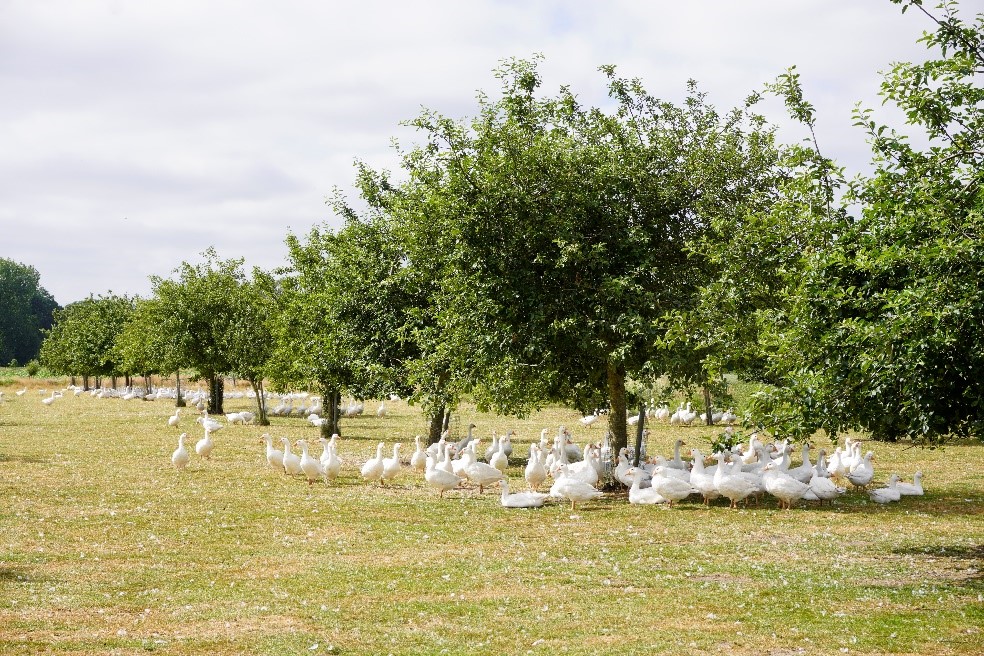
Apart from a few full-time farms in the regions of Germany typically associated with goose farming, goose fattening in this country is predominantly carried out as a sideline to farming for direct marketing, with the animals reared outdoors. A sufficiently large outdoor grazing area should be provided for this purpose. From the 9th week of life at the latest, when the geese are fully feathered, they can be reared exclusively on pasture. A practical approach is to allow young goslings access to a green and dry outdoor area for a few hours at a time from as early as the 2nd or 3rd week of life, provided the weather is good. Here, the young birds find fresh greenery and herbs such as chickweed, which they readily eat. Once the geese are fully feathered, they can also be kept outdoors at night and during periods of bad weather. However, it is advisable to house the geese at night in a familiar, covered shelter with bedding. According to Lower Saxony’s ‘Goose Husbandry Agreement’, an outdoor area of at least 10 m² (permanent pasture) per animal should be available; in a rotational grazing system, at least 4 m². Programmes such as ‘Geese from Farm-Raised Free-Range’ even require 15 m² of vegetated and structured area per animal. The NEULAND guidelines for species-appropriate goose husbandry stipulate a minimum of 20 m² per animal for rotational and static grazing.
The pasture/outdoor area must be available to the animals throughout the entire fattening period and can contribute significantly to a needs-based and cost-effective diet for the animals. Accordingly, particular attention should be paid to the maintenance and design of the outdoor area. With intensive use of the pasture by 500 or more animals per hectare of agricultural land (LF), there is increasing wear and tear on the sward. 50–70 m² of grassland per goose is required to keep them on a fully vegetated area all year round. The requirements for a good and robust goose pasture are shown in Table 3.
| Soil |
|
| Vegetation |
|
| Grass sward |
|
| Growth height |
|
| Other requirements |
|
<figcaption>Table 3: Conditions for an optimal goose pasture (Schneider et al., 2002)</figcaption>
The goose spends most of its time outdoors. Even during the final fattening phase, the goose should remain in its familiar surroundings. If the goose has been accustomed to free-range conditions throughout its life, fattening the animals in a shed is difficult; similarly, separating the group in autumn can lead to problems. As geese react very sensitively to changes in location, their environment should not be altered. Although final fattening in a shed is possible, the transition from free-range to purely shed-based rearing causes the animals enormous stress. The aim should therefore be to provide the animals with optimal conditions on pasture all year round.
(Photo: Jule Schättler, LWK Lower Saxony)

(Photo: Regine Revermann, LWK Lower Saxony)
Structure of the outlet
Adequate shade is particularly important during the hot summer months. Shelters must be provided for this purpose, but trees and shrubs are also suitable for providing shade. These also serve to protect against aerial predators, which pose a particular risk to young foals in their first few weeks.
Appropriate fencing of the outdoor enclosure, e.g. using a wildlife fence with an electrified wire, provides protection against other predators such as foxes and martens and, depending on the region, also against wolves. To ensure a constant supply of fresh water and, where necessary, feed for the animals, appropriate feed and water provisions must be maintained in the outdoor area in accordance with the Goose Husbandry Agreement. In accordance with Section 3 of the Ordinance on Protection against Avian Influenza (GeflPestSchV), the feed and water points must be designed in such a way that wild birds cannot access them. To protect the outdoor run, it is recommended that the water points for the geese be moved at regular intervals. Providing enrichment materials is not necessary where access to the outdoor area is provided.
Maintenance measures
The forage requirement per bird and fattening cycle is approximately 140 kg for a late-fattening goose weighing 7–8 kg. The strain placed on the pasture by the birds is considerable. The birds cause deep browsing damage, and their highly corrosive droppings can also damage the sward, which may lead to a one-sided plant community. A rotational grazing system can provide a solution here, which is easily implemented by moving a mobile electric fence. On the other hand, due to their lower body weight compared to other farm animals and their large feet, the pressure on the ground is lower, which proves advantageous in some locations, particularly damp ones.
Maintaining the pasture therefore involves, where possible, a regular rotation of the area or, if necessary, ploughing. Particularly in late autumn and winter, when the pasture areas have been grazed down and are heavily worn, a rotational grazing system is advisable if sufficient land is available. The principle of rotational grazing, whereby the area is expanded every 3–4 days, has also proven effective.
When reseeding or sowing new crops, it is advisable to use mixtures containing grasses that geese enjoy eating. These include German ryegrass, red fescue, red fescue, as well as white clover, Swedish clover or dandelion. Less favoured are smooth oatgrass, cocksfoot or meadow grass, as well as field alfalfa, red clover and many wild herbs. The location influences the choice of varieties. Some plants pose a risk of poisoning to geese. Cress-leaved rockcress (Erysium crepidifolium) and black nightshade (Solanum nigrum L.) can lead to the death of the animal if ingested.
The grass height should not exceed 15 cm; 10 cm is preferable, as grass that is too tall is trampled by the animals and is no longer eaten. Overgrown and neglected plants, as well as areas where the animals have concentrated, should be re-mowed.
Liming with approx. 10 tonnes of quicklime per hectare is recommended every two to three years. This has a disinfecting effect and binds acids in the soil. Rolling the paddock in spring levels the turf and promotes a dense grass cover. Hygiene in the area near the barn can be further improved by measures such as spreading wood chips to prevent mudding and/or the formation of puddles.