

The rearing of fattening geese is divided into the rearing phase and the subsequent fattening phase.
The rearing of goslings covers the first four weeks of life. This usually takes place in the barn. However, in dry and warm weather, goslings just a few days old can already be taken outdoors for a few hours at a time.
This is followed by the fattening of the geese. Here, fattening methods are distinguished according to the duration of fattening and divided into early fattening (up to approx. 9 weeks of age), medium fattening (up to approx. 16 weeks of age) and late fattening (up to 21–32 weeks of age).

(Photo: Karen Schemmann, LWK Lower Saxony)
Preparing the stable
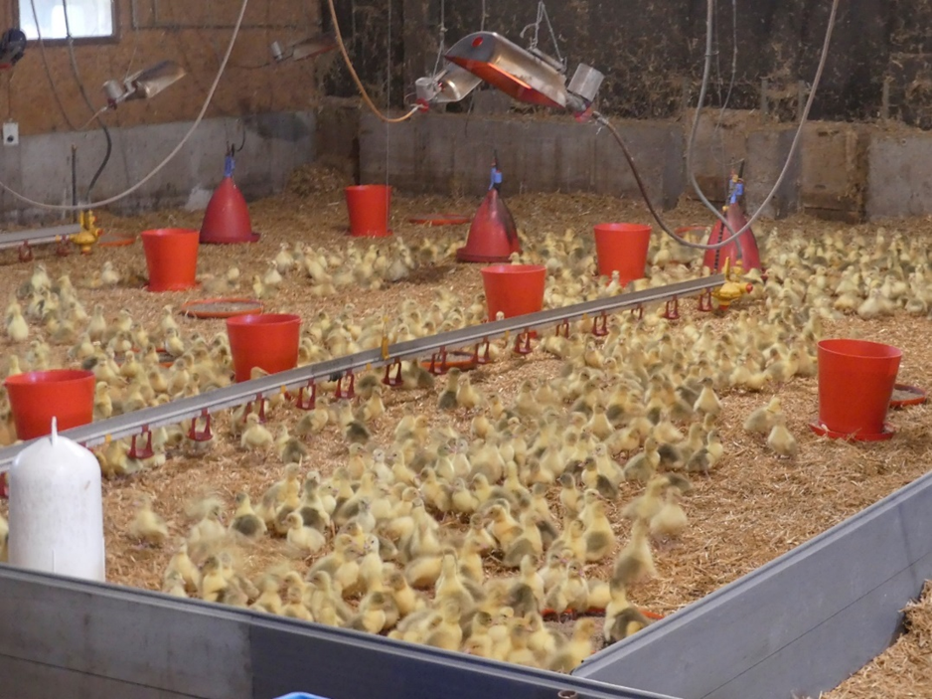
The cleaned and disinfected rearing shed is heated to a temperature of at least 30 °C before the chicks are brought in. At least two to three days should be allowed for this. Care must be taken to ensure that the floor and the walls of the shed are also preheated. There are radiant heaters in the shed to ensure that the chicks receive sufficient heat during the first few days.
The functionality of the feeding and watering equipment is checked. The drinkers are rinsed beforehand. In the first few days, additional dip drinkers and feed trays are also set up.
Straw, preferably chopped, is used as bedding, to a depth of approx. 10 cm. This corresponds to roughly 2.5–3.0 kg/m². The straw must be clean and hygienically sound. Wood shavings may also be used.
(Photo: Karen Schemmann, LWK Lower Saxony)
Settling the animals in
The animals arrive at the farm as day-old chicks from the hatchery in special transport crates. They should then be placed in their pens quickly but calmly.
The animals are placed near feed and water. Due to their high heat requirements, the goslings are initially housed under heat lamps or in small heated pens or chick rings.
The rapid growth of the goslings requires a swift adjustment of the space available to the animals (Goose Husbandry Agreement, as of 03/2020):
| Age of the animals (weeks) | Max. number of animals/m² of usable housing or shelter area |
| 1 | 20 |
| 2 | 10 |
| 3 | 6 |
| 4–10 | 4.5 |
| from 11 | 2 |
| Fattening | 2.5 |
The German Animal Welfare Association recommends a maximum stocking density of 2 animals per square metre from the fourth week of life.
Stable temperature
Young lambs are very sensitive to temperature in the first few days. The room temperature should be around 25 °C, but the nest temperature (under the heat lamps) must be approximately 35 °C. The temperature is always measured at the animals’ level. From the fifth day of life onwards, the temperature is gradually reduced.
When setting the temperature, it is essential to pay close attention to the birds’ behaviour and their distribution, and to make adjustments at an early stage if necessary.
At around three weeks of age, the goslings are less sensitive to heat and cold.
Ventilation/Harmful gases
Fattening geese are usually kept in naturally ventilated houses. They are relatively tolerant of draughts. However, air speeds exceeding 0.3 m/s at animal height should not be exceeded.
In forced-ventilated houses, the minimum air flow rate should be 4.5 m³/kg live weight/hour to ensure adequate ventilation in summer.
The maximum levels of harmful gases are shown in the table below and should not be exceeded (Goose Husbandry Agreement, as of 03/2020):
| Harmful gas | Max. concentration per m³ of air |
| Ammonia | <10 ppm, not exceeding 20 ppm continuously |
| CO₂ | <3,000 ppm |
Lighting
Lighting in the barn should be uniform throughout. The lighting schedule may vary during the acclimatisation period in the first three days. It is recommended that the light period be increased to 24 hours during the first few days to allow the animals to become accustomed to the feeding and watering facilities. Thereafter, a day/night rhythm as close to natural as possible should be maintained, and a continuous period of darkness of at least 8 hours must be ensured, provided that there is a deviation from the natural, seasonally varying periods of darkness.
Emergency lighting of max. 2 lux can serve as a guide at night.

(Photo: Karen Schemmann, LWK Lower Saxony)
(Image: Netzwerk Fokus Tierwohl, DLG e.V.)
Water
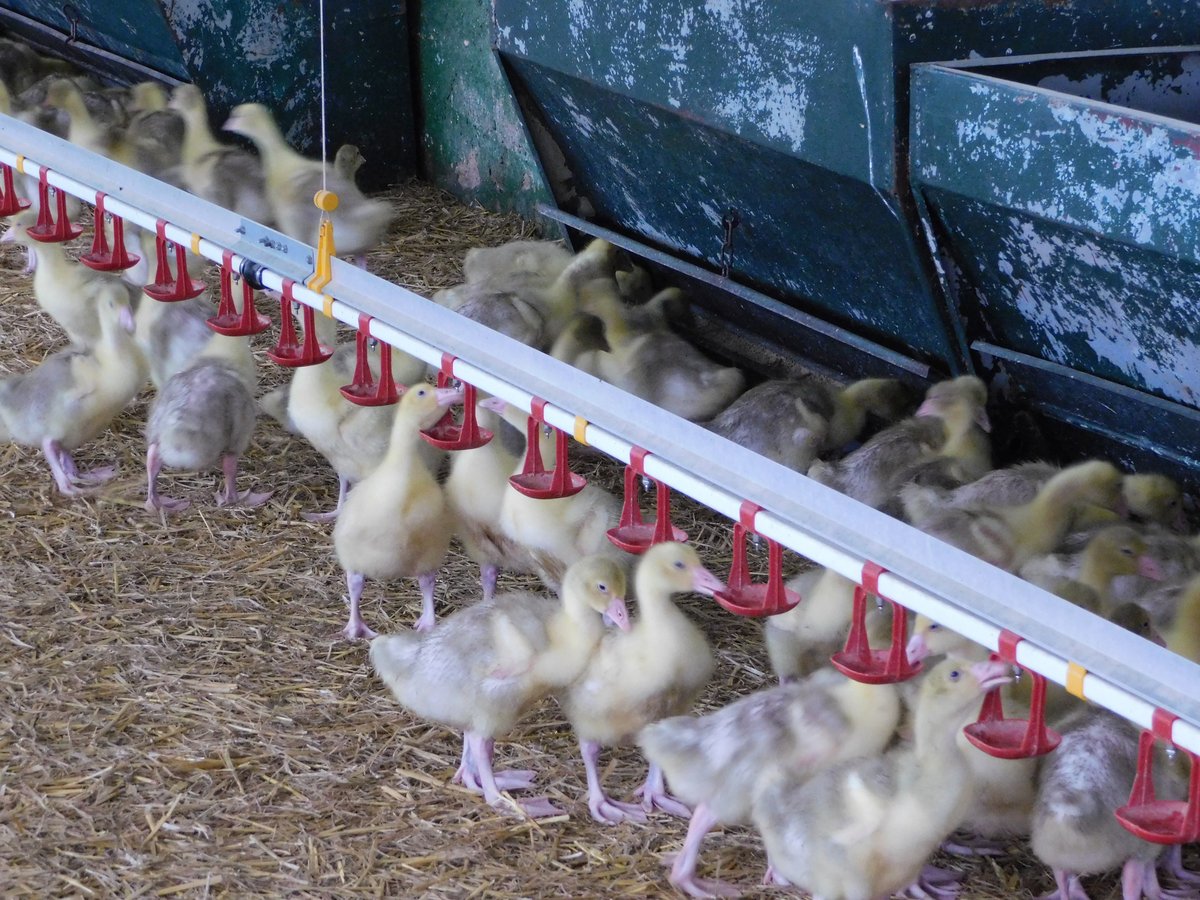
A constant supply of fresh and hygienically safe drinking water must be ensured for the animals. The drinking trough should be positioned in such a way that young animals cannot enter or fall into it, thereby avoiding the risk of hypothermia. In rearing, animals are generally supplied with water via round troughs, but nipple drinkers may also be provided at this stage.
In the first few days, bowls of water or slip-on drinkers should also be placed in the shed.
The requirements for drinking facilities during rearing are set out in the following table (practical data provided as a guide, Goose Husbandry Agreement, as of 03/2020):
| Age of animals (weeks) | Drinking trough (cm) per animal |
| 1–4 | 0.5 |
| 5–9 | 0.5 |
| 10–28 | 0.75 |
The height of the drinking troughs should be adjusted according to the age and size of the animals. Nipple drinkers should be easily accessible to the animals with their necks stretched out. For drinking troughs or round troughs, the upper edge should be at the animals’ back height.
Additional water supply (Goose Husbandry Agreement, as of March 2020)
As waterfowl, access to water is vital for geese. Open drinking troughs must therefore be provided at all times, even in outdoor enclosures*. Access to an outdoor run and to water for bathing is necessary to allow the geese, as waterfowl, to behave in accordance with their biological needs. Where such access is not possible, the geese must be provided with a sufficient number of water facilities, which must be designed so that the water covers at least the head and can be taken in with the beak, enabling the geese to pour water over their bodies without difficulty. Every goose must have the opportunity to submerge its head under water (see Art. 11(2) of the Council of Europe recommendations). A water supply adapted to the animal’s development must be provided by the start of fattening at the latest.
- In the view of the German Animal Welfare Association, a bathing facility must be provided to which the geese have constant access and in which they can swim or at least submerge themselves up to their chests. However, this bathing facility may be located indoors if this is necessary from a disease control perspective (see Section 3 of the Avian Influenza Control Ordinance).
* In accordance with Section 3(2) of the Avian Influenza Ordinance, it must be ensured that the animals are not watered using surface water to which wild birds have access.
Food
The recommended usable trough side length and the recommended animal-to-feeding area ratio for batch feeding are set out in the table below (Goose Husbandry Agreement, as of March 2020).
| Age (weeks) | Usable trough length (cm) per feeding place / animal-to-feeding-place ratio for bulk feeding |
| 1–4 | 4 / max. 20 :1 |
| 5–9 | 8 / max. 15 : 1 |
| 10–28 | 10 / max. 15 : 1 |
It is recommended that foals be offered additional feed in feeding troughs on the floor during the first few days of life.
As the animals grow very quickly in the first three weeks, intensive feeding is necessary. The energy content of the starter feed is approximately 11.5 MJ ME and the crude protein content is around 20%. From the fourth or fifth week of life, the crude protein content is reduced to approximately 16%.
Daily routine tasks
The animals and their housing conditions should be checked several times a day, but at least twice a day. Particularly in the first few days after the foals have been brought into the stables, intensive and attentive care is required, with more frequent checks, for which sufficient time should be set aside.
Important parameters include (see also the chapter on animal health parameters):
- Distribution of animals in the barn
- Feed and water intake behaviour
- Movement
- Condition of the plumage
- Faecal consistency
- Condition of the eyes and nostrils
Fresh straw must be added daily. In rearing, this is usually done by hand.
Water and feeding equipment must be checked daily to ensure they are in working order, and any animal losses must be recorded. Furthermore, it would be helpful to document daily feed and water intake in order to identify irregularities in consumption at an early stage. These can, for example, indicate that the animals are unwell. In practice, however, recording feed and water consumption is often difficult, particularly on smaller farms.
The animals should be accustomed to farm noises and machinery, such as the wheel loader, at an early stage. Day-old chicks show less fear than animals that arrive at the farm at a later stage.
If several age groups are kept on the farm, younger animals should be attended to before older ones, and healthy flocks before those showing signs of illness or potential disease, in order to minimise the risk of spreading pathogens.
Special projects
This includes tasks that are not carried out on a daily basis but are performed with a certain degree of regularity during or following a fattening cycle. These include, for example, the cleaning and disinfection work required during the service period (see Chapter 9), the maintenance of the outdoor run (see Chapter 7), care provided by the vet, and examinations to be carried out, such as drinking water tests when using water from the farm’s own well.
Vaccinations
Vaccinations can be used to protect against various infectious diseases. Unlike chickens and turkeys, there is currently no compulsory vaccination requirement for geese. It is standard practice to vaccinate parent birds before the start of the laying period (e.g. against parvovirus) in order to protect young goslings through maternal antibodies. However, depending on the risk of infection and the individual farm structure (e.g. different age groups, various poultry species on the farm), vaccination may also be advisable for fattening geese. Vaccination programmes should always be developed in consultation with the vet responsible for the flock.