

Animal Welfare Ordinance
The animal keeper must immediately rectify any defects in the facilities that adversely affect the animals’ welfare, or take appropriate measures to protect the animals.
Any dead animals found must be removed immediately (see Section 4(1) sentence 1 no. 2 of the Animal Welfare (Livestock) Ordinance), stored properly and disposed of (see the Animal By-products Disposal Act (TierNebG)).
All technical facilities necessary for animal health and welfare (lighting, ventilation and supply systems) must be checked for proper functioning at least once a day. Emergency power generators and alarm systems must be checked for proper functioning at technically required intervals (see Section 4(1) sentence 1 no. 5 of the TierSchNutztV).
The results of the checks must be recorded daily in the barn log (see Section 4(2) of the TierSchNutztV).
At appropriate intervals, the barn, bedding storage areas and feed silos must be thoroughly cleaned and effectively disinfected in accordance with good professional practice (see Section 4(1) sentence 1 no. 10 TierSchNutztV); effective rodent and pest control must be ensured.
Identifying sick and injured animals
- Basis: Check the barn at least twice a day
- Careful observation of the animals, for which sufficient time must be allowed
- Pay particular attention to areas where weaker animals tend to congregate (e.g. corners of the barn and areas under or next to feeding/watering facilities)
→ Early detection of sick and injured animals
Taking appropriate measures
- In order to decide whether an animal should be removed from the herd, taken to a holding pen or euthanised, it must first be caught and examined.
- Once the animal has been caught, a decision must be made as to whether it can remain in the herd, whether there is a ‘reasonable cause’ for culling, or whether the animal can be moved to the isolation pen and returned to the group after an appropriate recovery period or treatment.
- If there is a prospect of recovery, the animal must be taken immediately to a holding pen with dry and soft bedding or a soft surface.
- Any animal which, based on a professional assessment of its physical condition, is unlikely to survive must – in accordance with the applicable Animal Welfare Slaughter Ordinance (TierSchlV) – be stunned in a manner consistent with animal welfare and killed without delay, and must not be placed in a separation pen.
- Where necessary, immediate measures must be taken for treatment and, where appropriate, a veterinarian must be consulted (Section 4(1) sentence 1 no. 3 TierSchNutztV).
- Where necessary, measures such as the direct provision of water and, where appropriate, feed, as well as wound care using covering, wound-healing sprays (e.g. zinc sprays) or treatment with further medication, must be provided for the animals in the isolation pen.
- Close monitoring of the course of the disease is required, which, depending on the circumstances, should exceed the minimum monitoring frequency of ‘twice daily’.
- Any animal in a quarantine pen whose health, according to expert assessment, shows no improvement within a reasonable period of time must be anaesthetised and killed in accordance with animal welfare standards. The animal keeper must ensure that the person carrying out the killing of the animals possesses up-to-date knowledge and skills relevant to animal welfare – including humane methods of stunning and killing (see Section 4(1) of the Animal Welfare Act).
- Reintegration: Isolated animals should be allowed to socialise again immediately after full recovery.
DLG Leaflet 477 ‘Handling sick and injured domestic and farm poultry’ provides guidance on deciding when a sick animal should be euthanised and when there is a chance of recovery.
separation compartment
- Already available / can be set up immediately if required
- Space that can be expanded if required
- Optimal supply of food and water
- Fully accessible, even for animals with limited mobility
- Unrestricted access to fresh feed and water in clean troughs / drinking troughs
- Sturdy partition from the herd
- Good hygiene, regular cleaning of the facilities and surfaces
- Regular replacement of bedding
- Optimal ambient temperature for the animal, free from draughts
- In isolation pens, the requirements of the Animal Welfare Ordinance (TierSchNutztV) must be observed.
- Injured geese or geese that do not pose a risk of infection should not be placed alone in a isolation pen.
Legal basis (emergency killing)
- Where an animal must be killed, the legal basis for this is provided by the Animal Welfare Act (TSchG), Regulation (EC) No 1099/2009 on the protection of animals at the time of killing, and the Animal Slaughter Ordinance (TierSchlV).
- ‘Emergency killing’ is defined as ‘the killing of injured animals or animals suffering from a disease that causes severe pain or suffering, where there is no other practicable means of alleviating such pain or suffering’ (Article 2(d) of Regulation (EC) No 1099/2009).
- A vertebrate animal may only be killed under effective pain relief (stunning) in a state of unconsciousness and insensitivity, or otherwise, insofar as is reasonable under the given circumstances, only in a manner that avoids pain. (Section 4(1) TierSchG)
- Persons who, on a professional or commercial basis, regularly anaesthetise or kill vertebrates for the purpose of killing must provide the competent authority with proof of competence. (Section 4(1a) Animal Welfare Act)
- Knowledge and skills regarding legal and technical requirements and methods of killing are necessary.
- The animal keeper must ensure that the person carrying out the killing of the animals possesses the necessary expertise, including the requisite skills.
- There is a reasonable ground for emergency killing if
- the animal has been suffering from severe, incurable pain for a prolonged period.
- the animal is suffering from a serious illness with no prospect of recovery.
- the animal is unable to take in food or water independently and is therefore no longer able to care for itself.
Under Regulation (EC) No 1099/2009 and the German Animal Welfare Slaughter Ordinance, emergency slaughter refers to the killing of injured animals or animals suffering from a disease that causes severe pain or distress, where there is no other practicable way to alleviate such pain or distress. It must be carried out as soon as possible.
Under Section 1 of the Animal Welfare Act, no one may cause pain, suffering or harm to an animal without reasonable cause. The killing of animals is only permitted if there is a reasonable cause. This must be weighed up for each individual animal.
Only a person who possesses the necessary knowledge and skills may kill a vertebrate animal.
Procedure for humane euthanasia
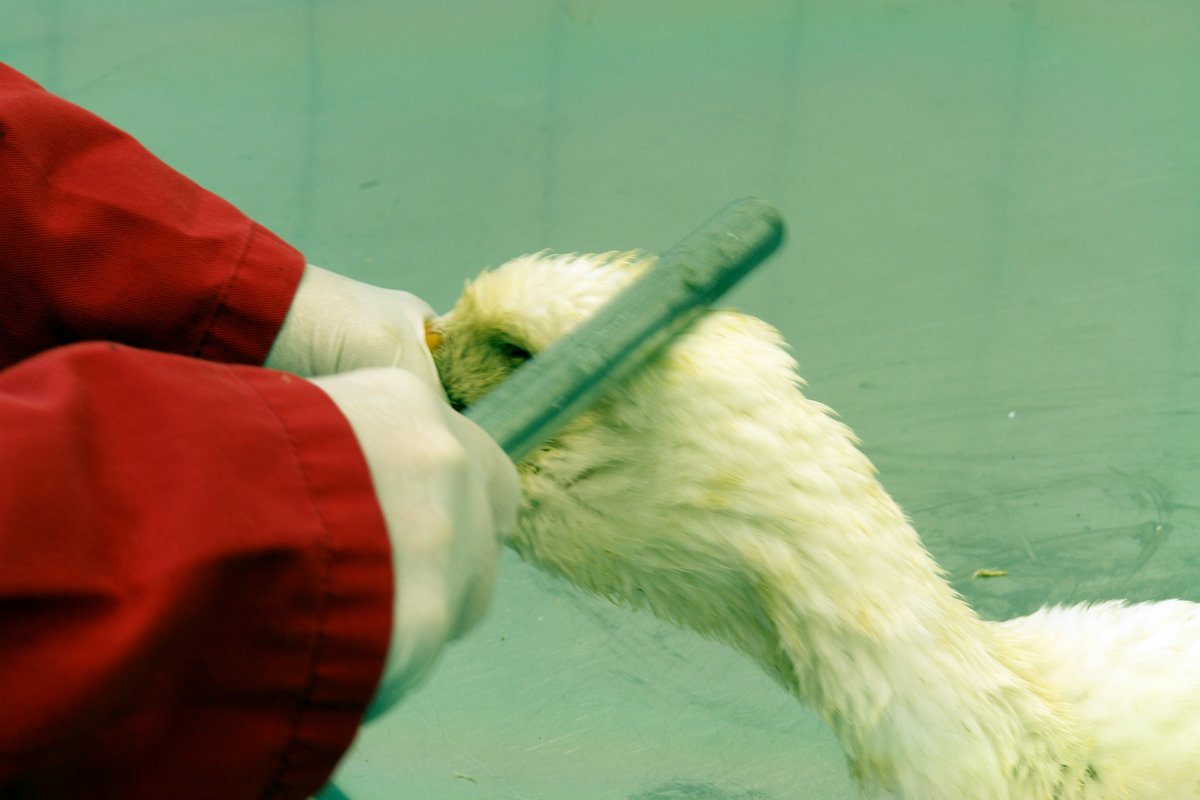
Geese identified as requiring slaughter must be killed as soon as possible to avoid unnecessary pain and suffering. The goose to be slaughtered must be handled calmly and gently until the anaesthetic takes effect, to prevent the animal from becoming agitated. Every goose must be stunned before slaughter. Immediately after successful stunning, the animal must be killed using a suitable method (the standard practice is neck breaking). The functionality of the equipment to be used must be checked before each use. Stunning and slaughter should not be carried out in the middle of the flock and, where possible, without causing distress to the other animals.
Procedure
- Capturing the animal to be killed
- Restraining
- Restricting the animal’s movement so that it cannot evade the procedure and the stunning can be carried out safely. From an animal welfare perspective, a suitable area outside the barn (e.g. an antechamber) should be used for stunning and killing.
- Stunning
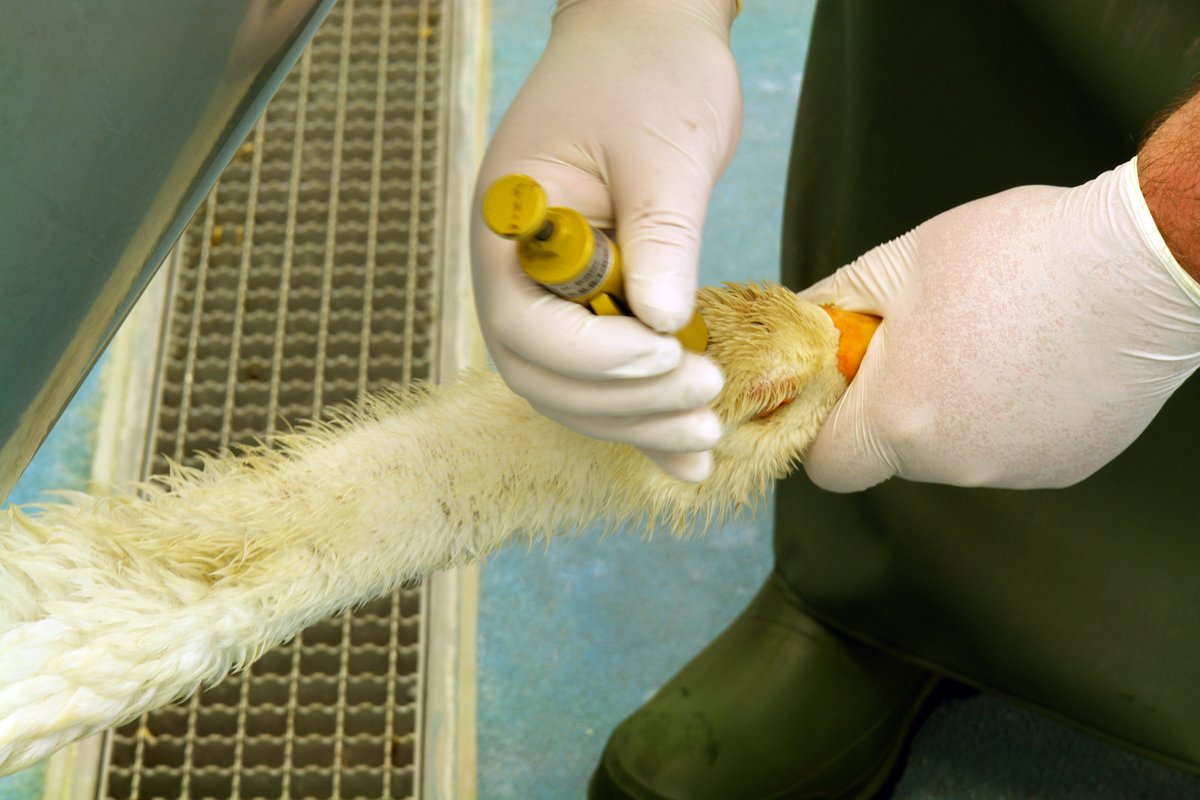
- Every vertebrate must be rendered unconscious and insensitive to pain before slaughter.
- The effectiveness of the stunning must be checked before killing:
- No breathing
- Pupils dilated / no blinking
- Touching the eye elicits no reaction (no longer any eyelid closure reflex)
- Neck muscles flaccid
- Beak opens easily
- No vocalisation
- No directed movements
- No vigorous wing flapping
- Killing
- Killing must follow immediately after stunning.
- Killing must be carried out competently and safely, without delay and without causing fear or pain to the animal concerned.
- The onset of death is carefully monitored:
- A palpable gap between the head and cervical vertebrae and
- No eyelid reflex (the eye remains open when a finger is brought close to it)
- No breathing
- No directed movements
- If breathing, eye reflexes or directed movements are observed after killing, the killing procedure must be repeated (if necessary, after re-anaesthetising – see Checking anaesthesia)
- Disposal
- It must be ensured that the animal is dead before the carcass is disposed of.
- Carcasses must be disposed of immediately and securely in the carcass storage facility.
Further guidance on the proper storage of carcasses can be found in the Lower Saxony Guidelines on the Proper Storage of Poultry Carcasses, taking biosecurity aspects into account.
Permitted methods of stunning
Up to 5 kg live weight
- A sufficiently forceful, targeted blow to the head may be used as a stunning method for poultry weighing up to 5 kg. It must be delivered using a hard, blunt and heavy object appropriate to the size of the animal. The object must be brought towards the animal’s head, rather than the animal being brought towards the object.
No weight limit
- Penetrating bolt gun
- Non-penetrating bolt shooting
- Electrical stunning
Permitted methods of killing (TSchlV)
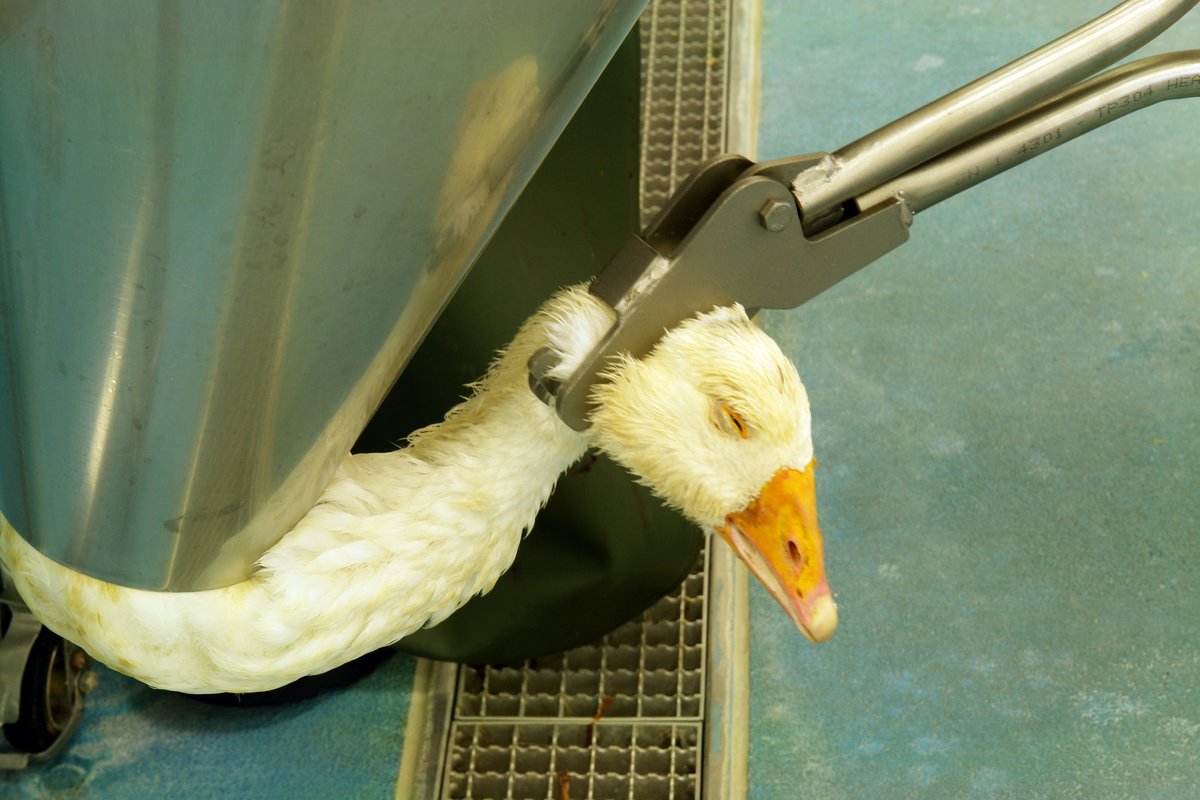
- Destruction of the spinal cord by neck break (fracture of the cervical spine between the skull and the first cervical vertebra)
- Permitted manually for animals weighing less than 3 kg (The neck is hyperextended with a sudden movement of the hand, severing the spinal cord directly behind the head.)
- using forceps (mechanical, designed so that the spine can be severed quickly and safely without great effort) for animals weighing 3 kg or more
- Blood drainage (not recommended for disease control reasons)
- Electrical cardiac arrest