
Behaviour of fattening geese
The wild ancestor of today’s European domestic goose breeds is the greylag goose (Anser anser). Over the course of domestication, domestic geese have undergone a number of changes compared to their wild counterparts, affecting both their appearance and behaviour. As a result of increases in body size and weight, domestic geese have become flightless. In terms of behaviour, they are less shy. However, the animals’ behaviour is fundamentally genetically determined, and their rearing environment should be adapted to this as closely as possible. If existing behaviours are suppressed by rearing conditions, this can lead to considerable psychological and physical stress for the animal.
Behavioural patterns can be divided into so-called functional groups (e.g. locomotor behaviour), which are expressed within the respective functional area (e.g. pasture).
Functional group vs. functional area
- Functional circuit: A behavioural system organised according to functional, goal-oriented principles, involving corresponding coordination of movement
- Functional area: The spatial area of the postural system in which one (or more) functional circuits are performed
Feed intake
Geese are predominantly herbivores. Under natural conditions, geese consume part of their food in the water. They do this by dabbling and sifting, much as can be observed in ducks.
On land, the birds are able to pluck grass and green plants effectively with their strong beaks, though they also cause significant browsing damage. When feeding, their sense of touch plays a key role. Due to the shape of their beaks, they prefer moist grain to dry grain, as it is easier to consume. Thanks to their expandable oesophagus, which functions like a crop, geese can consume a relatively large amount of food in a short time.
Water absorption
To drink, the beak is lowered horizontally onto the water’s surface so that the tip of the beak is slightly submerged. The beak opens and closes in rapid movements, after which the head is jerked upwards and the water is swallowed. Alternatively, the goose submerges two-thirds of its beak directly into the water and then lifts its head to swallow the water. Sifting movements of the beak are also performed.
Grooming behaviour refers to the wide range of behaviours that contribute to the cleaning and maintenance of the plumage, as well as to thermoregulation, and enhance well-being. These activities are particularly observed after the morning meal and account for approximately 10–15% of the total daily time. On the one hand, comfort behaviour serves the purpose of personal grooming; on the other hand, some movements also serve as signals (e.g. raising the wings whilst simultaneously straightening and rearing up the body as a display of pride or to impress).
| Comfort behaviour | Characteristics |
| Shaking |
|
| Stretching |
|
| Preening behaviour |
|
| Bathing behaviour |
|
(Image: Netzwerk Fokus Tierwohl, DLG e.V.)
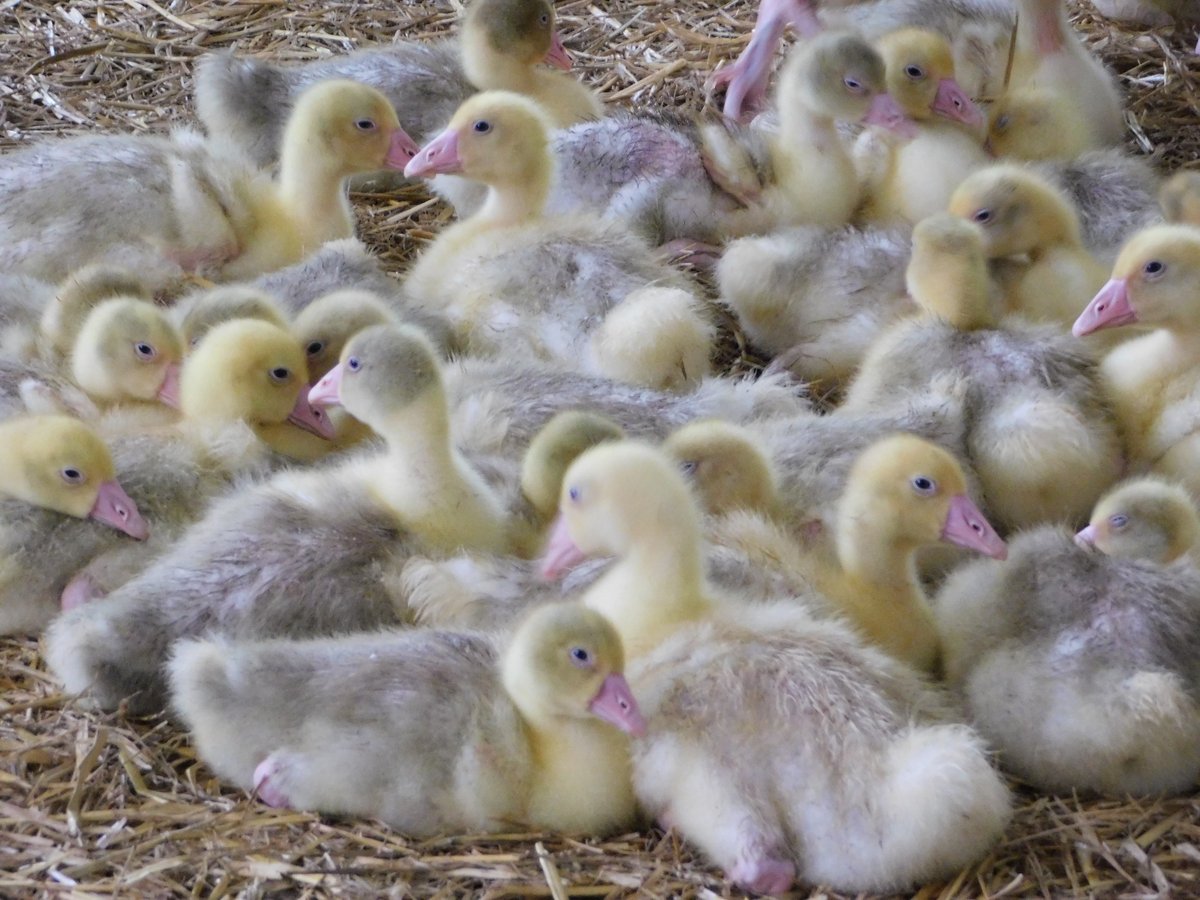
Geese usually rest or sleep after every substantial meal. When resting on land, they usually stand on one leg. On the water, they paddle from time to time to prevent themselves from drifting ashore. When sleeping on land, their bodies lie on the ground. They tuck their heads into their shoulder feathers or pull them back onto their backs, resting their beaks on their chests.
At night or in the shed, geese rest in large groups; during the day, they also rest together in smaller groups. Resting (sitting/standing) accounts for over 50% of all their behaviour.
(Photo: Jule Schättler, LWK Lower Saxony)
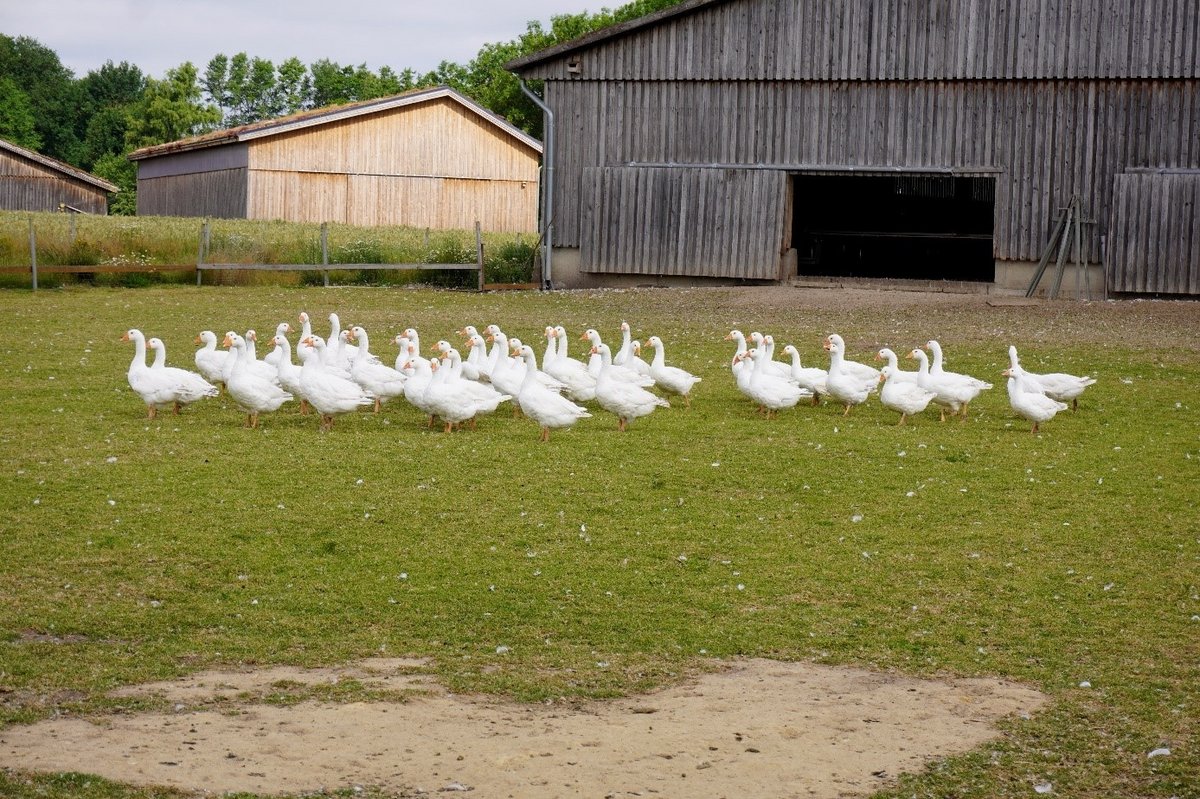
The social structure of geese is more tightly knit than that of ducks. A flock of geese always moves as a group. In the wild, leadership falls to the strongest gander. In modern commercial goose farming, this social structure is usually no longer as pronounced.
In goslings, imprinting after hatching is particularly strong compared to other poultry species. The hierarchy is established within the first few days.
The animals’ acoustic signals are also part of their behavioural expressions and play an important role in their communication with one another, e.g. the chirping of goslings, alarm or warning calls, hissing as a sign of agitation, etc.