
- Detlef May, Groß Kreutz Research and Training Centre for Animal Breeding and Husbandry
- Prof. Dr. Heiko Scholz, Anhalt University of Applied Sciences
- Prof. Dr. Ralf Waßmuth, Osnabrück University of Applied Sciences
- Guests:
- Immo Georg, Consultant for Dairy and Suckler Cattle Farming at the Hesse State Agricultural Agency
- Jonas Carle, advisor on dairy and suckler cow husbandry at the Hesse State Agricultural Agency
- Dr. Rebecca Simon, Landesbetrieb Landwirtschaft Hessen
- Leonie Schnecker, Landesbetrieb Landwirtschaft Hessen
- Saskia Markmann, Landesbetrieb Landwirtschaft Hessen
Funding note
: This document was developed as part of the joint project ‘Netzwerk Fokus Tierwohl’ (Funding codes 28N419TA01 to 28N419TA17) by the ‘Suckler Cow’ working group of the Centre of Excellence for Cattle Welfare and was adapted for methodological and educational purposes by DLG e.V.
The joint project of the Chambers of Agriculture and agricultural institutions across all federal states aims to improve the transfer of knowledge into practice in order to make cattle, pig and poultry farms fit for the future in terms of animal-welfare-friendly, environmentally sound and sustainable livestock farming.
The project is funded by the Federal Ministry of Agriculture, Food and Rural Affairs pursuant to a resolution of the German Bundestag.
All information and advice is provided without any warranty or liability.
Publisher
DLG e.V. Agricultural
Centre
Eschborner Landstraße 122
60489 Frankfurt am Main
Reproduction and transmission of individual text sections, drawings or images (including for educational purposes), as well as the provision of the information sheet in whole or in part for viewing or download by third parties, is permitted only with the prior approval of the relevant department of the Animal Welfare Competence Centre for Cattle and DLG e.V., Marketing Division, Tel. +49 69 24788-209, [email protected].
Introduction
What are the suckler cow’s requirements regarding its environment, and to what extent can it adapt to these? To ensure that the animals’ ability to adapt is not overstretched, certain husbandry requirements must be met. Cattle farmers bear a significant responsibility here to meet the animals’ needs. By law, livestock farmers are obliged to continuously and systematically observe and monitor the animals and their housing environment. This should be seen as a supplement to the daily routine checks. Objective assessment criteria are required to evaluate the welfare of one’s own herd(s) and, where necessary, to improve it.
Animal welfare for one’s own animals can be recorded and assessed using relevant indicators. To this end, the Working Group on Pasture Management in Suckler Cow Farming has developed assessment tools in the form of checklists.
The following checklists can help livestock farmers prepare for the outdoor rearing of suckler cows and their calves (either part-time or year-round). They can also be used for daily individual animal and herd observation and monitoring, whilst simultaneously serving as a basis for the farm’s own internal monitoring in accordance with Section 11(8) of the Animal Welfare Act.
Legal framework
Since 2014, livestock farms have been required under Section 11(8) of the Animal Welfare Act to carry out internal self-monitoring using animal welfare indicators. The Federal Council’s explanatory memorandum on the amendment to the Animal Welfare Act states:
“The aim of animal welfare-related on-farm self-monitoring is to assess the welfare of the animals, for example using suitable indicators, and, where necessary, to plan and implement measures for improvement.”
Livestock farmers are to be made more aware of animal welfare on their own farms and their personal responsibility in this regard is to be strengthened. Whilst the recording of animal welfare as part of on-farm self-monitoring is required by law, the procedure and documentation have not been specified in detail. The checklists are intended to help with this.

What are suitable indicators?
Animal-related indicators are used to assess aspects of the animals’ health and behaviour, such as body condition, external physical characteristics, health, behaviour, injuries and lameness. They allow direct conclusions to be drawn about the impact of housing, feeding and management on animal welfare. Whether the animals are actually thriving and whether they show signs of injury or illness can only be determined by observing them directly.
Resource- and management-related indicators (e.g. space allowance, cleaning of drinking troughs, shelter from the weather) can be used to assess the structural and technical housing conditions. These indicators form the basis for designing housing that is as animal-friendly as possible. However, they only allow for an indirect assessment of how the animals are actually faring under these conditions.
3.1 Animal-related indicators and resource- and management-related indicators for animal monitoring and control
Legal regulations and the requirement for animal-friendly suckler cow husbandry demand adequate protection from adverse weather conditions (in both summer and winter) for suckler cows and calves. To ensure that the animals can cope well with stressful weather-related situations, good physical condition, good health and weather protection with a dry, bedded-down lying area are essential. Sufficient sheltered areas should be provided, thereby reducing problems arising from social behaviour and ensuring that all animals have access to weather protection at all times of the day. A continuous, high-quality supply of feed and water must be ensured and must be guaranteed even in adverse weather conditions; if not, management adjustments are required. At the same time, an adequate supply of vitamins, minerals and trace elements must be ensured, as deficiencies can lead to increased susceptibility to infection, as well as reduced performance and fertility problems.
Daily observation of individual animals and the herd is mandatory in order to identify the animals’ adaptive responses and behaviour at an early stage and to be able to react quickly. Signs of illness, injury or restlessness within the herd must be recorded, assessed and documented. It is also recommended to document birth monitoring, management measures (e.g. hoof care) and animal losses to ensure clarity and traceability.
Sufficient animal-specific indicators are available for on-farm self-monitoring of suckler herds. It should be noted that the location, breed, other influencing factors and farm-specific conditions must be described. The assessment of body condition, for example, serves to evaluate the long-term nutritional status of the animals, whilst the assessment of rumen fill can provide valuable insights into current feed intake. Stress caused by warmth, heat or cold can be estimated by recording respiratory rate as an initial indicator. Animal reactions and ethological changes (e.g. grazing times) can supplement these findings.




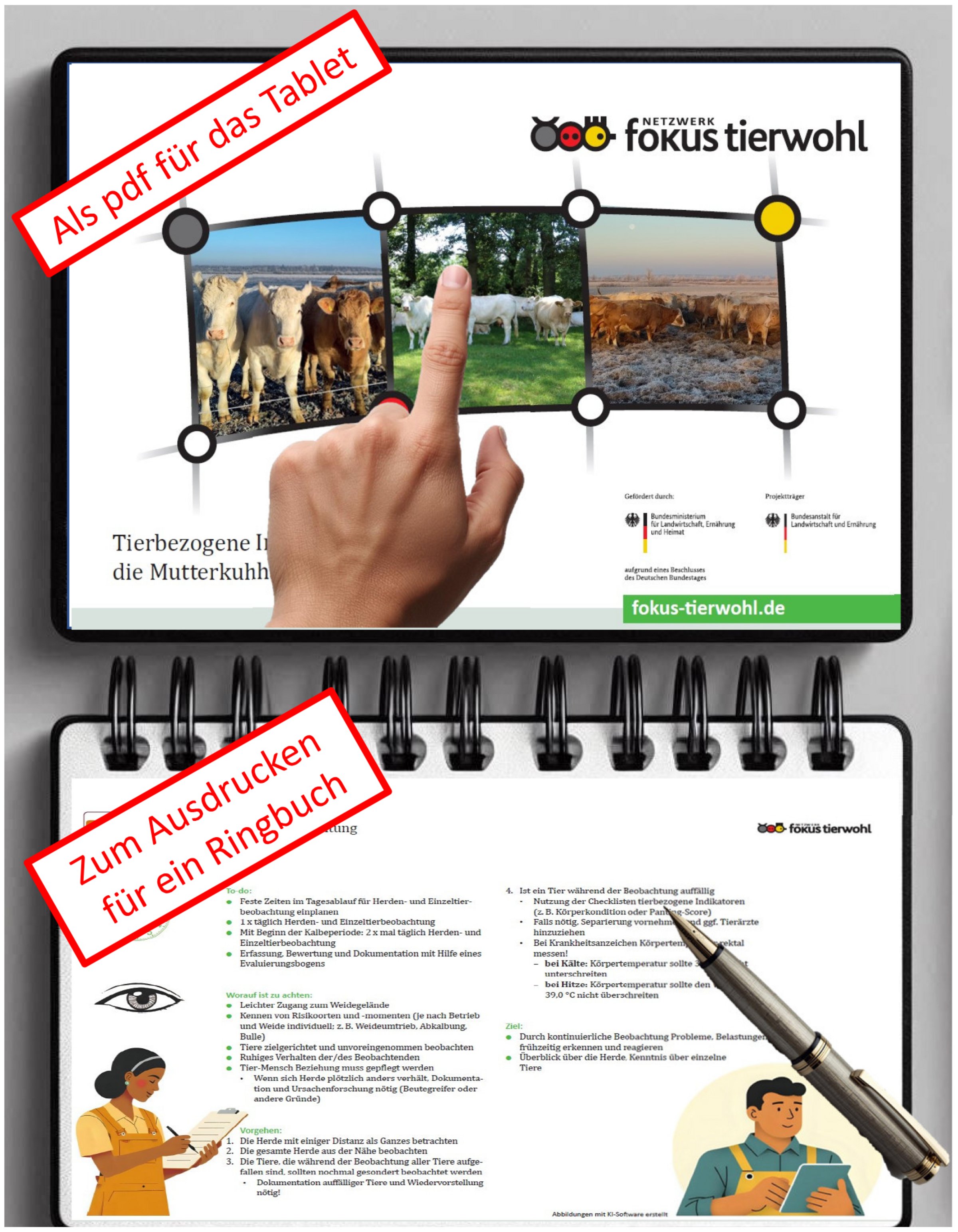
All checklists can be printed out, laminated and bound together using a ring binder. This means the assessment sheets can be reused time and time again using a whiteboard marker. If cattle farmers wish to carry out daily herd and individual animal observation and checks using a tablet, all assessment sheets can also be used as editable PDFs.
To make the best possible use of the checklists provided, the following recommendations are available, along with supplementary information.


3.2.1 Herd and individual animal monitoring
A checklist setting out the procedure and objectives has been drawn up for daily and ad hoc herd and individual animal monitoring (Fig. 2).
A table sets out all the key indicators for this area that should be taken into account during herd and individual animal observation (Fig. 3). In case of uncertainty or for more detailed observation, references to further checklists (from herd and individual animal checks) and guidance via QR codes are provided there. A legend shows which indicators can be used for daily herd and individual animal observation and which indicators serve as the basis for an occasion-specific assessment.
For animal-related indicators, the entire herd must almost always be assessed. Exceptions are the indicators for body condition, respiration, health status (assessment of rumen fill) and movement/posture. For these, a sample of the herd must be taken, depending on the herd size.
How to take a sample is described in the KTBL Animal Welfare Indicators: Practical Guide – Cattle on p. 12.
In addition, an assessment form has been created for daily herd and individual animal observation. This table contains all the indicators that are important for daily assessment (Fig. 4). For documentation purposes, there is the option to enter the date, location, name of the herd and the name of the person carrying out the assessment. To indicate that a particular indicator has been checked, one or more tick boxes can be ticked. If there are any abnormalities, these can be recorded in more detail under ‘Comments’ (e.g. ear tag, cow’s name, etc.).


3.2.3. Checklists: Recognising and preventing cold stress and heat stress
To enable farms to prepare specifically for cold or hot spells and respond appropriately, the working group has drawn up two checklists containing animal-related indicators on the topic of ‘Recognising and preventing cold stress and heat stress’ (Fig. 5).
These contain indicators that are important to assess in relation to cold and heat (Fig. 5). References to other checklists (from herd and individual animal checks) help the assessor to examine any abnormalities in greater detail. To simplify documentation, assessment forms have also been developed for this purpose (Fig. 6). There is the option to enter the date, location, herd name and the name of the person carrying out the assessment. To indicate that a particular indicator has been checked, one or more tick boxes can be ticked. If there are any abnormalities, these can be noted under ‘Comments’ (e.g. ear tag, cow’s name, etc.).
Conclusion
Animal-specific indicators are necessary for daily animal monitoring and the statutory on-farm self-monitoring required for suckler cow husbandry.
The checklists and assessment forms for suckler cow husbandry enable animal welfare to be assessed and, where necessary, specifically improved. Indicators from animal-related, resource-related and management-related areas allow conclusions to be drawn about health, behaviour and housing conditions. It is recommended that records be documented. Reliably documented data on the herd and individual animals can withstand critical scrutiny and provide a sound basis for targeted management measures on the farm.
To promote the integration of animal-related indicators into suckler cow husbandry, it would be desirable to provide joint training for farmers and vets. This would help to raise awareness of this important area and identify joint courses of action.
Further information
Managing heat stress in suckler cows
Managing cold stress in suckler cows
Parasite management in suckler cows and their calves
To provide information to interested parties directly in the pasture about outdoor grazing in winter, a pasture sign can be used:
Pasture sign: Keeping suckler cows outdoors in winter!?
Bibliography
- Brinkmann, J. et al. (2020): Animal Welfare Indicators: A Practical Guide – Cattle. Recommendations for production facilities for dairy cows, reared calves and beef cattle. Published by: Kuratorium für Technik und Bauwesen in der Landwirtschaft e. V. (KTBL). 2nd, updated edition. URL: https://www.ktbl.de/fileadmin/user_upload/Allgemeines/Download/Tierwohl/Leitfaden2020_Mastrinder.pdf
- Federal Ministry of Justice and Consumer Protection (2025): Animal Welfare Act, Section 11(8). URL: https://www.gesetze-im-internet.de/tierschg/__11.html
- Bundesrat (2012): Federal Government draft bill: Draft of a Third Act Amending the Animal Welfare Act. Drs. 300/12, page 54. URL: https://dserver.bundestag.de/brd/2012/0300-12.pdf
- Animal Welfare Focus Network (2024): Managing cold stress in suckler cows. URL: https://www.fokus-tierwohl.de/de/rind/fachinformationen-mutterkuhhaltung/umgang-mit-kaeltestress-bei-mutterkuehen
- Animal Welfare Focus Network (2025): Parasite management in suckler cows and their calves. URL: www.fokus-tierwohl.de/de/rind/fachinformationen-mutterkuhhaltung/parasitenmanagement
- Pelzer, A.; Kaufmann, O. (2016): Focus on the animal – dairy cows. DLG Fact Sheet 381. 5th ed. Published by DLG e. V. URL: https://www.dlg.org/fileadmin/downloads/Merkblaetter/dlg-merkblatt_381.pdf
- Scholz, H. et al. (2025): Use of animal indicators in suckler cow husbandry. 13th Stendal Symposium of the State Office for Consumer Protection and the Veterinary Chamber of Saxony-Anhalt: Animal diseases and animal welfare in cattle, 26–28 March, Stendal