Overall impression of the herd
(including animal behaviour)
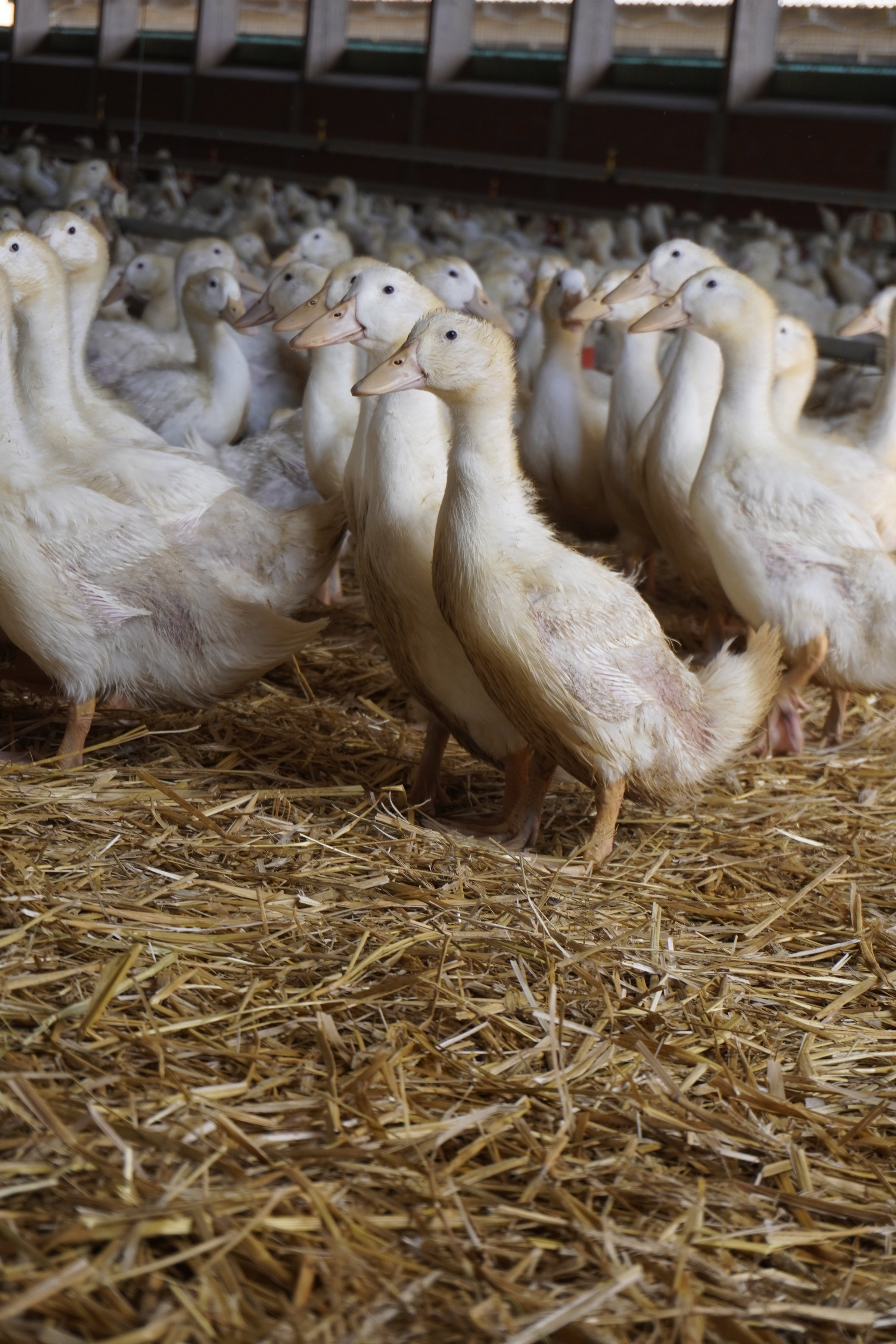
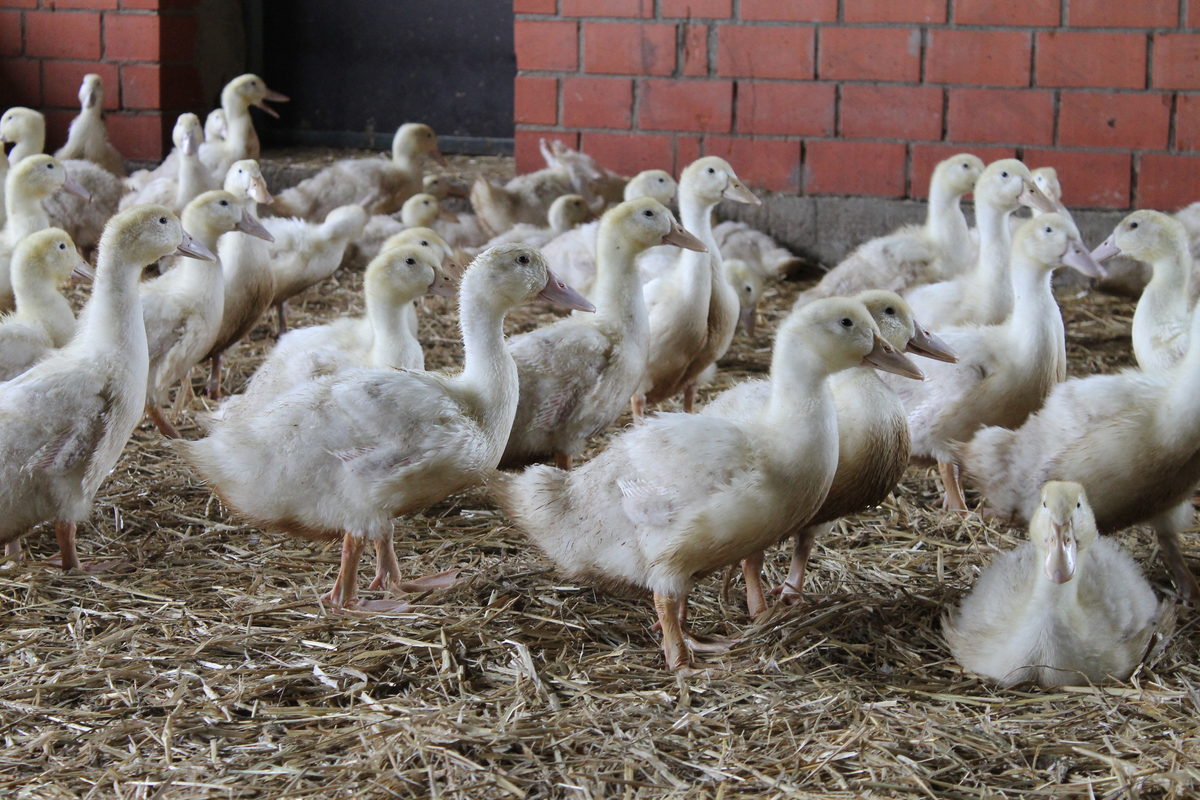
- Normal behaviour of the animals:
- Active
- Alert
- Reaction to the presence of people through quacking and movement
- No ducks in the flock show clinical symptoms indicating illness or injury
- The animals are not crouching (no tucked-in head)
- No conspicuous noises (e.g. sneezing/wheezing)
- No noticeable movement disorders

(©Jule Schättler, LWK Lower Saxony)
Anomalies in the distribution of animals across the usable area
- Even distribution across the available area in accordance with their herd behaviour
- No crowding
- No animals crowding against the outer walls
Feed consumption
Life stage (days) | Feed type | kg / bird |
| 1–16 | Starter | approx. 1.1 |
| 16–42 | Finishing feed | approx. 5.2 |
- Feed intake per animal is influenced by several factors, such as temperature or feed quality.
- Adequate feed intake is essential for meeting daily nutritional requirements and should therefore always be monitored.
- The relevant management recommendations from the breeding companies can be used as a guide.
Water consumption
| Week of life | ml / bird per day | ml / bird per day (with additional water available) |
| 1 | 120 | Up to 160 |
| 2 | 160 | Up to 300 |
| 3 | 300 | Up to 400 |
| 4 | 400 | Up to 500 |
| 5 | 500 | Up to 700 |
| 6 | 700 | Up to 900 |
| 7 | 900 | Up to 1,000 |
- Water consumption should not be equated with actual drinking water intake, as the birds also use water for preening and as a form of activity. It also depends on the outside or shed temperature and, in particular, on the watering system.
- Approx. 21 l per bird per cycle; with additional water available, approx. 28 l per bird per cycle
- Feed-to-water ratio
- approx. 1:2.7
- With additional water available: approx. 1:3.2
- Significant deviations in water intake may indicate illness in the birds or a faulty drinking system.
- The relevant management recommendations from the breeding companies can be used as a guide.
During the hot summer months, animals are more prone to heat stress. Appropriate measures should be taken in good time to prevent and reduce heat stress (see the information sheet on preventing heat stress in Peking ducks).

Nostrils
- Clean
- Unbound / free
- Unobtrusive breathing (with beak closed, no breathing sounds)
Weight trends
- Evenly distributed within a group of the same age
- Complies with the breeding company’s specifications
| Day of life | Weight in g | |||
| Spring curve | Summer curve | Autumn curve | Winter curve | |
| 0 | 55 | 55 | 55 | 56 |
| 7 | 246 | 264 | 238 | 245 |
| 14 | 702 | 722 | 730 | 709 |
| 21 | 1386 | 1344 | 1385 | 1335 |
| 28 | 2130 | 2085 | 2117 | 2092 |
| 32 | 2490 | 2350 | 2500 | 2470 |
| 35 | 2782 | 2678 | 2796 | 2807 |
| 42 | 3216 | 3082 | 3241 | 3331 |

Avian Influenza Regulation (Section 4(1) and (2))
(1) If, within a 24-hour period, losses of
- at least three animals within 24 hours in a herd or a spatially defined part of a herd comprising up to and including 100 animals, or
- more than 2 per cent of the animals in a flock or spatially defined part of a flock of more than 100 animals, or if there is a reduction in the usual laying performance or average weight gain of more than 5 per cent in each case, the keeper, subject to paragraph 2, must immediately have a veterinarian rule out the presence of infection with the highly pathogenic or low pathogenic avian influenza virus by means of appropriate tests.
(2) If, in a flock or a geographically defined part of a flock in which only ducks and geese are kept, over a period of more than four days
- losses amounting to more than three times the usual mortality rate of the animals in the flock or the spatially defined part of the flock, or
- a reduction in the usual weight gain or laying performance of more than 5 per cent
, the keeper shall immediately have a veterinarian rule out the presence of infection with the highly pathogenic or low pathogenic avian influenza virus by means of appropriate tests.