
Behaviour of Peking ducks
The natural and species-specific behaviour of Peking ducks has hardly changed despite domestication and intensive selective breeding.
However, changes have occurred in their ability to fly, the dissolution of pair bonds, a partial loss of breeding ability, and a reduction in aggression and flight behaviour towards humans.
The Peking duck is descended from the mallard (Anas platyrhynchos). Unlike the Muscovy duck (Cairina moschata), it shows a high degree of adaptation to aquatic life in terms of physique and behaviour. Muscovy ducks, on the other hand, rest in elevated positions such as on trees and tend to make less use of bathing opportunities. A clear distinction must therefore be made between the two species in terms of their behaviour and their requirements for the rearing environment.
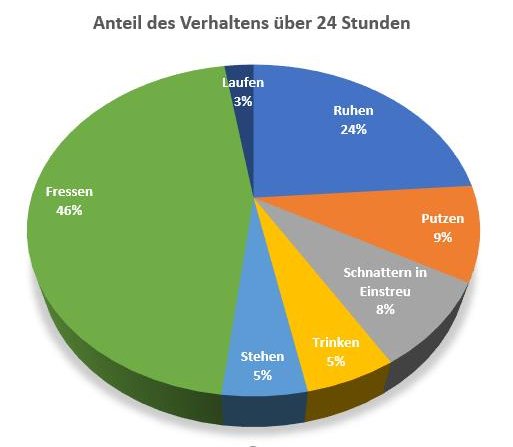
Fig. 2 shows the distribution of the animals’ behaviour throughout the day. Resting and preening take up most of their time. The animals are also active at night, but their main periods of activity are at dawn and dusk. The Peking duck thus differs fundamentally in behaviour from the chicken.
Functional group vs. functional area
- Functional circuit: A behavioural system organised according to functional, goal-oriented principles, involving corresponding coordination of movement
- Functional area: The spatial area of the postural system in which one (or more) functional circuits are performed
The following section discusses the behaviour of the wild type. Any deviations or distinctive features resulting from modern methods of rearing Peking ducks are also noted.
The reproductive behaviour of Peking ducks will not be discussed in detail, as in Peking duck fattening the birds are slaughtered before reaching sexual maturity.
Their movement patterns are largely linked to their feeding habits. Peking ducks can cover considerable distances on foot at a leisurely pace. Over short distances, they can run quickly and even hop onto low objects. On average, they reach running speeds of 0.3–0.6 m per second. With their short legs set far back on their bodies, they shift their centre of gravity alternately onto whichever leg is bearing the weight, moving their heads sideways in sync with this movement. This results in their characteristic waddling gait.
Feed intake
Peking ducks have a long, flat beak that is approximately 7 cm long and 2.7 cm wide. To help them feed, their beaks are equipped with lateral horn-like ridges, which enable them to pluck hard grasses and filter the finest food particles from the water.
Ducks employ various techniques for feeding. These include, amongst others, sifting, dabbling and pecking.
Sifting can be classified as an indirect form of drinking within feeding behaviour. The food is filtered from the water flowing past the sides of the beak with the help of the lamellae, transported further into the beak, collected in the upper part and swallowed.
Dredging is another frequently observed feeding technique, in which the head and neck are submerged in shallow water and food is taken from the bottom of the water.
- Drinking from nipple drinkers does not correspond to ducks’ natural behaviour, but it does offer hygienic advantages.
- With their necks and heads stretched out, the ducks nibble at the drinking nipple with their beaks open and swallow the water that flows out.
- Open drinkers or bathing facilities, where the animals can dip their heads or display bathing behaviour, pose a hygiene risk if they are not kept sufficiently clean.
Grooming behaviour refers to the wide range of behaviours that contribute to the cleaning and maintenance of the plumage, as well as to thermoregulation, and enhance the animals’ well-being. Plumage maintenance, or preening, takes place both on land and in the water.
Typical aspects of body and plumage care include:
Grooming with drinking/bathing water
- Bathing several times a day is part of ducks’ comfort behaviour.
- Ducks wet their plumage by quickly submerging their head and neck and then jerking upright. The feathers are then smoothed and arranged with the beak and greased with the secretion from the uropygial gland.
- This species-specific behaviour is described by Knierim et al. (2004) as follows:
“The duck is on a body of water and begins bathing by shaking its tail rapidly. It then submerges its head up to its eyes in the water, stands up and lets water run over its body, shaking its body and raised wings. This movement is performed several times in quick succession. Afterwards, extensive plumage grooming is carried out on land using the beak.”
Beak washing
- By submerging its head in the water, the duck cleans its beak, nostrils and eyes.
- The birds dip their beaks into the water and blow water through their nostrils.
Grooming movements
- Feather preening is preferably carried out after bathing and in combination with greasing via the uropygial gland. The ducks smooth their beaks, necks, the sides of their heads and throats over entire areas of feathers or work on individual feathers.
- Wing flapping, shaking of the body and head, scratching and stretching of the legs can also be observed.
In the wild, ducks rest and sleep either sheltered on land or floating on the water. They rest and sleep after every meal. To do this, they tuck their heads into their shoulder feathers or pull their necks towards their backs and rest their beaks on their chests. They rest together in groups (synchronisation).
Social behaviour refers to all behaviours that serve to facilitate communication between animals. In the wild, ducks form loose social groups without a hierarchy. The birds rest and feed together in groups. From the third day onwards, the birds recognise one another in small groups; however, in larger groups they are unable to recognise individual birds. Ducklings have a tendency to run towards or after moving objects. Through this innate behaviour, a bond develops with the mother and siblings. In modern Peking duck husbandry, the birds are imprinted on the person responsible for their care.