
Skin injuries caused by pecking
Pecking damage is a behavioural disorder in turkeys characterised by birds pecking at each other’s feathered and bare body parts. This can result in large wounds, which are painful and may lead to losses. It is important to prevent an ‘outbreak of pecking’ in the flock through skilful management and sufficient enrichment. Through close observation of the birds during daily checks, potential ‘outbreaks of pecking’ can be identified at an early stage by monitoring behavioural changes in the flock, enabling appropriate measures to be taken. In this context, turkeys must be monitored closely, particularly during critical life stages (e.g. change of feed, moulting, sudden changes in weather). Injured birds should be isolated as early as possible.
As this is a multifactorial process, it is usually not possible to identify a single cause with certainty. Information on the implementation and evaluation of animal assessments can be found, amongst other sources, in the KTBL Practical Guide – Poultry⁹ and the corresponding recommendations on target and alert values for on-farm self-monitoring¹⁰.
Deviating condition
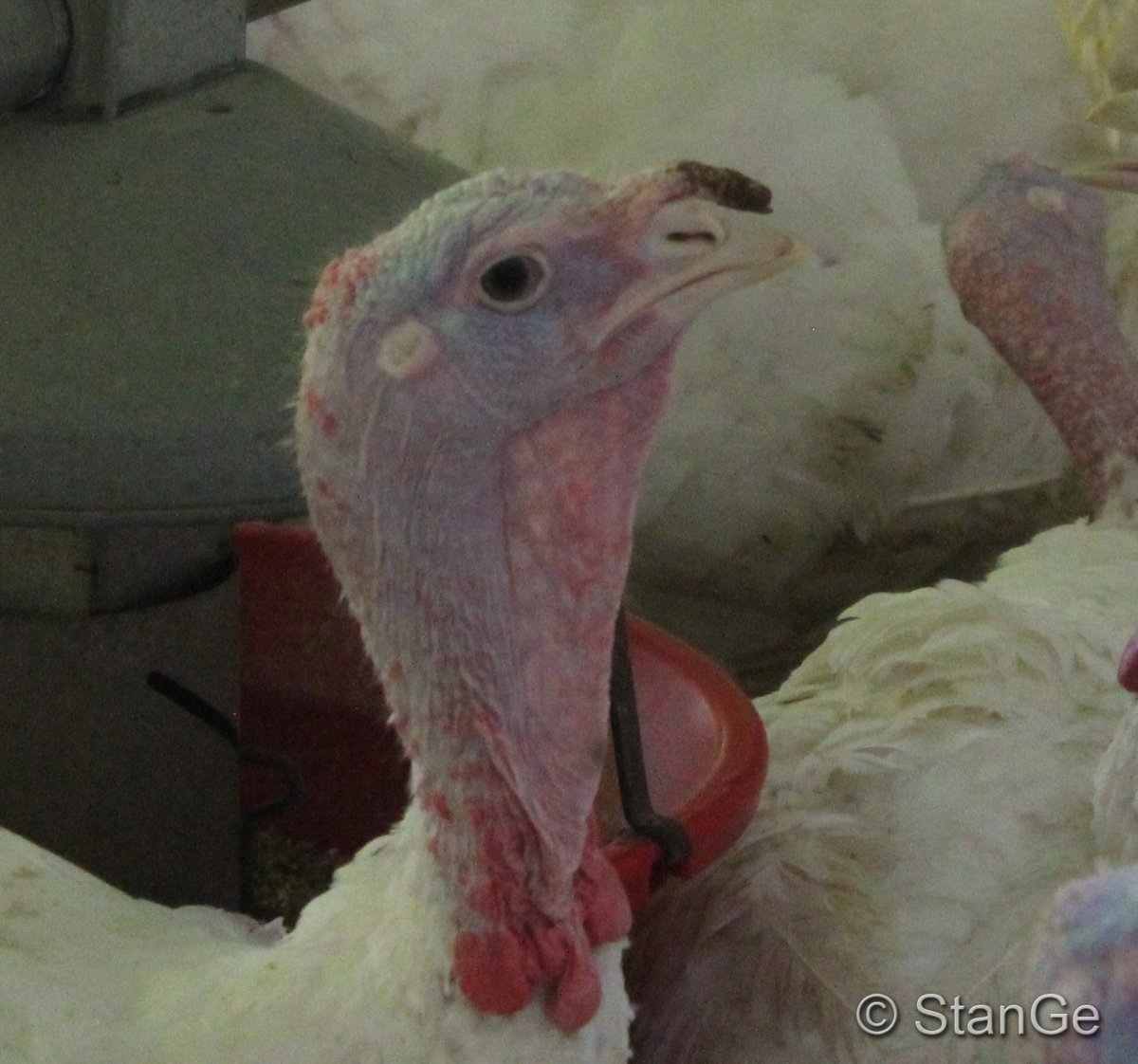
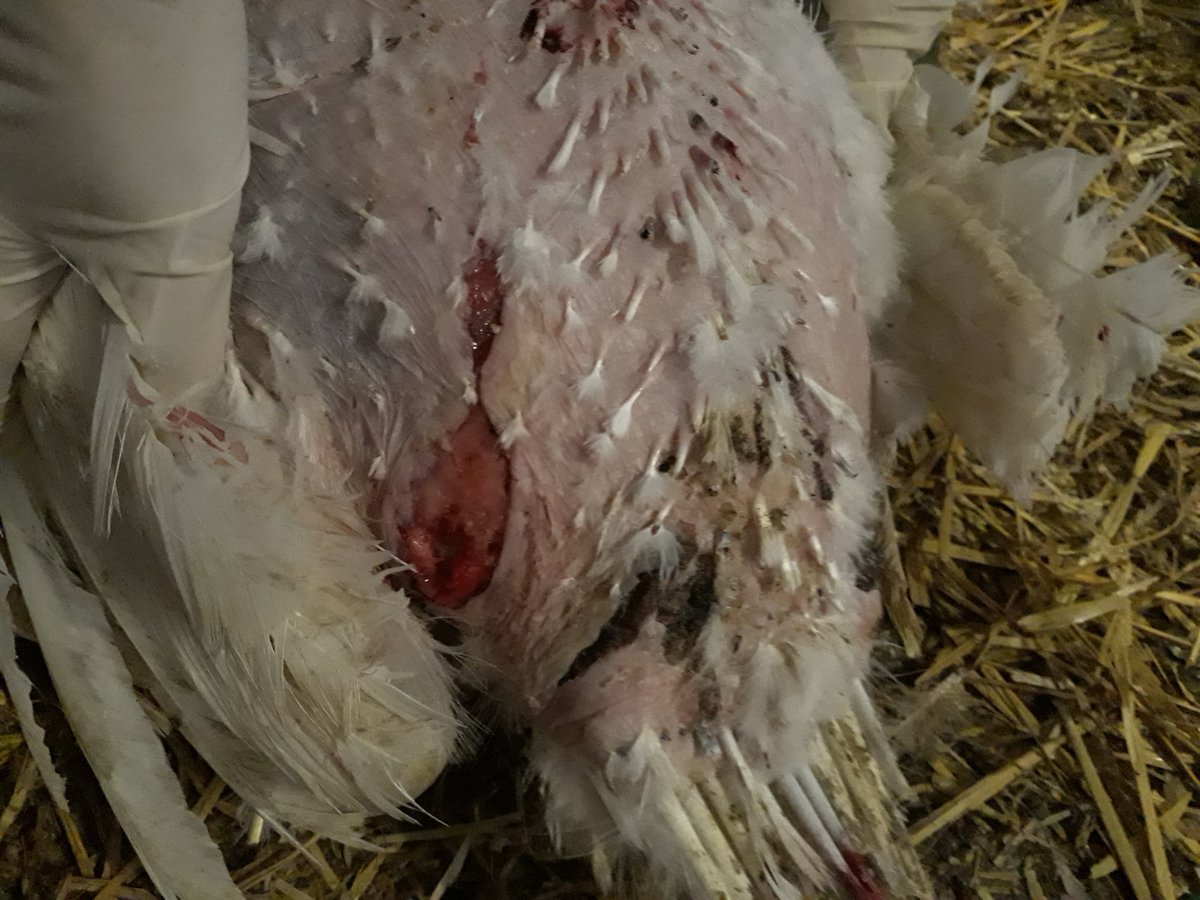
Skin injuries in the form of pecking or scratching wounds (damaging pecking, Figs. 21/22) frequently occur on the wings and tail of turkeys, as well as on areas of the bird’s body with little or no plumage (e.g. the head, forehead, neck or cloaca). Injuries to the head and facial structures usually occur upon reaching sexual maturity, particularly in cocks. Furthermore, cannibalism may occur if the injuries are subsequently pecked at by other birds of the same species.
Measures
At the individual animal level
The animals should be thoroughly checked for injuries and wounds, including under their plumage if bloodstains are found
Injured animals with open wounds must be separated and, where necessary, treated with zinc spray
In the case of large open wounds that cause distress and/or prolonged pain and provide a gateway for pathogens, the animals must be anaesthetised and euthanised in accordance with animal welfare principles, as necessary and depending on the severity of the injuries
The isolated animals must continue to be monitored closely
If in doubt, a vet must be consulted
At herd level
In the event of pecking, it is important to intervene at an early stage to contain the outbreak. To this end, it is advisable to provide the turkeys, as far as possible, with fresh litter and additional, unfamiliar enrichment materials (see examples).
For example, adding table salt (approximately 1–2 kg per 1,000 litres of water) for 2–3 days can help2. Experience has shown that administering magnesium compounds or tryptophan can also have a calming effect on the flock (follow the manufacturer’s and vet’s instructions)
Partitions within the barn can offer protection to affected animals
A short-term, significant reduction in light intensity as directed by a vet (the barn must be equipped with facilities for dimming the lights for this purpose). Gradually increase the light intensity back to the initial level after 2 to 3 days
Practical Handbook on Turkeys | Key figures for turkeys | TWW (housing system) | ||
|---|---|---|---|---|
|
| Housing plus outdoor access | Fresh-air house | Outdoor access |
| at least 1 BM per 500 birds and at least 1 SE per 1,000 birds | 1 BM per 500 animals | 1 BM per 400 m² or part thereof of usable area | 2 BM per 400 m² or part thereof of usable area | 2 BM per 400 m² or part thereof of usable area |
| Organic BM : ≥ 1 dispenser per 500 animals | 1 SE per 400 m² or part thereof of usable floor area (square/round bales) or a minimum (contiguous) standing area of 1.85 m² per 400 m² or part thereof of usable barn floor area | equivalent to housing plus outdoor space + additional BM must be provided in the event of feather-pecking | as in ‘house plus outdoor area’ + additional enrichment material must be provided in the event of feather-pecking | |
Table 3: Overview of recommendations for enrichment materials (BM) and structural elements (SE) for turkeys.
For example, administering table salt (approximately 1–2 kg per 1,000 litres of water) over 2–3 days can help2. Experience has shown that the administration of magnesium compounds or tryptophan can also have a calming effect on the flock (follow the manufacturer’s or vet’s instructions)
Partitions within the house can offer protection to affected birds
A short-term, significant reduction in light intensity as directed by a vet (the house must be equipped with facilities for darkening) Gradually increase the light intensity back to the original level after 2 to 3 days