
Although the statutory on-farm self-monitoring scheme may in some cases involve additional work, its value as a management tool for improving animal health and welfare on the farm should not be underestimated. To ensure that it is implemented systematically, technically sound guidance documents have been developed.
What exactly does on-farm self-monitoring involve?
All livestock farmers are responsible for the welfare of their pigs. This personal responsibility has been explicitly regulated since 2014 in Section 11(8) of the Animal Welfare Act. The law stipulates that all livestock farmers must assess and evaluate animal welfare in the barn using suitable animal-related characteristics (animal welfare indicators). What exactly needs to be recorded, how, and how often is not further specified. This naturally makes the implementation of on-farm self-monitoring difficult.
What animal welfare indicators are there?
Animal-related indicators are used to record aspects of the animals’ health and behaviour. They allow direct conclusions to be drawn about the effects of housing, feeding and management on animal welfare. Various data sources can be used for self-monitoring. Routinely collected data (e.g. slaughter findings, antibiotic use) can be used for evaluation quite easily and quickly. However, this data does not reflect all possible animal welfare issues in pigs, which is why other characteristics should be recorded directly ‘on the live animal’ (e.g. lameness, skin or tail injuries). If no valid animal-related indicators are yet available for recording specific animal welfare issues (e.g. inadequate water supply), or if recording them would be too time-consuming, resource- or management-related indicators are used (e.g. inspection of drinking facilities). For the recording of animal welfare indicators as part of on-farm self-monitoring, the KTBL has published the guide ‘Animal Welfare Indicators. Practical Guide – Pigs’. This provides a flowchart for each production system. It explains which indicators should be recorded, when, how often and on which animals, e.g. on a described sample. Each indicator is briefly explained and there are photos or calculation formulas as well as further guidance on data collection. The guide also contains forms that can be used for data collection in the barn.
Tools for collecting animal welfare indicators
In the “EiKoTiGer” (Self-monitoring of Animal Welfare) project, the animal welfare indicators were tested for their practical suitability and various application aids were developed. The Excel application and two data collection forms (sows and suckling piglets, rearing piglets and fattening pigs) help livestock farmers to systematically record animal-related indicators in their own barns. The tools are available for free download on the KTBL ‘Animal Welfare Assessment’ page.
The indicators have been recorded – what next?
Once the farm-level indicators have been recorded, that is half the battle, but the legislation requires not only the recording but also the assessment of the farm’s animal welfare situation. However, to assess the current situation on one’s own farm and identify opportunities for improvement, reference values are needed. For this reason, the “EiKoTiGer” project developed a reference framework for classifying the farm’s animal welfare situation based on target and alert values. In a multi-stage process, the reference values determined from a two-stage Delphi survey were compared with findings from the literature and data from field surveys, and were then presented to, discussed with and finally agreed upon by experts from various stakeholder groups in further technical discussions. The guidance framework (sows and suckling piglets, rearing piglets and fattening pigs) was published online in 2020 and is available for free use.
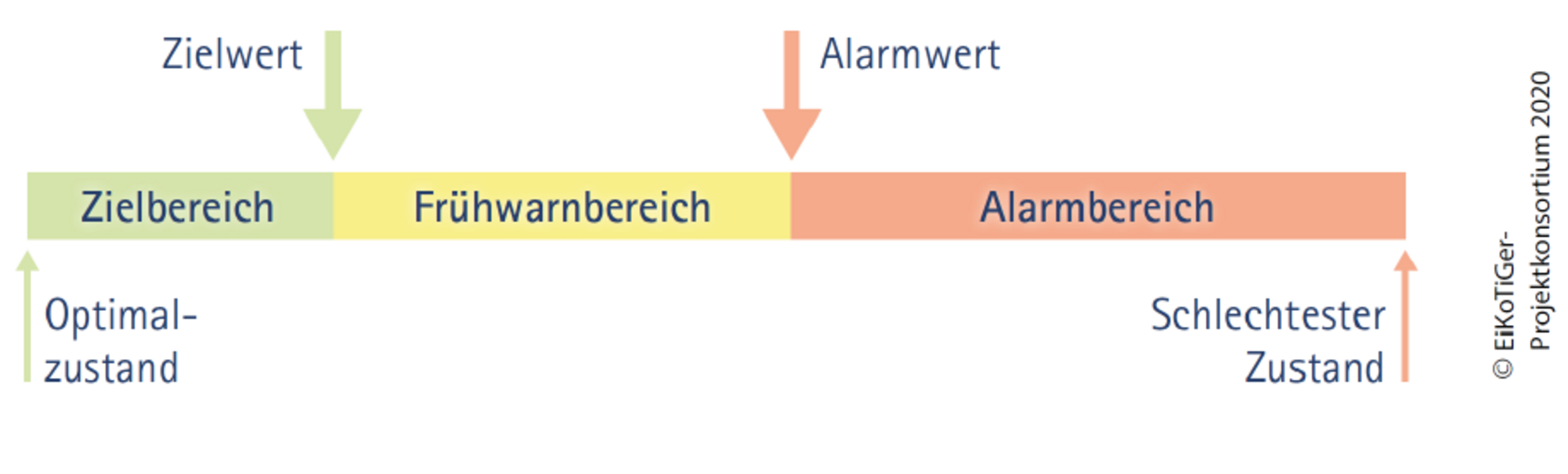
With regard to the animal welfare situation on the farm, everything is in the green zone if the values determined for the individual farm lie between the optimal state and the target value. Based on current findings regarding the indicator, there is no animal welfare problem for values within the target range. If the alarm value is exceeded, the alarm range is reached, in which, based on current findings regarding the indicator, there is an animal welfare problem requiring urgent action. If your own values fall between the target and alarm values, this should be regarded as an early warning. The relevant indicators should be monitored over a longer period, possible causes investigated, and targeted measures taken to improve the animal welfare situation. If necessary, specialist advice and/or the livestock veterinarian should be consulted.
Online training course on ‘Animal Welfare Indicators’
Before carrying out the survey, it is advisable to receive training in the use of animal welfare indicators. In the free online training course “Animal Welfare Indicators”, livestock farmers receive information on the indicators and can practise using them with the help of photos and videos. Participants can then assess their own progress by taking an online test. Furthermore, upon successful registration, a personalised certificate of course completion is issued (not available in the demo version).
Conclusion
The aim of on-farm self-assessment is to ensure that livestock farmers engage with and are aware of the conditions, specific features and, where applicable, issues on their farms. In day-to-day operations, a certain degree of tunnel vision can creep in, which can be countered by taking a more objective look at the animal welfare situation on the farm. Regular collection of animal welfare indicators offers the opportunity to initiate farm-specific optimisation measures at an early stage. It also serves to monitor the success of the measures implemented. The classification of one’s own farm figures can also be a motivation to improve the animal welfare situation on the farm. Self-monitoring should always cover the identification of all possible animal welfare issues; at the same time, however, it may also be adapted to the specific needs of the farm as part of a risk-based approach, once a comprehensive review has provided an overview of the weaknesses within the farm.
KTBL topic page ‘Animal Welfare Assessment’:
Free download of tools for collecting animal welfare indicators and further information
Sources
KTBL, Thünen Institute, Friedrich Loeffler Institute, University of Kassel (2021): “How was the guidance framework for on-farm self-monitoring with target and alert values developed?”, online document, accessed on 24 March 2022
Schrader, L., Schubbert, A., Rauterberg, S., Czycholl, I., Leeb, C., Ziron, M., Krieter, J., Schultheiß, U., Zapf, R. (2020): “Animal welfare indicators: Practical guide – pigs”, 2nd updated edition, KTBL special publication, Publisher: Kuratorium für Technik und Bauwesen in der Landwirtschaft e.V. (KTBL), Darmstadt.