
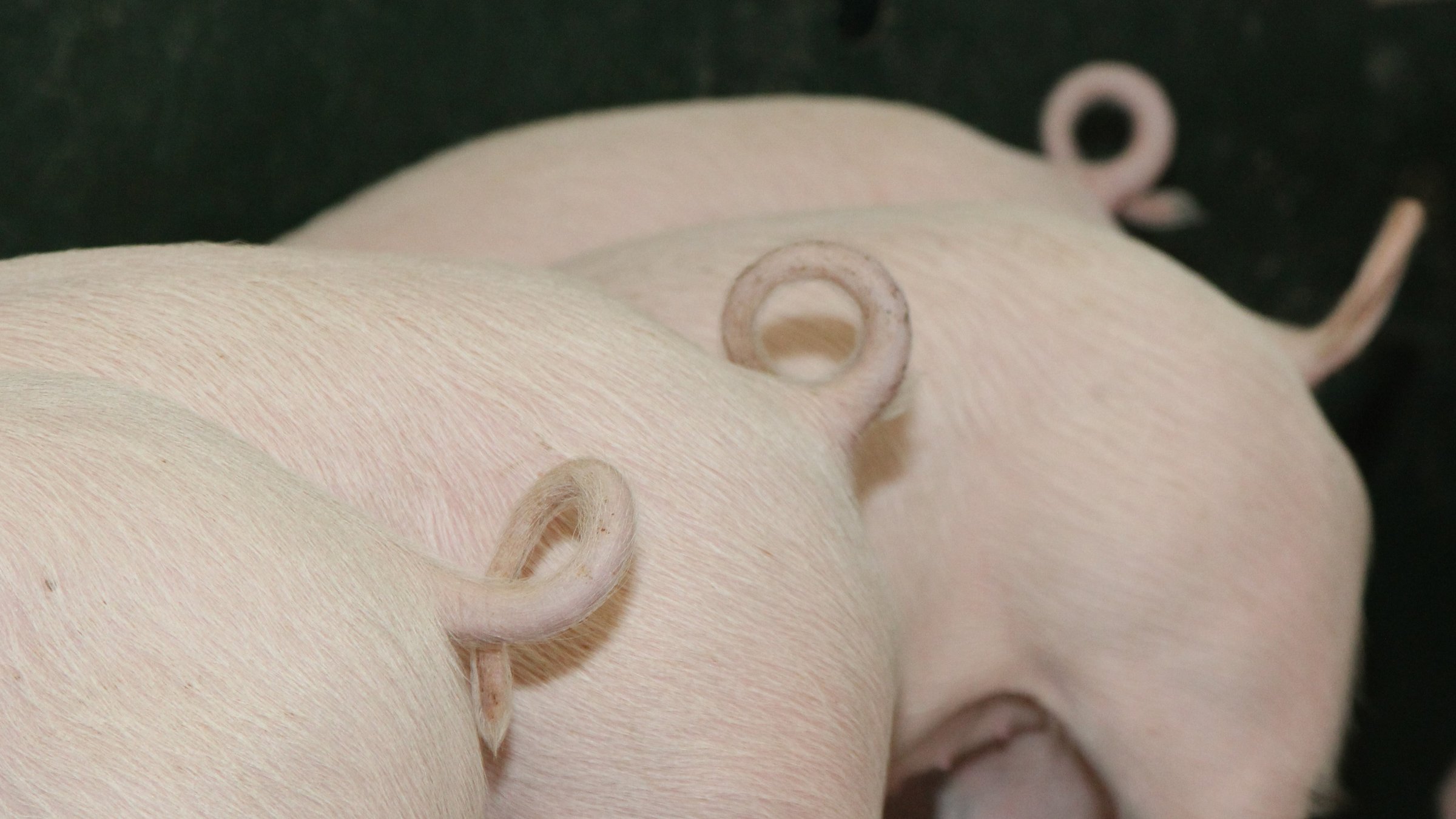
(Source: Bütfering, LWK NRW)
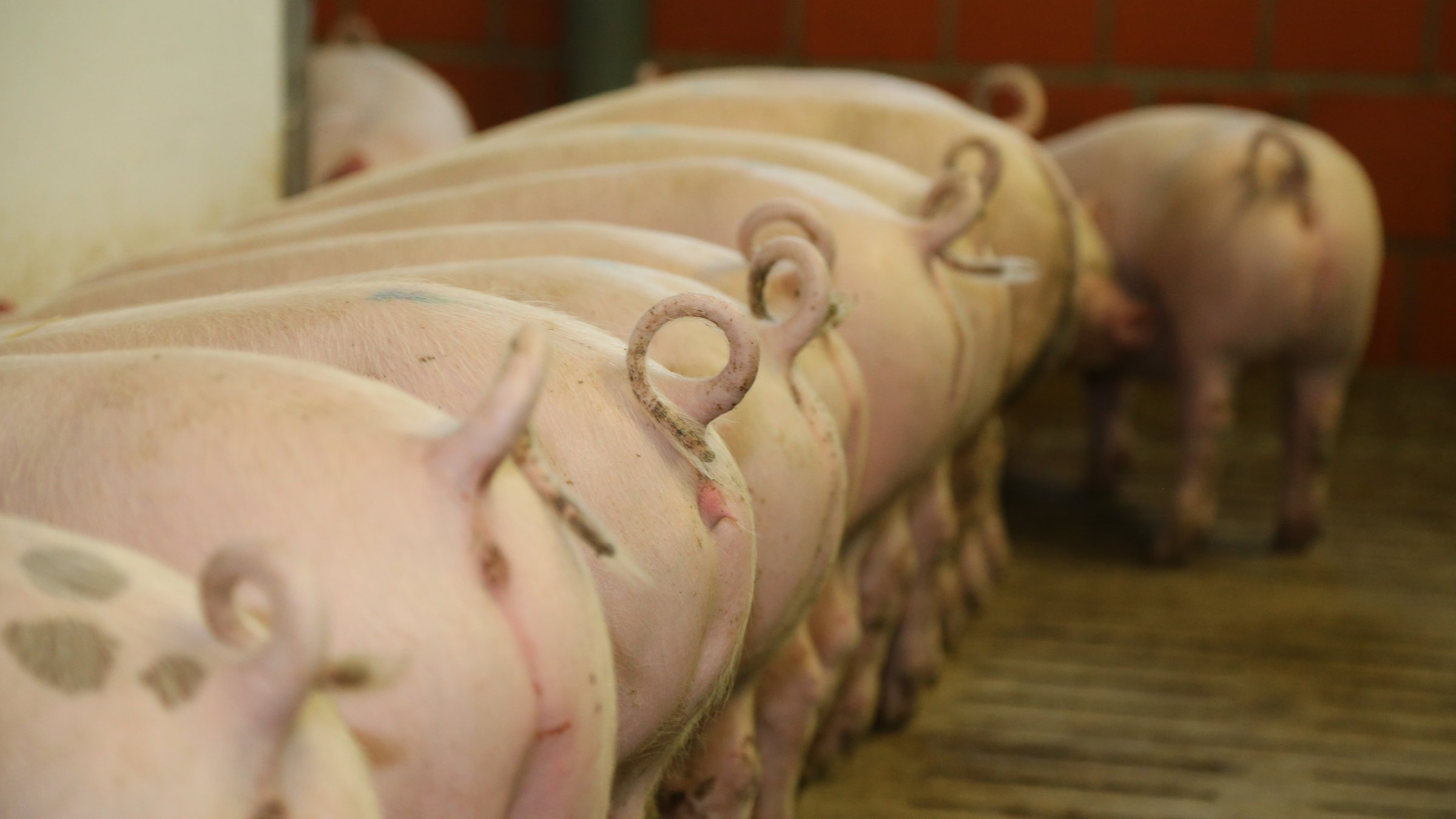
(Source: Bütfering, LWK NRW)
No tail docking
Tail docking of suckling piglets has long been practised in conventional livestock farming as the most effective method of preventing tail-biting (caudophagia). However, under EU legislation and the provisions of the German Animal Welfare Act, this is only permitted in justified exceptional cases where other measures that take account of environmental and husbandry conditions (in particular management, housing, stocking density, etc.) are ineffective. As tail-biting is known to occur even in pigs with docked tails, docking is by no means a universal solution to the problem. The underlying multifactorial causes of biting behaviour are not thereby resolved. The risk factors for tail-biting vary greatly from farm to farm. Therefore, there is no one-size-fits-all solution to this behaviour, known as caudophagia. Necrotic changes are also triggers for tail lesions. These can be triggered by the body’s own reactions (e.g. to endotoxins) and cause inflammation. Endotoxins are metabolic products of Gram-negative bacteria (e.g. E. coli, Salmonella, Pasteurella), which can multiply rapidly in the gut, for example, as a result of a diet high in starch and low in crude fibre. Furthermore, infectious agents such as streptococci, PRRS and mycoplasma can cause the blood supply to concentrate on central organs, resulting in inadequate blood supply to the peripheral parts of the body. This clinical picture is known as Swine Inflammatory and Necrotic Syndrome (SINS). The resulting necrotic changes promote the development of haemorrhages and infections. They thus also provoke tail-biting. Therefore, all known risk factors in the pigsty should be checked as far as possible and any problems rectified.
National Action Plan for the Abolition of Tail Docking
This is precisely the purpose of the on-farm risk analysis carried out as part of the ‘National Action Plan for the Abolition of Tail Docking’. This plan entered its second year on 1 July 2020. The aim of the action plan is to reduce the incidence of ear and tail injuries, even in docked animals, during rearing and fattening, and to gradually transition to the rearing of undocked animals.
The risk factors are often divided into six main risk areas:
- Enrichment
- Housing environment
- Health and fitness
- Competition for resources
- Nutrition
- Pen structure and cleanliness
The risk analysis includes a wide range of examples of optimisation measures. For further information, you will find an overview of guides and guidelines on the topic of not docking tails at
Tail-biting intervention programme
The Institute for Animal Welfare and Animal Husbandry at the Friedrich Loeffler Institute has developed the ‘Tail-biting Intervention Programme’ (SchwIP) for piglet rearing and fattening. SchwIP comprises a consultancy framework for farm planning, which incorporates software featuring a knowledge database for farm-specific analysis and feedback on the risks of tail-biting.
Online guide
There is an online guide that provides a concise summary of current knowledge and practical experience on preventing tail-biting, along with plenty of information and tips on rearing uncastrated pigs.
Current research projects
National Knowledge Network on the Abolition of Tail Docking
To make it easier for farmers, advisors and vets to identify risk factors and complete the risk analysis, the ‘PIG-CHECK’ app was developed as part of the MuD Animal Welfare Project ‘National Knowledge Network on Tail Docking’. The identified factors and optimisation measures can be entered via smartphone or tablet and viewed at any time.
FitForPigs
The “FitForPigs” app is being developed as part of an EIP project to assess animal health and record animal signals. In addition to information on typical clinical signs in pigs, this app also provides tips on identifying contributing factors that can lead to tail biting.
Vision Pig
The knowledge transfer project Vision Pig is part of the Animal Welfare Model and Demonstration Projects (MuD), funded by the Federal Ministry of Food and Agriculture (BMEL), for a period of two years. The project is managed by the Federal Office for Agriculture and Food (BLE). The aim of the MuD Animal Welfare project is the effective and rapid transfer of research findings into agricultural practice. Implementation is carried out by Vision 360 Agrar Forschung und Schulung gGmbH. The aim of Vision Pig is the exchange of practical experience regarding:
- necessary changes for modern sow husbandry and farrowing
- stress-reduced housing systems and societal expectations
- Avoiding non-curative interventions in pigs
- species-appropriate and forward-looking housing environments
- pen designs and equipment
Joint project to phase out tail docking in pigs (KoVeSch)
As part of the programme to promote innovation, the “KoVeSch” consortium project is funded by the Federal Ministry of Food and Agriculture (BMEL). The aim of the consortium project is to provide pig farmers with concrete guidance on farm-specific optimisation measures that will enable them to stop tail docking in pigs. To this end, a novel approach is being pursued in which measures are gradually reduced, starting from maximally optimised pens. By the end of the project, various implementation options for the minimum necessary optimisation measures can thus be described (“from the optimum to the necessary”). Through the concurrent recording of costs and labour requirements, livestock farmers gain additional decision-making criteria for farm-specific optimisation measures. To support livestock farmers in the necessary animal monitoring, various innovative methods for the early detection of tail-biting are also being developed and tested in parallel.
The project is coordinated by the Institute for Animal Welfare and Animal Husbandry at the Friedrich Loeffler Institute and is being carried out in collaboration with the Bavarian State Office for Agriculture, the Boxberg Education and Knowledge Centre (LSZ), the Chambers of Agriculture of Lower Saxony, North Rhine-Westphalia and Schleswig-Holstein, and the Christian Albrecht University of Kiel, Institute for Animal Breeding and Husbandry, over a period of three years.
Project information Friedrich Loeffler Institute
Project information Lower Saxony Chamber of Agriculture
Project information: North Rhine-Westphalia Chamber of Agriculture
Project information LfL Bavaria
Project information LSZ Boxberg
Artificial Intelligence against Tail-biting in Pigs (KISS)
The aim of the KISS project is to design and develop a decision support system for analysing the behaviour of a group of pigs, which, acting as an early warning system, provides indications of behavioural changes relating to early indicators of tail-biting. These include increased activity among the animals, frequent manipulation of enrichment materials, and the animals holding their tails down more frequently in the run-up to an outbreak of tail-biting. By recognising poses from real-time 2D video recordings, the system analyses dynamic behaviour by evaluating position, movements and interactions on an individual animal basis. The KISS (Artificial Intelligence against Tail-biting in Pigs) project is a joint initiative between the North Rhine-Westphalia Chamber of Agriculture and the Fraunhofer Institute for Applied Computer Science and is funded from the federal government’s special-purpose fund held at the Landwirtschaftliche Rentenbank.
Teaching materials from the Focus on Animal Welfare Network
The ‘No Tail-Docking’ working group of the Centre of Excellence for Pig Welfare, as part of the Focus on Animal Welfare network, has produced teaching materials on the topic of not docking tails for use by teachers at agricultural colleges and vocational schools, with the aim of incorporating this topic into lessons and raising awareness of the issue among the farmers of tomorrow.
To this end, sets of slides have been produced, divided into eight chapters. Teachers can select the chapters they wish to integrate into their lessons.
An accompanying document lists the contents of the individual slides. In some cases, supplementary key points are provided which were shortened on the slides for methodological and didactic reasons. To facilitate a more in-depth exploration of the topic, background and additional information on the individual chapters has been compiled and linked. A variety of images have been integrated into the teaching materials for illustrative purposes. The image captions are also included in this accompanying document. Videos on many aspects of the husbandry of unclipped pigs are available at www.ringelschwanz.info and can be used as supplementary material in the classroom
In addition to the slide sets and the accompanying document, frequently asked questions have been compiled and answered by the ‘No Tail-Docking’ working group of the Fokus Tierwohl network.