

Exchange of experiences on various farrowing systems – practitioners report
What will farrowing look like in the future? With the amendment of the Animal Welfare Livestock Farming Ordinance (TierSchNutztV) in February 2021, farmers will have to restructure the housing of sows during farrowing, among other things. However, the question remains: "Which system should I choose?" In order to facilitate exchange in times of African swine fever and coronavirus, animal welfare multipliers from Thuringia, Baden-Württemberg and Mecklenburg-Western Pomerania invited four practitioners to an online event to report on their experiences in the daily use of their farrowing systems.
Survey results "Focus on farrowing systems"
At the beginning, Lukas Schmidle, piglet production consultant at LSZ Boxberg, discussed the current legal framework and the "Focus on farrowing systems" survey. The amendment to the TierSchNutztV (Animal Welfare Ordinance) specified the minimum space requirements and fixation duration for sows, the requirements for the floor, the size and design of the piglet nest, and the conditions for the installation of cooling facilities. The survey "Focus on farrowing systems", which was conducted by the Animal Welfare Competence Centre for Pigs, aimed to provide an overview of the types of pens already in use in Germany, Austria and Switzerland and to give farmers tips as a "decision-making aid" as well as recommendations for management.
The subsequent reports from practitioners showed how farmers, in collaboration with various stable construction companies, are solving emerging problems in the development of their systems and what challenges still need to be overcome.
The invited farmers came from Baden-Württemberg, Thuringia and Mecklenburg-Western Pomerania. Different farm sizes and structures were represented:

(© Philipp Franz)

(© Philipp Franz)

(© Philipp Franz)
Before the speakers talked about their experiences, they briefly introduced their farms. It became clear that the motion pen and free farrowing systems work well and are used in various farm structures. All four farmers repeatedly emphasised that the transition can only be successful if the new system is approached with a positive attitude.
They used plenty of pictures to show the advantages and disadvantages of their farrowing pens. Nothing was embellished; instead, everything was presented objectively and realistically.
Agrarprodukte Bernsgrün-Hohndorf eG
In spring 2018, Agrarprodukte Bernsgrün-Hohndorf eG from Thuringia was able to put its two new farrowing compartments, each with 130 square movement pens from Vissing, into operation. Market research, the new construction and the subsequent operational trials and adjustments are being supported as part of EIP-Agri projects. Mr Franz reported that the employees and animals had to get used to the new system at the beginning and that the first adjustments were made after only a short time. In addition to adjustments to the stable temperature, minor modifications were made to the farrowing pens. Colleagues at the farm installed a safety device to prevent the lid of the piglet nest from falling (Figure 1), so that it remains open after castration under isoflurane anaesthesia, thus preventing the piglets from suffocating. They also secured the access board for the employees (picture 2), as the older piglets regularly pushed it up and then went for a "walk" in the corridor. After two years, the first piglet nests broke due to material fatigue. This problem was solved in collaboration with the stable equipment supplier, so that the newer models last longer. A solution is currently being sought for a problem with the base of the piglet protection basket. When the basket is open, the piglets' claws are often injured (Figure 3).
Despite minor modifications, Agrarprodukte Bernsgrün is satisfied with the new system. The farm has observed many positive changes in its daily operations. For example, the main cause of losses has been brought under control, animal observation has improved, the working atmosphere has improved and the number of weaned piglets has increased. After the transition period ends in 2036, the farm will have to carry out further conversion work, as the required 6.5 m² pen area will not be achieved. When asked whether Mr. Franz already knew how he would do this, he admitted honestly that he would give it serious thought when the time came.
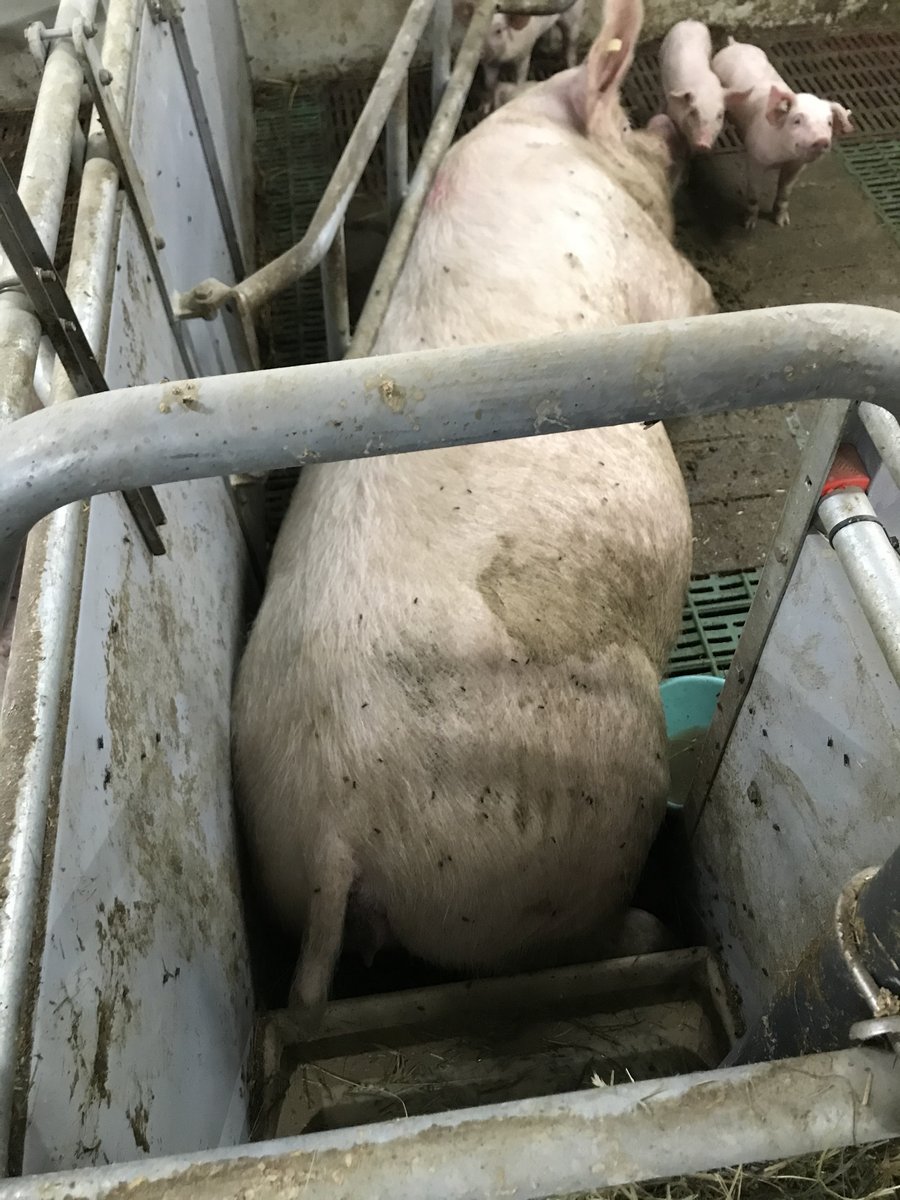
(© Lukas Schmidle)
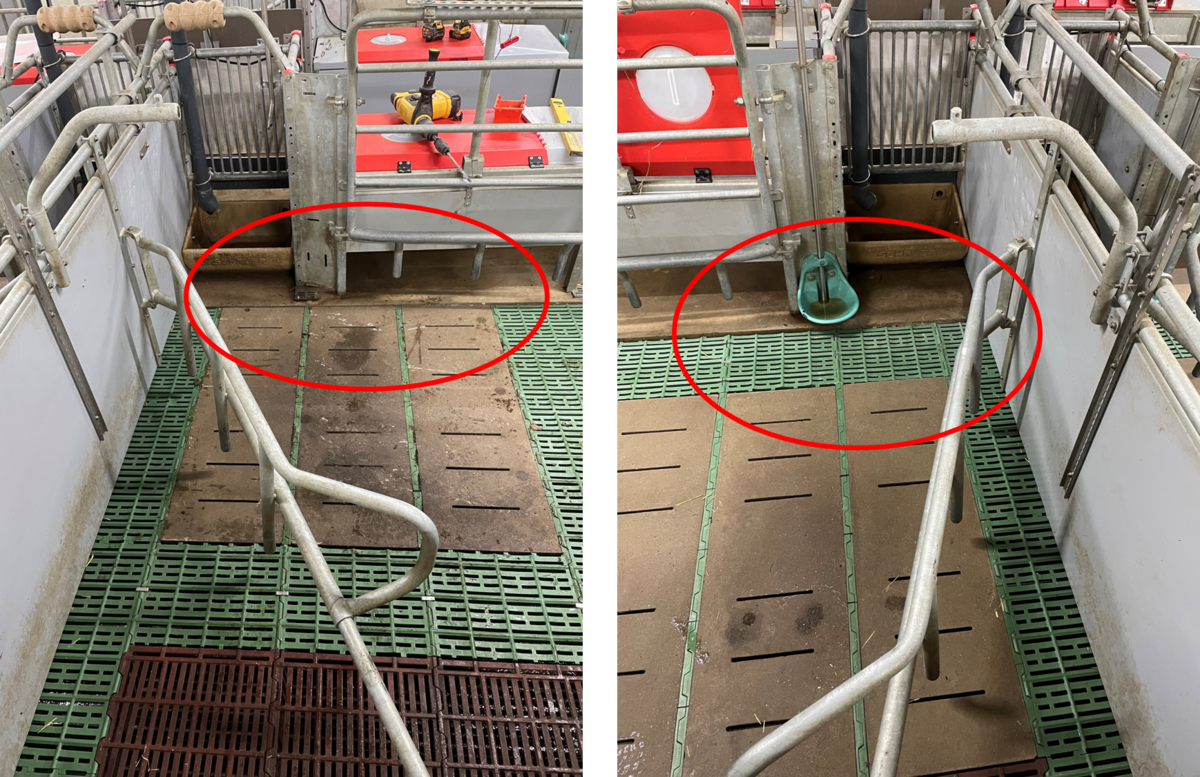
Left: before adjustment; right: after adjustment (© Lukas Schmidle)
Schmidle Pig Farm
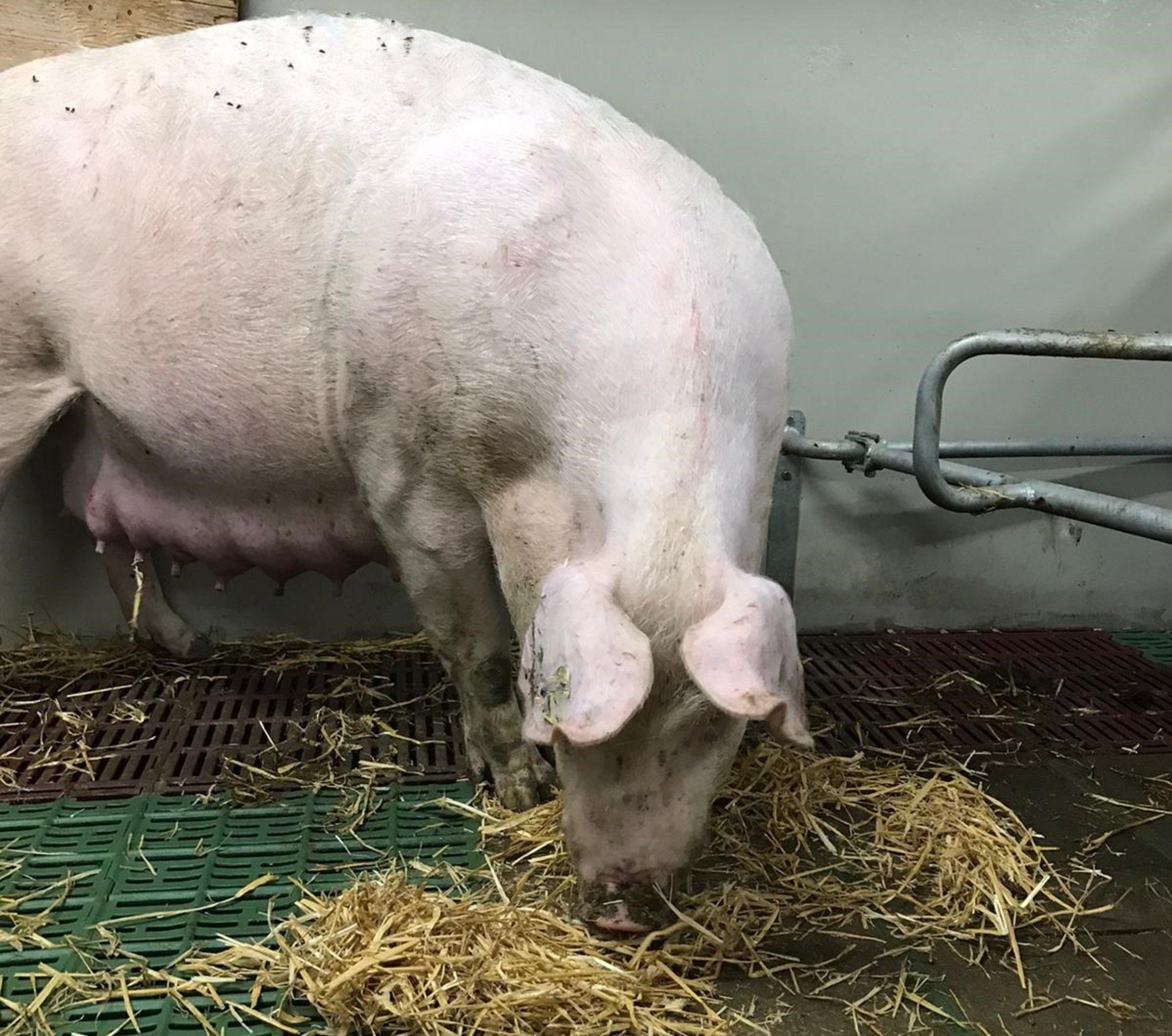
At the Schmidle Piglet Farm in the Ostalb district of Baden-Württemberg, the farrowing pen completed in 2020 is equipped with the Schauer BeFree farrowing pen (a video can be found here). This allows the sow to be restrained. Mr Schmidle reported that the sows quickly get used to the larger space and really resent it when they are restrained after building their nests. The resulting stress can lead to increased birth problems. Therefore, they only restrain gilts that are not used to being restrained when it is necessary. Older sows are usually restrained before farrowing and then released individually depending on the health and fitness level of the sow and piglets. He observed that the sows in the exercise pen are much more relaxed and lie on their sides more often instead of sitting. This makes it easier for the piglets to access the teats. To avoid crushing losses, the farrowing pen is kept at a maximum temperature of 20 °C around the time of birth. High-pressure cooling is installed to ensure a pleasant pen climate in summer. A well-heated and closed piglet nest is essential to meet the temperature requirements of the piglets.
The pen has the piglet nest and the feeding trough in the aisle. This means that the important elements for daily animal checks are quickly visible. When arranging the pen, it is essential to avoid creating "problem corners" where the sows can "park" backwards. During birth, the piglets cannot get away from the sow quickly enough (Figure 4). This increases the risk of crushing losses. Initially, chains were hung in front of the trough to prevent the sows from lying down there. Later, the mother-child drinking trough was moved and the trough was positioned further towards the centre of the pen. This gave the sows more headroom and reduced crushing losses.
The floor in front of the feeding trough was also modified. The sows regularly defecated on the lying area because they did not take a step back to stand on the slatted floor to defecate. Moving the slatted elements forward towards the feeding trough led to a different positioning of the sow on the lying area and to a significant improvement (Figure 5).
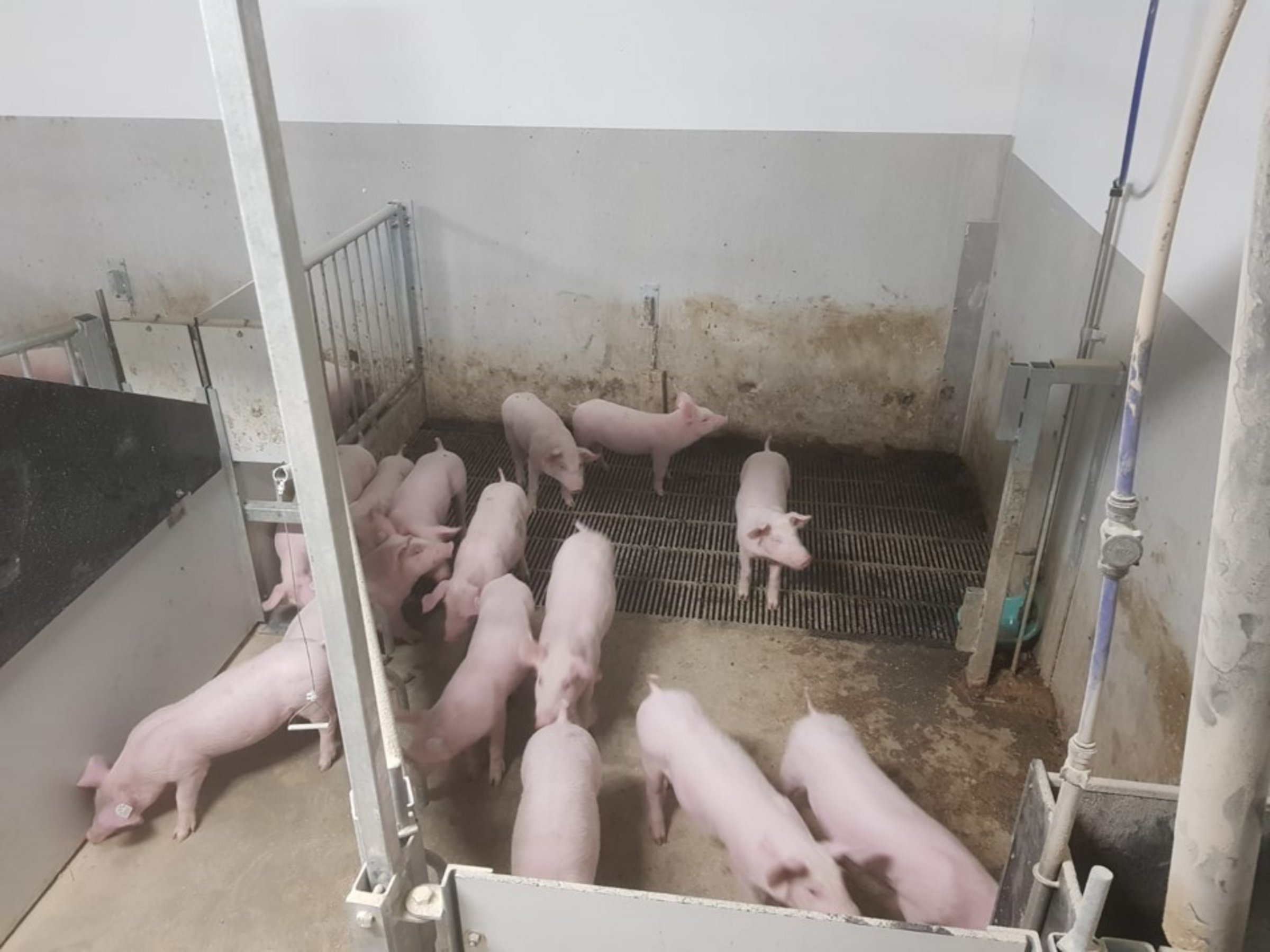
(© Tobias Urban)
(© Lukas Schmidle)
Tobias Urban
Tobias Urban from the Heidenheim district in Baden-Württemberg also started operating a newly built farrowing barn in 2020, which was built as part of an EIP project (a report including a video can be found here). The pens, in which the sows farrow freely, are a custom design that was built in collaboration with a local metalworker. They also serve as pens for rearing piglets (Figure 6). This means that the piglets remain in their familiar environment after weaning. This reduces stress and the associated stunting of physical development.
Mr Urban and Mr Schmidle agreed that the natural nesting instinct is stimulated by bedding material and calms the sows (Figure 7). Calmer sows pay more attention to their piglets, kick them less and lie down more carefully. This is an important aspect, as the risk of crushing losses is increased in free farrowing.

(© Tobias Urban)

(© Tobias Urban)
Just like the sow, the piglets also need to find their way around the pen and must not get lost, explained Mr Urban. Due to the different temperature requirements of sows and piglets, newborn piglets in particular quickly become too cold outside the piglet nest. Ideally, the sow should be close to the piglet nest (Figure 8) and not in the other corner of the pen (Figure 9). This way, the piglets can quickly find their way back to the warmth. Underfloor heating has proven to be effective in the piglet nest and should not be dispensed with. Mr Urban emphasised that a large amount of straw is required to prevent the piglets from getting cold in the nest. With underfloor heating, significantly less straw needs to be spread. To regulate the temperature in the barn on hot days, Mr Urban has integrated a cool pad. The warm air sucked into the roof space is cooled by the cool pad and then enters the barn via the ceiling.
Liescher Organic Farm
The Liescher organic farm, located in the district of Rostock, has been working with the free farrowing system for three years (a video about the farm can be found here). Breeding for mothering ability, good fertility and milk yield are essential success parameters for the Liescher farm in implementing this husbandry concept. The suckling period here is 42 days. Since the switch to free farrowing, the gilts have been farrowing in a much more relaxed manner and are following their natural nest-building behaviour. This behaviour is further encouraged by the use of straw. Due to the freedom of movement and the associated increased activity of the sow, mastitis-metritis-agalactia (MMA) problems have visibly decreased for the farm. There are also some advantages for the piglets. They start eating earlier because the mother can teach them how to eat. They are also more eager to run than piglets from sows that farrow in piglet protection baskets. The Liescher farm sees the disadvantages of this method in the very high straw consumption per sow per year and the higher workload due to mucking out three times a week. As an important tip for farms that want to start using this husbandry method, Ms Liescher advises that gilts that are very trusting should be selected in order to avoid aggressive behaviour by the sow towards the caretaker. The integration of resting bars in the pen is also particularly important in order to minimise crushing losses.
Following the presentations, the practitioners were available to answer questions. Among other things, questions were asked about suitable genetics and occupational safety. All farmers agreed that sows must be maternal and sociable without being overly protective towards humans. Sows that are aggressive towards humans are culled. It is also important that the animals have regular and, above all, pleasant contact with humans. They are welcome to be stroked on the head. This helps to avoid accidents at work as far as possible.
All the invited farms enjoy working with their system and have observed improvements in their sows, such as an easier birth process and generally calmer and more relaxed animals.
The high number of participants and the interested questions showed that farmers are looking for opportunities to exchange ideas and experiences. Further events of this kind are being planned.
Authors: Sophie Klinkhart (TLLLR), Josefine Scheinert (LSZ Boxberg), Patricia Lößner (LFA MV)