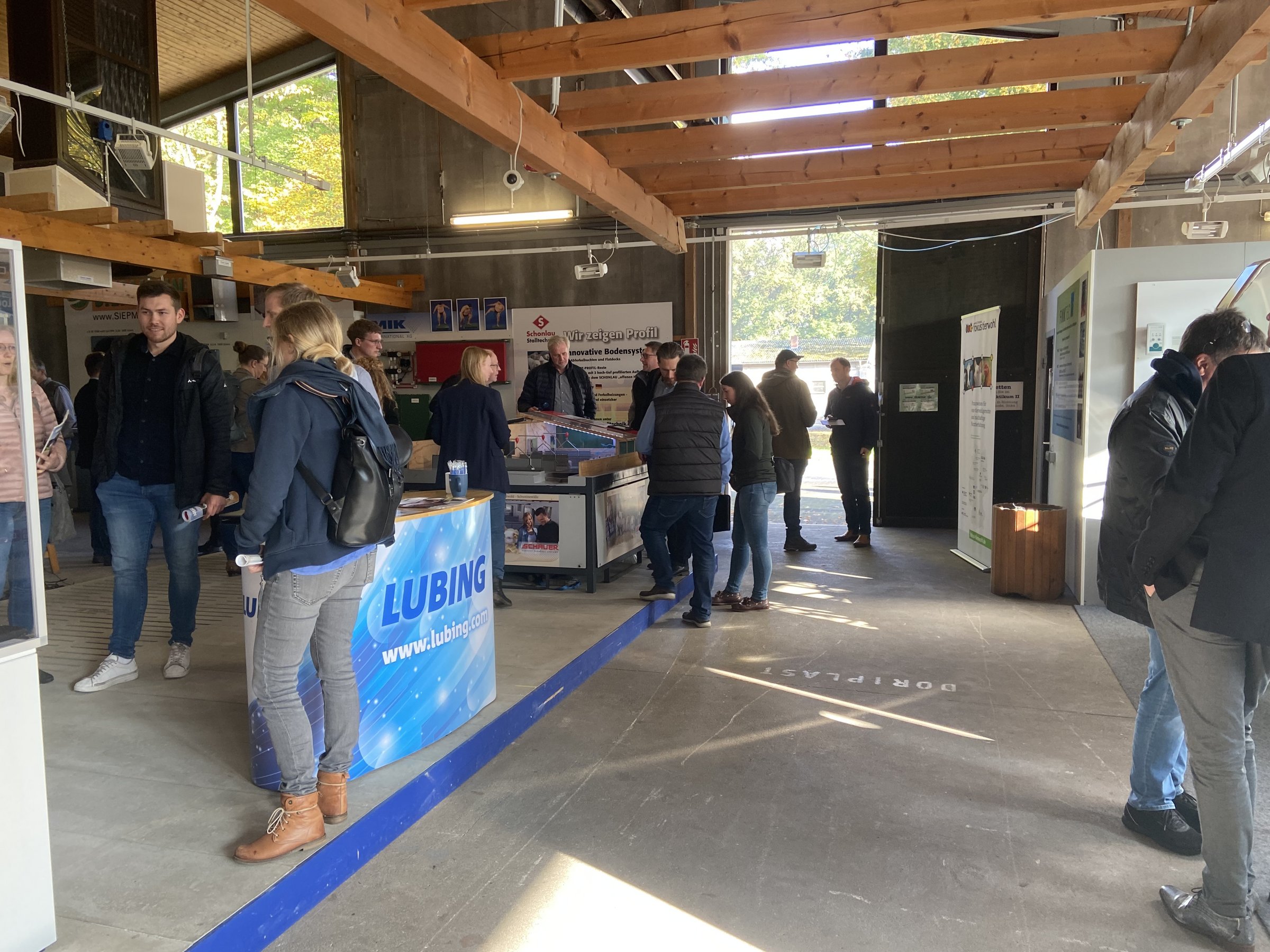
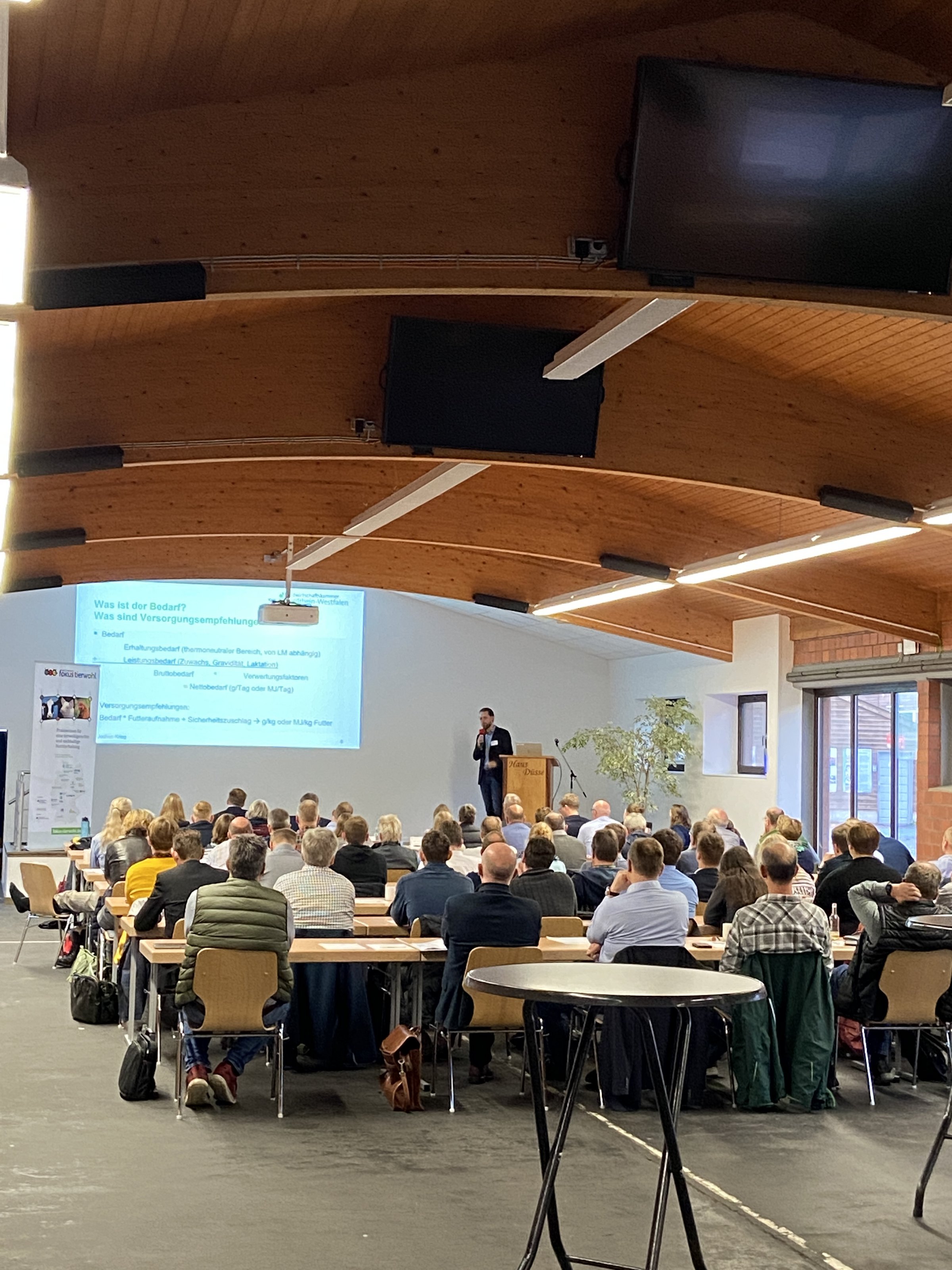
Livestock farming is currently undergoing change, with animal welfare, the environment and sustainability becoming increasingly important. To inform farmers about emissions in pigsties, the "Pig Farming Emissions Reduction Day" was held on 18 October 2022 at the Haus Düsse Agricultural Research and Education Centre as part of the Animal Welfare Focus Network, sponsored by the Federal Ministry of Food and Agriculture. Eight speakers and various companies gave presentations and held an exhibition to inform 71 interested parties about legal issues such as innovations in the TA Luft (Technical Instructions on Air Quality Control) and methods for minimising emissions from pigsties.
Henrik Ohlendorf from the North Rhine-Westphalia Chamber of Agriculture began the presentations and reported that emissions within the meaning of the Federal Immission Control Act (BImSchG) include air pollutants such as harmful gases, dust and odours. There is a risk of confusion between the terms emission, immission and transmission. According to the BImSchG, emissions are air pollutants, noise, radiation, bioaerosols and similar substances emitted by a facility (barn). Immission, on the other hand, refers to the effect of pollutants on humans, animals, plants and materials. Transmission is the transport or spread and possible conversion of substances into the atmosphere. There are various methods of reducing emissions in order to protect human and animal health and preserve the environment. Some of these methods are already approved, while others are still being researched and awaiting approval.
Next, Prof. Jörg Oldenburg explained that farmers face many legal hurdles. On the one hand, they are obliged to optimise animal welfare and reduce emissions, but on the other hand, many of the options for implementation are still legally unclear. For many farmers, modernising their own farms in terms of animal welfare and emissions is therefore not possible or only possible with difficulty. Prof. Oldenburg emphasised that it should be made easier for farmers to make their farms sustainable, improve animal welfare and protect the environment. However, this requires legal changes.
Nitrogen- and phosphorus-reduced (N-/P-reduced) feeding is also highly relevant, partly because the TA Luft (Technical Instructions on Air Quality Control) specifies maximum N and P excretion levels for pigs. It is an essential part of ammonia reduction, because "what is not there cannot be emitted," says Dr Jochen Krieg from the North Rhine-Westphalia Chamber of Agriculture. According to the rule of thumb, just 1 point less protein means 10% less ammonia (NH3). The focus here is on amino acids and ration optimisation based on praecaecal digestible amino acids. Feeding the animals as closely as possible to their needs not only reduces emissions but also promotes animal welfare. Over- or undersupply can lead to a drop in performance. Stress on the metabolism, reduced performance and obesity are just a few examples of the negative consequences of N over- or undersupply. N/P-reduced feeding must be combined with other techniques in order to achieve the NH3 reduction targets. N/P-reduced feeding allows the herd to be supplied with nutrients according to its needs, taking into account the individual farm situation and performance level. It is not possible to make a general recommendation on how to achieve the necessary reduction in NH3 emissions for all farms.
Exhaust air purification systems have been a common method of reducing NH3, odours and/or dust from livestock housing air in Germany for many years, Lars Broer from LUFA Nord-West explained to participants, naming the various systems and their specific suitability. For liquid feeding, only the multi-stage system with a biofilter is suitable, while for underfloor extraction, the multi-stage system with a chemical stage and biofilter is suitable, although underfloor extraction and exhaust air purification do not work well together. The costs must not be ignored either. In terms of investment costs, the single-stage trickle bed filter is cheaper than the multi-stage filter with chemical stage, but it is more expensive in terms of operating costs. Sufficient storage capacity must be available for the blowdown water, i.e. the water containing substances separated from the exhaust air, which is produced during the cleaning of the exhaust air. Chemical scrubbers require only a tenth of the storage capacity for blowdown water compared to trickle bed filters. Overall, purchases of exhaust air purification systems are declining.
Slurry cooling is also a method of reducing NH3 and methane (CH4), as cooling the slurry can reduce the biological processes and thus the formation of these harmful gases. Lilly Wokel from the University of Hohenheim told participants that there are two different methods: cooling fins that float in the slurry channel and cooling pipes that are concreted into the channel floor. The cooling fins are easy to retrofit. They cool the emitting surface in particular and can be flexibly adapted to channel sizes. It makes sense to align the cooling fins in the direction of slurry flow and to use flushing pipes, as feed rich in crude fibre and organic bedding material can lead to deposits in the channel or on the fins. The pipes in the floor may require more frequent emptying of the slurry channel in order to achieve a sufficient cooling effect. Water can be used as a coolant. In principle, slurry cooling in the barn only makes sense if the heat is used in other areas of the barn by means of a heat pump. The TA Luft (Technical Instructions on Air Quality Control) specifies an NH3 reduction of 50% for the cooling fins and 40% for the cooling pipes for slurry cooling below (permanently) 10 °C.
Ms Wokel went on to explain slurry channel reduction. According to TA Luft, this includes sloping side walls in the channel. The emitting slurry surface is reduced and smooth walls mean that less emitting contaminants accumulate on the walls. Furthermore, the slurry is drained more frequently, which means that less slurry is stored in the barn and fewer harmful emissions can be produced. Retrofitting slurry channel reduction is costly. Flushing and cleaning the reduced channels means additional work for farmers. Since slurry channel reduction can often only be achieved through partially perforated pens, good pen structuring is a basic requirement for achieving the desired reduction in emissions. The pigs must accept the faeces area so that the surrounding surfaces and the animals themselves remain clean. This is necessary throughout the year. It is often forgotten that soiled surfaces and animals are partly responsible for a high proportion of the emissions produced in the barn. For example, contact grids and humidification in the faeces area, the positioning of drinking troughs and feeders, the temperature control of the lying areas and the design or adjustment of the ventilation can support the animal in pen structuring. Partial and full slatted floors with sloping side walls in the channel can reduce NH3 emissions by up to 50% according to TA Luft.
One future method of reducing emissions could be the use of urease inhibitors. When faeces and urine come into contact, the enzyme urease converts urea into NH3. The urease inhibitor inhibits the urease enzyme and thus reduces the formation of NH3, according to scientist Henning Schulte from the University of Kiel. The inhibitor can be sprayed daily above ground on the slatted floors or below ground in the slurry channel. No effects on animal health or performance parameters are to be expected. When used in a forced-ventilation barn on a slatted floor, this method can reduce NH3 by up to 21% (Schulte et al. 2022), and in a slurry cellar with free ventilation by up to 29% (Calvet et al. 2022). Approval of the inhibitor for use in cattle is being sought for 2023. It will take a little longer for it to be approved for use in pig houses.
Faeces-urine separation is installed in the animals' faeces area and prevents substances from faeces and urine from "reacting" with each other and producing harmful NH3. According to Dr Frauke Hagenkamp-Korth from the University of Kiel, there are underfloor scrapers under the slats or above-floor and underfloor faeces belts with faeces-urine separation. This method can minimise at least 40% of NH3 emissions (Loussouarn et al. 2014). The underfloor scraper runs several times a day and can reduce NH3 emissions by up to 54%. The underfloor manure belt runs twice a day and, according to studies, can reduce NH3 emissions by 58% (Aarnink et al. 2007). Overfloor manure belts have a urine collection tray into which the urine is drained via the perforated manure belt. The manure is directed into the slurry cellar and removed from there. The urine tray must be rinsed with water twice a day to remove particles such as straw. In Germany, there are no test results for above-ground manure belts yet, as these are still in operation. The prices for manure-urine separation vary greatly depending on the farm.
In liquid manure acidification, the pH value of the slurry is reduced to 5.5 by adding acid, which results in lower NH3 and CH4 emissions. By shifting the ammonium-ammonia balance in the slurry, the proportion of NH3 that would otherwise be released into the environment as a gas is reduced. For acidification, part of the manure is pumped from the manure channel into an external process tank. There, the pH is measured automatically. Depending on the pH value, acid is then dosed into the manure. After the acidification process, the freshly acidified manure can either be pumped back into the manure cellar or stored outside the barn. The acidification process takes place every one to three days, reported Dr Veronika Overmeyer from the University of Bonn. "When specifying the required amount of acid, it is important to pay attention to the unit," she emphasised. For example, 9 litres of sulphuric acid (96%) correspond to a quantity of approximately 17 kg, which was required for internal liquid manure acidification per cubic metre of manure in the experiments carried out. The research group also found that NH3 emissions can be reduced by approximately 40% and CH4 emissions by approximately 67% if the acidified manure continues to be stored in the manure cellars in the pigsty. It was found that the hydrogen sulphide concentration in the animal area was also safely low and that the floating layers in the acidified manure could also be reduced. Better air quality offers advantages for both animals and farmers. The cleaner the animals and the pen, the more ammonia emissions can be reduced, she says, once again emphasising the importance of good pen hygiene management. It was confirmed that liquid manure acidification can be retrofitted in existing pigsties. Manure acidification is established in Denmark, but due to the difficult legal situation in Germany, it has only been used on one dairy farm. For the practical application of this process, an amendment to the AwSV (Ordinance on Installations for Handling Substances Hazardous to Water) is necessary so that, in addition to farm manure, the acid for acidification can also be stored in JGS installations. The amendment is currently pending.
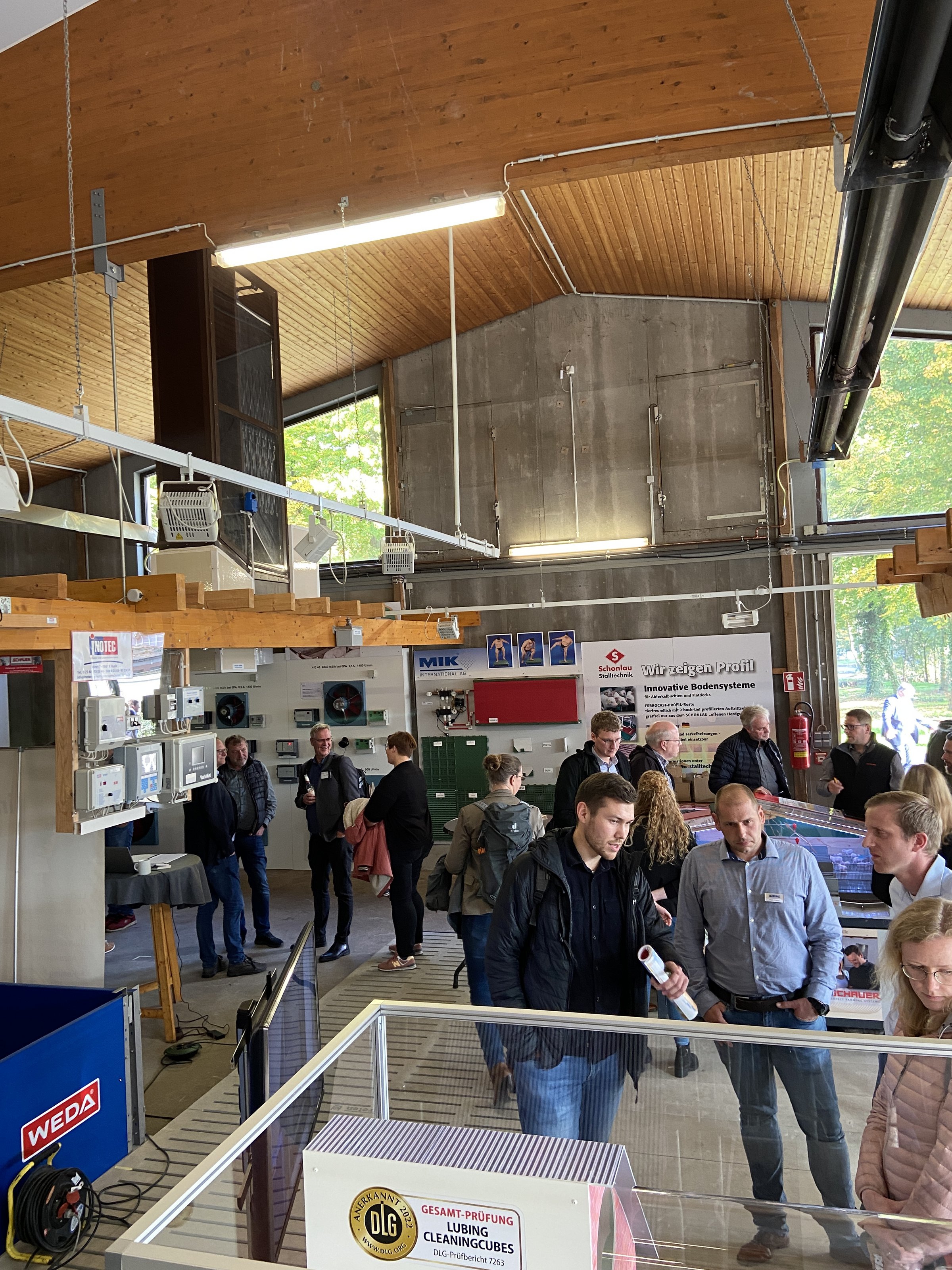
Following the presentations, participants took advantage of the accompanying exhibition featuring various manufacturers to learn about different methods of reducing emissions. There was a lively exchange and many technical discussions between the manufacturers, participants and speakers.
Authors: Dr Sabine Schütze, Sandra Terletzki, Laura Schönberg (all from the North Rhine-Westphalia Chamber of Agriculture)