

Introduction
What does the rumen need?
Consequences of subacute ruminal acidosis
How can we feed in a rumen-friendly way?
Rumen health in intensive young bull fattening
References
- Uwe Beißwenger, Baden-Württemberg State Control Association
- Lambert Grosse, VzF GmbH
- Ulrich Kühnlein, Baden-Württemberg Cattle Fattening Advisory Service
- Martin Mayr, AELF Töging am Inn
- Stefan Müller, KälberKontorSüd GmbH
- Lower Saxony State Office for Consumer Protection and Food Safety
- Dr. Georg Teepker, Lower Saxony Chamber of Agriculture
- Klaus Zimmerer AELF Nördlingen-Wertingen
- Julia Maischak-Dyck, Landesbetrieb Landwirtschaft Hessen
- Caroline Leubner, Landesbetrieb Landwirtschaft Hessen
- Lukas Trzebiatowski, Department of Veterinary Medicine, JLU Giessen
- Lydia Stahl, Department of Veterinary Medicine at JLU Giessen
Introduction
The health, well-being and performance of cattle as ruminants depend largely on favourable conditions in the rumen. Feeding is particularly important for rumen function and health. In bull fattening, the structural effect of the feed plays an important role. This guide covers the most important points regarding structural supply in fattening bull feeding.
Why is the supply of structurally effective fibre a problem in intensive bull fattening? Why is subacute ruminal acidosis becoming more common?
- Very high proportions of maize silage (with high starch content and little structural effect) in the ration, often even as the sole roughage
- Intensive feeding with high concentrate content in the ration to enable high growth rates
- Additional structural components such as straw or hay are easily selected out in TMR
For this, the rumen requires
- a feed structure that promotes rumination and salivation of the feed (saliva also has a buffering effect),
- a ration composition that leads to pH values in the rumen that are as stable as possible (normal fluctuation range between pH values of 5.8 and 6.5) and
- a stratification of the rumen contents
What happens if the feed is not suitable for ruminants?
- Chewing is significantly reduced in duration and intensity
- Less salivation
- Low pH values from the conversion of rumen-degradable starch (sugar) to acids, which are insufficiently buffered
- Critical pH values in the rumen are not reached
→ Subacute ruminal acidosis (hyperacidity) with negative effects on health
Consequences of subacute ruminal acidosis
- reduced feed intake
- poorer feed conversion (especially in fibre digestion)
- Poorer adhesion of bacteria to fibres at lower pH values
- Change in the microbial community towards lactate-forming (lactic acid-forming) bacteria
- Damage to the mucous membrane of the rumen wall
- Insufficient supply of water-soluble B vitamins
- At low pH values: decrease in B vitamin-forming bacteria while there is a high demand for B vitamins for carbohydrate digestion
- Restlessness in bulls, stress
- Decreased performance
- Health problems
- The death of certain bacteria releases toxins (endotoxins) which enter the bloodstream in increased quantities via the damaged rumen mucosa. This can lead to diseases throughout the entire organism. Diseases promoted by the toxins include, for example, the development of laminitis and tail tip necrosis (Heers et al. 2017).
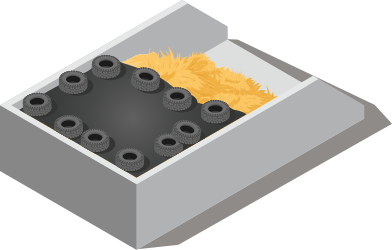
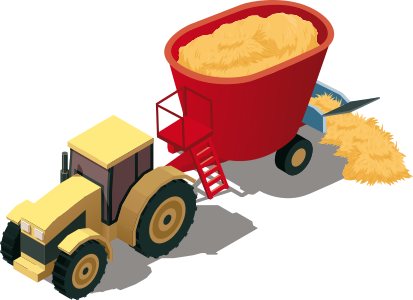
Mixing wagons and technology
Measures
|
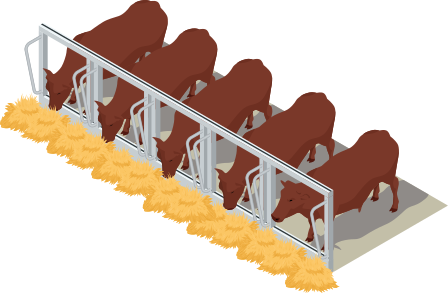
Feed tray and water supply
Measures
The amount of feed intake is significantly influenced by the quality of water intake. |

Important practical approaches to ensuring rumen health in intensive young bull fattening
Use of chopped straw
- Small quantities (200-500 g per animal per day) are already effective
- Cut only short (max. 3-4 cm, theoretical cutting length shorter), mix in thoroughly
Use of alfalfa, clover grass and grass silage
- Examine the grass silage and calculate the ration! Caution: the structural effect is often overestimated!
- Is readily eaten, provides additional crude protein
- Only the best qualities for high weight gains
- Proportion of roughage DM depends on energy content
Use of shredlage
- Chop length 20–30 mm with intensive processing of the residual plant.
- Intensive grain processing can improve the utilisation of starch from the maize grain.
- Predominantly positive results in trials (Bunk, 2021), but no final assessment for practical use yet
- More silage space, higher compaction and more feed rate required during removal!
- Note: Chopping technology only available regionally
- Avoid feed selection
- Observe feeding behaviour
- Intensive mixing without pulverising the feed, adding water if necessary
- Replace pellets with meal feed (leads to a more homogeneous mixture)
- Check feed residues
- Use rumen buffers (e.g. sodium bicarbonate)
- Only as an "emergency brake" to reduce symptoms
- The cause of ruminal acidosis must be remedied elsewhere
Literature
Assessment of structural nutrition in cattle; School and Advisory Service 4/5, 63-67; Ettle, T., Schuster, H., Rutzmoser, K. 2015
What are the benefits of Shredlage in bull fattening? top agrar 5/21; Bunk, L; Westendarp H; Fenske K; Korte, H.
Feed for farm animals; Durst, L; Freitag, M; Bellof, G; 1st edition; DLG-Verlag 2021
Gruber Table for feeding in cattle fattening, 25th unchanged edition 2021, ; LfL Bavaria
Tail tip necrosis – because fattening bulls step on their tails when kept in confined conditions? Nutztierpraxis aktuell, 2017; Heers, P A; Beune, H; Freitag, M.
Rutzmoser, K., Ettle, T., Obermaier, A., Schuster, H. (2011): A structure index as a continuation of the description of the structural effect with the physically effective NDF. Conference proceedings 10th Boku Symposium on Animal Nutrition, 231-236
https://www.lfl.bayern.de/ite/rind/120273/index.php (accessed 02.02.2022)
https://www.lfl.bayern.de/mam/cms07/ite/dateien/29204_unterschiedliche_haecksell__nge_maissilage_bullen.pdf (accessed on 02.02.2022)