

Introduction
What does the rumen need?
Consequences of subacute ruminal acidosis
How can we feed in a way that is suitable for the rumen?
Rumen health in intensive young bull fattening
References
- Uwe Beißwenger, Baden-Württemberg State Audit Office
- Lambert Grosse, VzF GmbH
- Ulrich Kühnlein, Baden-Württemberg Cattle Fattening Advisory Service
- Martin Mayr, AELF Töging am Inn
- Stefan Müller, KälberKontorSüd GmbH
- Lower Saxony State Office for Consumer Protection and Food Safety
- Dr. Georg Teepker, Lower Saxony Chamber of Agriculture
- Klaus Zimmerer, AELF Nördlingen-Wertingen
- Julia Maischak-Dyck, Landesbetrieb Landwirtschaft Hessen
- Caroline Leubner, Landesbetrieb Landwirtschaft Hessen
- Lukas Trzebiatowski, Department of Veterinary Medicine, JLU Giessen
- Lydia Stahl, Department of Veterinary Medicine, JLU Giessen
Introduction
The health, welfare and performance of cattle as ruminants depend largely on favourable conditions in the rumen. Feeding is of particular importance for rumen function and health. In bull fattening, the structural properties of the feed play a key role. This guide aims to cover the most important aspects of structural fibre provision in the feeding of fattening bulls.
Why is the provision of structurally effective fibre a problem in intensive bull fattening? Why is subacute ruminal acidosis becoming more prevalent?
- Very high proportions of maize silage (with high starch content and little structural effect) in the ration, often even as the sole roughage
- Intensive feeding with a high proportion of concentrate in the ration to enable high growth rates
- Additional structural components such as straw or hay are easily rejected in TMR
For this, the rumen needs
- a feed structure that promotes rumination and the salivation of the feed (saliva also has a buffering effect),
- a ration composition that leads to pH values in the rumen that are as stable as possible (normal range between pH values of 5.8 and 6.5) and
- a stratification of the rumen contents
What happens if the feed isn't suitable for the rumen or for ruminants?
- Rumination is significantly reduced in duration and intensity
- less salivation
- low pH values resulting from the conversion of rumen-degradable starch (sugar) into acids, which are insufficiently buffered
- pH levels in the rumen fall below critical levels
→ Subacute ruminal acidosis (over-acidification) with adverse effects on health
Consequences of subacute ruminal acidosis
- reduced feed intake
- poorer feed conversion (particularly in fibre digestion)
- Poorer adhesion of bacteria to the fibres at lower pH levels
- Shift in the microbial community towards lactate-producing (lactic acid-producing) bacteria
- Damage to the mucous membrane of the rumen wall
- Deficiency in water-soluble B vitamins
- At low pH: decrease in B-vitamin-producing bacteria alongside a high demand for B-vitamins for carbohydrate digestion
- Restlessness in bulls, stress
- Reduced performance
- Health problems
- As certain bacteria die off, toxins (endotoxins) are released, which enter the bloodstream in increased quantities via the damaged rumen mucosa. This can lead to diseases throughout the entire organism. Diseases promoted by these toxins include, for example, the development of laminitis and tail tip necrosis (Heers et al. 2017)
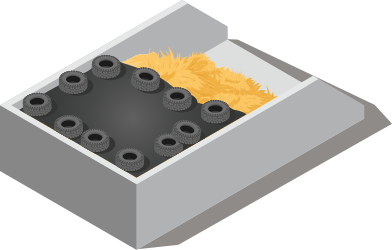

Mixing trolleys and technology
Measures
|
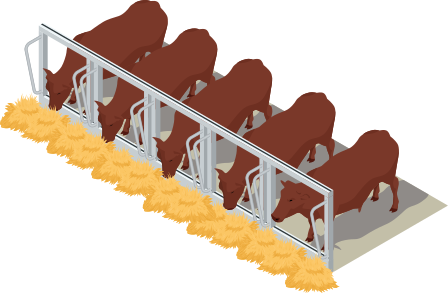
Feed supply and water supply
Measures
Feed intake is significantly influenced by the quality of water intake. |
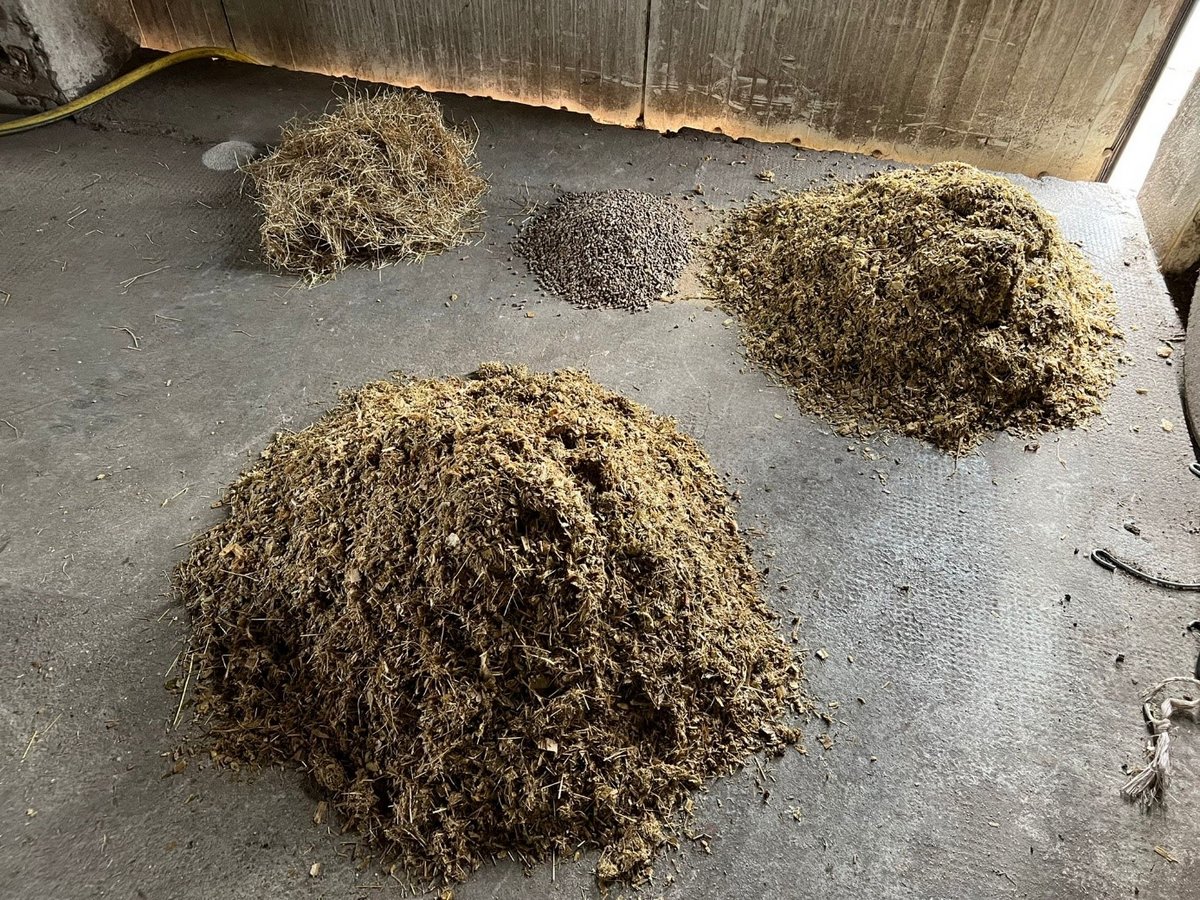
Sample ration for a fattening bull: individual components listed above (125 g mineral feed, 300 g chopped straw (alternative: grass seed hay), 2.5 kg concentrate, 16 kg maize silage), mixed together below.
Note: The calculated ‘feed structure’ of a ration alone is by no means a guarantee of rumen-friendly feeding!

Figure 1: Optimal dental care is essential for preventing health problems.
- To assess the structural effect of a feed or ration, information is required regarding its chemical composition (fibre content, digestibility) and its physical form (fibre length and texture).
- A laboratory parameter such as crude fibre content or aNDFom content alone is therefore insufficient to describe structural efficacy.
- Additional generalised classifications based on fibre origin, such as ‘structured crude fibre’ or the ‘structural value SW’, are insufficient for evaluating particularly high-energy rations.
- The feed structure must be assessed once during ration calculation and once for the finished mixed ration.
- When calculating the ration, the aNDFom content (neutral detergent fibre, i.e. the structural components cellulose, hemicellulose and lignin, following amylase treatment and incineration) from the roughage and the structural index are used.
- The aNDFom content from roughage should account for at least 25% of the total ration for fattening bulls.
- The structure index summarises the opposing effects of easily soluble carbohydrates and fibre components in the ration in a single figure. It is based on the internationally used fibre fraction aNDFom, relates directly to the actual target parameter (rumen pH) and is linked to the peNDF system via the aNDFom from the roughage. A structural index of 50 describes the ratio of the amount of aNDFom ingested from roughage to easily soluble carbohydrates at which a ruminal pH of 6.15 is expected (Rutzmoser et al., 2011; Ettle et al., 2015). It can take values between 0 and 100. The target value is ≥ 45.
- When monitoring the mixed ration, the ‘physically effective NDF content’ (peNDF) of feedstuffs is used and is also intended to be used as a parameter in ration calculations in future.
- When checking the mixed ration, the ‘physically effective NDF content’ (peNDF) of feedstuffs is taken into account and is also intended to be used as a parameter in ration calculations in future.
- What is peNDF?
- The term peNDF stands for ‘physically effective neutral detergent fibre’
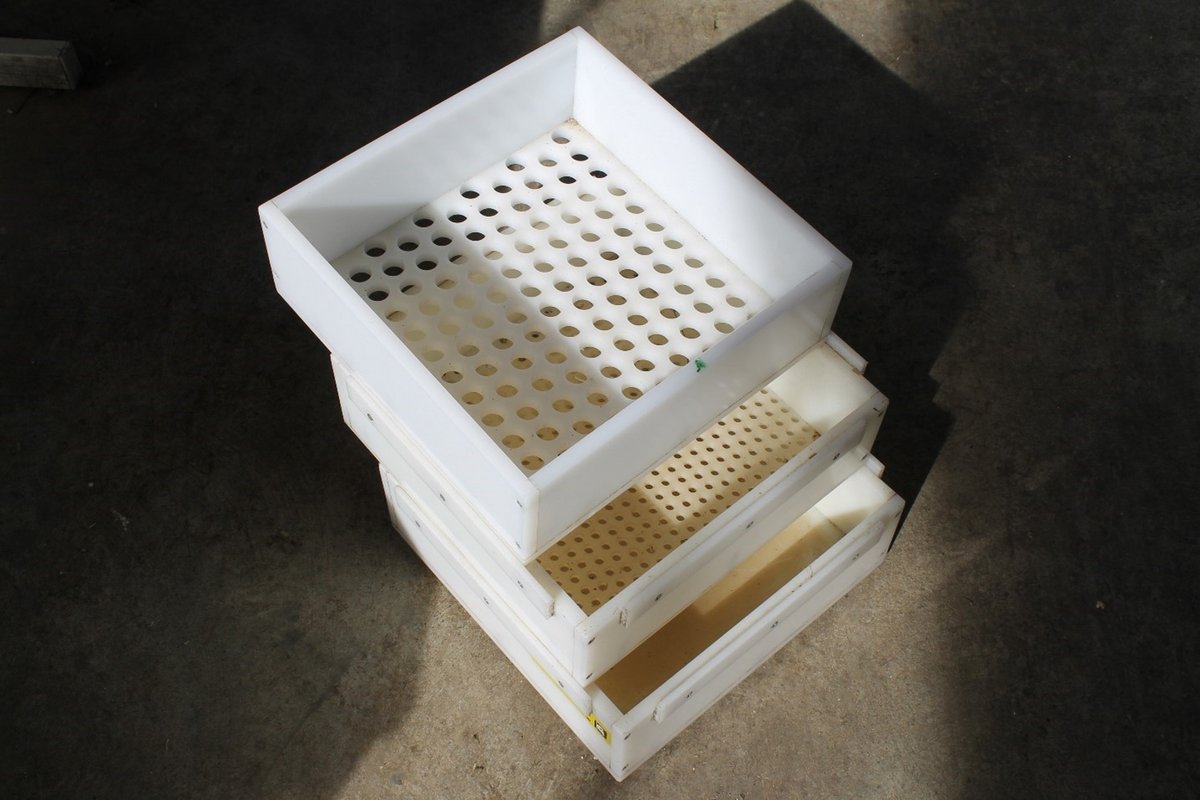
- To determine this, a shaking box is used to determine the mass fraction of the feed or ration that is over 8 mm in length.
- This weight fraction is multiplied by the percentage of aNDF in the dry matter of the total ration.
- The peNDF allows for farm-specific consideration of the particle size of the ration, including all effects prior to the animal’s feed intake (e.g. chop length; pulverisation in the mixer wagon). The value cannot therefore be calculated additively from table values of the individual ration components, but is determined for the ration as a whole.
- If concentrate is fed in addition to the mixed ration, this should be allocated to the lower sieve box (< 8 mm)
- At present, no values have been established for bull fattening. These currently exist only for dairy cattle, although the starch content of the total ration is also taken into account in this case.

Key practical approaches to ensuring rumen health in intensive young bull fattening
Use of chopped straw
- Even small amounts (200–500 g per animal per day) are effective
- Cut only short (max. 3–4 cm, theoretical cut length shorter), mix in thoroughly
Use of alfalfa, clover-grass and grass silage
- Test the grass silage and calculate the ration! Note: The effect of texture is often overestimated!
- is readily eaten, provides additional crude protein
- Only the best quality for high weight gains
- Proportion of roughage DM depends on energy content
Use of shredded silage
- Chop length 20–30 mm with intensive processing of the plant residues.
- Intensive grain processing can improve the utilisation of starch from the maize grain.
- Predominantly positive results in trials (Bunk, 2021), but no final assessment for practical application yet
- Requires more silage space, higher compaction and greater feed-through during removal!
- Note: Chopping technology only available regionally
- Avoid feed selection
- Observe feeding behaviour
- Mix thoroughly without turning the feed into a paste, adding water if necessary
- Replace pellets with meal feed (results in a more homogeneous mixture)
- Check for feed residues
- Use of rumen buffers (e.g. sodium bicarbonate)
- Only as a ‘last resort’ to alleviate symptoms
- The cause of ruminal acidosis must be addressed separately
Bibliography
Assessment of structural nutrition in cattle; School and Advisory Service 4/5, 63–67; Ettle, T., Schuster, H., Rutzmoser, K. 2015
What are the benefits of shredlage in bull fattening? top agrar 5/21; Bunk, L; Westendarp, H; Fenske, K; Korte, H.
Feed for farm animals; Durst, L; Freitag, M; Bellof, G; 1st edition; DLG-Verlag 2021
Gruber Table on feeding in cattle fattening, 25th unchanged edition 2021, ; LfL Bavaria
Tail tip necrosis – Is it because fattening bulls step on each other’s tails in confined housing?, Nutztierpraxis aktuell, 2017; Heers, P A; Beune, H; Freitag, M.
Rutzmoser, K., Ettle, T., Obermaier, A., Schuster, H. (2011): A structural index as a continuation of the description of structural effects using physically effective NDF. Proceedings of the 10th BOKU Symposium on Animal Nutrition, 231–236
https://www.lfl.bayern.de/ite/rind/120273/index.php (accessed 02/02/2022)
https://www.lfl.bayern.de/mam/cms07/ite/dateien/29204_unterschiedliche_haecksell__nge_maissilage_bullen.pdf (accessed 02/02/2022)