
5.1 General measures
- Frequent, thorough checks on the animals several times a day to assess their general condition; key points: taking their temperature, movement within the pen, stamina, rumination
- Monitoring and encouragement of water and feed intake
- Encouraging the animal to stand up
- If the animal’s general condition deteriorates: repeat clinical examination of the animal and consultation with the vet
- Medical care (e.g. administering medication or changing dressings)
5.2 Therapy/Treatment
What factors need to be taken into account when considering therapeutic and treatment options?
- Treatment is always necessary.
- Diagnosis and treatment by a vet.
- In principle, there is an obligation to eliminate pain through anaesthesia during painful procedures. This must be carried out by a vet (e.g. during surgery). Exceptions to the anaesthesia requirement are governed by Section 5 of the Animal Welfare Act (TSchG).
- Treatments such as cleaning and disinfecting simple wounds, applying or changing a dressing, and also administering injections may be carried out by the pet owner. However, this requires instruction from the vet and supervision of the procedure.
- Furthermore, such treatments must also be documented.
- If a vet was not initially consulted and there is no improvement within 1–2 days, veterinary advice should be sought at this point at the latest.
- The vet’s treatment instructions must always be followed in full.
- It is unlawful to withhold necessary treatment from an animal for financial reasons.
5.2.1 Wound care
Pet owners should also be able to treat wounds. That is why the first-aid kit should contain sufficient dressings and other supplies.
Contents of the first-aid kit for injuries:
- clean disposable gloves
- For wound disinfection: iodine-based preparations
- Disposable razors or a clean clippers for hair removal, scissors
- Compresses
- Adhesive crepe bandages
- Gauze
- Freezer bag clips for controlling bleeding from pulsating wounds/vessels
- After consulting a vet: topical sprays, ointments
First, assess the severity of the injury and whether a vet needs to be consulted. However, first aid for more serious injuries can be administered by the pet owner themselves. The principles of first aid applicable to humans apply here. It is advisable to seek general guidance from the vet on how to carry out first aid measures. If necessary, temporary wound dressings can also be used to bridge the gap until the vet arrives.
Assessing the severity of the injury:
- Where exactly is the injury?
- Sensitive areas include the abdomen, the lung area, the joints and surrounding tissue, the udder and the vulva
- How large is the injury?
- Smaller wounds are usually considered less serious than larger ones. CAUTION: even smaller wounds can be deep and life-threatening
- What kind of discharge is coming from the wound?
- Is blood, joint fluid or pus oozing out?
- If blood is oozing out: is it a pulsating wound or a seeping wound?
First aid measures (using clean disposable gloves):
- Cleaning the area around the wound:
- Removing hair
- Clean the surrounding hair
- Rinse the wound with water / isotonic saline solution
- Disinfect with iodine and gauze pads
- Covering the wound with plasters or adhesive crepe bandages
- Daily wound checks and dressing changes as required
- Daily monitoring of the animal’s general condition
When carrying out the daily check-up and inspecting the wound, look out for signs of inflammation. If there is no improvement, seek veterinary advice.
For further information:
Lamp O. (2020): Wound care with a stable first-aid kit: Just a scratch or a serious injury?
5.2.2 Pain management
From an animal welfare perspective, pain should always be alleviated. As pain management products are available only on prescription, the vet decides during the clinical examination whether, and if so, which treatment measures should be initiated. In general, optimal pain management offers various benefits. The animal usually recovers more quickly, its general condition is restored sooner, and its intake of food and water returns to normal. Wound healing can proceed unhindered, the immune system can recover more quickly, and the performance levels affected by the illness – such as milk yield – return to normal more rapidly.
5.2.3 Caring for confined cows
After checking the animal’s general condition and determining whether it is conscious, it is important to move immobilised animals to a recovery pen. The animals must be separated from the herd immediately to prevent further injury. If this is not possible, the downed animal should be laid on a soft surface where it is. In this situation, it is still advisable to keep the herd away from the downed animal.
5.2.3.1 Initial steps for animals that are stuck
- If an animal is trapped, contact a vet
- First aid by the farmer:
- Secure the animal to protect it from other animals, apply a leg restraint (see section 5.2.3.6), offer water, place the animal on a soft surface
- Do not attempt to lift the animal on your own. You should wait for the vet. Attempts to get the animal moving may actually make the subsequent examination more difficult for the vet, as the animal may exert itself too much. Furthermore, animals that are stuck should under no circumstances be moved until serious injuries to the musculoskeletal system have been ruled out.
⇒ Administer first aid and wait for the vet
5.2.3.2 Possible causes of jamming
The animal cannot stand up unaided:
- Injuries:
- Muscle damage (e.g. muscle tear)
- Nerve damage (e.g. spinal cord injury, paralysis of nerves in the hind or front limbs)
- Damage to bones (e.g. fractures) or joints (e.g. dislocated hip joint)
- Electrolyte imbalances:
- e.g. calcium deficiency
- Severe systemic diseases:
- e.g. severe mastitis or severe metabolic imbalance (acidosis or ketosis), poisoning
Animal could stand up but does not want to:
- Painful conditions:
- Uterine inflammation, mastitis, laminitis, peritonitis, pneumonia, displacement of the abomasum, swallowed foreign body or other
Diagnosis by a vet
Through a clinical examination, the vet can determine the cause of the lameness. If necessary, further examinations such as lifting the animal or blood tests may be required.

5.2.3.4 Forecast
- The prognosis is good: the cow is eating, drinking and changing the side on which she lies unaided.
- The prognosis is favourable: with appropriate treatment and good care, the cow can be monitored and cared for in constant consultation with the vet. There is a good chance of success.
- Poor prognosis: Despite treatment, the cow remains on her side, is unable to turn over unaided, and is not eating or drinking. The prognosis is poor and raises animal welfare concerns, requiring a significant amount of work. Euthanasia should be considered.

5.2.3.5 Decision tree for dry cows
The following figure shows a decision tree for dry cows.

5.2.3.6 Transferring and repositioning, standing aids
To ensure the animal has a secure footing when attempting to stand up, the surface must be non-slip, firm underfoot and, where possible, yielding. Suitable options include recovery pens well-bedded with straw or filled with sand, or, where weather protection is available (e.g. via a pasture tent), natural ground, such as in a pasture.
If a cow needs to be moved to a suitable location, a rubber mat, for example, can be used as a sled. This must be at least as large as the animal so that it lies completely on it and does not sustain any abrasions during transport. In principle, the surface must be of such a nature that it does not disintegrate or tear when pulled.
If a cow does not reposition itself or change position, it should be repositioned or turned at least three to four times a day. Placing straw bales can help maintain the desired chest-to-belly position.
Halters (restraint harnesses)
If an animal continues to try to stand up but is still unable to do so, the hind legs should first be tied together using foot restraints (restraint harness). The foot restraints consist of two cuffs (leather or nylon) connected to one another. Such restraints provide the animal with additional support when attempting to stand and prevent further injury caused by slipping (risk of muscle tear).
Standing aids to assist the standing process
Pelvic clamps
These consist of straight or curved brackets that form a U-shape. The brackets are placed over the hip bones and tightened using a threaded rod or hydraulically. The animal can then be lifted using a pulley, chain hoist or front loader. A pelvic clamp should only be used in extreme emergencies, with care and for as short a time as possible, as it can also cause serious injuries (haemorrhaging into the muscle, muscle damage). A cow should never be suspended in the pelvic clamp for a prolonged period. If the cow cannot maintain an upright position (weight-bearing on the limbs) unaided, it is better not to lift her in this manner. Lifting with the pelvic clamp should be carried out under veterinary supervision, as further examination of the animal during the lifting attempt is possible and necessary for diagnosis.
Lifting harnesses
These consist either of a network of wide straps or a sturdy tarpaulin placed under the animal’s belly. Additional straps stabilise the front or rear of the animal so that it cannot slip out of the ‘belly harness’. Here too, lifting is carried out using a chain hoist or front loader.
Lifting frames
Another option for lifting immobilised animals is the use of lifting frames. These consist of a collapsible frame that is erected over the immobilised heifer or cow. The animal is lifted and held upright using several straps that are threaded under the animal. Despite the straps being in place, the udder remains freely accessible, allowing for normal milking. A pull-through hook is useful, as it allows the lifting straps to be pulled easily and gently under the animal.
Lifting bags
Lifting bags are used, for example, by fire brigades to lift vehicles in order to rescue people trapped underneath. Such lifting bags were available for a time for lifting animals. The immobilised animal is rolled onto the lifting bag. The bag is then filled with compressed air, thereby lifting the animal.
Water baths
There are various water bath systems: inflatable rubber ones or rigid metal ones. As the cost of such systems is comparatively high, they are very rarely found in agricultural practice.
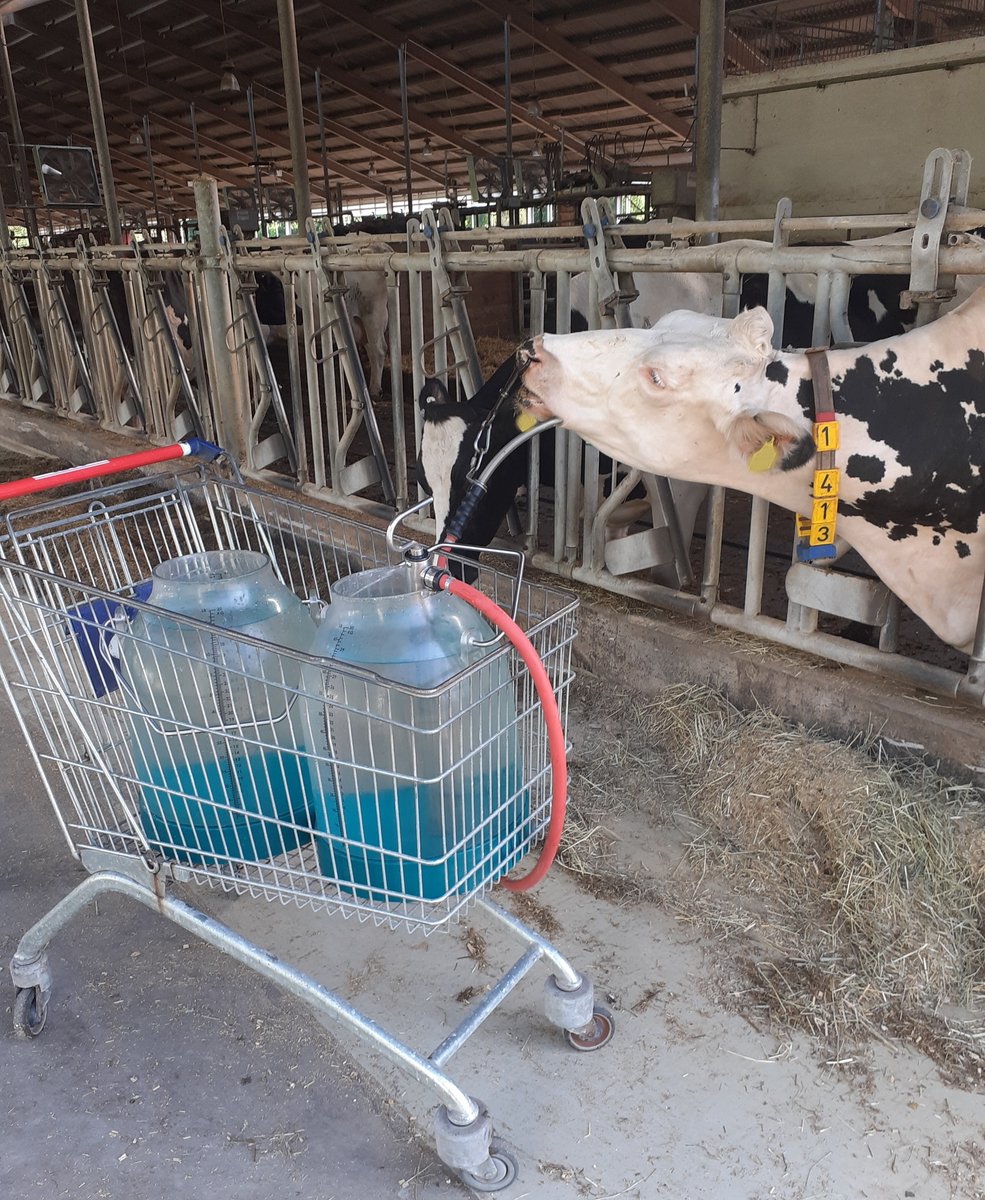
(Image: Dr Theresa Scheu, Hofgut Neumühle Teaching and Research Centre)
5.2.4 Watering the cows
If sick animals do not drink enough water, this can further worsen their condition. It can even lead to circulatory failure. Signs of dehydration in cattle include reduced skin turgor: if a skin fold is pinched on the side of the neck or on the eyelid, it remains in place. The speed at which the skin fold disappears completely provides an indication of the animal’s hydration status. Furthermore, the eyes may appear sunken and ‘hollow’. In such cases, water should be administered. In a procedure known as drenching, fluid is administered into the rumen. If the animal has never been drenched before, a vet should be present during the first drenching. Errors can lead to serious injury to the cattle, for example if water accidentally enters the lungs or the oesophagus is injured.
In this video, Georg Stieg, a qualified vet from DR.VET – Die Tierärzte, explains how to perform drenching safely: https://www.youtube.com/watch?v=NEgn8v8mdME
Note: Various models for drenching are available on the market. The vet can provide specific guidance when using the equipment for the first time.