
The AminoVit project is a collaborative project funded by the Federal Ministry of Food and Agriculture (BMEL) through the Federal Programme for Organic Farming (BÖL), involving the Research Institute of Organic Agriculture (FiBL), Weihenstephan-Triesdorf University of Applied Sciences (HSWT) and the Bavarian State Farms/Bavarian State Institute for Agriculture (LfL).
The aim of the project was to investigate how organic turkey fattening can be organised as closely as possible to the animals’ needs through an optimised feed composition, with a particular focus on amino acid and vitamin supply. The aim is to make the best possible use of available protein sources and to keep competition for food with human nutrition as low as possible. Organic feeding poses a particular challenge in turkey fattening, as there are no organically selected turkey lines and the addition of amino acids to feed is prohibited in organic livestock farming. In particular, the first-limiting essential amino acid methionine and vitamin B2 are to be regarded as critical nutrients. These two nutrients were therefore the focus of the project.
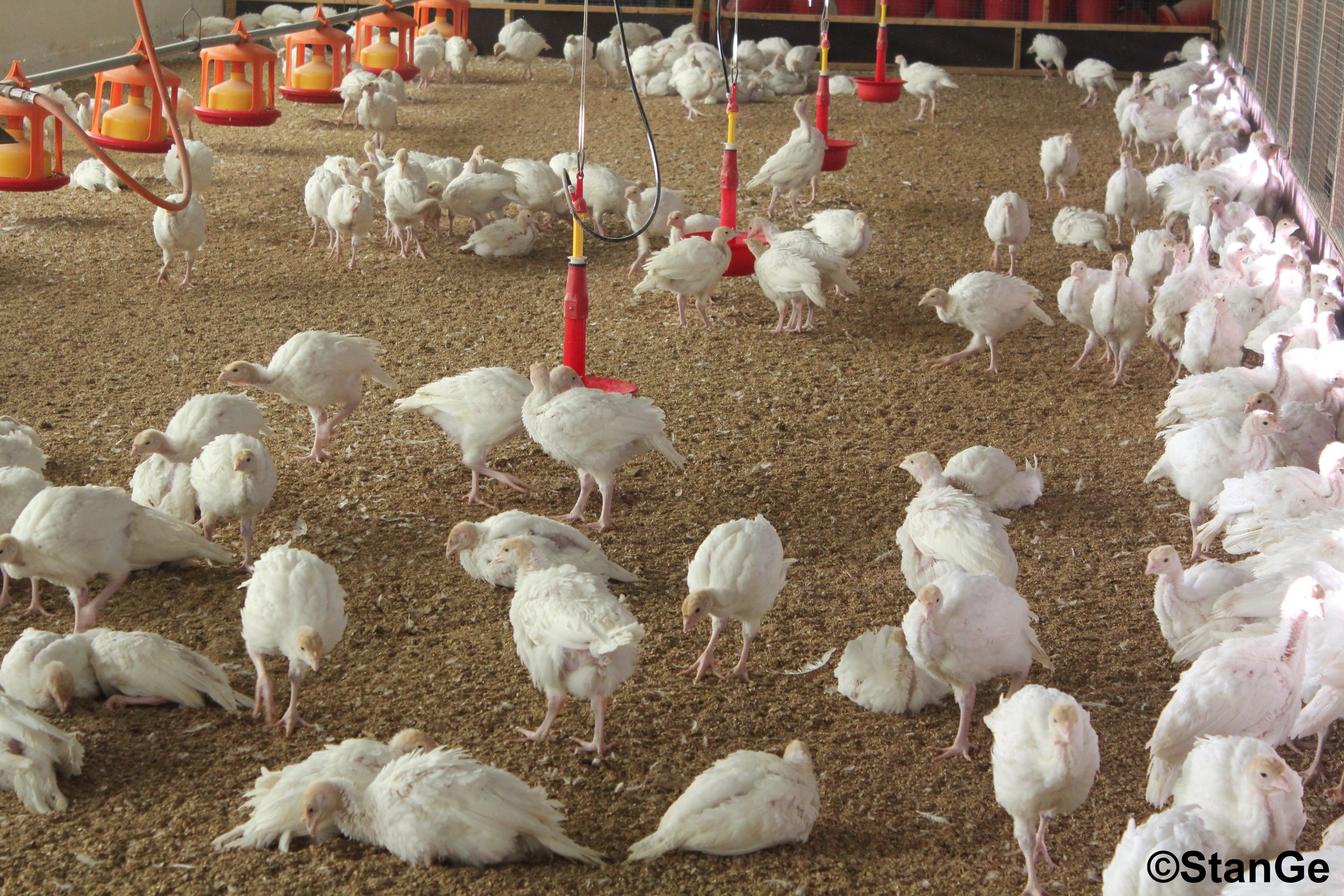
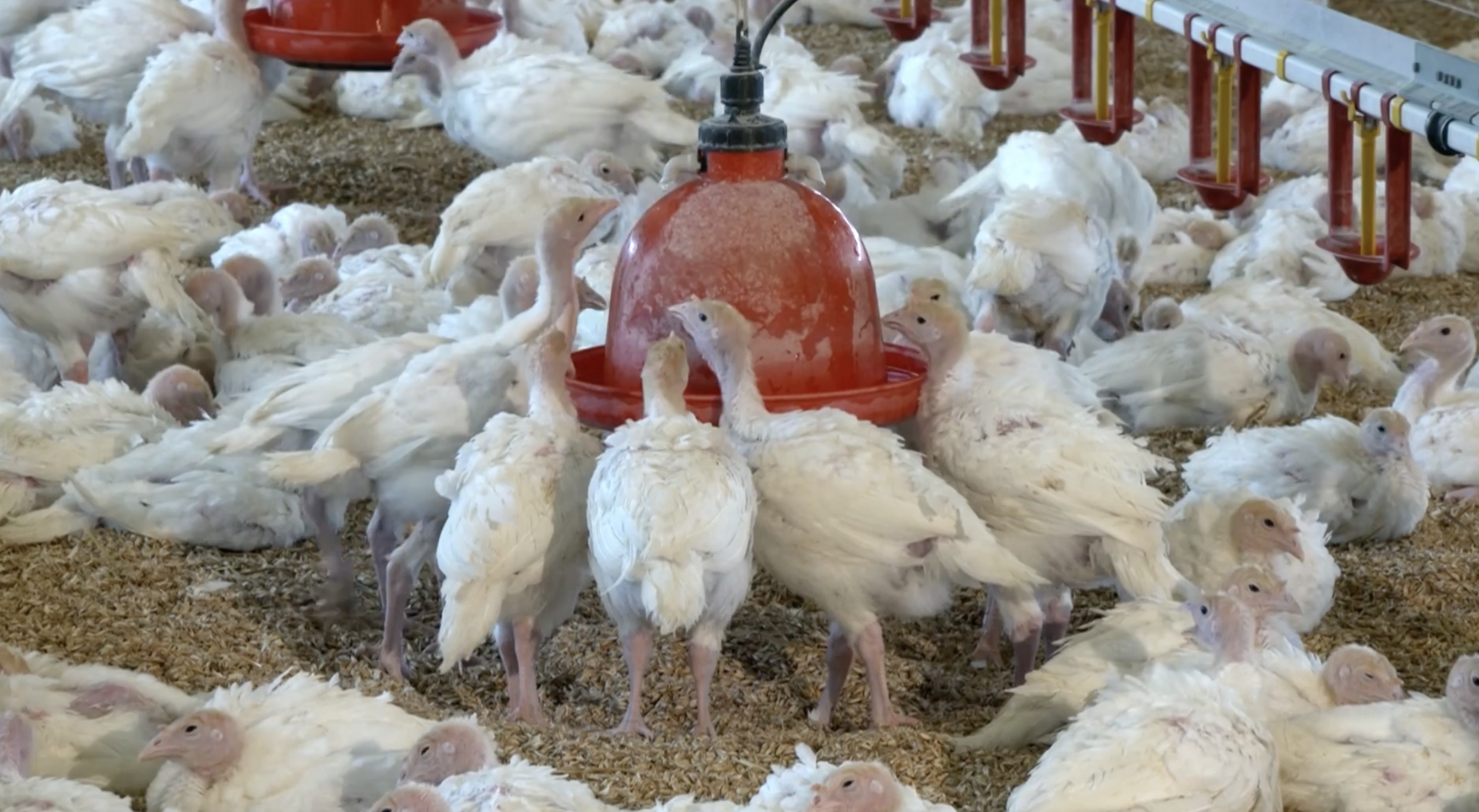
Depending on the genotype, housing conditions and feeding strategy, trials were conducted at the Bavarian State Farms in Kitzingen and at the HSWT in Freising, examining cocks and hens in a total of three experimental setups with 5 or 4 feeding phases and 20% or 30% amino acid reduction alongside a 10% energy reduction. Auburn was used as the slow-growing genotype and B.U.T.6 as the fast-growing genotype. The feeding strategies were the same for both cocks and hens. The
following were tested: feeding with complete feed mixture only, feeding with additional alfalfa silage, and feeding via outdoor access with supplementary feed. The birds were housed in fixed and mobile housing systems.
The Auburn birds coped less well with the feed restrictions than the B.U.T.6 birds; however, both genotypes exhibited compensatory growth once feed intake was increased again during the fattening phase following rearing. The addition of alfalfa silage to the feed ration led to a reduction in breast meat proportion in both genotypes, whilst the provision of access to pasture led to an increase, accompanied by reduced abdominal fat. In combination with a later slaughter age, the growth potential of both breeds can thus be optimally utilised, even when using domestic protein sources.
As a further part of the project, feed conversion efficiency – a method for assessing the nutritional competition within a production process – was investigated. In essence, this is a method used in food production to estimate what proportion of the protein input is ultimately available for human consumption. Generally, the target is a coefficient of ≥1, although this is rarely achievable in poultry fattening. However, with outdoor access, a value of 0.80 can be achieved in organic turkey fattening.
To make poultry fattening as sustainable and efficient as possible and to counteract ‘protein destruction’, these trials show that turkeys can be fed a diet with reduced energy and amino acid content without any loss in slaughter weight. Furthermore, there is a recommendation to feed poultry more with by-products in future, such as those from the grain harvest.
Further information from the project partners
Further information (in English)
- https://www.european-poultry-science.com/riboflavin-supply-strategies-in-male-turkey-production-including-either-supply-of-alfalfa-silage-or-free-range-acces,QUlEPTc2MDM0MDAmTUlEPTE2MTAxNCZQQUdFX1RQTD1QcmludHByZXZpZXcuaHRtJk1FVEFfUk9CT1Q9T0ZG.html
- https://www.european-poultry-science.com/effects-of-increasing-riboflavin-content-in-feed-mixtures-on-selected-liver-traits-and-performance-of-organically-re,QUlEPTc3MTEwMjQmTUlEPTE2MTAxNCZQQUdFX1RQTD1QcmludHByZXZpZXcuaHRtJk1FVEFfUk9CT1Q9T0ZG.html
- https://www.european-poultry-science.com/effects-of-reduced-energy-and-amino-acid-contents-in-complete-feed-mixtures-on-fattening-and-slaughter-performance-of-slow-or-fast-growing-turkey-genotypes-in-different-o,QUlEPTcyNTQ5MTQmTUlEPTE2MTAxNA.html?UID=23F10C0D61F851EBC8912455E9C9B8EC01A01A17F2AEE1CA
- https://www.european-poultry-science.com/effects-of-increasing-riboflavin-content-in-feed-mixtures-on-selected-liver-traits-and-performance-of-organically-reared-hens-up-to-eight-weeks-of-age-of-intensive-and-se,QUlEPTc3MTEwMjQmTUlEPTE2MTAxNA.html?UID=23F10C0D61F851EBC8912455E9C9B8EC01A01A17F2AEE1CA