
Initial situation
The culling of male day-old chicks from laying lines has been a subject of controversy within the agricultural sector and among consumers for years. As these lines are bred for egg-laying performance, the male chicks gain very little weight and are therefore regarded as ‘unwanted by-products’. As a result, around 45 million1 chicks were killed shortly after hatching each year in Germany up until 2022. However, since 1 January 2022, the killing of male day-old chicks has been banned in Germany. Alternatives include sexing in the egg, fattening male chickens – so-called ‘broiler chicks’ – and breeding dual-purpose breeds2. Although dual-purpose breeds do not achieve the same performance levels as animals from traditional laying and broiler lines, the hens are suitable for egg production and the chicks for meat production.
The draft bill to end chick c1ulling initially provided that, from 1 January 2024, only methods of sex determination in the egg commencing before the 7th day of incubation would be permitted. The reason for this was that there were uncertainties regarding when pain sensitivity begins in chicks. However, a study funded by the Federal Ministry of Food and Agriculture (BMEL) concluded in 2023 that it can be assumed that no sensation of pain is3 present up to and including the 12th day of incubation. Consequently, on 16 June 2023, the Bundestag passed an amendment to the Animal Welfare Act banning the culling of chicks, under which sex determination in the egg may now be carried out up to and including the 12th day of incubation, followed by the culling of male embryos.
The amendment has met with broad approval from the industry, as the new law allows current sex determination methods to continue to be used. Accordingly, the “Association for Controlled Alternative Husbandry Methods” (KAT) announced that, from 1 January 2024, KAT-certified eggs may only be marketed if they were laid by a hen originating from a hatchery where alternative methods to chick culling were used. These eggs are also labelled4 as “without chick culling” (OKT).
Overview of the procedures
The following provides an overview of the methods currently permitted for sex determination in the egg. Regardless of the method used, the following requirements apply2 to sex determination in the egg:
- Sex must be determined before the 13th day of incubation to avoid causing pain to the embryos
- No adverse effects on the hatch rate
- High reliability in sex determination
- Rapid determination, to ensure high throughput in the hatchery
- Cost-effective, to ensure the procedure can be implemented economically
- Possibility of using the sorted eggs for further processing
- Public acceptance must be ensured
The methods used here include endocrinological and molecular biological techniques, sex determination via spectroscopy, and an AI-supported MRI method.
Endocrinological procedures (e.g. SELEGGT)
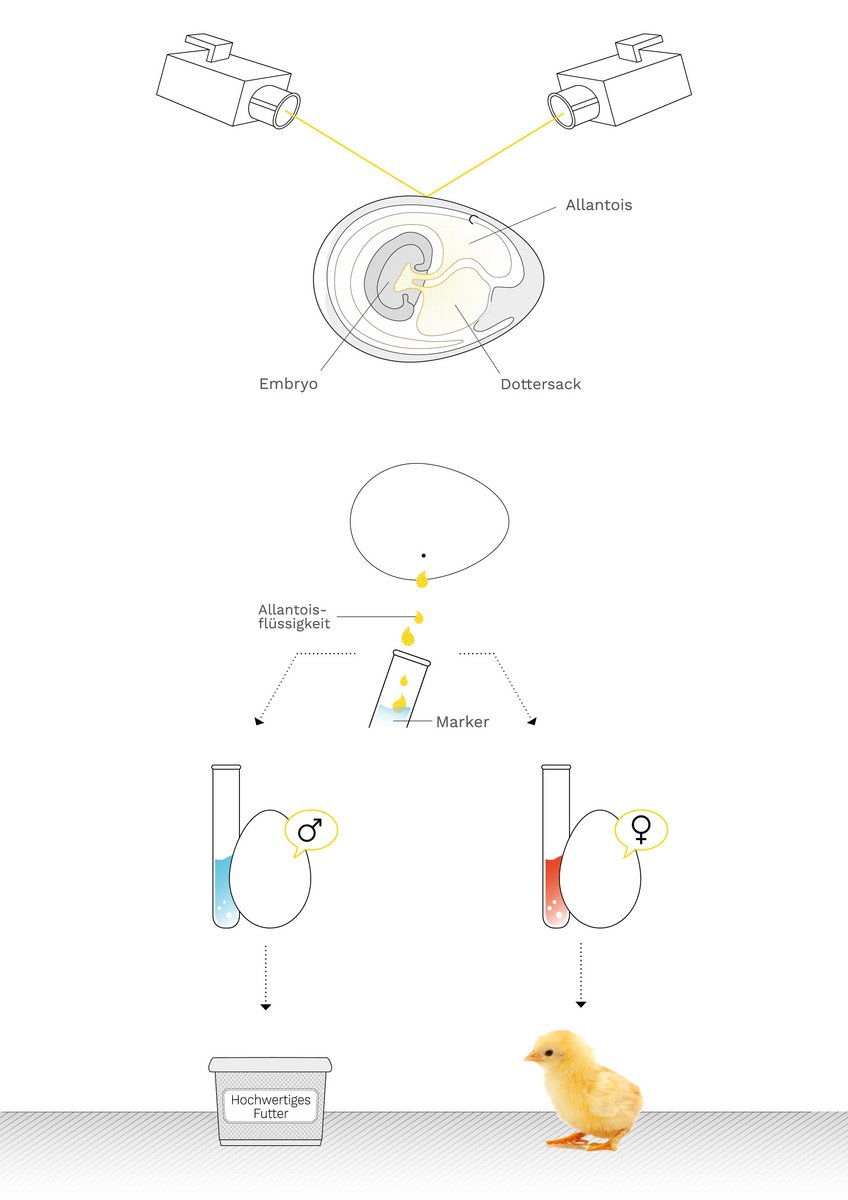
In this method, a small hole is burned into the shell of the eggs using a laser on the 9th day. A small amount of allantoic fluid, a protrusion of the yolk sac, is then extracted and mixed with a marker. The interior of the egg is not damaged in the process, meaning the procedure has5 no effect on the hatch rate. The allantois fluid consists of oxidised water and metabolic products produced during the development of the embryo. In female animals, the sex hormone oestrone sulphate is produced, which can6 be detected by a colour change caused by the added marker. The colour change facilitates the sorting of the eggs. Eggs containing female embryos are then incubated further, whilst eggs containing male embryos can5 be used for other purposes, such as feed production. The sex is determined7, 8 with a reliability of around 98%.

Molecular biology method (e.g. PLANTegg)
Compared to mammals, the sex chromosomes of birds have evolved differently. As a result, in poultry, sex is determined by the female’s egg rather than by the male’s sperm. This means that sex sorting of sperm, as is done in cattle and pigs, is not possible8.
In the molecular biology method, a small hole is similarly burned into the eggshell and allantoic fluid is extracted. The sex-specific chromosomes are isolated and amplified and analysed using a molecular biological detection method, PCR (polymerase chain reaction). This method can also be used from the 9th day onwards and has an accuracy of >999%.


Spectroscopic methods (e.g. AAT) and Raman spectroscopy
Two different spectroscopic methods are currently under development:
Hyperspectral measurement technology
With this method, there is no need to open the egg. Instead, similar to using a candling lamp, the egg is shone through between the 11th and 12th day of incubation and the resulting light spectrum is analysed. The method can only be used for brown-egg-laying hens, as it relies11 on the difference in plumage colour between female (brown) and male (white) chickens. The accuracy is >9105%.
Raman spectroscopy
On the 4th day of incubation, the air chamber in the egg is located using a thermal imaging camera, and a hole approximately 15 mm in diameter is cut into the eggshell using a laser, without damaging the egg membrane. Subsequently, a blood vessel of sufficient diameter is examined using a special procedure known as Raman spectroscopy. The scattering of certain light beams is specific to male and female animals and can therefore provide information on the sex of the embryo within the egg. Finally, the opening in the eggshell is sealed again using a biocompatible adhesive tape. Research has shown a reliability of 90–93% and a hatch rate of 81–96%. No launch date has yet been12,13 announced for this technique.

AI-assisted MRI technique (e.g. ORBEM)
Spectroscopic method
An MRI (magnetic resonance imaging) scan produces images by using a magnetic field in conjunction with radio waves. Unlike X-rays or CT scans, no X-rays are used in this process. These images are then fed into an algorithm that classifies the eggs as male/female and fertilised/unfertilised. Thanks to artificial intelligence (AI), the system continuously learns and can thus improve the accuracy of the classification. The accuracy is >98% and the procedure can be14 used from the 12th day onwards.
A comparison of methods
SELEGGT was the first company in Germany to bring its method to market. As a result, the first eggs from laying hens whose sex had been determined using the endocrinological method were5 marketed under the ‘Respeggt’ label as early as 2018. PL9ANTegg followed suit at the end of 2020. The molecular biology method is used to select hens whose eggs are sold through the discount supermarket chain ALDI. Since 2022, Aldi has only sold shell eggs from hatcheries where sex determination is carried out in the egg, thereby avoiding15 the killing of male chicks. The Cheggy spectroscopic method from A10AT, as well as the MRI- and AI-supported method from ORB13EM, are both used16 by the Lohmann hatchery for in-ovo sex determination. In Germany, the endocrinological method, hyperspectral measurement technology and the MRI-supported method are therefore currently in use7,10,14,15,17.
International research
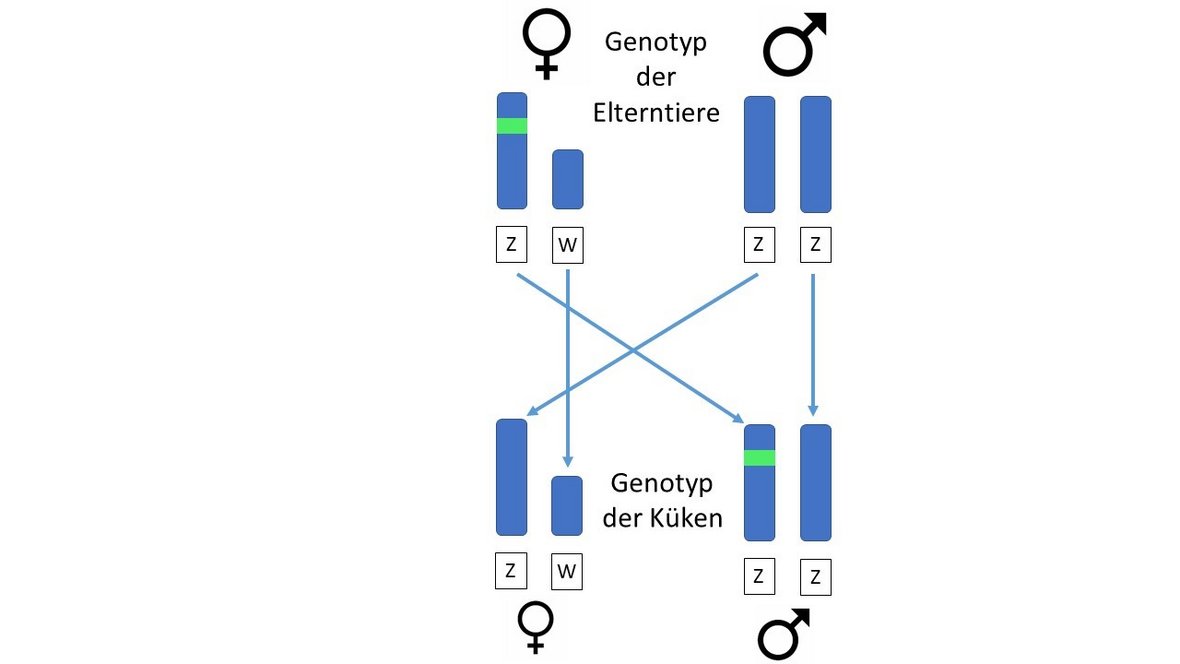
The Israeli company eggX17Yt is developing a completely different method that begins even before the egg is actually incubated. Using CRISPR/Cas, a so-called gene-editing tool, a modification is made to the Z chromosome in the hens at the parental level (Fig. 6). As a result of this molecular biological modification in the mother’s genome, the genetic material of the male chicks contains a marker that can be detected using UV light. The eggs from which male chicks would have hatched can thus be sorted out before being placed in the incubator and used for other purposes. The remaining eggs, from which female chicks emerge, can be incubated as usual and show no genetic modification. This method therefore not only prevents the killing of male day-old chicks, but also promises to double capacity in hatcheries and reduce staffing and energy17 costs.
In Europe, the CRISPR/Cas procedure, and all genetically modified organisms resulting from it, are subject to EU genetic engineering legislation18. This means that genetically modified parent animals, and the male offspring or eggs resulting from crossbreeding with these animals, may only be placed on the market with authorisation and must be labelled as such. However, the same applies to female offspring and their eggs, which do not exhibit any genetic modification. According to EU Regulation No 1829/2003, Chapter II, Article 4, ‘Food produced from a GMO’, these are also subject to authorisation and labelling19 requirements.

The method developed by another Israeli company, SO21OS, also comes into play before incubation. This company is conducting research into influencing the sex of chicken embryos before sexual characteristics are determined. By controlling humidity and temperature, and with the aid of sound waves, the aim is to ensure that only female embryos develop. To this end, the hatching eggs are placed on a special egg tray where the vibrations of the sound waves move evenly towards each egg. These sound waves stimulate the expression of female genes, causing genetically male embryos to develop female sexual characteristics and, consequently, the ability to lay eggs. This ‘sex reversal’ is possible because, in chickens, sex is22 not determined until after the sixth day of embryonic development. The method is non-invasive and works without genetic modifications or hormonal interventions.
Use of hatching eggs containing male embryos
Once the sex of the embryos has been determined, the incubation process for eggs containing male embryos is terminated immediately after sorting, regardless of the method used. The hatching eggs are then crushed and the resulting ‘male mix’ is stabilised. This is subsequently stored under refrigeration and regularly supplied as CAT 323 material, i.e. low-risk animal material.
Conclusion
In recent years, various methods have been successfully established that allow the sex of chicks to be determined with a high degree of accuracy whilst they are still in the egg. These methods are applied before the 13th day of incubation, meaning that the chicks do not experience any pain during the sex determination process. The requirements of the Animal Welfare Act have thus been successfully implemented. Consequently, chick culling no longer takes place in German hatcheries. Nevertheless, none of the methods currently achieves 100% accuracy, meaning that the rearing of young cocks will continue.
Further information on young male chickens can be found in the specialist article ‘Rearing young male chickens – a genuine prospect or a stopgap solution?’.
Furthermore, most organic associations do not regard sex determination in the egg as a suitable alternative, as this merely postpones the killing of male chicks to an earlier stage. Instead, they advocate the increased use of dual-purpose breeds to counteract selective breeding for meat and egg production. The rearing of young cocks is also widespread.
It remains to be seen to what extent other methods, such as that developed by the Israeli company SOOS, will be further developed and whether they will gain a foothold on the German market.
Bibliography
- 1 Consumer Advice Centre (2024): The culling of day-old chicks has ended – but only in hatcheries in Germany. https://www.verbraucherzentrale.de/wissen/lebensmittel/lebensmittelproduktion/toetung-von-eintagskueken-vorbei-aber-nur-in-bruetereien-in-deutschland-11924 (20 March 2024)
- 2 Krautwald-Junghanns, M.-E., Cramer, K., Fischer, B., Förster, A., Galli, R., Kremer, F., Mapesa, E. U., Meissner, S., Preisinger, R., Preusse, G., Schnabel, C., Steiner, G. and Bartels, T. (2018): Current approaches to avoid the culling of day-old male chicks in the layer industry, with special reference to spectroscopic methods. Poultry Science, 97, pp. 749–757.
- 3 Federal Ministry of Food and Agriculture (BMEL): Project summary: Pain perception in chicken embryos (2023). https://www.bmel.de/SharedDocs/Downloads/DE/_Tiere/Tierschutz/bericht-21-6a-tierschg-anlage.html (15 February 2024)
- 4 KAT – Association: What’s on the egg. Phasing out chick culling. https://www.was-steht-auf-dem-ei.de/de/kat-verein/ausstieg-kuekentoeten.php#:~:text=With%20the%20completion%20of%20this%20natural,%20biological%20process,%20the%20male%20chicks%20were%20not%20killed. (15 February 2024)
- 5 Respeggt group: The SELEGGT method – sex determination in hatching eggs. https://www.respeggt.com/de/loesungen/ (20 March 2024)
- 6 Weissmann, A., Reitemeier, S., Hahn, A., Gottschalk, J., Einspanier, A. (2013): Sexing domestic chicken before hatch: A new method for in ovo gender identification. Theriogenology, 80, pp. 199–205.
- 7 Federal Ministry of Food and Agriculture (BMEL): Breakthrough: Let’s end chick culling together! (2018) https://www.bmel.de/SharedDocs/Pressemitteilungen/DE/2018/171-seleggt-methode.html (20 March 2024)
- 8 Weissmann, A., Förster, A., Gottschalk, J., Reitemeier, S., Krautwald-Junghanns, M.-E., Preisinger, R., Einspanier, A. (2014): In-ovo sex determination in laying hen hybrids: Effects on hatching and production performance. European Poultry Science, 78.
- 9 PLANTegg GmbH: In-ovo sex determination. www.plantegg.de (23 October 2020).
- 10 Agri Advanced Technologies GmbH: In-ovo, sex determination in the egg. www.agri-at.com/produkte/in-ovo (23 October 2020, 22 February 2024).
- 11 Doreen Göhler, Björn Fischer, Sven Meissner, In-ovo sexing of 14-day-old chicken embryos by pattern analysis in hyperspectral images (VIS/NIR spectra): A non-destructive method for layer lines with gender-specific down feather colour, Poultry Science, Volume 96, Issue 1, 2017, Pages 1–4, ISSN 0032-5791, https://doi.org/10.3382/ps/pew282. (https://www.sciencedirect.com/science/article/pii/S0032579119312398, 12 March 2024)
- 12 Galli, R., Preusse, G., Uckermann, O., Bartels, T., Krautwald-Junghanns, M.-E., Koch, E., Steiner, G. (2016): In-ovo sexing of domestic chicken eggs by Raman spectroscopy. Analytical Chemistry, 88, pp. 8657–8663.
- 13 Galli, R., Preusse, G., Schnabel, C., Bartels, T., Cramer, K., Krautwald-Junghanns, M.-E., Koch, E., Steiner, G. (2018): Sexing of chicken eggs by fluorescence and Raman spectroscopy through the shell membrane. PLoS ONE 13(2): e0192554
- 14 ORBEM https://orbem.ai/ (22 February 2024)
- 15 Poultry Industry Magazine (2024): External pressure. DGS Issue 01, Volume 75
- 16 ALDI SÜD (2020): We are ending chick culling! https://blog.aldi-sued.de/ohne-kuekentoeten/ (12 November 2020)
- 17 Lohmann – In-ovo sex determination and male chick rearing. https://lohmann-deutschland.de/ (20 March 2024)
- 18 eggXYt: Count your chickens before they hatch. www.eggxyt.com (23 October 2020).
- 19 Court of Justice of the European Union (2018): http://curia.europa.eu/juris/document/document.jsf?text=&docid=204387&pageIndex=0&doclang=DE&mode=req&dir=&occ=first&part=1&cid=732085
- 20 Regulation (EC) No 1829/2003 of the European Parliament and of the Council of 22 September 2003 on genetically modified food and feed https://eur-lex.europa.eu/legal-content/de/TXT/?uri=CELEX:32003R1829 (05.11.2020)
- 21 SOOS – Egg Sex Reassignment. SOOS – Egg Sex Reassignment (26 March 2024)
- 22 Okuno, M., Miyamoto, S., Itoh, T. et al. (2020): Expression profiling of sexually dimorphic genes in the Japanese quail, Coturnix japonica. Sci Rep 10, 20073.
- 23 https://www.bmel.de/DE/themen/tiere/tiergesundheit/tierische-nebenprodukte/tierische-nebenprodukte-kategorie.html (15 April 2024)