
Initial situation
Since 1 January 2022, the killing of male chicks immediately after hatching has been prohibited by law. Until then, this had been standard practice in the rearing of laying hens, as rearing male birds from laying lines is economically unattractive due to their low growth rate and poor feed conversion.
The following alternatives are currently available:
Sex determination in the egg
Current legislation permits the use of technological methods to determine the sex of eggs in incubation up to and including the 12th day of incubation and to sort the eggs accordingly. This procedure is also known as ‘in-ovo selection’. Further details on the procedure can be found here.
The dual-purpose chicken
Animals of this breed are bred for both fattening and laying performance, but consequently do not achieve the high performance levels of animals specialised in one direction or the other. Intensive research has been conducted for years into the breeding and rearing of dual-purpose chickens. Although the use of dual-purpose chickens is favoured politically, their rearing currently plays a significant role only in organic livestock farming, as most organic associations reject sex determination in the egg.
Rearing male chicks from laying lines (broiler cocks or young cocks)
Thirdly, there is the option of rearing and fattening the male birds. This process is known as brother cock or young cock rearing. According to the Federal Statistical Office, 8.2 million male chicks were reared in Germany in 2023. This represented 45% of the 18.3 million female chicks hatched, suggesting that sex determination in the egg was used for the remainder.
(Source: Netzwerk Fokus Tierwohl, Lower Saxony Chamber of Agriculture)
market conditions
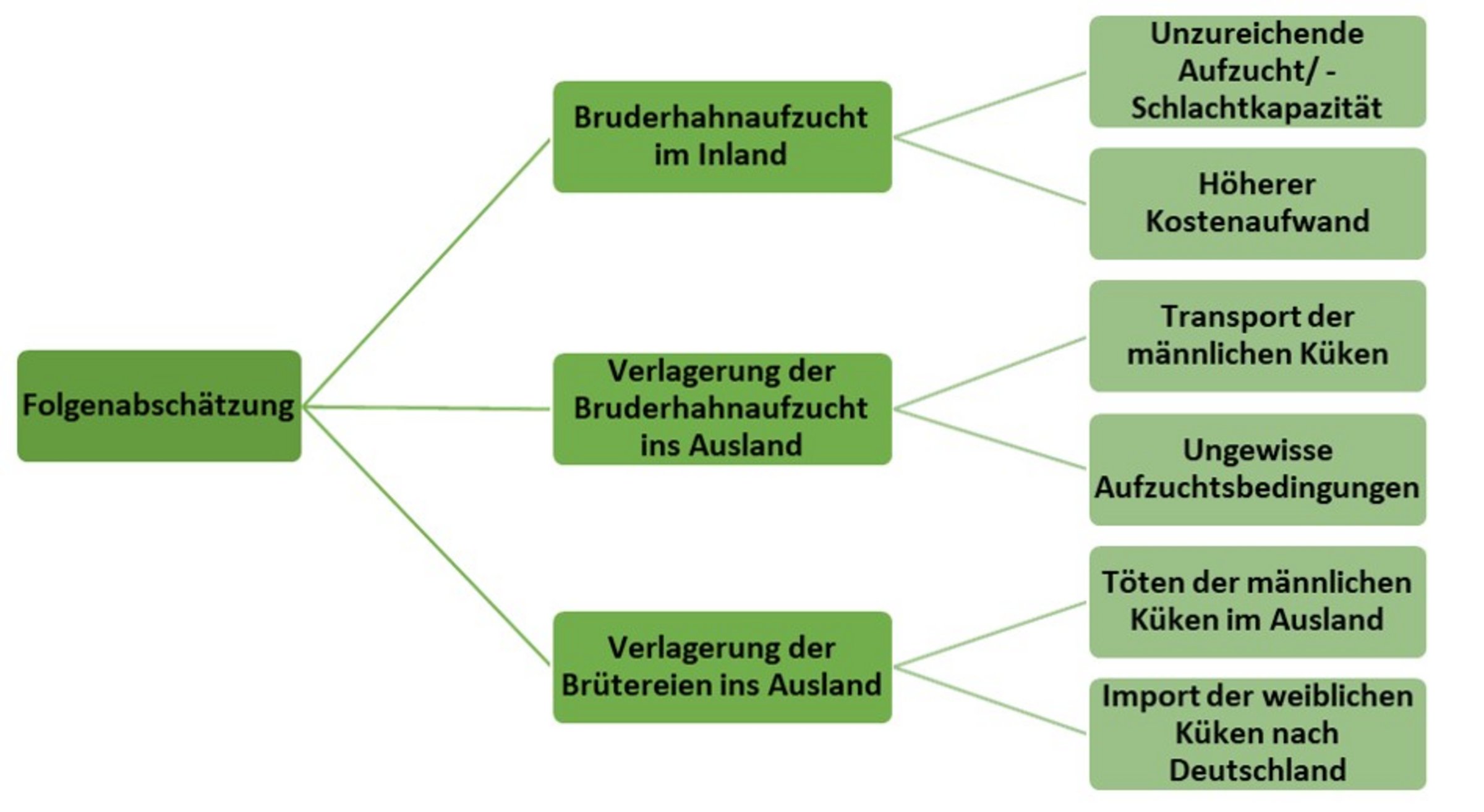
The German government’s decision to phase out the culling of male chicks has put pressure on German laying hen farms and hatcheries. The latter are obliged to pass on hatched male chicks to rearing farmers immediately after hatching.
No specific data is available on the number of male chicks reared in Germany, as no nationwide records have been kept to date. However, it can be assumed that the majority of male chicks are reared in other European countries. When rearing male chicks abroad, it is difficult to monitor the rearing conditions, and the chicks usually face longer transport journeys. However, farms rearing male chicks under the KAT system (Association for Controlled Alternative Animal Husbandry) must also comply with the relevant guidelines when operating abroad.
Following the ban on the culling of male day-old chicks, the rearing of male chicks became the dominant alternative in Germany. However, due to technological advances and the resulting fall in costs, in-egg sexing has become increasingly important and now represents the main alternative. The German government’s decision to permit sex determination from 1 January 2024 until the 12th day of incubation – rather than, as originally planned, only until the 6th day of incubation – is fuelling this trend. Furthermore, technological progress is causing the selection costs per egg to fall steadily, meaning that in-ovo selection is also becoming increasingly economically viable. This is usually not financed solely by the proceeds from the sale of the meat, but predominantly through cross-subsidisation via a 2 to 4 cent higher egg price for the ‘sister hens’.
The number of brother roosters is therefore likely to continue to fall; however, it should be borne in mind that roosters will still be produced as a result of misidentification during in-ovo selection. Furthermore, most organic associations fundamentally reject sex determination in the egg and regard the rearing of brother roosters as a transitional form towards dual-purpose chickens.
(Image: Alina Lückemann, Lower Saxony Chamber of Agriculture)
The behaviour of brother roosters
The rearing of male chicks is a relatively new area of production and presents farmers with new challenges. To date, legal requirements for their rearing exist only in the context of organic farming, as set out in Implementing Regulation (EU) 2020/464 to Regulation 2018/848, the so-called EU Organic Regulation.
In the conventional sector, Lower Saxony alone has defined specific minimum requirements for the rearing of brother cocks. In both cases, the rearing guidelines are closely aligned with those for pullets. At present, from a legal perspective, brother cocks are still classified as broiler chickens. However, due to their different behaviours (e.g. increased perching, pecking order fights, agility) and biological performance, they are more similar to their sisters, the pullets. For this reason, the birds can theoretically also be reared in mixed-sex groups, thereby avoiding the need for sex determination after hatching. However, due to a different vaccination programme for male and female birds, rearing them together is significantly more expensive than rearing them separately. Most of the eggs produced in Germany come from farms with KAT certification. With the new rearing guidelines, the association has decided that, from January 2022, only KAT pullets may be housed if the rearing of brother cocks also complies with KAT requirements.
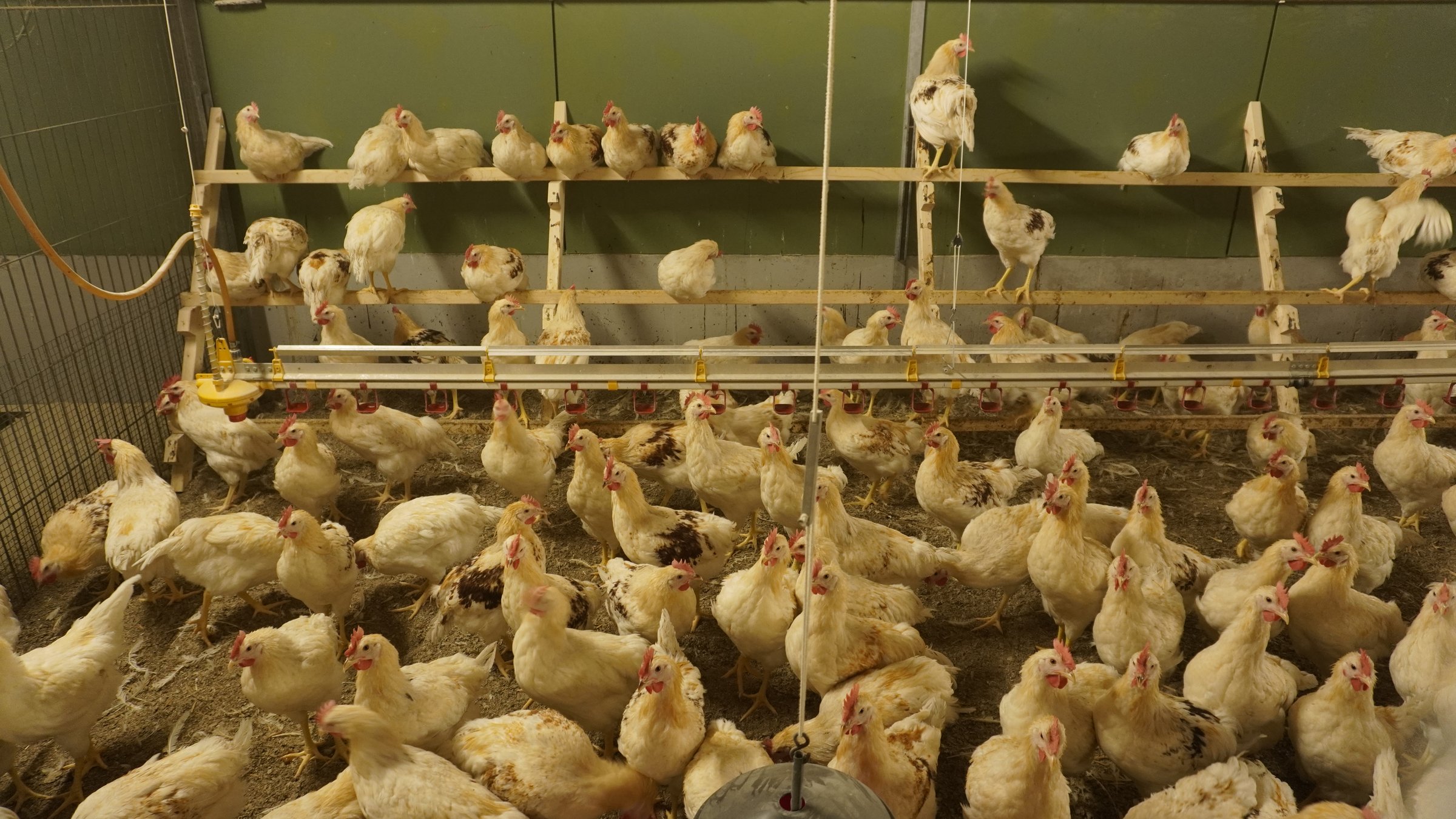
In Germany, former duck and broiler chicken houses are usually converted for the rearing of male chicks. Feeding and watering troughs from broiler chickens can continue to be used for rearing the male chicks. However, these must be fitted with a wire rope as a perch guard or reinforced to prevent them from being used as perches. The house must be well-structured overall to accommodate the animals’ more active behaviour and to prevent pecking, feather-picking and cannibalism. To this end, perches or raised platforms and enrichment materials (e.g. hay bales, dust-bathing facilities) should be provided as early as possible. Access to a cold-weather area and outdoor run can offer the animals additional incentives.
There is currently still disagreement regarding space requirements. Whilst KAT requires a maximum of 18 birds per m² of usable floor space from 1 July 2024, practical experience shows that a lower stocking density of 13 to 15 birds per m² is more favourable for preventing aggressive behaviour. An advantage for rearing is the significantly longer rearing period of 10 to 22 weeks, compared to broiler rearing, which accordingly involves fewer service periods. There is a tendency towards lower antibiotic use and lower mortality rates in young cocks. Due to the longer rearing period, an adapted vaccination programme should be considered.
Feed consumption in broiler cocks is approximately twice that of broiler hybrids. When reared under conventional conditions up to 1.5 kg live weight, the feed conversion ratio is approximately 1:3.0–3.5. With extended rearing, feed conversion efficiency deteriorates further. However, brother cocks have the potential to achieve satisfactory performance with a lower protein intake. In particular, the heavier brown breeds can achieve final fattening weights comparable to those achieved with a standard fattening feed when fed an adapted extensive diet. The birds must have unlimited access to feed in order to compensate for the lower protein content through increased feed intake. Furthermore, the energy content can be reduced to prevent earlier sexual maturity and the associated cockfighting.
Slaughter and marketing
The carcass composition of these birds differs significantly from that of broiler chickens. Male broilers have a comparatively low proportion of breast meat, which is the most valuable cut. Instead, a higher proportion of meat develops in the legs. They cannot therefore be integrated into standard slaughtering processes. For slaughter, therefore, either the slaughter lines must be retrofitted or alternative arrangements must be made with laying hen slaughterhouses. It is advisable to clarify acceptance by a suitable slaughterhouse before commencing brother cock rearing. Farms with smaller flocks may also have the option of working with a mobile slaughterhouse.
For marketing purposes, the positive characteristics of the meat should therefore be highlighted, such as the more intense flavour, the slightly darker colour and the good meat qualities. To achieve good profitability, the meat can be marketed as a premium product and supported through cross-subsidisation of the eggs.
A number of individual and inter-farm initiatives have been established across Germany to market their products under their own labels. Nevertheless, targeted education is necessary to increase acceptance of the comparatively more expensive meat.
Young cocks have a comparatively low proportion of breast meat, which is the most valuable cut. Instead, a higher proportion of meat develops in the legs. For marketing purposes, the positive characteristics of the meat should therefore be highlighted, such as its intense flavour, slightly darker colour and good meat quality. To achieve good profitability, the meat can be marketed as a premium product and supported through cross-subsidisation of the eggs.
A number of individual and inter-farm initiatives have been established across Germany to market the products under their own labels. Nevertheless, targeted consumer education is necessary to embed the benefits of brother rooster meat in people’s minds and increase willingness to pay for the comparatively more expensive meat.
Conclusion
The majority of consumers oppose the culling of male chicks from laying lines. For the alternative of rearing brother cocks to succeed, the resulting products (fresh eggs, meat, processed products) must gain acceptance. Higher feed consumption, longer rearing periods, specific carcass characteristics and slaughter in specialised slaughter lines contribute to higher production costs. Consumers must therefore be informed about the specific circumstances surrounding the rearing of male chicks in order to understand the higher price of the products. Ultimately, it is consumers who, through their purchasing behaviour, determine the success of male chick rearing.
Conclusion
The majority of consumers oppose the culling of male chicks from laying lines. For the alternative of rearing male chicks to succeed, the resulting products (fresh eggs, meat, processed products) must gain acceptance. Higher feed consumption, a longer rearing period, specific carcass characteristics and slaughter in specialised slaughter lines all contribute to higher production costs. Consumers must therefore be informed about the specific circumstances surrounding the rearing of male chicks in order to understand the higher price of these products. Ultimately, it is consumers who, through their purchasing behaviour, determine the success of male chick rearing.
Sources
- ALDI Nord (undated): We are phasing out the culling of chicks. www.aldi-nord.de/unternehmen/verantwortung/lieferkette-food/tierwohl-bei-aldi-nord/ohne-kuekentoeten.html
- ALDI Süd (n.d.): We are phasing out chick culling. www.aldi-sued.de/de/nachhaltigkeit/lieferkette/produktionsstandards/tierwohl/ohne-kuekentoeten.html
- Ammer, S., Quander, N., Gangnat, IDM., Maurer, V. and Leiber, F. (2017) Growth performance and meat quality of male laying hybrids fed different protein sources. Scientific Conference on Organic Farming, Campus Weihenstephan, Freising-Weihenstephan, 7–10 March 2017.
- Biohandel (2021): Edeka plans to stop chick culling for own-brand eggs | BioHandel https://biohandel.de/markt-branche/edeka-will-bei-eigenmarken-eiern-auf-kuekentoeten-verzichten
- BLE (2023) Report on the market and supply situation for eggs in 2022. https://www.ble.de/ [Last accessed: 29 April 2024]
- Federal Information Centre for Agriculture (2020): What is a male chick? https://www.landwirtschaft.de/landwirtschaft-verstehen/haetten-sies-gewusst/tierhaltung/was-ist-ein-bruderhahn (12 October 2021)
- Destatis (2024): Hatcheries, hatching eggs placed, hatched chicks. Federal Statistical Office, Genesis Online, Table 41321-0003
- DGS Magazine for the Poultry Industry (2019): Increase in hen places in Europe. https://www.dgs-magazin.de/Anstieg-der-Hennenplaetze-in-Europa,QUlEPTYwNTM0MjMmTUlEPTQ3Mg.html (12 October 2021)
- DGS Magazine for the Poultry Industry (2020): Harsh tones from the political arena. DGS Issue 40, Volume 72.
- Hörning, B. (2021): Dual-purpose chickens & brother cocks – an overview of recent developments. Lecture, Neuland e.V. Advisory Platform for Dual-purpose Chickens/Free-range Poultry, 18 August 2021.
- Hörning, B. 2024. Current status of developments regarding dual-purpose chickens. Dual-purpose Chicken Day, Ecological Animal Breeding (ÖTZ), Neuland e.V., Lower Saxony State Representation, 22 January 2024, Berlin. Link to recording
- Jahn, A. & Tiemann, I. (2022) An update on the culling of male chicks from laying lines. In: Deutsches Tierärzteblatt 70 (8), 1016–1020.
- KAT – Association for Controlled Alternative Animal Husbandry e. V. (2024): KAT Guide to Rearing.
- Krautwald-Junghanns, M. (2021): Rearing of male chicks – Literature review. University of Leipzig, Faculty of Veterinary Medicine, Clinic for Birds and Reptiles.
- Krieg, C. (2019): Chick culling: A ban calls for alternatives. www.landundforst.de/landwirtschaft/tier/kuekentoeten-verbot-verlangt-ersatz-554594 (12.10.2021)
- Animal Welfare Focus Network (2021): Roster rearing, podcast. fokus-tierwohl.de/de/podcasts/bruderhahnaufzucht (17 November 2021)
- Lower Saxony Ministry of Agriculture: Minimum requirements for the rearing of male laying hybrids, known as ‘broiler roosters’, defined (Circular of the Ministry of Agriculture dated 25 November 2021 – 204.1-42503/2-1111 (E))
- REWE Markt GmbH (n.d.): Did you know? 500 million eggs without chick culling. (rewe.de) www.rewe.de/nachhaltigkeit/nachhaltig-einkaufen/gruene-produkte/tierwohlprojekte-ei/
- Schröter, I. and Mergenthaler, M. (2019) Male chicks from laying hens should live! And what do we do with the roosters then? Willingness to pay for rooster meat products, taking into account information framing. Innovative thinking for a sustainable agricultural and food industry. Papers from the 15th Scientific Conference on Organic Farming, Kassel, 5–8 March 2019, Berlin.
- Schütz K., Mergenthaler, M. and Wittmann, M. (2018) Market potential for poultry products made from rooster meat from laying and dual-purpose hybrids. Research Reports of the Department of Agricultural Economics, Soest No. 45.
- Animal Welfare Act (TierSchG): Section 4c(1) to (3)
- Waterloh, B. (2020) A whole barn full of roosters. Agricultural Weekly, 29/2020.