
- Dr Gürbüz Daş, Leibniz Institute for Farm Animal Biology (FBN)
- Dr Frauke Deerberg, University of Kassel
- Dr Julia Gickel, University of Veterinary Medicine Hannover / WING
- Prof. Dr Pia Münster, Osnabrück University of Applied Sciences
- Dr Jochen Schulz, University of Veterinary Medicine Hannover
- Prof. Dr Christian Visscher, Hanover University of Applied Sciences and Arts / WING
- Hannah Kanwischer, Lower Saxony Chamber of Agriculture
- Constanze Lüntzel, Lower Saxony Chamber of Agriculture
The cleaning and disinfection of poultry houses, alongside other measures—including those relating to the area outside the house, which are explained below—is essential for maintaining animal health, ensuring food safety, and achieving good animal performance. Under EU regulations (EU Regulation 2016/429 Animal Health Law (AHL)19) and German legislation (Section 3 of the Animal Health Act (TierGesG)14), the livestock keeper must ensure that no animal diseases are introduced into or spread from the herd. However, the obligation to carry out proper cleaning and disinfection applies not only in the event of an outbreak, but also to the routine maintenance of clean livestock housing before and after each batch (EU Directive 2007/43/EC (Annex 1, para. 10)13, TierSchNutztV20). This not only reduces the risk of diseases and animal epidemics such as avian influenza8,9, but also of food safety-relevant pathogens such as salmonella and campylobacter. An effective hygiene concept reduces the bacterial load, lowers the number of sick animals and animal losses, and consequently also reduces financial losses3.
By drawing up a biosecurity plan, farmers actively contribute to the United Nations’ 2030 Agenda (Sustainable Development Goals, SDGs)28. A suitable plan, such as the ‘Lower Saxony Poultry Biosecurity Plan’31, can help to prevent disease outbreaks and reduce the use of antibiotics. The production of safe, sufficient and nutrient-rich food helps to prevent hunger (SDG 2.1 – Zero Hunger). Furthermore, reducing the use of antibiotics in animal husbandry can help to limit the spread of resistance and ensure that available active substances can still be used effectively in both humans and animals (part of SDG 3.8 – Good Health and Well-being)10.
The use of chemical cleaning and disinfectant agents, which are necessary for the safe and hygienic production of animal-based food, can have environmental impacts that can be reduced through proper and responsible use. Well-considered cleaning and disinfection procedures tailored to the specific farm not only support global sustainability goals but also provide additional protection for people by ensuring occupational safety.
The following article aims to provide a brief overview of potential environmental impacts, the correct cleaning and disinfection procedures for optimal animal health, and the steps to be taken to ensure occupational safety.
The impact of biocides on the environment
Cleaning and disinfection tailored to the farm’s operations help to maintain animal health throughout the production cycle, thereby minimising the occurrence of sick animals and animal losses. Maintaining a healthy and stable herd is essential not only for animal welfare reasons24, but also for economic reasons.
Active substances used in livestock housing, such as aldehydes (e.g. glutaraldehyde, formaldehyde), quaternary ammonium compounds, organic acids, peracetic acid and ketones, are biocides used to combat undesirable microorganisms. They are effective against pathogens but can enter the environment via wash water, slurry, solid manure and aerosols, where they may harm non-target organisms1, which is why they are often subject to the European Biocidal Products Regulation11,12. In particular, the use of formaldehyde – which may only be applied for disinfection in the veterinary sector with appropriate expertise and following authorisation – must be viewed critically for occupational health and safety and environmental protection reasons.
A study by the German Federal Environment Agency (UBA)¹ shows that unnecessary environmental releases can result from incorrect application – for example, due to incorrect dosage, the wrong product, or errors in application or temperature during use. Integrating the substances used into a holistic hygiene management system to reduce unnecessary use is therefore crucial¹⁶.
To minimise waste of the products used and ensure occupational safety, it is necessary first to check the shelf life of the products, as they may lose their effectiveness if stored for too long1. To avoid packaging waste, bulk containers, concentrates and refill systems are recommended. When stockpiling, however, care should be taken to ensure that the products are used up completely within their shelf life. If expired products and empty containers are disposed of improperly, microplastics can enter soil and water. Empty containers and those with residual contents should be returned to the recycling cycle via local recycling collection points. In the European Union, waste classification is regulated by the European Waste Catalogue (EWC). In Germany, the relevant requirements are set out in the Waste Catalogue Ordinance (AVV25). All waste types classified as hazardous in the EAV are marked with an asterisk (*) after the waste code number. Corresponding disposal instructions can also be found on the cleaning/disinfectant container (see Fig. 2). In those federal states where there is a so-called ‘duty to deliver and hand over’ for hazardous waste (under the Circular Economy Act (KrWG26)), the waste-generating business must inform its competent authority of the type, quantity and composition of the waste, as well as the intended disposal facility. The authority then assigns the waste to a suitable facility27. As a general rule, only products with a current BAuA registration number (Federal Institute for Occupational Safety and Health)18 should be used to ensure legal and economic compliance. If there is any uncertainty regarding disposal, it is advisable to consult the relevant waste management authority.
Approved products with recommendations for their respective applications, including for organic livestock farming, are listed on the website of the German Veterinary Medical Society (DVG)7.
Side note: Preventing environmental pollution
- Rinsing water and waste water from the barn should not be allowed to escape outside
- Should wash water and waste water nevertheless escape to the outside, or during cleaning of outdoor areas, a buffer zone should be established around the buildings to be cleaned: the enclosed and sealed area should be large enough to ensure that no cleaning or wash water can enter the environment. It is also advisable to check the drainage angle of the fixed slab and ensure that appropriate drains are in place for the wastewater
- If disinfection equipment is used and subsequently rinsed, care must be taken to ensure that the rinse water is collected and does not enter the environment uncontrolled. Wastewater (dirty water, cleaning and disinfectant solutions) must be discharged in a controlled manner via floor drains etc., where permissible, into septic tanks or the sewerage system. If agents are used that must not enter the environment via wastewater, the wastewater must be collected separately and disposed of appropriately. Relevant regional requirements can be found in the applicable annexes to the Wastewater Ordinance or the local wastewater regulations
- Unused residues of cleaning and disinfectant agents must be disposed of in accordance with the instructions in the safety data sheet and must not simply be disposed of via the drain and the sewerage system23
- In mobile housing systems, care should be taken to clean the pens only on a hard surface with collection facilities to prevent cleaning agents and/or disinfectants from entering the environment. Here too, the wastewater must be disposed of appropriately
- The manufacturer’s instructions for use and storage must be followed
- Care must be taken to ensure the correct storage/disposal of treated manure in the event of an outbreak14,19
Comprehensive hygiene management
Effective barn hygiene does not rely solely on the appropriate use of cleaning or disinfectant products, but on a systematic, comprehensive approach. First and foremost, careful planning of cleaning and disinfection measures is essential. This must be tailored to the barn environment, size and system, the animal species, as well as the frequency of use and (where known) the presence of pathogens and their resistance. DLG Fact Sheet 36417 contains a list of critical control points to which particular attention should be paid during cleaning and disinfection.
The recommended stand-down periods for each system and animal species should be observed. During the stand-down period between two cleaning cycles, sufficient time should always be allowed for effective (e.g. contact times) and proper (e.g. drying) cleaning and disinfection. Where necessary, time should also be set aside for any repair work.

- Before wet cleaning begins, a thorough mechanical pre-cleaning should be carried out to remove coarse dirt while the surfaces are dry. This saves water and cleaning agents and prevents application errors (see the section on application errors) during the subsequent disinfection process.
- The surfaces should then be soaked with warm water. Depending on the degree of soiling, cleaning agents (surfactants) may also be added to make it easier to remove heavier soiling afterwards17.
- If cleaning agents are added for the subsequent wet cleaning, biodegradable products should be used wherever possible. The relevant usage instructions for the cleaning agents can be found on the product packaging and/or in the manufacturer’s instructions (see Fig. 2).
- Rinsing is carried out from top to bottom and from the rear towards the entrance. If necessary, remove any remaining splash water from the bottom and empty the bowls to prevent recontamination. In doing so, the points listed in the appendix on preventing environmental contamination must be observed.
- Before proceeding to the next step, the cleaned surfaces must be dried to ensure successful disinfection. Ventilation may also be switched on to aid the drying process. Subsequently, any removable stable fittings that were previously dismantled can be reassembled after appropriate cleaning, and their functionality checked. Should repairs be necessary, these can be carried out.
- The dosage may vary depending on the product used and the objective of the disinfection. In the case of known pathogens, the choice of disinfectant should be adjusted if necessary. The correct dosage can be found in the DVG disinfectant list7, under the column ‘Working concentration in volume per cent (V-%) or g/100ml’. For the calculation and effective disinfection, 0.4 l of working solution per m² of surface area should be assumed. The floor area of the stable (in m²) can be taken as the base value and multiplied by a factor (e.g. 2.5) to include walls, fixtures and a safety factor15. To ensure occupational safety, it is essential to follow the manufacturer’s specific instructions, e.g. regarding respiratory protection.
The disinfectant should be completely dry after the contact time specified by the manufacturer (see Fig. 2) and before entering the barn (ideally over 24 hours). It may be necessary to switch on the heating and/or ventilation for this purpose to avoid irritation of the mucous membranes when entering the barn (see section on occupational safety). Furthermore, all cleaning steps should be documented and checked by internal and external audits, as is already the case with some quality assurance systems (e.g. QS29, IKB30)16. Swab or contact samples enable targeted monitoring of effectiveness and help to optimise the use of the agents employed1,15. Before animals are reintroduced into the barn, it is essential to check the drinking and feeding facilities for residues of cleaning and disinfectant agents to prevent ingestion. Formaldehyde
represents a special case among disinfectants. Its use is not common and is subject to strict authorisation. In a study by the German Federal Environment Agency (UBA)¹ , elevated concentrations of formaldehyde were detected in the soil, originating from the manure of a treated barn. Formaldehyde had been used there some time previously due to an outbreak of disease. After the manure was spread, contrary to expectations, the formaldehyde did not break down under the influence of sunlight and soil bacteria, but instead accumulated in the soil. In such cases, the manure should be disposed of separately and not spread onto the environment. As a general rule, when using any disinfectants, the points listed in the appendix on avoiding environmental contamination and application errors must be observed.
Side note: Application errors
The effectiveness of disinfectants can be reduced by the following avoidable application errors:
Protein contamination
- Presence of fats and proteins on the surface to be cleaned due to inadequate mechanical pre-cleaning. The use of a degreaser may be necessary
Soap-related errors
- Use of cleaning agents and disinfectants that are not compatible with each other, or errors caused by residues from other cleaning agents
Temperature/cold-related errors
- Use or storage at the wrong temperature, often during the winter months in cold livestock buildings or during storage/loading. This is particularly true for cleaning agents containing aldehydes and acids, which cannot then develop their full effectiveness
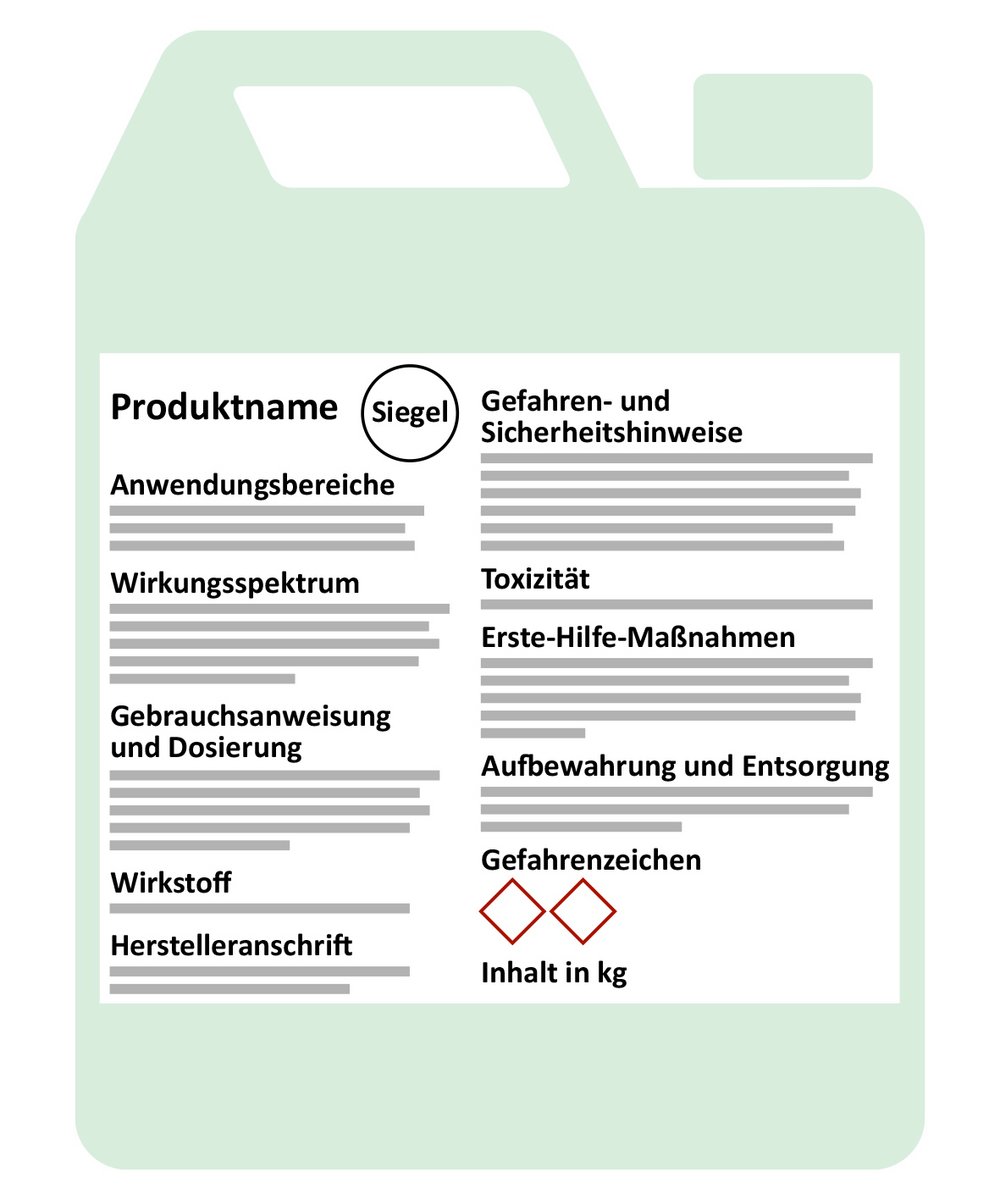
Many chemical products are not permitted in organic livestock farming. Organic cleaning products must comply with the requirements of the EU Organic Regulation. The FiBL List of Materials and Products² includes, amongst other things, cleaning and disinfectant products that have been tested by FiBL for suitability for use in organic farming in Germany.
As part of an enhanced hygiene management programme, further measures to maintain animal health should also be taken during the passage of animals. These include both internal biosecurity (e.g. appropriate personal hygiene, bedding management, etc.) and external biosecurity (e.g. effective rodent control, appropriate choice of transport routes to prevent the introduction or spread of pathogens via vehicles, etc.).
In addition, other measures can be taken during the passage, such as the addition of probiotic products4 to promote gut health21,22, thereby reducing general susceptibility to disease and consequently the use of medication.
Another key component of the hygiene concept is the regular training of staff5 through courses run by chambers of agriculture, state agencies or private companies. Instruction on occupational safety measures, dosage, contact times and environmental protection ensures proper application and prevents errors.
Side note: Health and safety at work
- Follow the manufacturer’s instructions regarding the use and storage of cleaning and disinfectant products
- Allow the disinfectant to dry completely before entering the barn (preferably for 24 hours). It may be necessary to switch on the heating and/or ventilation to prevent irritation of the mucous membranes
Conclusion
Environmentally responsible use of biocides
- The environment and resources can be protected in a sustainable manner through the responsible use of officially approved cleaning and disinfectant products, adherence to expiry dates, correct application and disposal, as well as the avoidance of packaging waste wherever possible and the reduction of rinse water and wastewater discharge into the natural environment
- The use of biodegradable products and appropriate agents reduces unnecessary environmental impact. Approved organic cleaning and disinfectant products are listed in the FiBL’s list of operating materials and on the DVG’s website
Stable and farm hygiene
- Stable hygiene is a holistic concept, and cleaning and disinfection are key components. Mechanical pre-cleaning, soaking time, wet cleaning, rinsing, drying and correct disinfection reduce microbial load and can help reduce antibiotic use by preventing the spread of disease.
- Supplementary measures such as sufficient or extended fallow periods, herd isolation, rodent control, bedding management and probiotic products can strengthen animal health and help to minimise losses in performance
Health and safety
- Monitoring and training of staff through regular briefings on dosage, contact times and safety precautions for cleaning and disinfectant products prevent errors and health risks and ensure a high standard of occupational safety
- To avoid mucous membrane irritation and health risks, protective clothing and respiratory protection should be worn, and the disinfectant should be completely dry before entering the barn (ideally 24 hours)
Bibliography
- Federal Environment Agency. (2022). Biocides in animal husbandry: Minimising environmental releases. Retrieved from www.umweltbundesamt.de/themen/biozide-in-der-tierhaltung-umwelteintraege; https://www.umweltbundesamt.de/sites/default/files/medien/479/publikationen/texte_39-2022_the_use_of_biocides_in_animal_housings.pdf#:~:text=The%20aim%20of%20this%20project%20was%20to%20analyse,arthropods%20%28PT%2018%29%20with%20regard%20to%20the%20environment.
- FiBL Projekte GmbH. (2025). List of agricultural inputs for Germany. Retrieved from: www.betriebsmittelliste.de
- DLG – German Agricultural Society. (2019). Biosecurity – An important cornerstone for long-term success (DLG Kompakt 06/2019). Retrieved from www.dlg.org/mediacenter/dlg-merkblaetter/dlg-kompakt-06-2019-biosicherheit-wichtiger-grundstein-fuer-den-langfristigen-erfolg
- Overview of the Use of Probiotics in Poultry Production (2021). Krysiak, K., Konkol, D., & Korczyński, M. Animals, 11(6), 1620. Retrieved from: doi.org/10.3390/ani11061620
- Büro für Lebensmittelkunde & Qualität GmbH (BLQ GmbH). (2024). Practical guide to more environmentally friendly cleaning and disinfection in organic food processing and storage. Retrieved from https://blq-bio-beratung.de/wp-content/uploads/2024/03/Praxisleitfaden-fuer-eine-umweltfreundlichere-Reinigung-und-Desinfektion-in-der-oekologischen-Lebensmittelverarbeitung-und-Lagerung_2023.pdf
- TU Munich. (2023). MuD project “MiniAbeR” to minimise the use of antibiotics and the spread of resistance in poultry farming. Retrieved from https://www.mls.ls.tum.de/anm/arbeitsgruppe-tierernaehrung-und-metabolismus/forschung/laufende-projekte/miniaber/
- DVG. List of disinfectants. Retrieved from: DVG | Disinfection in Veterinary Medicine | Committee of the German Veterinary Medical Society e.V.: Disinfectants in Animal Husbandry
- trafo:agrar. Retrieved from: https://risikoampel.uni-vechta.de/plugins.php/aisurveyplugin/ai/survey?disease_id=1
- Friedrich Loeffler Institute. (2017). Factsheet: Protecting poultry. Retrieved from: https://www.openagrar.de/servlets/MCRFileNodeServlet/openagrar_derivate_00001778/Merkblatt-Nutzgefluegel_schuetzen-2017-02-15.pdf
- United Nations. Sustainable Development Goals (2015). Retrieved from: https://www.bmz.de/de/agenda-2030
- REGULATION (EU) No 528/2012 OF THE EUROPEAN PARLIAMENT AND OF THE COUNCIL concerning the making available on the market and use of biocidal products (2012). Retrieved from: https://eur-lex.europa.eu/legal-content/DE/TXT/HTML/?uri=CELEX:32012R0528
- European Chemicals Agency Database (ECHACHEM). Retrieved from: https://chem.echa.europa.eu/
- COUNCIL DIRECTIVE 2007/43/EC of 28 June 2007 laying down minimum rules for the protection of chickens kept for meat production (2007). Retrieved from: eur-lex.europa.eu/legal-content/DE/TXT/HTML/
- Animal Health Act (2018). Retrieved from: www.gesetze-im-internet.de/tiergesg/
- Biosecurity in Poultry Farming – Optimal Hygiene – Healthy Animals (2016). DLG Verlag. ISBN: 978-3-7690-2047-2. Dr Pia Münster
- Guideline: General Regulations (2025). QS Qualität und Sicherheit GmbH. Retrieved from: https://q-s.de/services/files/downloadcenter/a-allgemeines-regelwerk/2025/leitfaeden/deutsch/Leitfaden_Allgemeines_Regelwerk_01_01.2025.pdf
- DLG Fact Sheet 364. Hygiene technology and management guidelines for the cleaning and disinfection of livestock housing (2010). Retrieved from: https://www.dlg.org/fileadmin/downloads/Merkblaetter/dlg-merkblatt_364.pdf
- baua: Federal Institute for Biosafety and Occupational Medicine. eBIOMELD – open search. Retrieved from: www.ebiomeld.de/DE/Offen
- European Union. Regulation (EU) 2016/429. Animal Health Act (2021). Retrieved from: https://food.ec.europa.eu/animals/animal-health/animal-health-law_en
- Federal Ministry of Justice and Consumer Protection. Ordinance on the Protection of Farm Animals and Other Animals Kept for the Production of Animal Products during their Husbandry (Animal Welfare Farm Animal Husbandry Ordinance – TierSchNutztV) (2006). Retrieved from: https://www.gesetze-im-internet.de/tierschnutztv/BJNR275800001.html
- Animal Welfare Focus Network. Focus on Poultry Welfare – How to keep the gut of broiler chickens healthy and stable (2023). Retrieved from: https://www.fokus-tierwohl.de/de/gefluegel/fachinformationen-masthuehner/gefluegelwohl-im-fokus-darmgesundheit-bei-masthuehnern/vorwort-und-inhaltsverzeichnis
- Animal Welfare Focus Network. Focus on Poultry Welfare – How to keep the gut healthy and stable in turkeys (2025). Retrieved from: https://www.fokus-tierwohl.de/de/gefluegel/fachinformationen-puten/gefluegelwohl-im-fokus-darmgesundheit-puten-1
- IHO – INDUSTRY ASSOCIATION FOR HYGIENE & SURFACE PROTECTION (2025). Retrieved from: https://www.iho.de/aktuell/desinfektionsmittel-richtig-dosieren-nachspuelen-entsorgen/
- Federal Ministry of Justice and Consumer Protection. Animal Welfare Act (2006). Retrieved from: https://www.gesetze-im-internet.de/tierschg/BJNR012770972.html
- Federal Ministry of Justice and Consumer Protection. Ordinance on the European Waste Catalogue (Waste Catalogue Ordinance – AVV) (2001). Retrieved from: https://www.gesetze-im-internet.de/avv/AVV.pdf
- Federal Ministry of Justice and Consumer Protection (2012). Act on the Promotion of the Circular Economy and Ensuring the Environmentally Sound Management of Waste. Retrieved from: www.gesetze-im-internet.de/krwg/BJNR021210012.html
- Federal Environment Agency. Hazardous waste (2017). Retrieved from: https://www.umweltbundesamt.de/themen/abfall-ressourcen/abfallwirtschaft/abfallarten/gefaehrliche-abfaelle
- United Nations. Department of Economic and Social Affairs. Sustainable Development. The 17 Goals (2015). Retrieved from: sdgs.un.org/goals
- QS Qualität und Sicherheit GmbH (2022). Cleaning and disinfection documentation for livestock farms. Retrieved from: https://q-s.de/downloadcenter-de/attachment-18567-2094-de.html
- AVINED Foundation – IKB EI (2021). IKB EI Control Checklist. Retrieved from: IKB-Ei-DUI-Checkliste-IKB-EI-Legehennenbetriebe-version-1.2-04-2021.pdf
- Lower Saxony Animal Disease Fund (2025). Biosecurity in poultry. Retrieved from: www.ndstsk.de/1348_Biosicherheitskonzept_Gefluegel.html