
Group size
When it comes to group size, there are various options for organising pig groups depending on the number of animals, the farm layout and the farmers’ preferences. Groups of up to 30 animals are easier to manage than larger groups. However, it is more difficult to achieve a clear pen layout with smaller groups, as there is less space available overall than with larger groups. With more than 30 animals, a clear pen structure with opportunities to avoid other animals can be implemented more effectively due to the total space available. Further advantages and disadvantages are shown in Table 1.2
Larger groups of 80 pigs or more gradually reach the ‘metropolitan effect’. The animals no longer know each other as well and the groups are more anonymous. Due to the ‘big city effect’, conflicts occur less frequently, as the group structure is looser.3
| Advantages | Disadvantages | |
| Groups of up to 30 animals | good overview | Difficult to establish a clear pen layout |
| Fewer options for animals to move around | ||
| Groups of 30 or more animals | Clear pen layout | More challenging overview |
| Alternatives | The animal group dispersing | |
| Same functional areas can be distributed across multiple locations | ||
| Short-term functional failures can be better mitigated |
Space per animal
Rearing of piglets
The ‘Pen Structure’ Working Group recommends 0.35 m² per animal up to 20 kg body weight and 0.5 m² per animal for animals weighing over 20 kg. This is 40% more than required by the Animal Welfare Livestock Husbandry Ordinance (TierSchNutztV).
Fattening
There are various requirements regarding space allocation for fattening pigs. Without access to outdoor areas, the TierSchNutztV stipulates a minimum of 0.75 m² for animals weighing 50–110 kg live weight and 1.0 m² for animals weighing over 110 kg live weight.
Furthermore, there are various husbandry systems currently found on different animal products in the food retail sector. Depending on the husbandry system, these stipulate, amongst other things, increased space allowances for the animals and were developed by the Society for the Promotion of Animal Welfare in Livestock Farming mbH (an association of the food retail sector).
In addition, the mandatory State Animal Husbandry Labelling Act has been in force since August 2023. It sets out five different husbandry systems with increased space allowances and requirements regarding outdoor environmental stimuli and access to outdoor areas. The Act is currently being revised, and the mandatory labelling is due to come into force on 1 March 2026.
| Legal standard according to the Animal Husbandry Ordinance | Housing systems (LEH/ITW) | Animal Husbandry Labelling Act | ||
| 0.75 m² | 1 | 0.75 m² | Stable | 0.75 m² |
| 2 | 0.85 m² | Stable + paddock | 0.85 m² | |
| 3 | 1.30 m² | Open-air barn | 1.30 m² | |
| 4 | 1.50 m² | Outdoor run/free-range | 1.50 m² | |
| 5 | 2.30 m² (organic) | Organic | 2.30 m² | |
Particularly in piglet rearing, but also generally in fattening, space exceeding the legal standard can be created structurally by means of raised levels.6 A second level provides an extended activity area at the top, whilst at the bottom it offers a sheltered retreat that is darker and therefore popular as a resting area. Unlike in fattening, where two ramps are required for ascending and descending the raised level to prevent conflict, a single ramp is sufficient in piglet rearing. Care should be taken to ensure that the angle of ascent in each rearing section is adapted to the age and weight of the animals.7 Essential items such as feed and water must not be provided exclusively on the levels, as not all animals use the second level. A disadvantage of the raised levels is that they require additional cleaning effort. The floors of the levels should not be perforated, as this would result in animals standing below becoming soiled.
Whether the raised level should be integrated into new buildings or added to existing ones to make better use of the available housing must be assessed on a case-by-case basis for each farm. The raised levels are not recognised as additional floor space.
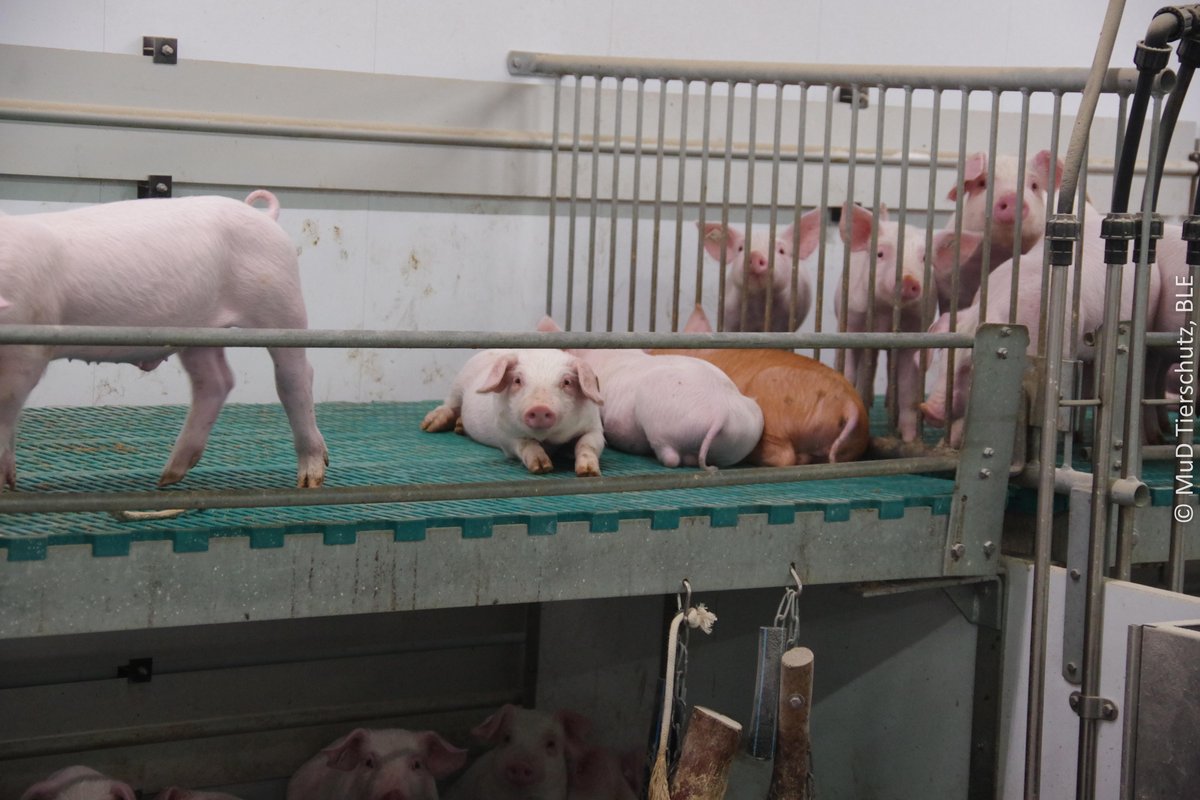
(Image: MuD Tierschutz, BLE)

(Image: MuD Tierschutz, BLE)
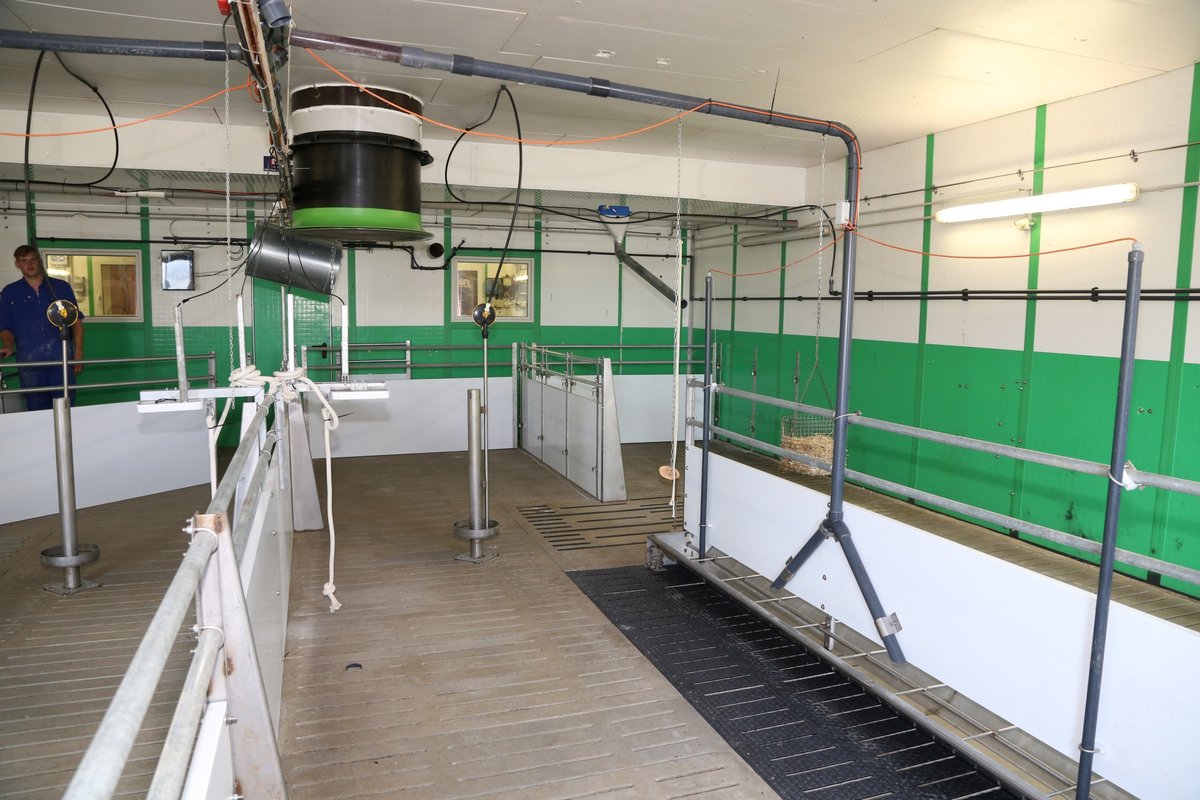
(Image: KoVeSch project, L. Bütfering, LWK NRW)
Floor design
Piglet rearing
In the piglet rearing unit, the lying area should be solid-floored, heatable and sloped at a gradient of 3–4% towards the manure area. A light layer of bedding on the lying area increases comfort and meets the thermal requirements and exploratory instincts of young animals.3 In the second half of the piglet rearing period, due to their growth and feed intake, the animals already prefer cooler lying areas such as concrete floors, which they favour over plastic flooring. Therefore, heat should initially be supplied via a cover or box in the lying area, so that cooler lying options can also be made available to the animals later if required. The covers or boxes can also save energy, as heat is stored in a targeted manner and the room temperature can be lowered.
The manure area is fitted with slatted flooring, the slot width of which must not exceed 14 mm in accordance with the Animal Welfare Regulation (TierSchNutztV), as otherwise there is an increased risk of injury. It is advisable to use flooring with a high perforation rate in the manure area. Suitable options include triangular steel grates or cast iron grates, which ensure good manure passage.7 In the case of cast iron grates and concrete slats, care must be taken to ensure they are deburred, depending on the manufacturing process.
Fattening
In the fattening pen, the recommendations regarding floor design are, in principle, similar to those for piglet rearing. The lying area should be fixed to a solid surface and, ideally, be capable of being heated or cooled.8 Cooling the area is particularly helpful during fattening to allow the rapidly growing animals to dissipate excess body heat.7 However, these are not yet common practice. Apart from coolable lying areas, metal floors are also well suited for dissipating body heat, although these are usually found in the manure area. For the manure area, concrete slats with a slot width of no more than 18 mm (Animal Welfare Regulation), triangular steel bars or cast iron grates have also proven effective in fattening.
Feeding
Ad libitum dry feeding via automatic dry feed dispensers is a viable feeding method in new facilities. A low animal-to-feeding-station ratio, ideally 1:1, is recommended. This can be increased to up to 3:1 if enrichment feed is provided in another part of the pen at the same time. A close animal-to-feeding-station ratio and ad libitum provision, even with enrichment feed, help to minimise stress caused by competitive behaviour.1 With the long troughs that are mainly used, care must be taken to ensure that the feed is evenly distributed in the trough.
As an alternative to dry feeding, wet feeding can also be offered. This places significantly higher demands on management and the cleanliness of feeding areas. In terms of hygiene, trough feeding has advantages over floor feeding.
Further information on feeding can be found in DLG Fact Sheet 463 and in the comprehensive farm management guidelines for pigs – fattening, as well as sows and piglets.
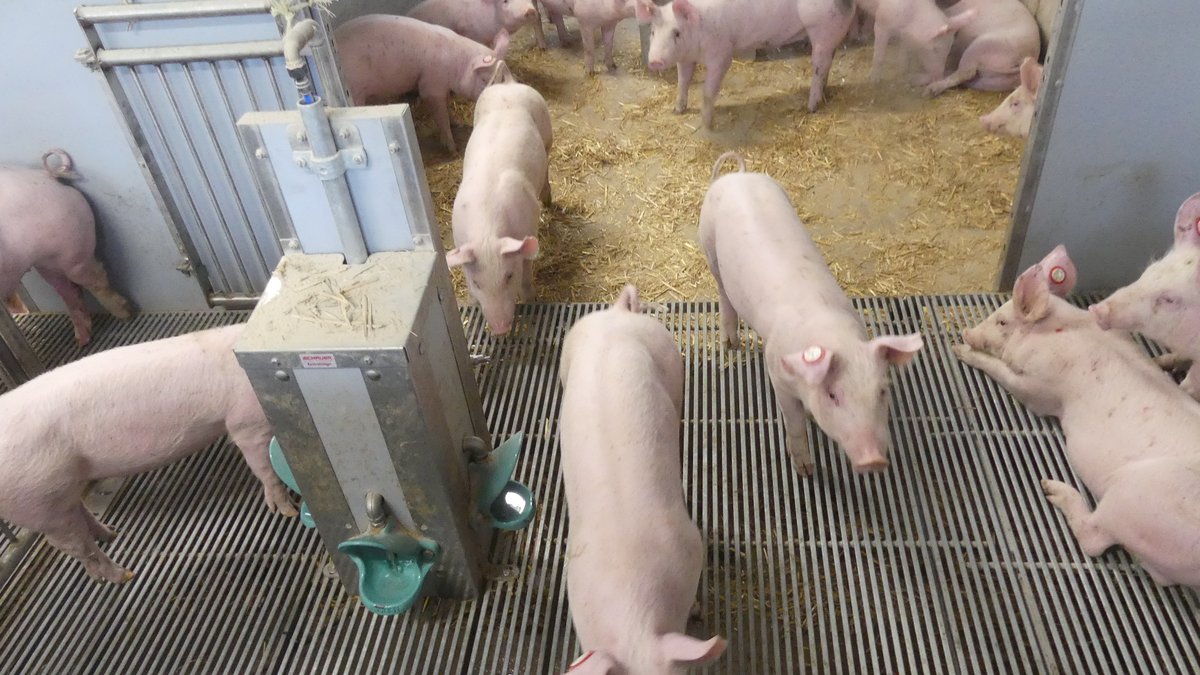
(Image: R. Wiedmann)
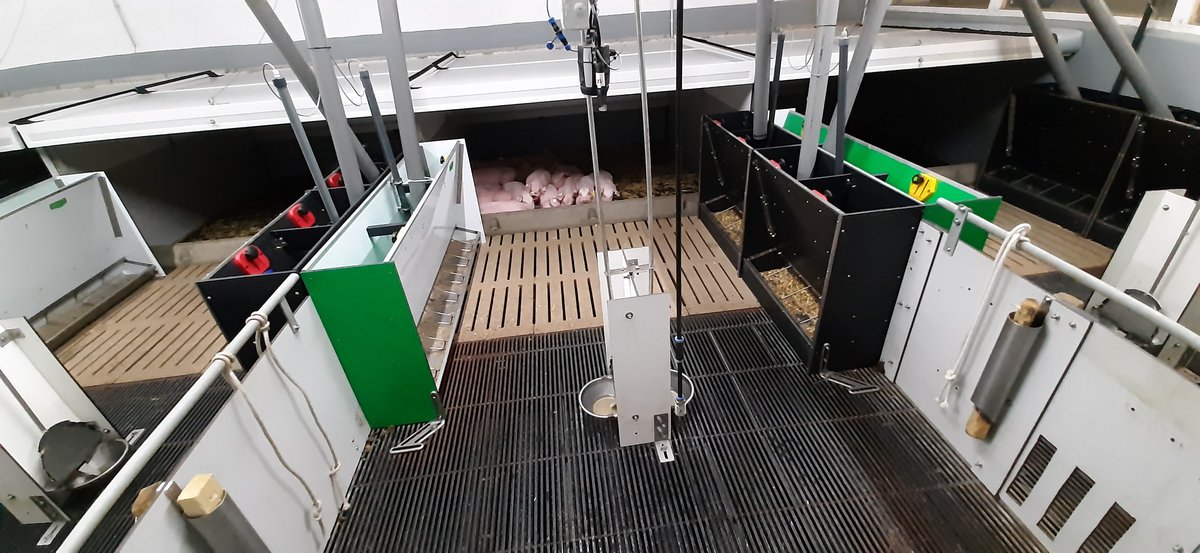
(Image: KoVeSch Project, V. Drexl, CAU)
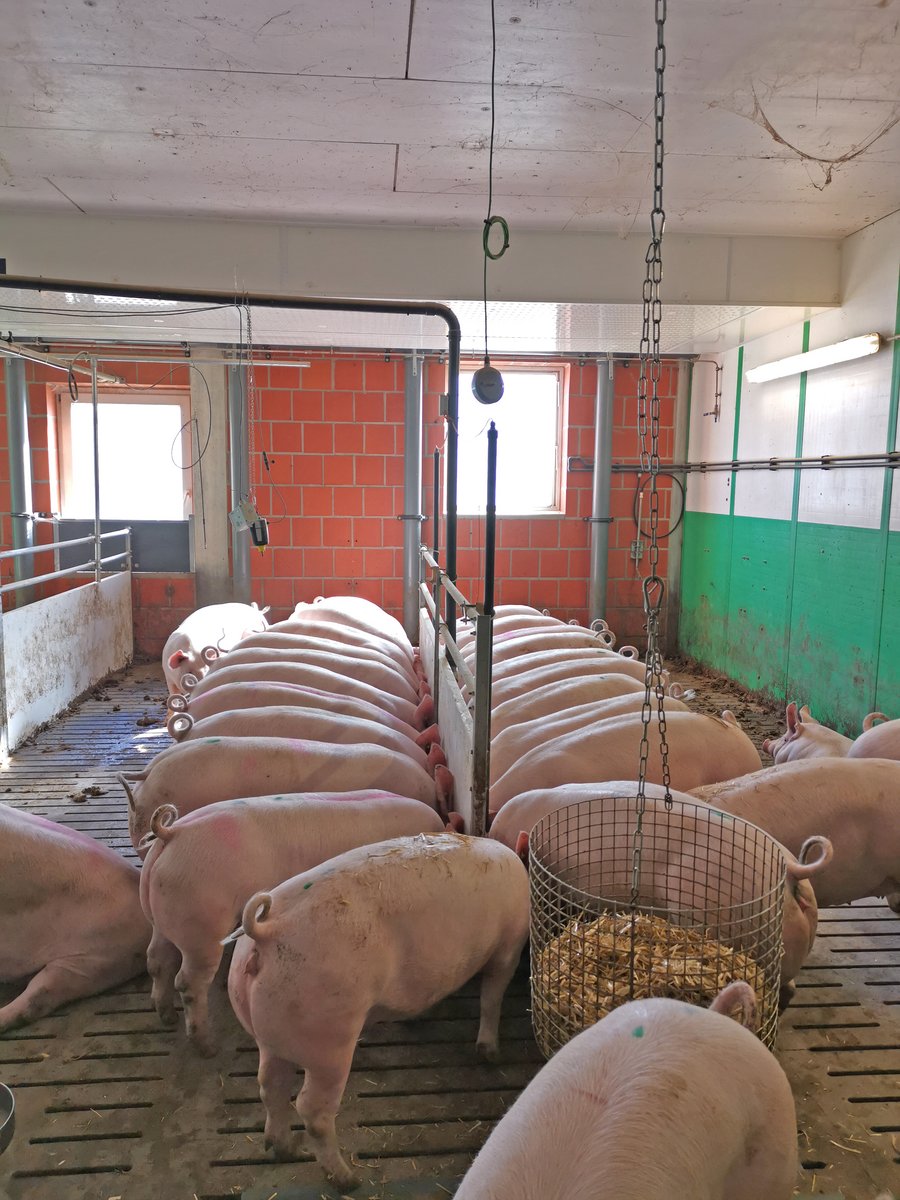
(Image: KoVeSch Project, L. Schönberg, LWK NRW)
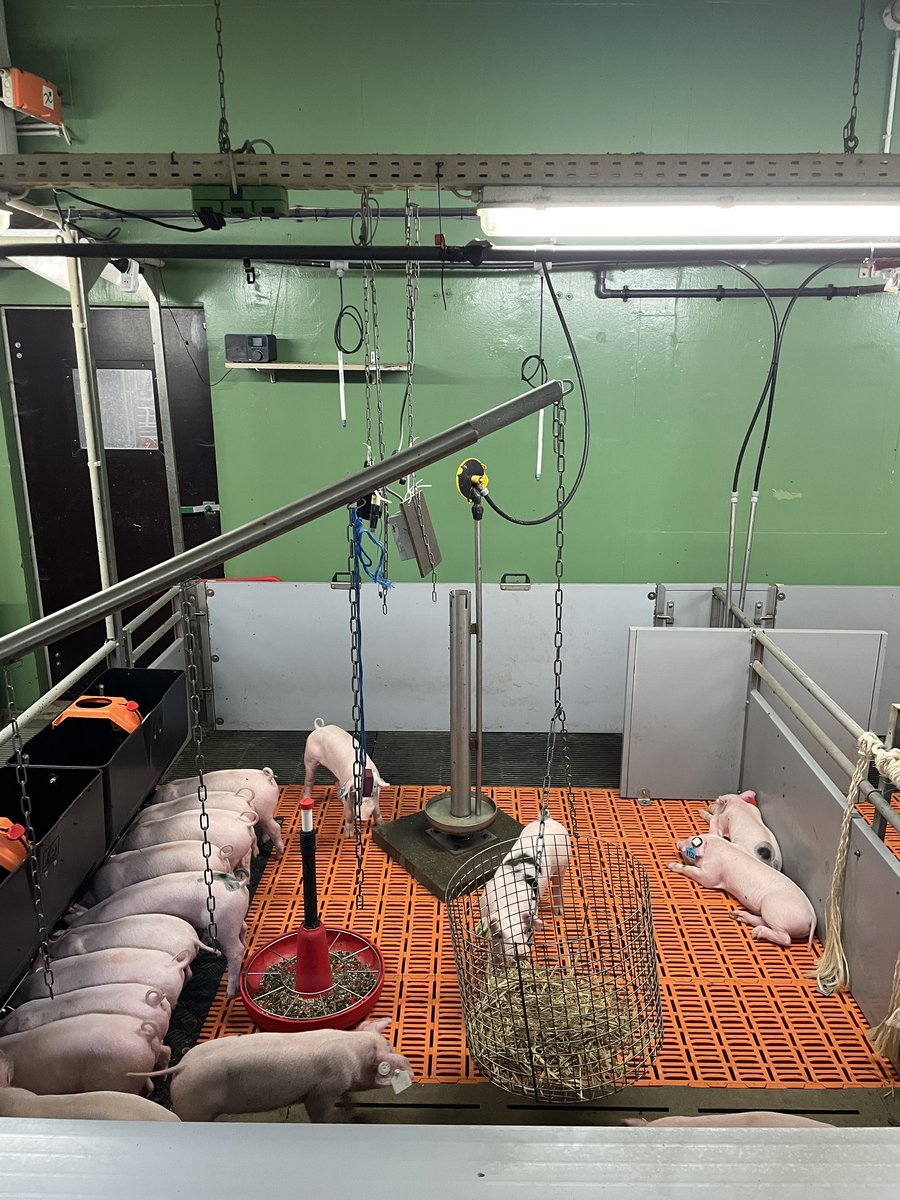
(Image: KoVeSch Project, C. Diekamp, LWK Lower Saxony)
Airflow
Airflow, together with the barn climate, is of great importance when designing pens.7 Pigs are sensitive to draughts and will avoid areas with unfavourable climatic conditions. In both rearing and fattening, it is important that the lying area is free from draughts. This should be checked by fogging, particularly during seasonal changes. If there are draughts in the lying area, these can be reduced, for example, by installing a cover.
Conversely, draughts can even be beneficial for controlling the deposition of faeces and urine in the manure area. It is important that the airflow in the pen is as constant as possible and that each animal can avoid conditions it finds unpleasant.
In fattening operations, particularly during summer conditions, supply air cooling – i.e. the introduction of pre-cooled air into the barn after humidification – is well suited to lowering temperatures in the barn and helping the animals to dissipate heat.3 A proven and energy-saving system is supply air conditioning using, for example, a heat exchanger.
In general, for the warmer months, the installation of cooling facilities, such as micro-wallows, wallows, spray cooling and/or floor cooling, is recommended.1
In open barns, care must be taken to ensure adequate cross-ventilation. The decisive factor is the orientation and airflow of the barns (take the prevailing wind direction into account).
Bedding
In future, bedding will be indispensable in pig farming. Therefore, every new building should be designed in such a way that bedding can be laid in the resting areas/pens and the manure removal system is suitable for this purpose. In open-plan housing, more straw must be allowed for than in closed housing.
Straw bedding on the solid-floored areas of the lying and activity zones in piglet rearing serves primarily as thermal insulation and allows the animals to engage in exploratory behaviour (rooting, scratching).3 The straw is spread in the pens either manually or mechanically. Where straw bedding is combined with slurry channels, the use of an underfloor scraper is necessary.
To provide the animals with sufficient cooling options during fattening, one option is to bed only the lying areas in straw-bedded pens and leave other areas, or part of them, bare.9 This ensures the animals still have sufficient contact surfaces for heat dissipation and limits the amount of straw in the slurry. In summer and towards the end of the fattening period, the amount of bedding should be reduced, as pigs need to release heat even at temperatures as low as 15 °C.7
Care should always be taken to ensure the bedding is of good quality. If it is spread by hand, animal checks can be carried out at the same time. In closed housing, smaller quantities of short-length straw should be used as bedding. Long straw is more suitable as enrichment material, as the animals engage with it more intensively than with short straw.
Temperature
To meet the changing thermal requirements as piglets grow, it is advisable to create different climate zones within the pen during piglet rearing. According to the ‘Pen Structure’ working group, floor temperatures of over 21–22 °C are crucial for lying down. To this end, the working group recommends room temperatures in the resting area or, in the case of outdoor climate-controlled pens, a microclimate of approx. 29 °C at the start of rearing. These temperatures are gradually reduced, as even the high growth rates seen in piglet rearing today can cause heat stress for the animals. If zone heating is installed, the rest of the pen can be kept cooler, ideally at 20–22 °C. This supports the acceptance of the other functional areas.
Pigs cannot sweat and therefore find it difficult to dissipate heat.1 As fattening pigs produce a lot of body heat and have a high need to dissipate heat, lower house temperatures are required for fattening pigs than for piglets. They already have a need to dissipate heat at ambient temperatures as low as 15 °C.7 Further information regarding temperature perception and heat stress in fattening pigs can be found here.