
Image: LLG
Combating ASF – breaking new ground!
Panel discussion on the eve of Central German Pig Day
426 days have passed since the outbreak of African swine fever (ASF) in Germany on 10 September 2020. Since then, there have been over 2,640 confirmed cases in the wild boar populations of the federal states of Brandenburg and Saxony. More than 400 farms with almost 170,000 pigs are affected by the associated restrictions.
Unfortunately, there is no end in sight and new cases are being added every day, although the control measures are showing initial success in the core areas and the wild boar population there has been significantly reduced. Nevertheless, it must be realised that the notifiable animal disease in Germany cannot be controlled in the same way as in Czechia or Belgium due to its widespread introduction from Poland.
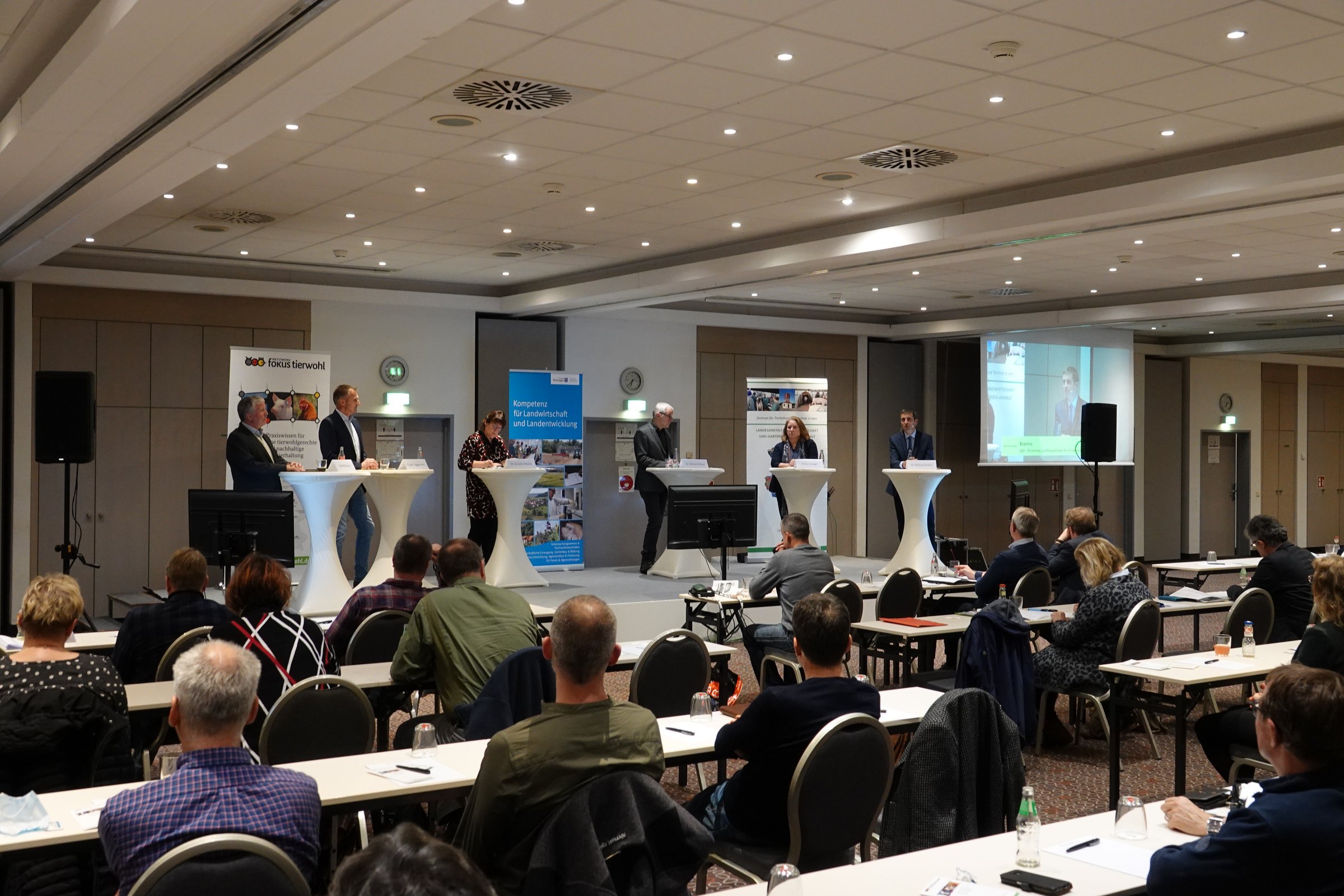
During a panel discussion lasting approximately two hours on the eve of the Central German Pig Day, the focus was therefore on "Problems and prospects for pig farms".
Frank Tiggemann, a pig farmer from the Märkisch Oderland district who is directly affected, and Petra Senger, an official veterinarian from the Veterinary and Food Monitoring Office (VLÜA) in the Oder Spree district who is heavily involved in the fight against the disease, discussed the issue with Dr Michael Richter, advisor for animal disease control (Saxon State Ministry for Social Affairs and Social Cohesion) and Gerold Blunk, head of the animal husbandry department at the Saxon State Office for Environment, Agriculture and Geology, about possible ways out of the crisis. The discussion, moderated by pig farming advisors Dr Simone Müller (Thuringian State Office for the Environment, Agriculture and Geology) and Dr Eckhard Meyer (LfULG), made it clear that in order to alleviate the existential fears of pig farmers in the affected countries, they need active support, as do all those directly involved.
"Our reserves are exhausted, as is our insurance cover, and in addition to the already very poor pig prices, we have to live with considerable additional marketing disadvantages and restrictions, with no hope that this will change in the short term," said Frank Tiggemann. In this situation, the inadequate response of political leaders is an additional burden. A lack of legal basis and problems with jurisdiction are the most common reasons given for insufficiently vigorous and effective action. In view of the national significance of ASF, this is no longer acceptable.
Effective design of control measures
Control measures are now underway, organised and coordinated by the animal disease control centres of the affected federal states and the VLÜA in the districts, in close cooperation with hunters, associations, the German Armed Forces and the THW, but with regional differences. The speed of the control measures, which has been criticised in some quarters, and their chances of success depend on local conditions. The construction of fences, which was still suboptimal at the beginning of the year, is now working better. "Unfortunately, before the ASF outbreak in Poland, there was no legal basis for erecting permanent fences as an effective preventive measure," stated Petra Senger and Dr Michael Richter. The breaches that occurred in Lusatia and other locations could have been avoided under different circumstances.
What matters now is to establish a wild boar-free corridor to Poland and to work together to ensure that this animal disease, which is harmless to humans, does not spread further north, south or west. "I am optimistic that it is possible to combat this animal disease with the aim of eradicating it," Petra Senger concluded. "To do this, the federal states of Brandenburg and Saxony need the support of the federal government and also of the other federal states that have not yet been directly affected." Central coordination and hunting as a sovereign task were suggested for consideration. "It is right to examine new ideas regarding control and removal strategies for their legal feasibility, depending on the situation," said Gerold Blunk. Unfortunately, the current state of vaccine development is not yet sufficient to effectively combat ASF in wild boars. "We need an oral vaccine that quickly produces antibodies against the ASF virus, which unfortunately is not very immunogenic. Although several pharmaceutical companies around the world are working on this, even in the long term it is not yet possible to make a reliable prediction as to when this might be," explained Dr Michael Richter.
New approaches and concepts in marketing required
In order to remain operational despite the restrictions for pig farmers based on the EU Implementing Regulation EU-VO 2021/605, the responsibility of the industry was discussed in the last third of the discussion. "Despite participation in the ASF status programmes and high biosecurity on farms, the movement of piglets or slaughter pigs is only possible at a very slow pace," described Frank Tiggemann. There is an urgent need for better communication between the authorities and countries to help eliminate existing resentment. ASF is of immediate relevance to Germany, as evidenced by the import bans imposed by third countries such as China. The regionalisation that has taken place so far allows pork exports from regions not yet affected to the EU, but this does not help the livestock farmers directly affected. The number of affected farms could grow every day. Therefore, new approaches and concepts for transport and marketing are urgently needed. This is particularly important in order to prevent animal welfare problems.
The European Union's classification of ASF as a Category A, D and E disease (EU-DUV 2018/1882) requires not only immediate eradication measures to be taken, but also measures to prevent its spread. The existing legal hurdles to federal participation in these measures should be urgently reviewed, as demanded by several professional federal, state and regional associations. The epidemiological situation caused by ASF has national implications in Germany.
Authors:
Dr Simone Müller, Thuringian State Office for Agriculture and Rural Areas
Dr Eckhard Meyer, Saxony-Anhalt State Office for Agriculture and Horticulture