
Thermoregulation in cattle under environmental stress
Thermoregulation – that is, the adjustment of body temperature in response to ambient temperature – operates within certain limits and can be severely challenged by weather-related stress. The following section explains the basics and mechanisms of thermoregulation in cattle.
Temperature zones and thermoregulatory capacity
Cattle attempt to maintain a constant core body temperature. According to Dirksen et al. (2006), the normal core body temperature in adult animals is between 38–39 °C, in calves between 38.5–39.5 °C and in young cattle between 38.0–39.5 °C. In response to weather-related stress, behavioural changes occur first, followed by physiological adaptation (Sporkmann et al., 2016). Adaptability changes with the age of the animal (Bianca, 1977). The overview also shows that adult cattle are more tolerant of cold than of heat (Bianca, 1976).
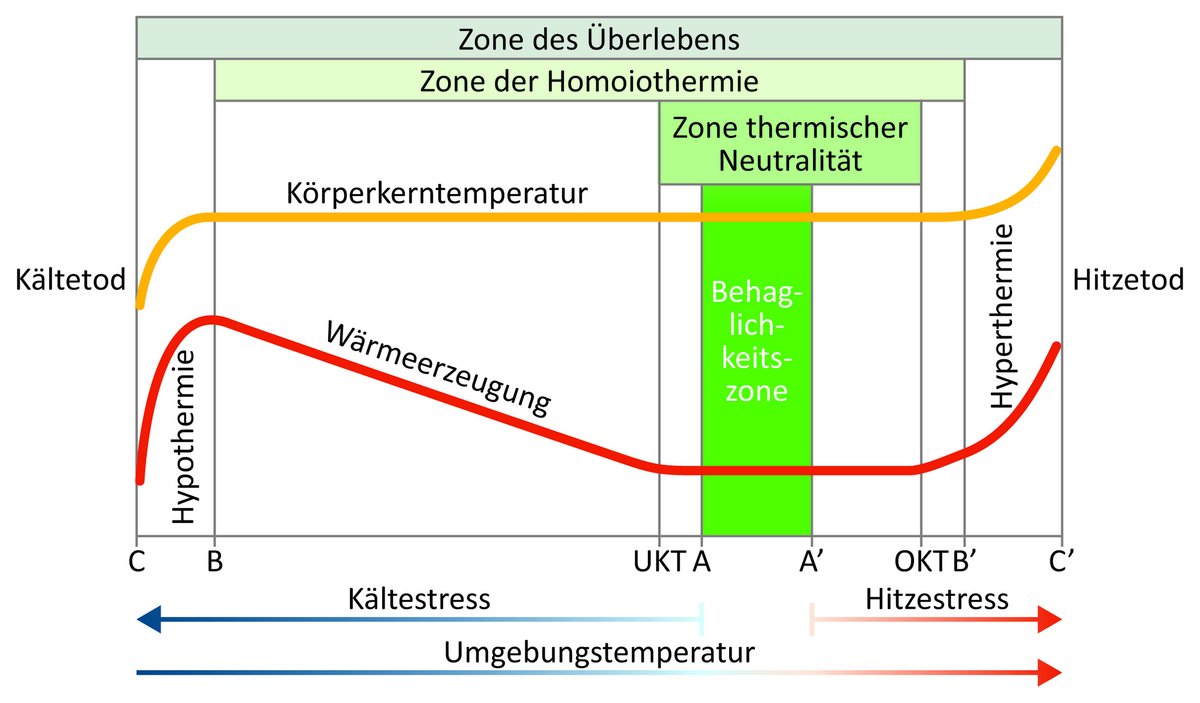
According to Bianca (1968), the thermoneutral zone – the range within which the animal does not need to expend additional energy to regulate its body temperature – lies between 0°C and 16°C for cattle.
If the limits B and B’ are exceeded or fallen short of, the animals can no longer maintain their body temperature within the physiological range and their lives are at risk (Sporkmann et al., 2016).
Calves whose mothers care very well for their offspring (early licking dry, presenting the udder, physical closeness, providing shade, etc.) have a higher tolerance to adverse weather conditions than those left to fend for themselves. The thermoneutral zone for milk-fed calves is described as between +15 °C and +25 °C at a humidity of 50% to 60%. For older calves, which already have a functioning rumen and are therefore able to ruminate, the thermoneutral range is assumed to be between +5 °C and +15 °C (Berkemeier, 2021 in Elite Magazin; Hufelschulte, 2020 in topagrar).
Brown-Brandl (2005) state that the core body temperature of suckler cows lags behind the ambient temperature by one to five hours. Mader et al. (2005) report a time of 1.0 to 3.5 hours for beef cattle for their core body temperature to return to normal following an increase.
In practical terms, this means that adaptive responses take time. If there is uncertainty as to whether the animals are suffering from heat stress, an assessment (measured internationally using the Panting Score) should be carried out based on panting, increased respiratory rate, salivation or core body temperature.
Curtis et al. (2017) found that the correlations between cattle’s daily dry matter intake and ambient temperature data for the same day were not significant. Instead, the authors observed a three- to five-day time lag in the response of daily dry matter intake to heat stress. This constitutes a delayed adaptive response.
Limit of adaptability
- “At a core body temperature of between 40.5 °C and 41.7 °C, most cattle breeds experience a complete cessation of bodily functions; this threshold is referred to as the lethal temperature.” (Fischer et al., 2014)
- If the heat tolerance threshold is exceeded, there is a risk of dehydration, central nervous system symptoms caused by cerebral oedema, and death as a result of respiratory centre paralysis or circulatory failure. Rectal temperature 40–43.5 °C (Dirksen et al., 2006)
(adapted from FAT Report No. 620)
(adapted from FAT Report No. 620)
Heat transfer (conduction, convection, radiation)
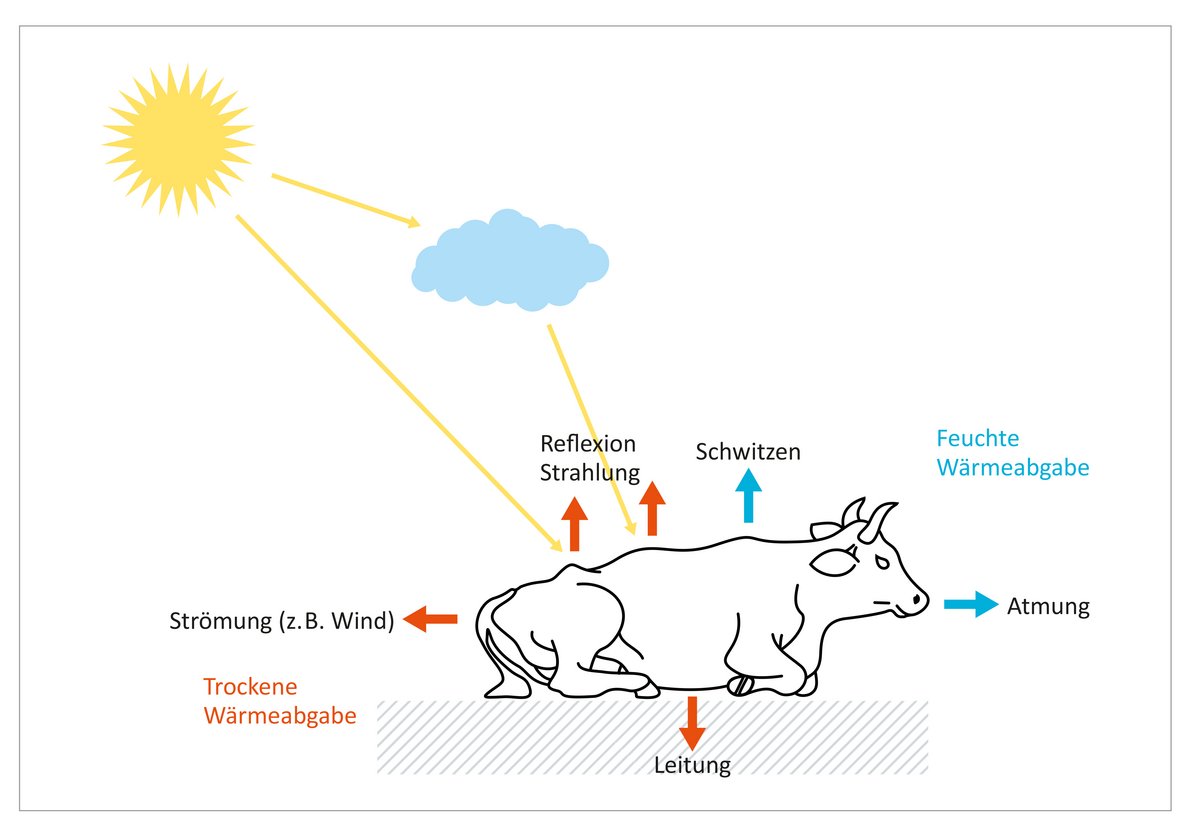
There are various ways in which heat is exchanged:
- Heat conduction: Heat flows towards the medium with the lower temperature (e.g. water, air, ground)
- Heat flow or convection: Heat is carried away by a flowing medium (e.g. wind)
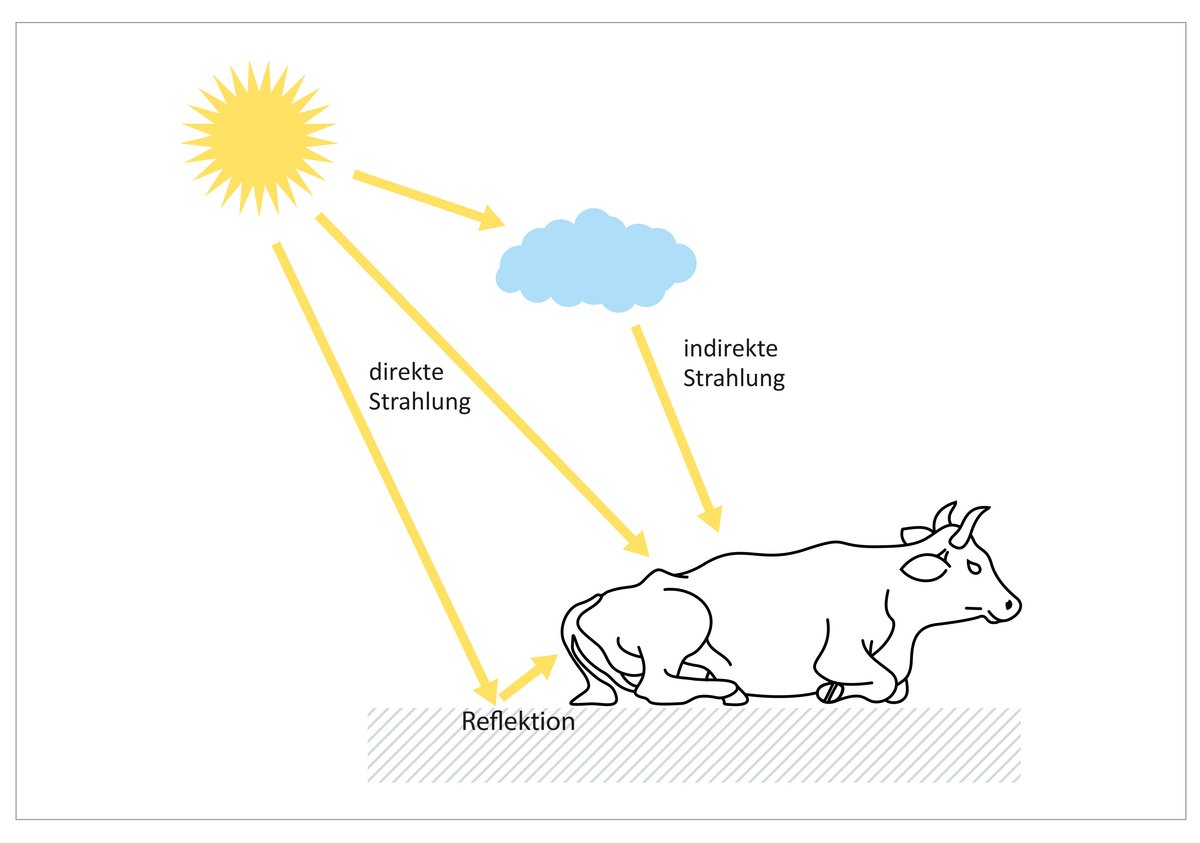
- Radiation: Heat is transferred via electromagnetic waves (e.g. sunlight)