

- Prof. Dr. Axel Wehrend, Veterinary Clinic for Reproductive Medicine and Neonatology, Justus Liebig University Giessen
- Prof. Dr. Johannes Kauffold, Clinic for Ungulates, University of Leipzig
- Peggy Käferle, Thüringer Landgesellschaft mbH
- Julia Maischak-Dyck, Landesbetrieb Landwirtschaft Hessen
- Lukas Trzebiatowski, Department of Veterinary Reproductive Medicine and Neonatology at Justus Liebig University Giessen
Introduction
Effective monitoring of cows due to calve is essential for identifying calving complications in good time and ensuring that the calf receives its first intake of colostrum and that the cow is properly cared for afterwards. Technical aids for calving monitoring can reduce the need for staff to be present or for regular rounds. The cows are not disturbed unnecessarily during this sensitive phase, and the workload involved in monitoring is reduced.
Reliable notification of births, combined with fewer disturbances in the calving area, can have a positive effect on the course of the birth and the subsequent postpartum phase.
To achieve this, a system suitable for the farm and reliable notification of impending births by the devices without false alarms are desirable. Among the systems currently available, a distinction can be made between those specifically designed for use in animals for birth detection and those that issue a birth alert in addition to monitoring other parameters. Consequently, the systems currently available on the market show significant differences in terms of their reliability in correctly detecting births. A good sensor reliably signals an impending birth without triggering false alarms. To classify the quality of a system, a distinction is made between sensitivity and specificity. Sensitivity indicates how many of the births that have taken place were correctly detected. Specificity indicates how many of the cows that were not in labour were correctly identified, and thus no false alarm was triggered. A major difference lies in the timing of the alert and thus in the interval before the onset of the expulsion phase. The closer the alarm is set to trigger relative to the birth, the higher the error rate becomes. Exceptions to this are sensors that only emit a signal once the expulsion phase has begun. The choice of the right sensor must therefore be made on a farm-by-farm basis.
Camera
The camera provides a direct view into the calving pen. It offers a visual representation of the overall situation; however, direct observation remains essential. Internet-enabled cameras allow the feed to be streamed to mobile devices (mobile phones, laptops, etc.), thereby offering greater flexibility in terms of location. Using a camera can save a considerable amount of time, as it eliminates the need to travel to the calving pen. Automatic alarm functions are not yet ready for practical use. Several cameras may be required to view the entire calving area. The camera system must be suitable for use in barn conditions (dust, humidity, etc.). The camera position and lighting conditions (possibly an infrared camera for night-time viewing) must be taken into account.
Birth monitor for vaginal use
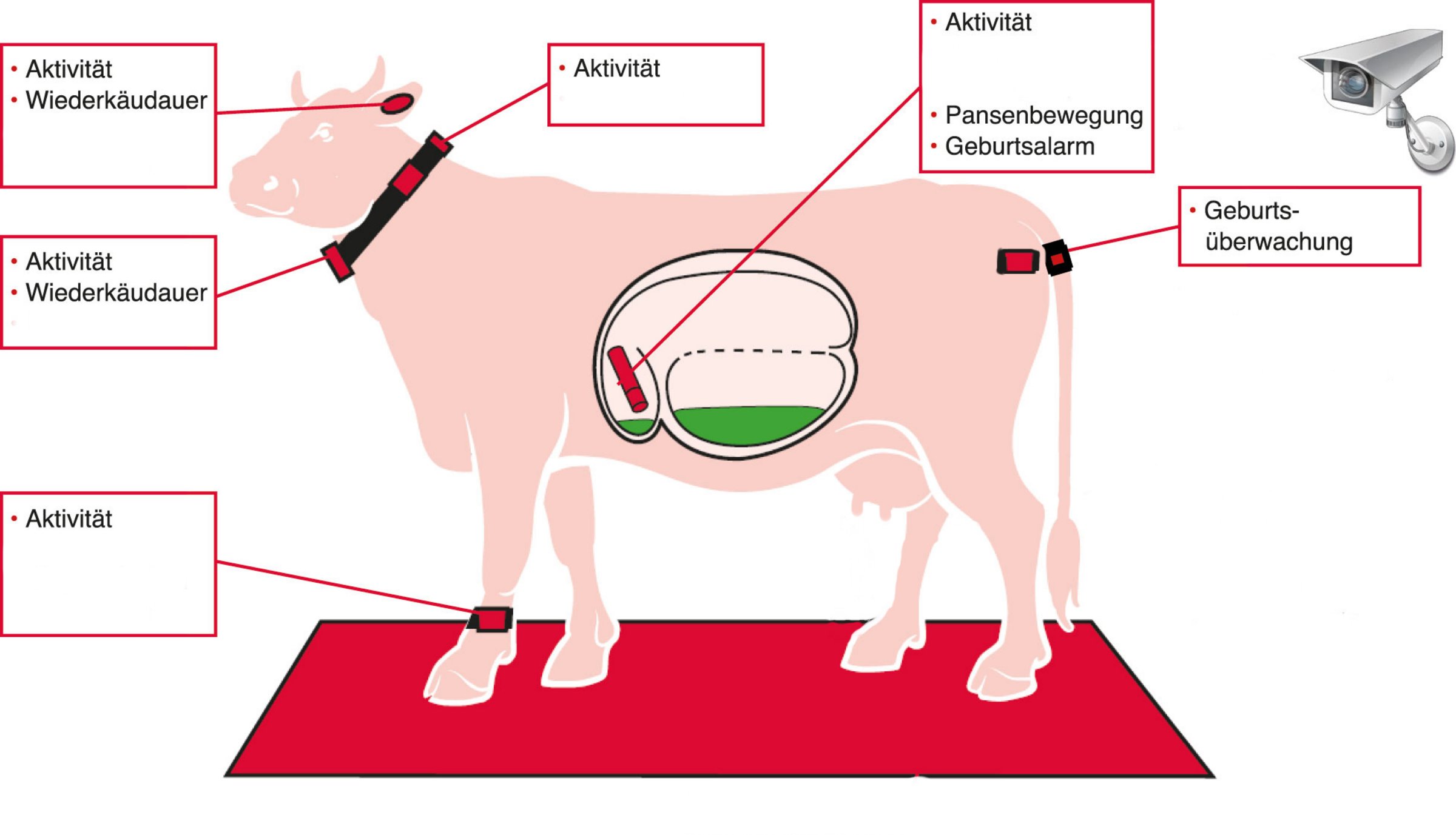
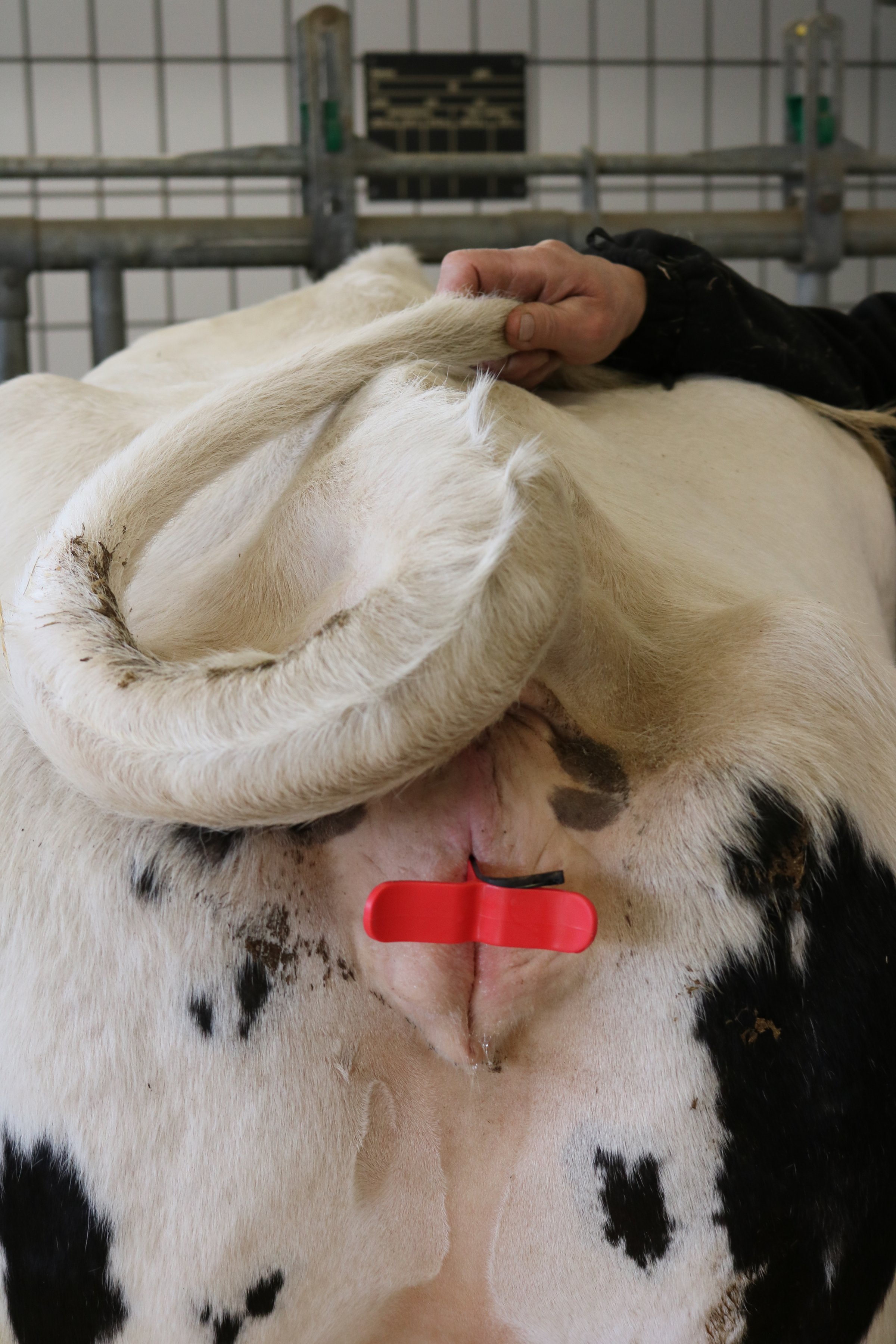
A sensor is inserted into the cow’s vagina prior to the calculated calving date. The exact timing varies according to the manufacturer’s instructions and can range from approximately two weeks to a few days before birth. The sensor measures either temperature or temperature and light exposure. If the sensor emerges from the vagina during the birth process, the drop in temperature or the drop in temperature and light exposure is recorded. This triggers a notification. Depending on the manufacturer, this can result in a high number of false alarms, e.g. due to the sensor falling out without labour having started.
Birth notifier: base of the tail
The birth detector at the base of the tail reacts when the tail is raised. During the dilation phase of birth, and often in the days leading up to it, this occurs even independently of defecation. Due to significant individual differences in behaviour, false positive alerts may occur even days before birth. Devices for this measurement can either be fixed at the base of the tail or attached to the base of the tail using a chest and belly harness. In this case, correct positioning must be carefully checked and regularly monitored to ensure that blood circulation to the tail is not impeded and that the devices do not fall off. If the fit is too tight, it can lead to the lower half of the tail becoming necrotic within a short time.
Rumen bolus
Depending on the manufacturer, a rumen bolus measures various parameters such as activity, rumination, temperature or rumen pH. To monitor calving, one of the indicators used is the drop in body temperature that occurs around 24 hours before calving. The bolus is administered to the cow using a bolus inserter and then remains in the reticulum for the rest of the animal’s life.
physical activity
Movement activity can be monitored using pedometers, collars, ear tags or rumen boluses. Changes in walking and lying behaviour in the period leading up to calving trigger an alarm, which may indicate that calving is imminent. The advantage here lies in the ease of use and the secure positioning of the sensors. However, activity measurement as an indicator of calving is less reliable than other systems.

Comparison of different foetal monitoring systems
| System | Handling | Hygiene requirements | Follow-up costs | Workload | Technical requirements |
| Camera |
|
|
|
|
|
| Birth detector (vagina) |
|
|
|
|
|
| Birth notifier at the base of the tail |
|
|
|
|
|
| Rumen bolus |
|
|
|
|
|
| Physical activity |
|
|
|
|
|
| Ruminant activity |
|
|
|
|
|
Bibliography
-
Immler, M. et al. Maternal Impact on Serum Immunoglobulin and Total Protein Concentration in Dairy Calves. Animals 2022, 12, 755.
-
Crociati, M. et al. How to Predict Parturition in Cattle? A Literature Review of Automatic Devices and Technologies for Remote Monitoring and Calving Prediction. Animals 2022, 12, 405.
-
Hoy, S. Predicting the onset of calving by measuring rumination duration. Prakt. Tierarzt 96 (2015) pp. 164–172
-
Birth detector for cattle from Ireland tested at Haus Riswick (North Rhine-Westphalia Chamber of Agriculture)