
- Prof. Dr. Wolfgang Büscher, University of Bonn
- Dr. Katharina Dahlhoff, Haus Düsse Research and Training Centre
- Dr. Adriana Förschner, Baden-Württemberg Agricultural Centre
- Dr. Jernej Poteko, Bavarian State Institute for Agriculture
- Prof. Dr. Ralf Waßmuth, Osnabrück University of Applied Sciences
- Dr Rebecca Simon, Landesbetrieb Landwirtschaft Hessen
- Saskia Markmann, Landesbetrieb Landwirtschaft Hessen
- Leonie Schnecker, Landesbetrieb Landwirtschaft Hessen
- Dr. Paul Vogel, Noerr Partnerschaftsgesellschaft mbB
The livestock sector faces major challenges. Digitalisation offers the potential to support and relieve the burden on farmers as they work towards an animal-welfare-friendly, labour-efficient and resource-conserving agricultural sector. Digital technology should not, and cannot, replace people; rather, it should serve as a tool to aid decision-making and implementation, as well as making their work easier.
Conclusion
Every farm manager must decide for themselves whether and how to use digital systems on their own farm. It is important to be willing to engage with the technology, to put it into practice and to make adjustments tailored to the specific needs of the farm. Like a new member of staff, the new system first needs time to settle in. Once it has, digital technology can be a very valuable aid, but it should never and cannot replace people and their responsibilities.
The current state of digitalisation in cattle farming (Germany)
Alongside the structural changes in the agricultural sector (Table 1) over the past century, technological advancements have also taken place. As part of this, digitalisation in agriculture in general, and in cattle farming in particular, has gained momentum in recent years. A significant step in this regard was the introduction of automatic milking systems (AMS), first presented in 1989 and installed in a dairy barn for the first time in 1992.
| Around the turn of the 20th century | Around the turn of the 21st century | |
|---|---|---|
| Number of farms in Germany | 5.6 million | approx. 458,400 (downward trend) |
| Cattle population (head) | 18.9 million | 14.5 million (downward trend) |
| Average number of cattle per farm | 4 | 65 (upward trend) |
| Average land area per farm (hectares) | approx. 4.6 ha per farm | approx. 62 ha per farm (upward trend) |
| Proportion of the workforce employed in agriculture and forestry in Germany | 38% | 1.4% (trending down) |
| Number of people supported per farmer | approx. 4 | approx. 127 (upward trend) |
Table 1: Agriculture in transition – Agricultural holdings have become significantly larger and support significantly more people; however, due to the greater efficiency of processes and the increasing level of automation, fewer workers are required to achieve this. (DBV 2025; BZL 2024; BMEL 2022, Deter 2016).
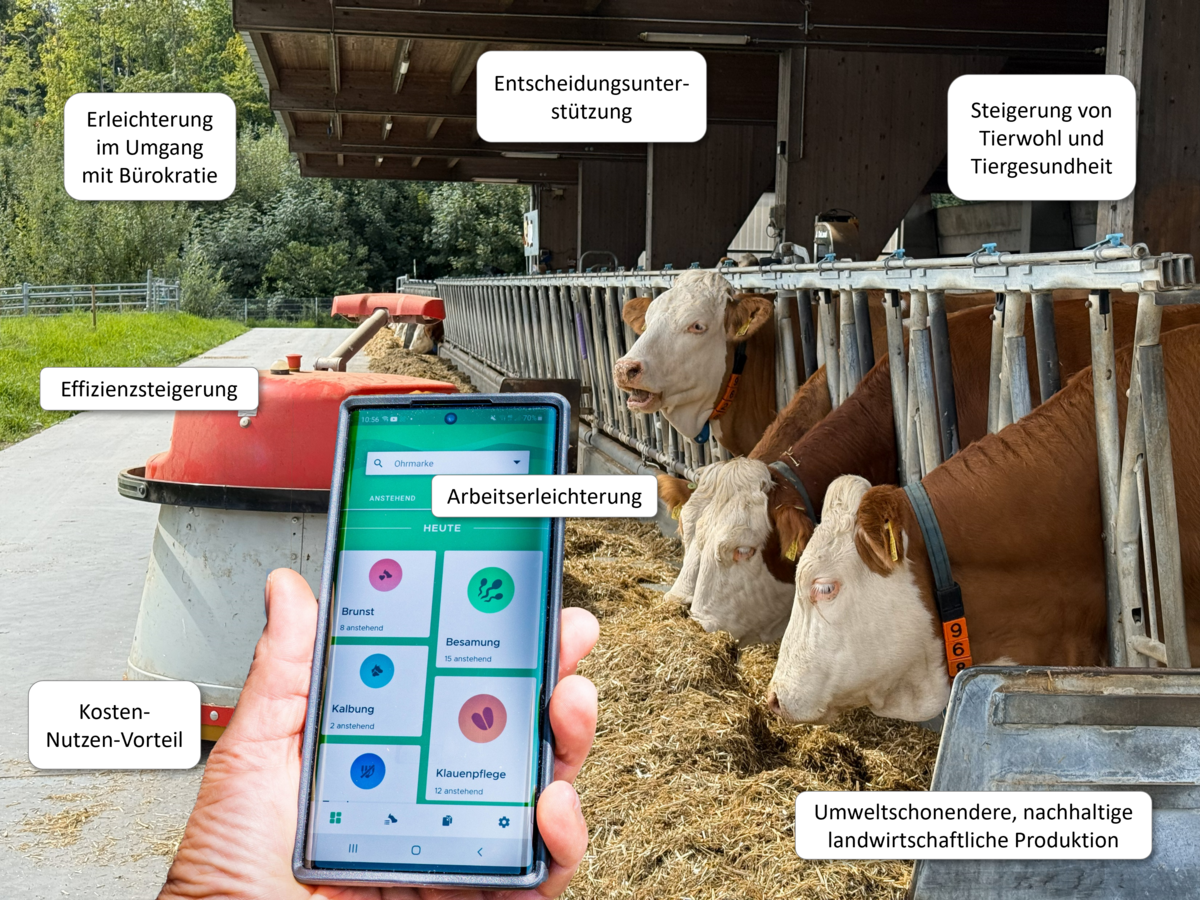
Since then, there has also been talk of a revolution in agriculture driven by digitalisation.
Agriculture 4.0 (the digitalisation of agricultural production processes) is characterised by the use of advanced technologies such as artificial intelligence (AI), cloud computing and robotics, combined with the potential to transform the sector into digital agriculture (smart farming) (Schukat et al. 2019). Expectations regarding digital technology are diverse (Fig. 1).
According to a survey from 2024, 90% of agricultural holdings were already using digital technologies – the larger the holding, the more frequently they were used. AI-based systems were already in use on just under one in ten holdings (9%), whilst around 40% of holdings were considering their use in the future (Bitkom 2024).
In 2025, the Federal Ministry of Agriculture, Food and Rural Affairs also published the results of a large-scale survey on digitalisation on agricultural holdings. In addition to frequency of use, the survey also examined the benefits and barriers to digitalisation, as well as the information channels utilised.
There is currently no nationwide survey on the use of digital technology in cattle farms. It can be assumed that there are significant differences depending on the specific sector within the cattle farming industry.
Such a survey does exist, for example, for the state of Bavaria.
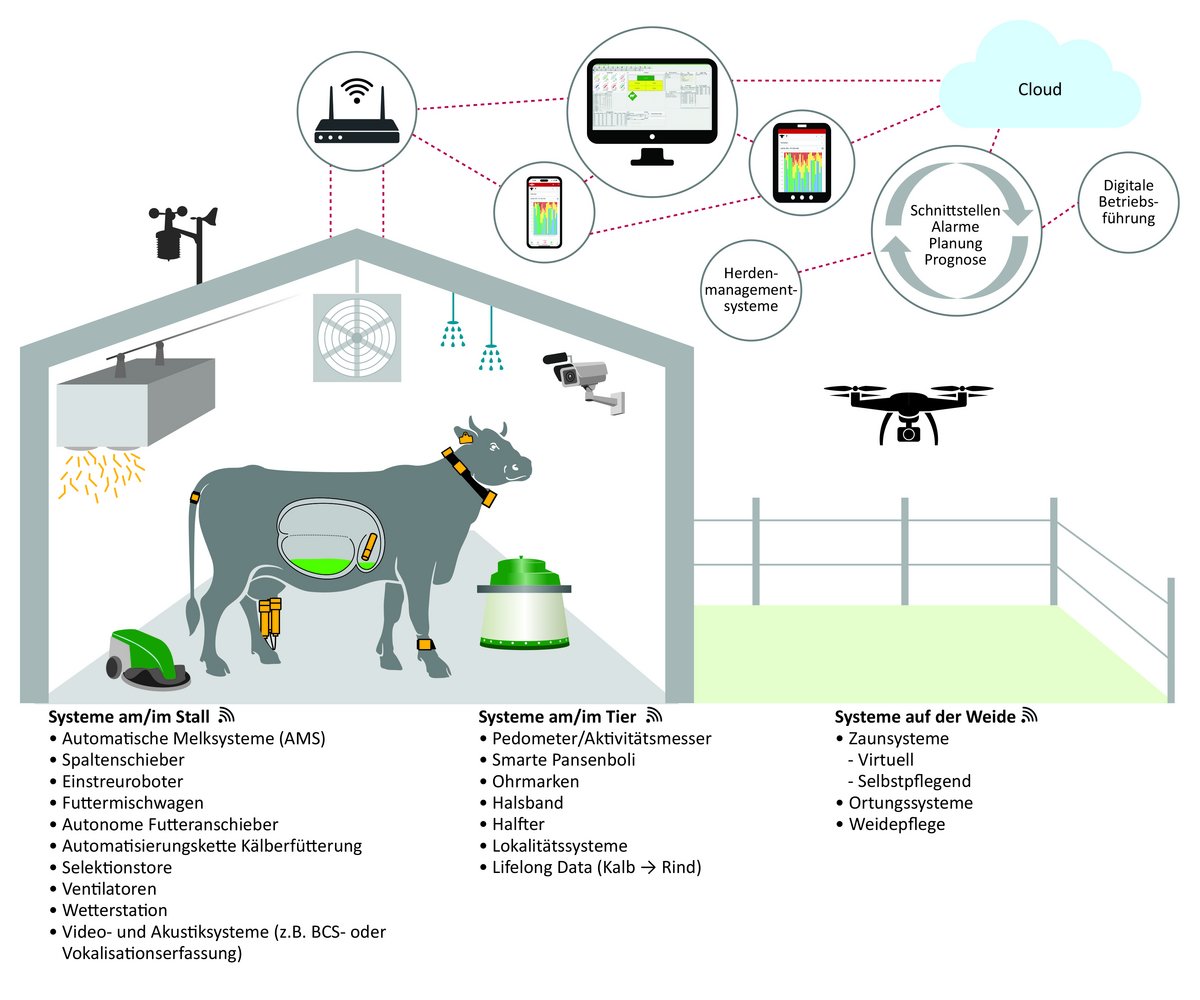
A wide range of digital applications from various manufacturers is now available on the market (Fig. 2). The choice of system must be tailored to the individual farm, taking into account operational requirements, farm size and expectations of the systems. Digital technologies collect a vast amount of data (big data) which, when securely stored, correctly analysed and used effectively, provides valuable support for farm management, such as daily animal checks. Other systems take over routine, repetitive tasks, allowing staff to use the time saved to focus on other tasks, such as more intensive animal monitoring.

There are obstacles to implementation in various areas. Firstly, the digitalisation of a farm initially involves high upfront costs, even though it can help to reduce costs in the long term. Secondly, the public digital infrastructure needs to be further expanded, particularly in rural areas. This includes, for example, network coverage to ensure the smooth operation of systems in outdoor areas (e.g. in pastures) that rely on mobile data – this is set to be available nationwide in Germany by 2030.
Another critical issue is the currently still inadequate interconnectivity of systems (machine-to-machine communication, M2M = automatic real-time exchange of information between end devices), particularly between different manufacturers (interoperability). The human factor should not be overlooked either. As with other innovations, there is initially a degree of uncertainty and a limited pool of personal or sector-specific experience, which hinders widespread implementation across agricultural holdings.
In conclusion, it can be stated that the introduction and advancement of digitalisation are bringing about many changes – ranging from job profiles and the demands placed on employees, through to work processes, and ultimately extending to training and further education.
Opportunities and risks
Digitalisation offers potential for optimising cattle farming in various areas, such as improving efficiency, conserving resources and animal health (Table 2). At the same time, however, there are also risks – for example, regarding costs, data protection and operational security – which need to be minimised (Table 2). A vast majority of farms (79%) consider the opportunities presented by digitalisation to outweigh the risks (Bitkom Research 2024).
| Opportunities | Risks |
|---|---|
Process automation (feed provision, milking, monitoring of environmental data...) | Additional costs for technology and skilled labour |
Early detection of health problems (continuous monitoring of vital signs) | Occurrence of technical problems
|
| Comprehensive data collection and analysis | Dependence on external providers |
| Interfaces for reporting requirements | Data security |
| Flexibility (e.g. working hours) | Applicability (human factor and digital infrastructure factor) |
| Monitoring of various parameters, e.g. feeding and metabolism | Lack of compatibility between different systems |
| Herd and fertility management | |
| Support for animal observation and monitoring, as well as on-farm self-monitoring | |
| Attractiveness of the workplace and the profession as a whole (reduction in physical labour) | |
| Resource savings |
Table 2: Opportunities and risks associated with the use of digital technologies and processes in livestock farms.
Overview of the systems
Systems available on the market (Table 3) enable the digital monitoring of cattle through data collection throughout their entire lifespan.
| Areas of application | Selected examples |
|---|---|
| Digital office | Digital accounting |
| Digital time recording | |
| Digital tools for carbon footprint calculation | |
| Tracking (in the barn or out in the pasture) | GPS-based systems for outdoor use |
| Drones | |
| Floor cleaning | Scraper robots |
| Collection robots | |
| Spreading systems | Mobile or stationary |
| Milking systems | Automatic milking systems (AMS) |
| Fencing systems | Virtual fences |
| Automatic feeders / smart feeding systems | On-demand feeding |
| Automatic water dispensers | |
| Ration planning | |
| Feed mixers | |
| Automatic feeding systems, e.g. rail-free feeding robots | |
| Barn climate | Fans |
| Curtains and duct ventilation | |
| Barn cooling, ventilation and misting systems | |
| Individual animal sensor technology | Acceleration sensor |
| Rumen bolus | |
| Pedometer | |
| Birth monitoring | |
| Farm management system | Integrated process control for networking different systems |
| Herd management systems | Cow planner |
| Energy management systems | PV systems |
| Manure management | Field rotation records |
| Fertiliser portal |
Table 3: Selection of digital technologies and methods in cattle farms. Note: Not all of the systems shown are already available for practical use.
Further information:
DLG Fact Sheet 466:Digital applications for herd management in dairy farming
DLG Fact Sheet 398: Automatic feeding systems for cattle
Digitalisation also plays a major role in downstream processes. This includes, amongst other things, the digital recording and evaluation of product quality. This data can be utilised in practice through feedback loops. For the dairy sector, the German Dairy Industry Association (Verband der Deutschen Milchwirtschaft e. V.) has designed a digital map to illustrate existing digital connections and potential.
Legal Overview
As a result of the use of digital technology, vast amounts of data are collected, stored and processed. A question that frequently arises in this context is that of ownership rights to one’s own data or to data collected within one’s own business.
Until now, it was considered that no comprehensive right to the data existed, as it does not constitute physical objects protected by property law under the German Civil Code (BGB). This has changed with the introduction of the EU Data Act. Since its entry into force, users have been entitled to access data in the generation of which they were involved. Once users have actively claimed this right, the data must be provided in a machine-readable format. However, the obligation to provide data applies only to data in its raw form, not to processed data or algorithms.
Road safety and access control when using robots on agricultural premises
Agricultural robots often move autonomously within specific areas of the farm, such as in farmyards, along paths between barns and feed stores, or inside the barns themselves. To prevent accidents involving uninvolved third parties – particularly children or people from outside the farm – the farmer is obliged to secure these operational areas against unauthorised access.
A typical example is a feeding robot that automatically drives over the feed table several times a day. Even if the robot is equipped with a shut-off sensor that activates when a minimum distance is not maintained, it should be ensured that, as far as possible, no unauthorised persons are present in the operating area whilst the robot is in motion. Children, visitors or external service providers in particular must be protected by appropriate measures.
This can be achieved through barriers, access restrictions, warning signs or automatic access controls. Particular caution is required in areas open to the public or near residential buildings.
A lack of or insufficient protection against unauthorised access can not only lead to accidents but also have consequences under liability and insurance law. It is therefore recommended to clearly define the robot’s operating area, mark potential danger zones and implement organisational and structural measures to protect third parties.
It must also be ensured that the company’s own employees are adequately instructed on the hazards posed by the robots.
Training and further education
Automation and digitalisation have not only transformed production processes in dairy farming, but also the wide-ranging demands placed on the professionals involved, who work with digital assistance both now and in the future. Despite all the benefits that digitalisation can bring to day-to-day farm operations, it quickly becomes apparent in daily use that working with such systems is highly complex and requires users to have extensive knowledge and, in many cases, to adapt their own routines. Digital know-how and a high level of digital and data literacy are therefore essential key skills, particularly for the farmers of tomorrow. To learn how to use the diverse range of technologies properly from the ground up, the topic of digitalisation should be given high priority during training and later as part of continuing professional development.
The training and further education of agricultural professionals therefore requires new approaches to promote key competencies such as digital and data-based practical skills. In addition to system-specific user training, overarching and manufacturer-independent formats, e.g. at chambers of agriculture and agricultural authorities, also play an important role. Here, various topics should be covered, ranging from the functional scope of the systems and the necessary installation requirements to economic evaluation (investment viability).
CattleHub – Guide to Assistance Systems
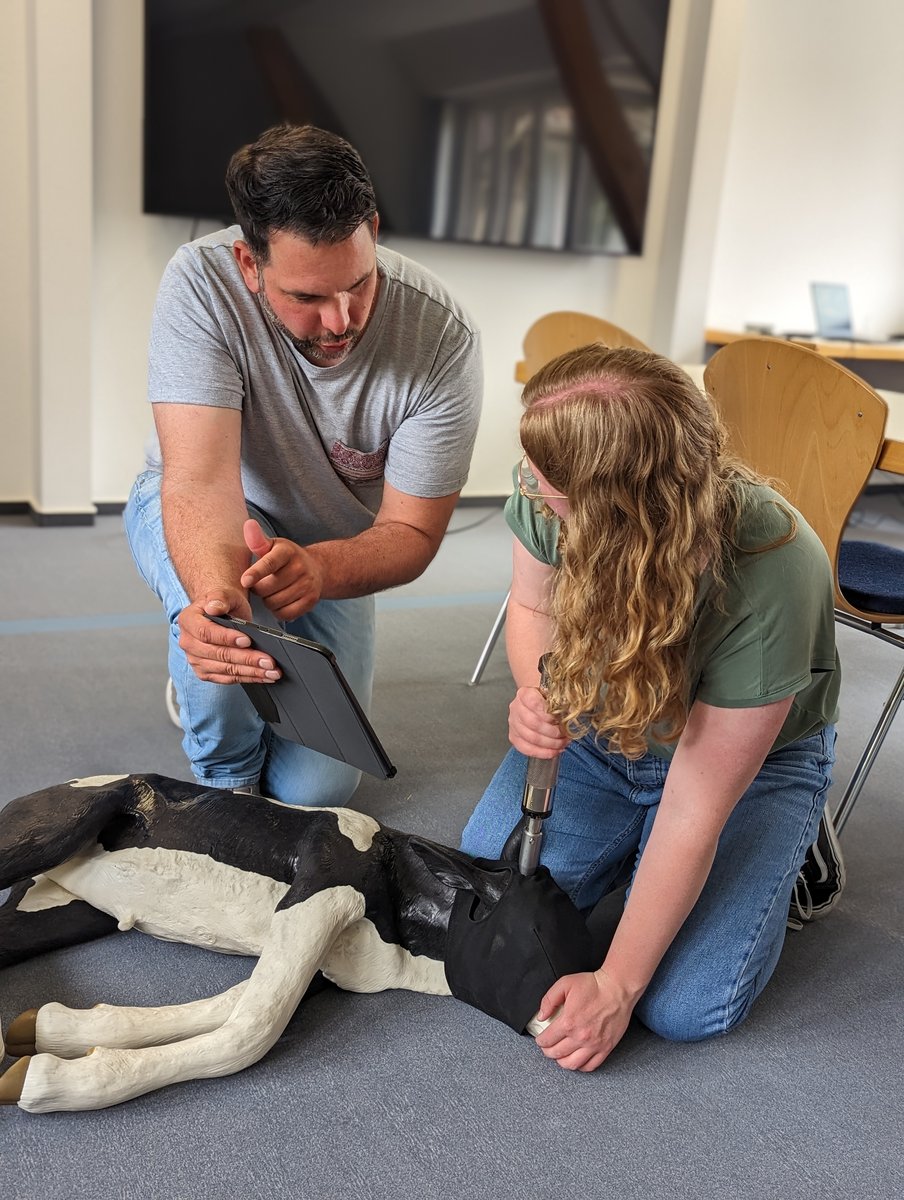
When it comes to the methodology of knowledge transfer, the focus should be on intuitive methods that promise a high level of practical and learning experience. A promising method that is becoming increasingly widespread today is immersive learning, which makes use of new digital technologies such as virtual reality (VR = computer-generated, often three-dimensional representation of reality), augmented reality (AR = computer-assisted representation of reality supplemented with virtual elements) and simulation-based systems (e.g. using veterinary models). Particularly in the case of animal welfare-sensitive procedures, the use of sensor-based demonstrators enables routines and skills to be learnt in a way that is both animal-friendly and practical. For inter-farm training of farmers, an immersive learning module on the topic of ‘dehorning calves’ was developed at the Haus Düsse Agricultural Research and Training Centre and has been in use since 2023 (Figure 4).
Outlook
In order to fully and effectively harness the potential of digitalisation, a number of further developments will be required. Examples of this include the interconnection of individual devices used in the barn (interoperability) and dynamic adaptations to current, changing conditions (machine-to-machine communication, DigiMilch – networked barn technology, DigiMilch – networked, animal-specific sensor systems).
It would also be desirable for the data collected to be used, for example, by consultants or vets to support or supplement herd management and medical history.
However, the deployment and successful use of the available digital technology also requires consistent training and further education for users. The provision of such training should be further expanded and continuously adapted to new developments.
Who is liable for errors made by AI?
The question of who is liable for errors made by AI – such as a wrong decision regarding the marketability of milk – has not yet been settled in the highest court. There are two possibilities: liability lies with the party who developed the AI or with the party who uses it. The challenge lies in the burden of proof – in liability matters, the burden of proof lies with the claimant. The extent to which it is possible to prove that an AI was trained using faulty data is questionable. When using AI, it should always be borne in mind that humans retain responsibility for its application and ultimately make the decision. AI should be regarded as a support tool, not a replacement for humans.
A collection of interesting projects in this field
A detailed overview of the projects aimed at promoting innovation in the digitalisation of livestock farming, which are funded through the innovation support programme of the Federal Ministry of Food, Agriculture and Home Affairs (BMELH), can be found on the platform www.digi-tier.de.
The ZukunftTier innovation network connects stakeholders from industry and research to develop innovative technologies for livestock farming.
DigiMilch experimental field – networking from the field to the milking parlour
Cow-More-Value Navigator – better balance between performance and animal health
Animal Welfare Traffic Light – Physiological animal welfare measurement and management system for dairy cattle
AutoPasture joint project – Digital applications for autonomous herd and pasture management of cattle
AgriData Observatory: Monitoring centre for contracts regarding the use of data generated by smart agricultural machinery. The project invites participation and the sharing of experiences.
Robotics on the pasture
POWERAIMAGE research project – Empowering a world of images
References
- Bitkom Research (2024): How digital is agriculture? https://www.bitkom.org/sites/main/files/2024-06/Bitkom-Charts-Pressekonferenz-Digitalisierung-der-Landwirtschaft.pdf (last accessed: 12 November 2025)
Federal Information Centre for Agriculture (ed.) (2024): How have the number and size of agricultural holdings developed? 2400516_Betriebsgrößen.jpg (1181×1181) (last accessed: 12 June 2025)
Federal Information Centre for Agriculture (ed.) (2024): How many people does a farmer feed? https://www.ble.de/SharedDocs/Downloads/DE/BZL/Informationsgrafiken/241121_Landwirt-ernaehrt.gif?__blob=publicationFile&v=1 (last accessed: 12 June 2025)
- Federal Ministry of Agriculture, Food and Rural Affairs (2025): Representative survey on digitalisation on agricultural holdings. https://www.bmleh.de/SharedDocs/Downloads/DE/Broschueren/befragung-digitalisierung-lw-betrieben.pdf?__blob=publicationFile&v=2 (last accessed: 12 November 2025)
Federal Ministry of Food and Agriculture (2022): Facts and Figures – Agriculture, Forestry and Food Industry, including Fisheries, Viticulture and Horticulture: Facts and Figures 2020 (Last accessed: 12 June 2025)
DBV (2025): Situation Report 24/25, Table of Contents – Situation Report 24/25 (last accessed: 12 June 2025)
Deter, A. (2016): Every farmer feeds 145 people. Top agrar Every farmer feeds 145 people | top agrar
Hannig, R., Schwiede, M. (2020): Smart Farming – how digitalisation is transforming agriculture. Gen Re I BUaktuell, Vol. 1 Smart-Farming-BUaktuell_2020-1.pdf (last accessed: 12 June 2025)
Langer, G. (2023): The digitalisation of the dairy industry: Social acceptance and willingness to adopt among farmers.
- Schleicher, S. and M. Gandorfer (2018): Digitalisation in agriculture: An analysis of barriers to acceptance. 38th GIL Annual Conference, Digital Marketplaces and Platforms. German Informatics Society (Gesellschaft für Informatik e.V.), Bonn, Conference Proceedings, 203–206.
- Schukat, S., Theuvsen, L., Schukat, E., Heise, H. (2019): The Four Industrial Revolutions in the Context of Agriculture, in Meyer-Aurich et al.: Digitalisation in Small-Scale Regions, Lecture Notes in Informatics. German Informatics Society, Bonn. https://dl.gi.de/server/api/core/bitstreams/0a13628d-de9d-4869-a3fa-d1594b0d2b97/content (last accessed: 12 November 2025)