
Picture: Patricia Lößner, LFA Mecklenburg-Vorpommern
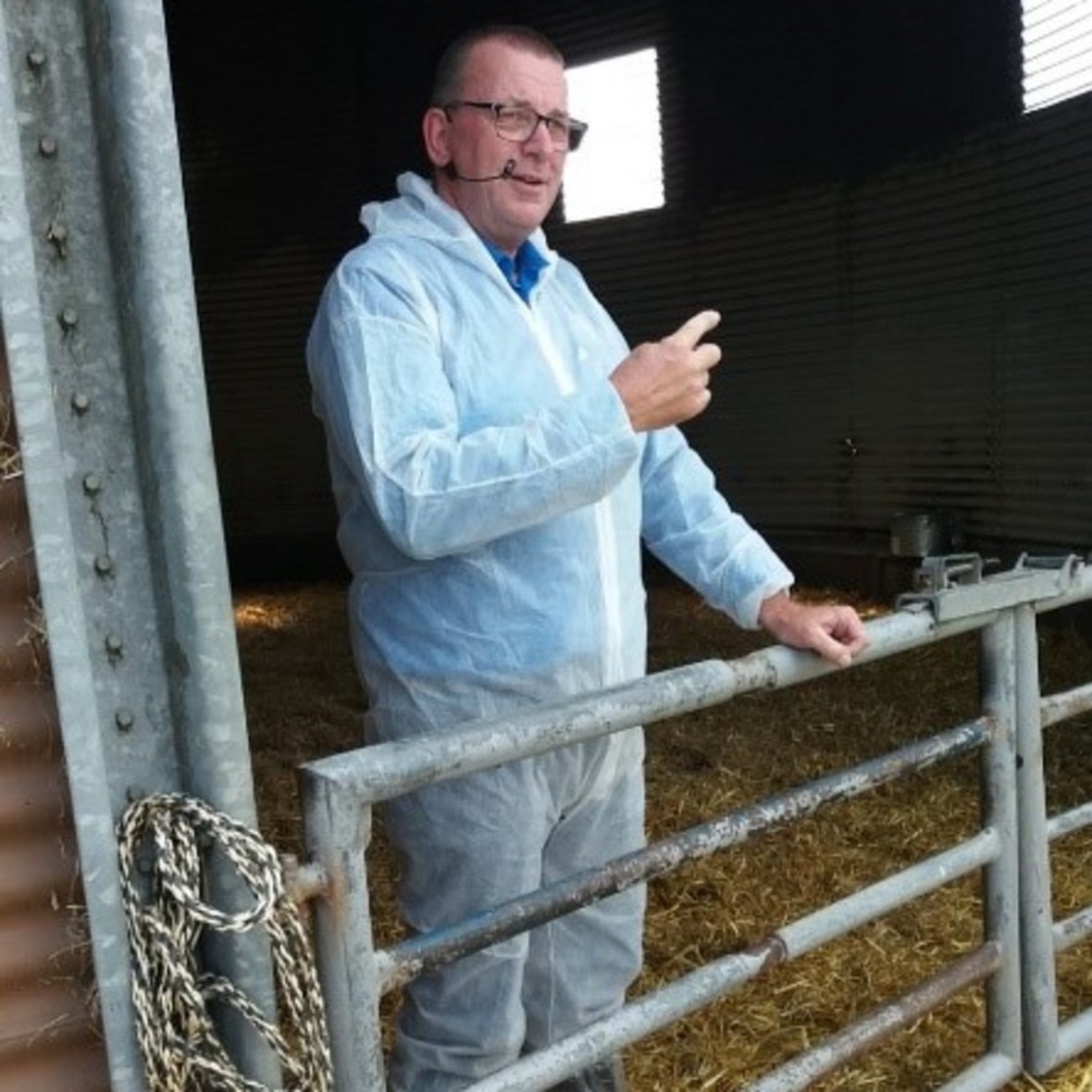
"Slow down - we don't have time!". Ronald Rongen, "Cowmunicator" (Low Stress Stockmanship Europe), welcomes the audience on his journey through Schleswig-Holstein, Mecklenburg-Western Pomerania and Brandenburg with this seemingly contradictory statement. A total of five seminars on the stress-free herding of cattle were organised as part of the Focus on Animal Welfare network.
Stress-free herding through correct body language
Anyone who sees Ronald Rongen working with the animals quickly realises that "slowing down" is faster. Hectic behaviour, whistling, shouting or clapping when working with cows and calves cause stress and should therefore be avoided. The human voice is far too unspecific as a control instrument anyway and therefore unsuitable. It is much easier to work with cows using body language. Everyone should build mutual trust through calm and friendly behaviour and make it clear who the herd leader is. Rongen is often criticised by practitioners for the fact that this type of herding takes far too much time. This is not the case if the low stress stockmanship method is started with the calves. It does not require more time, but can be integrated into the routine work. If the animals learn to be handled well by humans as herd leaders while they are still calves, no or only a few additional training sessions are necessary for the adult animals. Children learn best - and that's also the case with animals. For example, Mr Rongen himself has integrated a treatment stand in the calf barn. This allows the animals to experience it in a playful way and lose their fear of it. Familiar things considerably reduce the stress level during treatments.
Sensory perception of cattle
Before applying the Low Stress Stockmanship method, it is important to realise how cattle perceive their environment and humans in general. An online lecture on "The cow's senses - reducing misunderstandings and stress in the barn" with Benito Weise from the Echem Agricultural Training Centre helped with this. This allowed the participants and other interested parties to familiarise themselves in advance with the sensory perception of cattle before moving on to the practical part(see also article on sensory perception in cattle). Mr Weise summarised facts from science and current research on instinctive behaviour and the cattle's ability to hear, see and smell and linked the information with practical tips for everyday work. Where can we be more considerate in the barn and when dealing directly with the animals? How can work processes be better organised for farmers and employees?
Here too, avoiding stress was the most important basis for working with the animals. "Cattle are not cuddly animals", they should be treated with respect and the appropriate individual distance, but under no circumstances with fear or impatience. This is the best way to ensure communication and calm handling. Cattle are flight animals that feel safest in a group or herd structure. Separation always means stress, which should be dealt with sensitively and calmly.
Cattle hear much better than humans
Hearing plays a paramount role in cattle, as it has to compensate for deficits in vision. Cattle have much better hearing in the infra- and ultrasound range than humans. This means that high-pitched sounds in particular, which the human ear can no longer perceive, are still clearly audible to the animal and are often very unpleasant or even painful. These include, in particular, the high-pitched metallic, electronic, hydraulic and pneumatic noises of feed fences, hinges, gates, vacuum pumps, leaking hissing pipes, transformers, milking systems and hoof stands, to name just a few examples.
Cattle can see almost all round, but only with 30 per cent of the visual acuity of humans. Cattle are surrounded by a field of vision of 330 degrees. Blind spots are located directly in front of the muzzle and behind the animal. The lateral arrangement of the eyes only allows the field of vision to overlap in the front area, where spatial, i.e. three-dimensional, vision is possible. Animals have no depth perception from the side and find it difficult to judge size and speed. Their single-image perception is much more sensitive, so flickering light is more visible to them and can have a negative effect on their well-being. Adaptation to changing light conditions, on the other hand, is 5 to 6 times slower than in humans. This means that when cattle change from light to dark or vice versa, they initially see nothing of their surroundings for around 5 seconds. The colour red is not visible to cattle, but green/yellow, blue/violet and shades of grey are easily perceived, with yellow playing a particularly important role as a signal colour. As it initially has an irritating effect on the animals, this should be taken into account when choosing the colour of the barn equipment as well as work clothing and materials.
Cattle get a lot of information from what they smell. Stress and nervousness are thus precisely perceived, whether by conspecifics or humans.
Designing the housing environment
So what needs to be considered? Fast movements cause restlessness, nervousness and stress are immediately perceived by the animals. The animals' housing environment and the implementation of individual measures must be kept as free as possible from high-pitched and squeaking noises from metal, electronic, hydraulic and pneumatic equipment. It is worth paying attention to the high quality of electrical components in the lighting in order to avoid disturbing noises and light flickering. Uniform lighting is highly recommended at least for the milking and treatment area and the walkways. The intensity plays a subordinate role here. Abrupt changes in lighting are more unfavourable than darker illumination or twilight conditions. Walkways and driveways should have a matt, non-reflective, puddle-free surface to prevent glare from bright light.
The details of the presentations, the opportunity for discussion and the practical exercises complemented the previous experience and knowledge of the participants and certainly gave them a few pointers to take back to their own farms. If many of these potential stressors have already been eliminated in advance and people are more experienced, more focussed and more aware of the animals' perception and instincts, they can work with their animals more calmly, safely and ultimately more quickly. Unwanted reactions from the animals can be better anticipated, understood and often avoided.
Authors:
Natalie Wagner, Brandenburg State Office for Rural Development, Agriculture and Land Consolidation
Patricia Lößner, State Research Centre for Agriculture and Fisheries Mecklenburg-Western Pomerania
Janna Fritz, Schleswig-Holstein Chamber of Agriculture