

Sensory perception in cattle
Review of EuroTier digital 2021
At EuroTier digital, which premiered as an online-only format at the beginning of February 2021, the presentation on sensory perception in cattle organised by the nationwide Fokus Tierwohl network was one of the best-attended events in the specialist programme. The speaker was Benito Weise, who is responsible for inter-company training at the Echem Agricultural Training Centre (LBZ) of the Lower Saxony Chamber of Agriculture.
When handling cattle, a certain amount of familiarisation takes place between humans and animals. However, new situations are often associated with stress and can lead to difficulties. Familiarisation with the automatic milking system or, for example, moving to the hoof trimming crush are just two of many examples of this.
When classifying behaviour, it is important to bear in mind that cows are flight animals. In the event of danger, they react by fleeing, although unlike horses, cattle can also attack. Cattle that have escaped and are not recaptured within two to three days, for example, fall into this evolutionary pattern. They then tend to run wild again and display classic escape behaviour when approached.
The importance of the social organisation, i.e. the herd, is very great. The herd provides security. When people approach a herd, cattle first orientate themselves strongly to acoustic stimuli. If something unknown appears in the vicinity of cattle, their eyes and ears are directed towards this "novel object". The animals want to see what could potentially threaten them. Mr Weise therefore pointed out that it is important to keep the lines of sight clear in the barn, for example, and to deny the animals a clear view as rarely as possible. The sense of smell, which is very well developed in cattle, is also important. In unfamiliar situations in which they have not yet been able to familiarise themselves, cattle - like all flight animals - often show fear or anxiety.
Good hearing
Rickye and Henry Heffner, among others, have conducted intensive research into the sense of hearing in various animal species. They trained cattle to react to sounds with food and water rewards and then used this method to create hearing curves for cattle. The audible frequencies determined can be visualised in audiograms as a function of sound pressure. When comparing the performance of human hearing and that of cattle, it was found that the latter hear much better than humans, especially in high frequency ranges. The hearing curves of cattle and humans intersect at around 500 Hz and 4200 Hz - both perceive these frequencies in the same way. Cattle hear best at around 8 kHz and can perceive this frequency even at very low sound pressure (low volume). The hearing ability of cattle ends at around 35 kHz. In humans, this frequency range is much lower. Ethologists assume that high frequency ranges are perceived better by flight animals because they make it easier to recognise fine sounds. The cracking of branches, for example when a wolf is sneaking up, is easily recognised, but the warning calls of flocks of birds also lie in higher frequency ranges and can possibly give away the approach of an enemy at an early stage. The speaker conducted an acoustic survey of the cattle's surroundings using a bat frequency detector in order to detect potential sources of noise emissions in the barn.
Set to the frequency range of 19 Hz - 35 kHz, the measuring device clearly shows that there are many noises in the housing environment that could be disturbing without us as animal keepers realising it.
In addition to the familiar metallic beating noises, e.g. feed fences without rubber dampers, which we also find disturbing, it is mainly modern electric motors (e.g. brushless motors) and hydraulic and water pumps with a low pipe cross-section and high pressure through which air or liquids are pumped that emit noise, particularly in the ultrasonic range. The fact that lighting technology can also play a role in connection with hearing was made clear by Mr Weise. The ballasts for modern LED lighting in particular often cause ultrasonic noise, as do rectifiers for photovoltaic systems if they are installed in the barn. Especially when it comes to acclimatising cattle to new situations, sources of noise in an unfamiliar housing environment can have a negative effect and cause additional stress. If there is increased restlessness in the milking parlour, it should be checked whether this is possibly caused by noise. Cattle always try to detect the source of the noise visually, so it is problematic if their view is also obscured. The speaker categorised hearing as even more important than sight in cattle - in contrast to humans.
Adopting a different perspective
The lateral eye position in cattle means that their field of vision covers a total of around 330°, with the fields of vision of the left and right eyes overlapping by 30°. In this area, stereoscopy, i.e. simultaneous vision with both eyes, results in better visual acuity and depth perception than in the rest of the field of vision. However, the wide field of vision leads to blurred vision in the periphery (to the side). If a person or object appears in this lateral field of vision, the head must be turned, as only the front of the eye is in focus. Cattle are dichromats, i.e. they have a high sensitivity in the perception of only two colours (blue and green), but can also see other colours, just not in the same way as humans. On the other hand, they have enhanced contrast vision and increased single-image perception.
In order to make the differences in visual perception between cattle and humans easier to understand, virtual reality (VR) glasses were developed at the LBZ Echem in collaboration with a software company. The environment is captured with cameras and altered for viewing through the VR glasses as if you had the eyesight of a cow. This allows humans to visualise how the cow perceives being driven into the hoof box, for example. Removing cows from the social pen is a particular problem for cows and young cattle that are not yet accustomed to it. If steps or a change in flooring, different lighting and a different background noise are added to this, stress is inevitable. Very heavily obstructed hoof trimming chutes should be avoided in order to give the animals as clear a view as possible, otherwise it is often difficult to drive them into them. Engine and valve control noises, e.g. during selection or in the hoof trimming crush, should be kept to a minimum. Changing the flooring when entering the milking parlour is probably not a problem for experienced old cows, but can be very annoying for freshly milked heifers. Changes in lighting intensity can also cause massive problems because the cows' eyes need five to six times longer to become accustomed to changing light conditions. The change between very bright and very dark areas almost blinds the animals for several seconds. This is why they usually stop and refuse to go any further. It can also happen that an approach to the cow from behind is not recognised by the cow if the head is fixed in the feed fence, for example. As a result, the head is directed outwards and is strongly illuminated by the sun. The barn behind the cow is in the dark. The cows can then react frightened when touched because they cannot see the person due to the strong light/shadow change.
The single image perception of humans is around 15 - 16 images per second, i.e. a sequence of this number of images one after the other is perceived by us as fluid movement. In cattle, this value is 50 - 60 frames per second. Cows therefore do not always perceive moving images as a fluid, continuous movement, e.g. of an object, but rather as individual images of the object in different positions, depending on the lighting.
Strong, rapid fluctuations in illuminance intensify this effect. This flickering effect does not occur with incandescent lamps because the afterglow of the wire makes it appear as if they are permanently lit. Lighting with alternating current switches on and off 100 times at 50 Hz. This is why flickering light probably occurs much more frequently with LED lighting. This "false" lighting can be very irritating in rooms, especially during learning phases. Modern LEDs are classed as "cold" lighting. If the correct end frequencies from the rectifier are not used for control, the light flickers in a certain frequency range. Flickering can be checked with light source testers. The aim is to achieve flicker-free light. If you don't want to buy a tester, you can also use the camera app on your mobile phone. The mobile phone camera should be held as close as possible to the light source. If dark stripes are visible on the display that move through the image, the light is flickering. The darker the stripes, the stronger the light flickering.
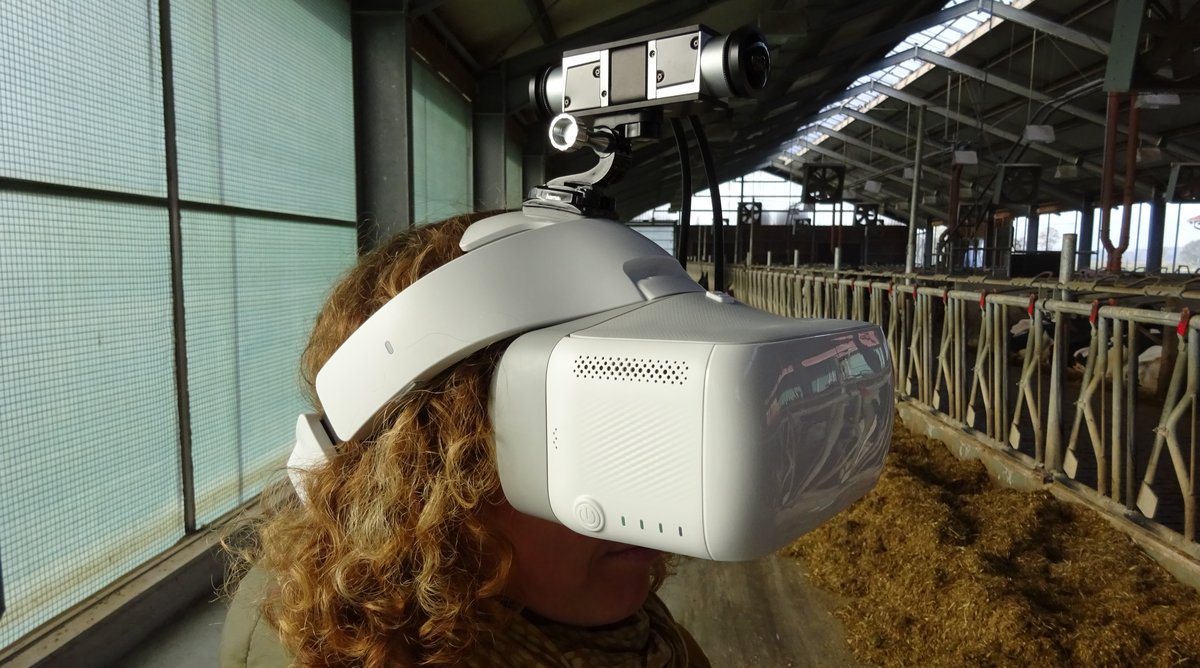
Source: Benito Weise (Agricultural Training Centre Echem)

Source: Peter Menzel
Summary
Cattle hear much better in the infra- and ultrasound range than humans. It can be assumed that the pain threshold in the ultrasound range is much lower in cattle.
Due to the wide field of vision of around 330° and the narrow angle behind the animal, which cannot be seen, cattle have a good perception of movement. However, the poor depth perception and the poor judgement of distances must be taken into account, as well as the slower adaptation to light (five times slower than in humans). Although only two colours are perceived, contrasts and reflections are perceived much more strongly. The reflective puddle of water that wasn't there yesterday can therefore irritate cows enormously.
When approaching cattle, fast movements, running or separating individual animals from the herd should be avoided, as cattle interpret this as feeding behaviour.
As a general rule, the unknown causes fear and if we take our time, curiosity usually wins out. When dealing with the animals, we should try to respect their individual distance whenever possible. We should also listen inside the hutch from time to time to identify potentially disturbing sources of noise and eliminate them where possible. The lighting should be checked not only for light flickering but also for possible emissions in the ultrasonic range. It should also be remembered that predators always approach silently. The rule therefore applies: "Silence is silver, talk is gold". If music is playing in the barn, it should always be the same music and not too loud. Cows are creatures of habit and love predictable routines. Better than "from dark to light" is "from light to light" or from "dark to dark" - as little difference as possible, that is the goal. Wherever possible, the field of vision and hearing should be able to be used for exploration at the same time. When assessing stress and attention, the ears and tail often say more than a thousand words.