
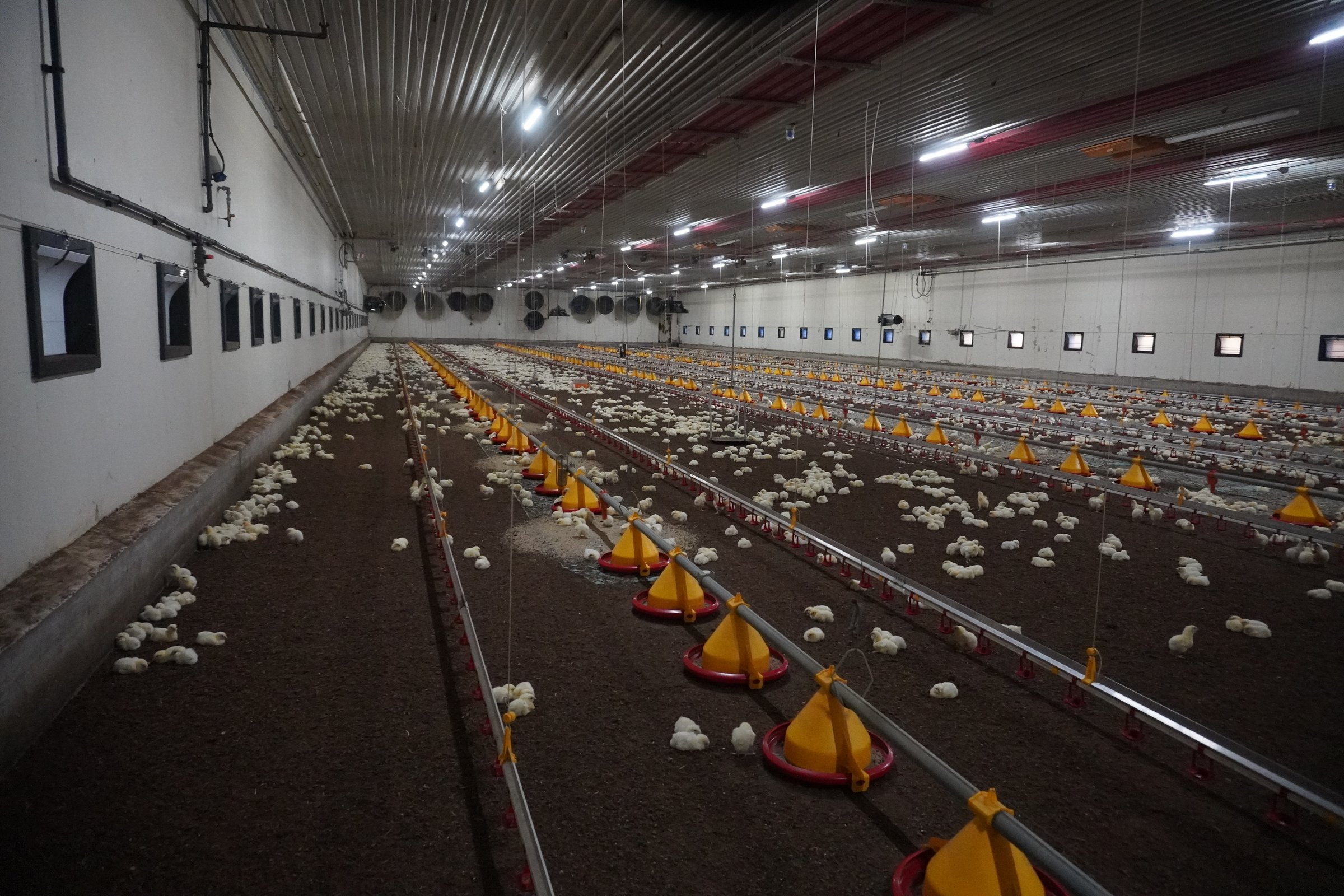
Conventional broiler rearing houses are generally designed as buildings with a single-layer outer shell. These structures often suffer from the problem that the negative pressure required to maintain a stable house climate is insufficient due to leaks in the outer shell, thereby adversely affecting climate control within the house. Particularly when gas heaters are used to warm the house air in the first few days after the birds are placed in the house, the negative pressure is further destabilised, resulting in unheated, cold air falling directly into the animal area. This can lead to the animals becoming chilled and to an increase in litter moisture.
As part of the EIP project ‘Broiler House 2023’, a poultry house was to be built and tested featuring a double-skin design to ensure the building’s airtightness. This innovative building is intended to enable an optimal, constant house climate, so that the birds are not exposed to significant climatic fluctuations.
The aim of the new building is to improve animal welfare in broiler rearing. By eliminating significant climatic fluctuations and, in particular, preventing cold air from entering the animal area, the aim is to reduce litter moisture and ammonia levels. This is expected to significantly reduce the prevalence of footpad and heel pad lesions in particular.
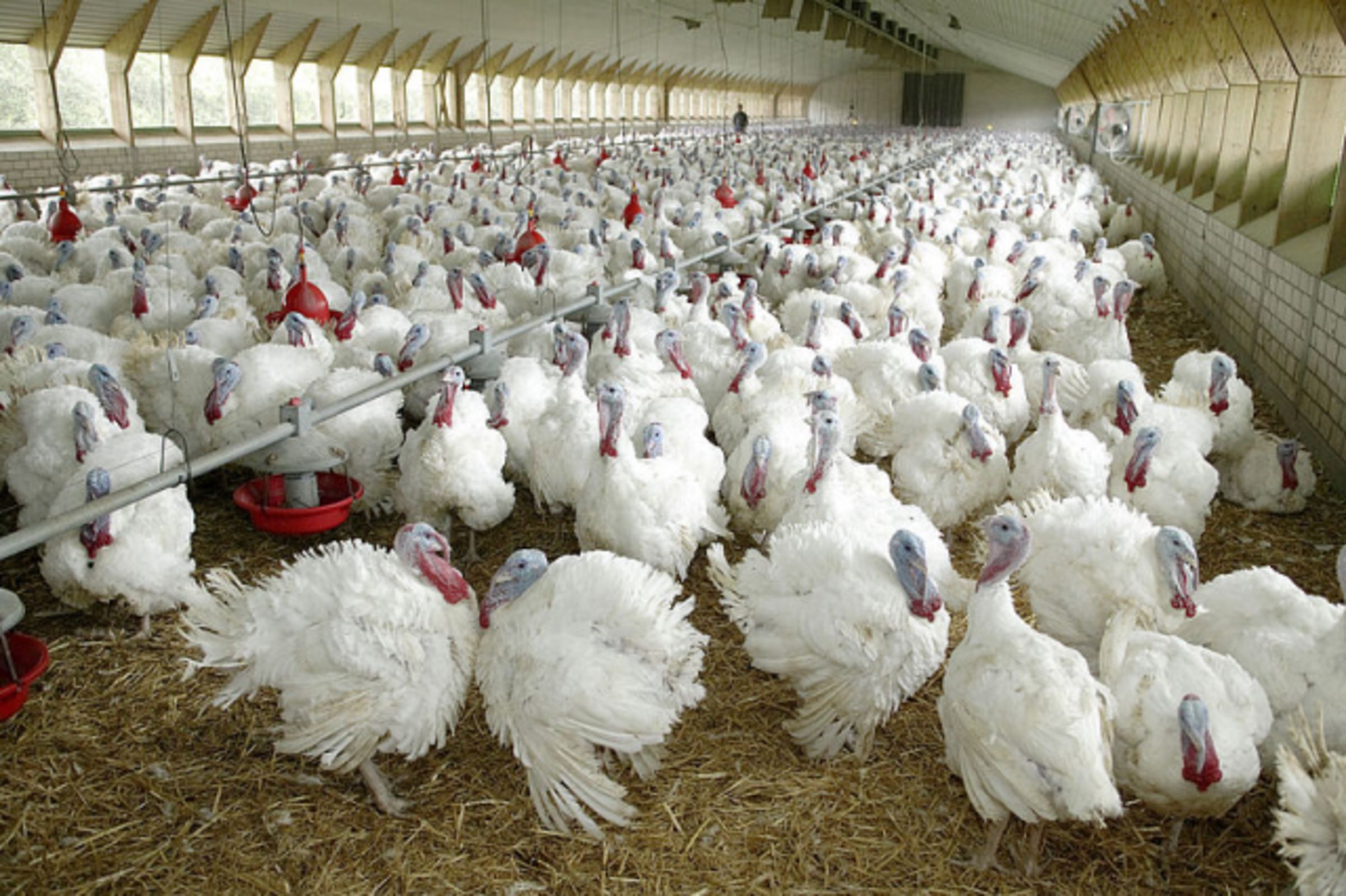
Where does the turkey meat on supermarket shelves come from – and how is the production process organised? Modern poultry farming is a complex interplay of many stakeholders and decisions, which go far beyond just housing and feed.
This article examines how integration works and what other models exist. In addition, it takes a closer look at parent stock rearing, which, as the first stage of turkey production, involves specific requirements.
The problem and the need for action
In the types of livestock buildings commonly used today, problems arise with creating negative pressure inside the building due to draughts and the use of gas heaters. However, a stable and sufficiently high level of negative pressure is essential to ensure an adequate inflow of fresh air in terms of both volume and velocity.
If cold, damp air enters the animal area, this promotes respiratory infections. Furthermore, the moisture content in the bedding increases, which in turn influences the development of contact dermatitis (changes to the footpads and heel spurs, as well as lesions on the chest skin).
Moisture in the bedding is also increased by the use of gas cannons, as the combustion of the gas produces CO₂ and water.
CO₂ is a harmful gas that contributes to a poor barn climate and, amongst other things, irritates the mucous membranes. This promotes the occurrence of both respiratory infections and behavioural disorders.
In a building constructed with only an outer shell, it is not possible to achieve complete airtightness, nor is it possible to pre-treat the incoming air appropriately to ensure that both the temperature is optimal and the moisture content is reduced.
Approach
The aim of the concept is to create a more animal-friendly barn environment without exposing the animals to significant climatic fluctuations. This is to be achieved through complete control of the supply and exhaust air, as well as proactive climate control. Furthermore, an optimised barn design should enable energy and water savings, as well as better control of emissions.
The barn is therefore designed as a heat exchanger building with an inner and an outer shell. The double-shell construction ensures that the building is windproof and insect-resistant, and has excellent insulation properties. This, in turn, ensures increased energy efficiency. Unlike systems currently in use that react to the barn atmosphere, the climate control system is proactively managed.
The weight and feed and water intake of the animals can be used to calculate the resulting quantities of CO₂, NH₃ and moisture, and the ventilation can be adjusted in advance to suit the climate conditions. This prevents any build-up of harmful gases inside the barn. Fully automatic control also prevents programming errors by the operator.
Both the supply air and the exhaust air are introduced and extracted at a central point in the building. The supply air duct, in which the air can be preheated using heat exchangers, is located in a sheltered part of the building. From here, the air first enters the area above the internal ceiling, where it can be pre-treated. The air then enters the animal area via a trickle ceiling. As the air cools, it sinks downwards, allowing the exhaust air to be extracted close to the floor at a central point on the side of the barn. If there is insufficient natural draught, the airflow is assisted by fans. The central exhaust air ducting functions similarly to an exhaust air purification system, but is comparatively simple to install. Furthermore, dust emissions settle in the floor area of the exhaust air tower due to the floor-level exhaust air duct and can thus be removed.
Heating in the animal area should be provided by underfloor heating and dark radiators, rather than using hot-air blowers in place of gas cannons. Dark radiators generate infrared radiation. This passes through the air without loss and is only converted into heat upon contact with a body. By arranging the equipment appropriately within the barn, both the entire barn area and individual zones can be heated. This offers the advantage that heat is supplied only to the areas where it is needed. Unlike with gas cannons, the entire room air does not need to be heated evenly. This results in significant energy savings. Energy savings of up to 20% compared to fan heaters can be expected.
During the summer months, pad cooling systems are primarily used to cool the barn; these are installed in the supply air duct. As a result, the supply air entering the barn is already pre-cooled. This means that the use of spray cooling systems can largely be dispensed with, thereby significantly reducing water consumption. Furthermore, it is expected that the moisture content of the bedding will be reduced.
Funding
The project is funded under the European Innovation Partnership (EIP) by the European Agricultural Fund for Rural Development (EAFRD).
In an interview
- Dr Stephanie Schäfers, project supervisor and research assistant at the University of Veterinary Medicine Hannover Foundation, Institute for Animal Hygiene, Animal Welfare and Farm Animal Behaviour
- Farm manager of the project farm
What is the project about?
How would you summarise the project in a few short sentences?
Dr Stephanie Schäfers:
In this project, we tested and established a broiler rearing house in which air intake and exhaust can be managed centrally and thus fully controlled.
The objectives we pursued with this project were, firstly, to create a more animal-friendly house climate that is as stable as possible, so that the animals are not exposed to significant climatic fluctuations. Furthermore, we wanted to achieve energy and water savings and improve our ability to control emissions. To this end, in addition to converting the building to improve energy efficiency, we tested the effects of proactive ventilation.
How does the 2023 broiler rearing house differ from conventional houses?
What renovation work has been carried out?
Dr Stephanie Schäfers:
In the first phase of the project, we fitted the building with a double envelope to prevent leaks in the outer envelope. The double envelope also provides better insulation. Ventilation is provided via central air inlets and outlets, with pad cooling installed in the air inlet. The supply air is then first channelled between the two ceilings and enters the barn via the slatted floor, where it can be distributed by additional fans. Furthermore, we have installed heat exchangers to save energy. The barn is heated primarily via underfloor heating and radiant heaters, so that the entire barn air does not need to be heated, but the barn can be divided into different zones.
Results of previous studies
Has animal health improved as a result of the barn renovation?
Dr Stephanie Schäfers:
We have observed significant improvements in the animals’ foot health. This is attributable to the lower moisture content of the bedding, particularly in areas with high moisture levels, namely around the feed and water lines. We have not observed any improvements in respiratory health or any impact on other animal health parameters.
Were there any savings in terms of water and energy consumption?
Dr Stephanie Schäfers:
Electricity consumption in the converted barn has increased slightly, which is partly due to the underfloor heating and partly because the fans were optimised for pressure stability rather than energy efficiency. However, gas consumption was significantly reduced, meaning that the total number of kilowatt-hours required per animal in the converted barn was reduced. The same applies to water consumption. This too has been reduced, primarily due to the significantly lower use of spray cooling.
What needs to be taken into account beforehand?
Can existing livestock buildings be retrofitted?
Dr Stephanie Schäfers:
Existing buildings can generally be retrofitted relatively easily. However, this cannot be done whilst the farm is in operation. Depending on the condition and fittings of the existing building, the conversion can be carried out in a few days to around two weeks between two fattening cycles.
Is official approval required for the conversion?
Dr Stephanie Schäfers:
Whether official approval is required for the conversion depends on the existing livestock building. This must be clarified on a case-by-case basis, particularly with regard to the structural integrity of the roof. In most cases, the conversion should be possible without approval. In the case of the livestock building converted in the project, no official approval was required.
What are the investment costs for a conversion?
Dr Stephanie Schäfers:
The conversion costs amount to approximately €60,000 to €100,000, depending on the existing equipment in the barn. It is not possible to give a flat-rate estimate in advance; instead, each case must be assessed individually to determine which installations may already be in place, what adjustments and conversion measures are necessary, and how these can be implemented in each specific instance.
Future prospects
With regard to animal welfare, there are growing calls for access to outdoor areas. Is this system compatible with providing an outdoor area?
Dr Stephanie Schäfers:
The building concept works on the basis that we can fully control the supply and exhaust air. However, with current outdoor climate areas, there would be an uncontrolled inflow of supply air. One possible solution here would be an additional airlock, for example.
Recent years have been characterised by very high temperatures in summer in some cases. Does the system offer advantages in minimising heat stress during such periods?
Dr Stephanie Schäfers:
The system offers advantages over conventional barns in this respect. Enthalpy was significantly reduced in the trial. However, the system alone is not sufficient to completely prevent heat stress in the animals at very high temperatures. Further measures to cool the animals must therefore still be taken.