
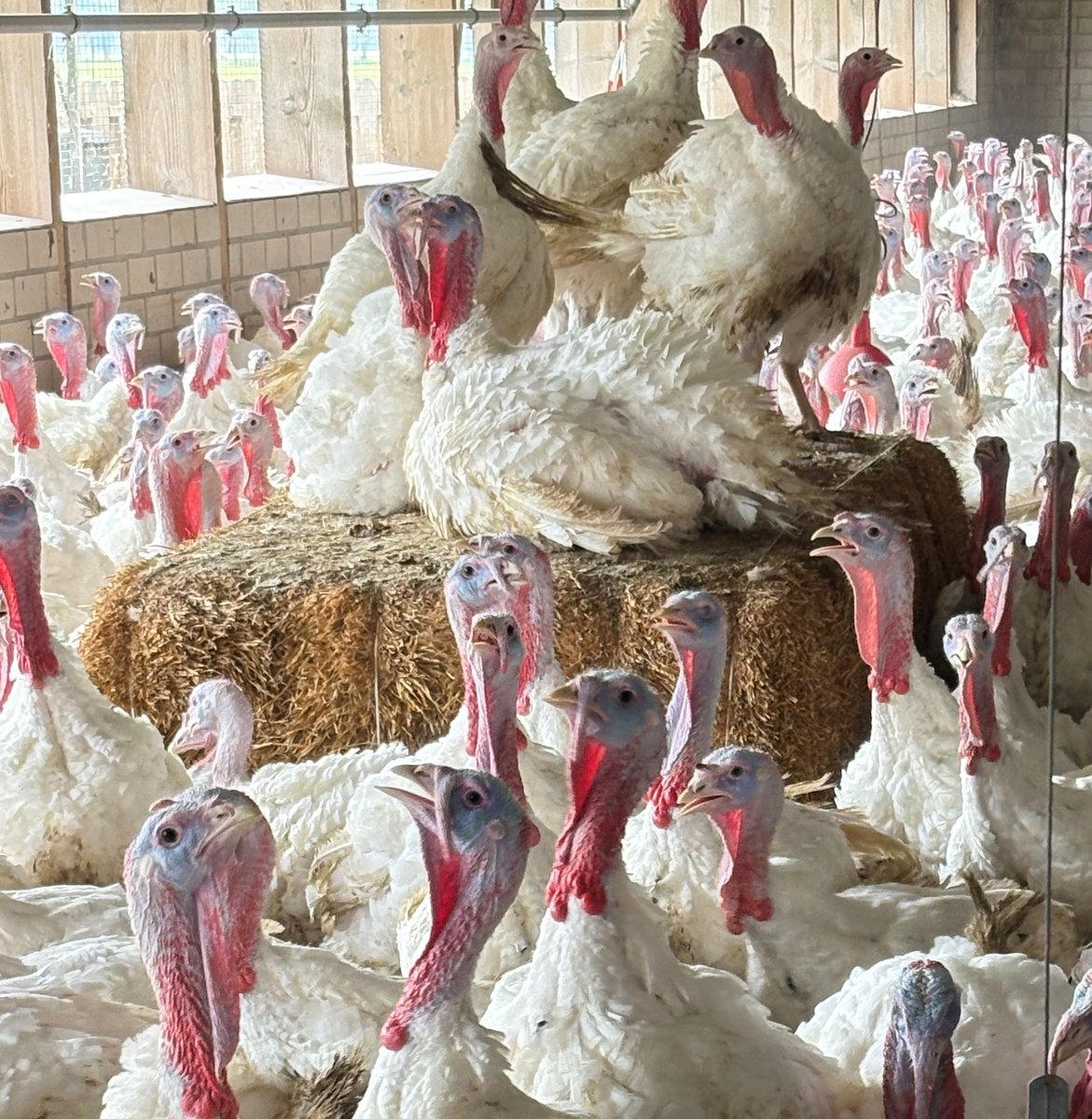
Turkeys are curious and active animals with a strong need to explore, retreat and have their environment spatially structured. A structured housing environment can therefore make a significant contribution to animal-friendly turkey husbandry.
The following information is aimed at poultry farmers and advisers, and is intended to help them identify suitable structural elements for their own farms, supplement existing equipment in a practical way, and realistically assess potential challenges. In addition to solutions already widely in use, ideas and proposals from the working group on alternative solutions are also presented.
Background
Animal-welfare-friendly turkey farming is based on the animals’ natural behaviour. The aim is therefore to design the rearing environment in such a way that it meets the turkeys’ natural needs as closely as possible. Among other things, the aim is to rear turkeys with uncut beaks.
However, this is not yet fully feasible in practice. Consequently, most turkey flocks are still reared with trimmed beaks in order to reduce the risk of injury from mutual pecking.
In principle, Section 6 of the Animal Welfare Act (TSchG6) prohibits the complete or partial amputation of body parts in vertebrates, which includes beak trimming. Notwithstanding this, authorities may, in accordance with Section 6(3), first sentence, grant exemptions if the procedure is essential in individual cases to prevent pain, suffering or harm to the animals.
In Lower Saxony, such an exemption is subject to certain conditions. These include, in particular, compliance with the ‘Lower Saxony Recommendations⁷’ as a husbandry standard, participation in recognised training courses on their content, and the systematic recording and documentation of pecking injuries within the flock. In other federal states, the relevant requirements should be checked with the competent authority.
In the long term, the aim remains to phase out beak trimming and to further adapt husbandry conditions accordingly. In organic turkey farming¹¹, turkeys with untrimmed beaks are already being reared. However, the data collected on pecking behaviour in this context is recorded on a farm-by-farm basis and is not published; consequently, no generally accessible conclusions can be drawn regarding the extent of pecking injuries in comparison with conventional farming.
With a view to rearing un-beak-trimmed birds, the design of the housing and management requirements therefore take on added importance. Structural elements can help to reduce stress, defuse hierarchical conflicts and limit maladaptive behaviours such as feather pecking. In doing so, they make a concrete contribution to the implementation of Section 2 of the Animal Welfare Act⁶, which requires species-appropriate housing and the opportunity to engage in natural behaviours.
In addition to enrichment materials and the provision of an ‘emergency kit⁷’ (enrichment materials introduced in the event of acute pecking incidents, which are not permanently present in the house), straw bales, raised perches, shelter options or an outdoor climate area are recommended for house structuring and to provide enrichment for the turkeys.
In practice, too, housing design has become significantly more important in recent years. The majority of turkeys reared in Germany are kept in housing type 2 in accordance with the requirements of the Animal Welfare Initiative (ITW)13 (as of 07/2026). Since 2025, the ITW has required structural elements such as straw bales or raised levels to divide the house into different functional areas (see Table 1). This is intended to encourage the expression of species-appropriate behaviours. This helps to meet the animals’ natural need to build nests. In addition, the use of enrichment materials is mandatory, alongside loose, dry and manipulable litter.
The ‘Turkey Guidelines⁸’ refer to the Council of Europe’s recommendations on the husbandry and care of animals; however, they do not themselves contain any specific guidelines on the structuring of turkey houses. At the time of their drafting, aspects such as enrichment opportunities and house structuring were not yet the focus of the animal welfare debate to the extent they are today. Current case law now emphasises the importance of an adequate house design. For instance, in April 2026¹⁴, the Federal Administrative Court ruled in a case concerning turkey rearing that housing in largely unstructured houses significantly restricts the expression of essential behaviours. In this context, it was also clarified that the “turkey benchmarks” cannot be used as a sufficient standard for assessing whether rearing practices comply with animal welfare requirements, as “[…] they do not sufficiently explain or justify the impact of the specified benchmarks on enabling turkeys to engage in resting and social behaviour appropriate to their species and needs14”. Furthermore, the Administrative Court points out that the Standing Committee’s recommendation does not constitute a set of regulations, but merely sets out the basic needs of turkeys22.
Accordingly, there is a need for further technical development of the ‘turkey guidelines’ in order to ensure species-appropriate and needs-based turkey husbandry, particularly with regard to housing design.
Employment or structuring?
As enrichment materials¹⁵ are frequently mentioned alongside housing design as part of animal welfare measures, it is important to distinguish between these two elements.
Enrichment materials primarily address the animals’ foraging and exploratory behaviour, whilst housing design focuses on the spatial layout of the housing. Key elements of housing design include raised platforms in the form of straw bales, jumping platforms or perches. Turkeys display a pronounced need to perch16,17,18, particularly during the dark phase, and use elevated structures for resting, as well as for observation and as places of retreat. Studies and practical experience show that raised levels support natural perching behaviour, expand the house area and can help to reduce stocking density.
If such a layout is established as early as the rearing stage, the animals will be familiar with these elements by the time they reach the fattening stage. The aim is to create different functional areas, for example for rest, activity, exercise and retreat.
It is also important to bear in mind that ‘more is not necessarily better’: over-structuring can restrict movement routes, increase restlessness and create new sources of danger.
Existing elements should therefore be assessed first before installing additional ones2.
Animal Welfare Programme | |||||
|---|---|---|---|---|---|
Criteria | Puteneck values | ITW | ITW | ITW | EU Organic Regulation |
| Housing layout | From transfer to the fattening barn:
or
| From the time of transfer to the fattening barn:
or
| From the time of transfer to the fattening barn:
or
| Perches or raised resting platforms, or both in any combination, provided that the following is ensured:
or
| |
| Additional enrichment materials | 1 piece of enrichment material per 500 animals | 1 pecking element or enrichment item per 400 m² or part thereof of usable floor area | 2 pecking elements or enrichment materials per 400 m² or part thereof of usable floor area | 2 pecking elements or enrichment materials per 400 m² or part thereof of usable area | |
Table 1: Overview of requirements for structural elements
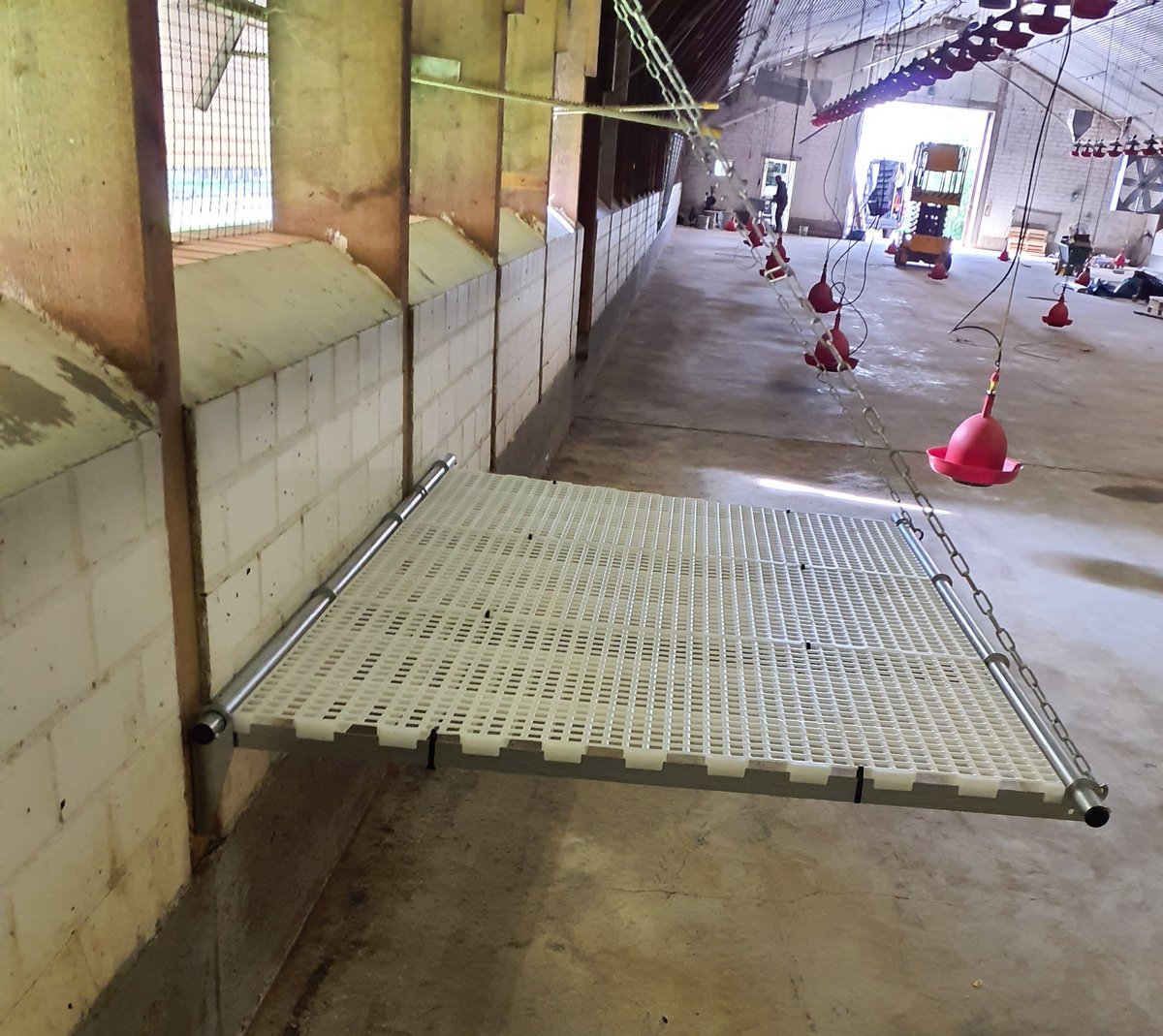
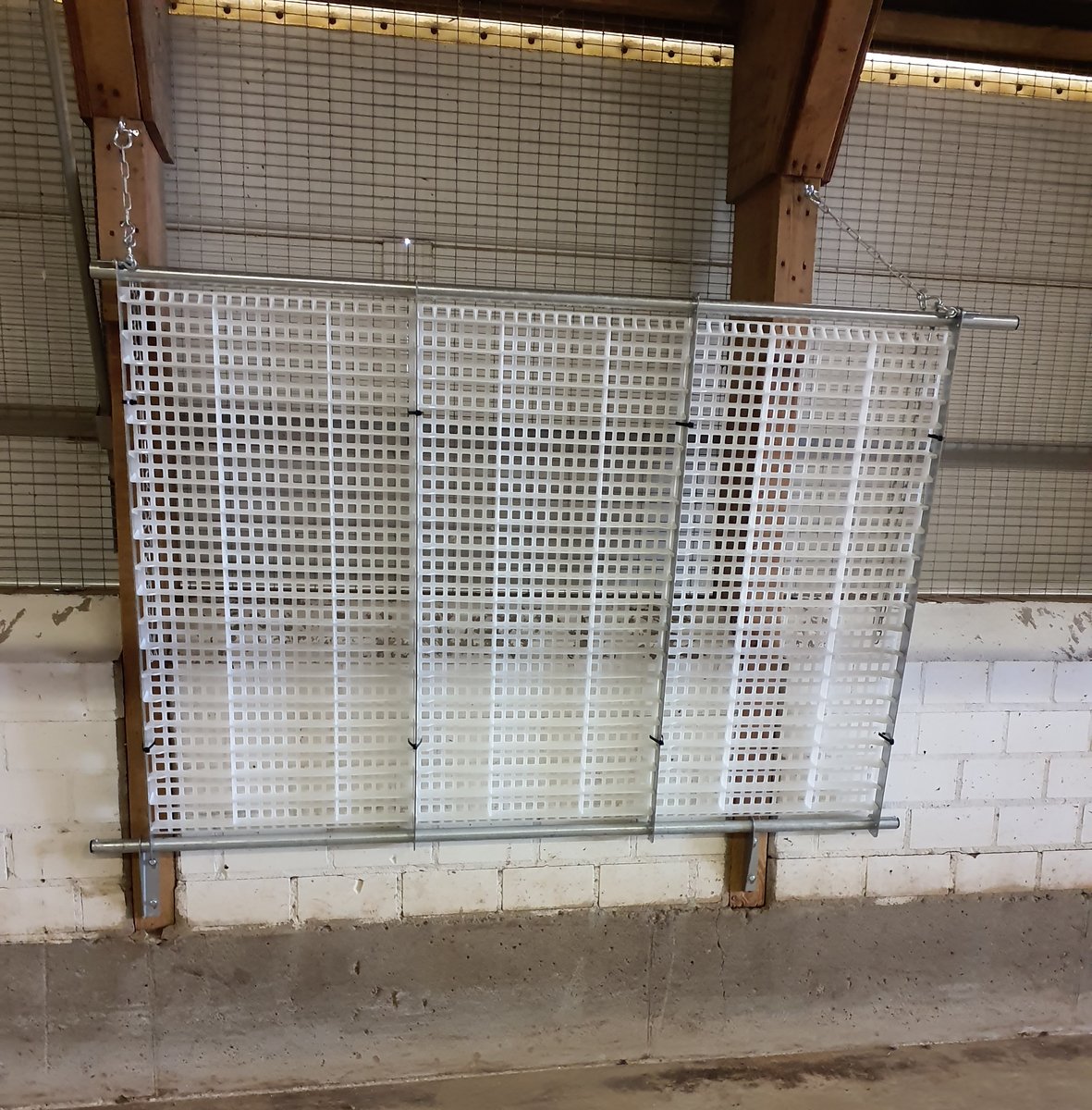
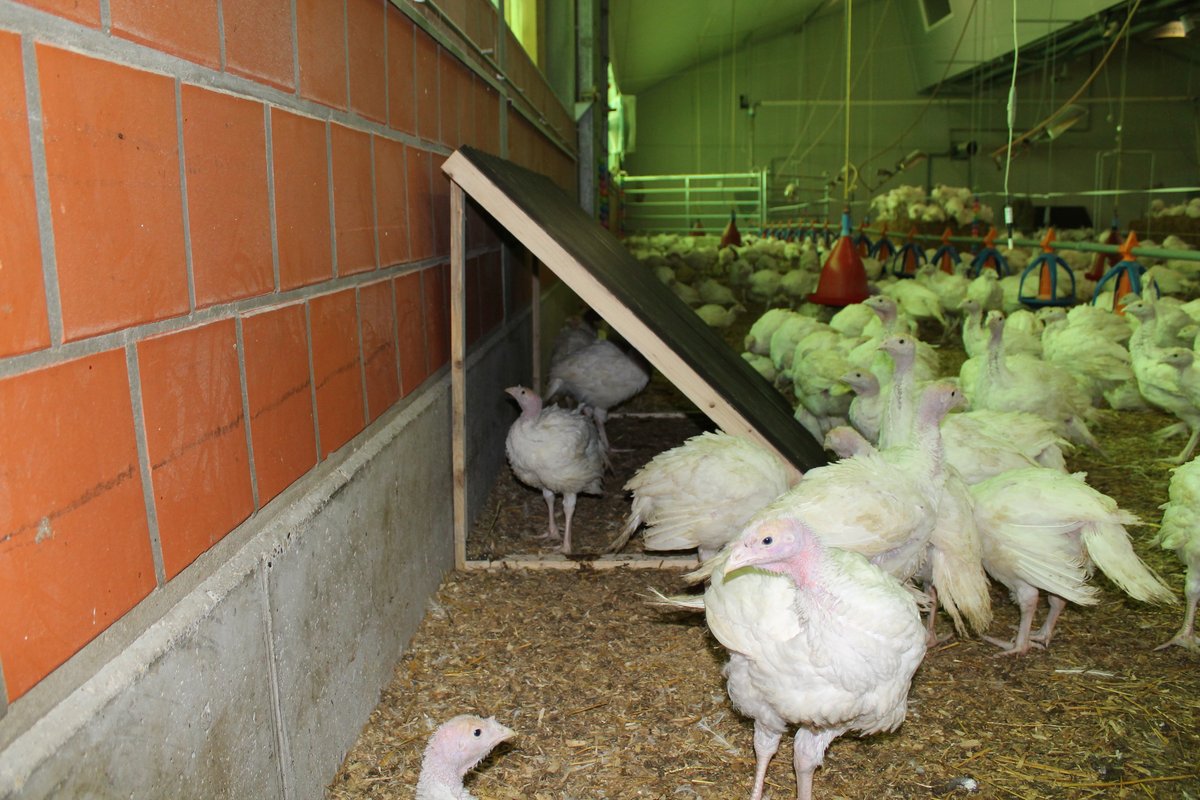
Diving boards
Options
- A refuge and additional shelter are created beneath the tables
- Perforated platforms (2 cm hole diameter, min. 30 cm deep, 70 cm high) provide ventilation for the animals sitting beneath them
- Perforated plastic panels are gentler on the animals’ footpads than metal mesh
- Wall-mounted platforms can be folded up, for example when mucking out or for animal checks
- They are also well accepted by heavier animals towards the end of the fattening period
- Hens make more use of raised platforms than cocks
- They reduce the risk of breast blisters in heavy cocks by ensuring even weight distribution
- Ramps can encourage the use of raised platforms and reduce the risk of injury when climbing up and down
- Height-adjustable elements allow the structure to be adapted to the animals’ stage of development: lower levels during rearing for smaller and lighter animals, higher levels during fattening for heavier and larger animals
Risks
- If solid manure panels are in place, adequate ventilation cannot be ensured for birds resting beneath the levels
- May pose a slipping risk during rearing
- Metal grids are harsher on the footpads than plastic grids
- Increased risk of wing and limb injuries if ramps are poorly positioned, or if heights, spacing or materials are not adapted to the animals’ age and weight
- Increased cleaning time
- Requires closer attention during animal checks to ensure that no sick animals are overlooked


Perches / A-Reuter
Options
- The square timbers should be at least 8 cm wide to provide sufficient perching space
- Can provide a way for the bird to perch on a branch during the rearing period (up to approx. 6 weeks)
Risks
- For A-shaped perches, the angle and spacing between the levels must be correct (see Fig. 4)
- Heavier cocks are at increased risk of developing breast blisters
- Wood can be more difficult to clean than, for example, metal and plastic
- No additional hiding place
- Less readily accepted by older birds

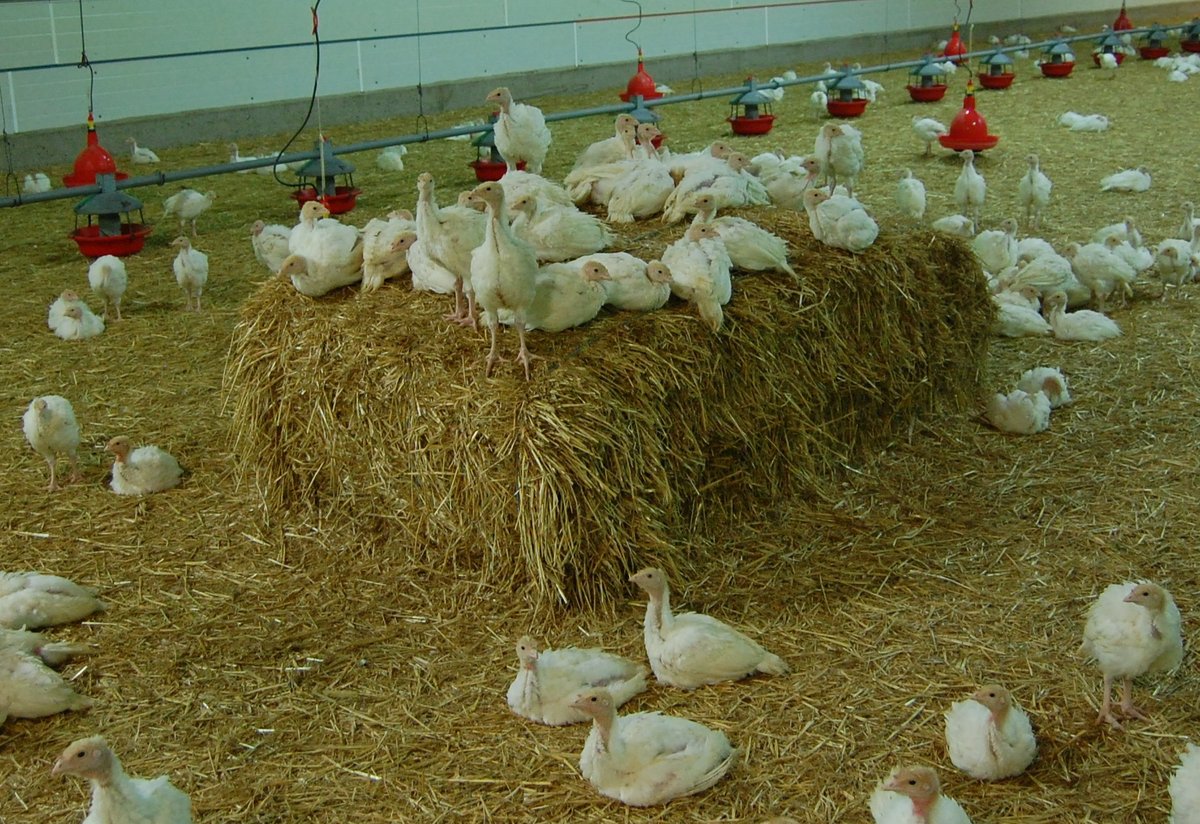
Straw bales
Applications
- Suitable for rearing and fattening
- Rearing: HD bales
- Fattening: rectangular bales, less commonly round bales
- Low risk of injury
- Serves a dual purpose as pecking/enrichment material and, at the same time, as an adaptable structural element offering places to perch and retreat
- However, under ITW guidelines, straw bales can only be counted as enrichment or structural elements
Risks
- Rounded edges may cause the animals to slip
- Dust exposure
- Less space to retreat in the event of social conflicts -> cannot be crawled under
- They lose their structure and size with increasing use -> must be replaced regularly
The following are suggestions from the working group for further organisational structures; these are not intended to be exhaustive, nor do they constitute approval by the regulatory authorities. Each farm must decide for itself to what extent the suggestions can be implemented. It may be helpful to consult with the regulatory authorities. Further resources can also be found in the practical handbook ‘#Pute@Praxis15’.
Metal trolley with bales of straw
Options
- Alternative raised platform
- May be more cost-effective than ready-made raised platforms
Risks
- Can only be used in the fattening phase
- May tip over with larger animals (may need to be secured separately)
- Cannot be walked under
- Unlikely to be eligible for credit under all animal welfare schemes

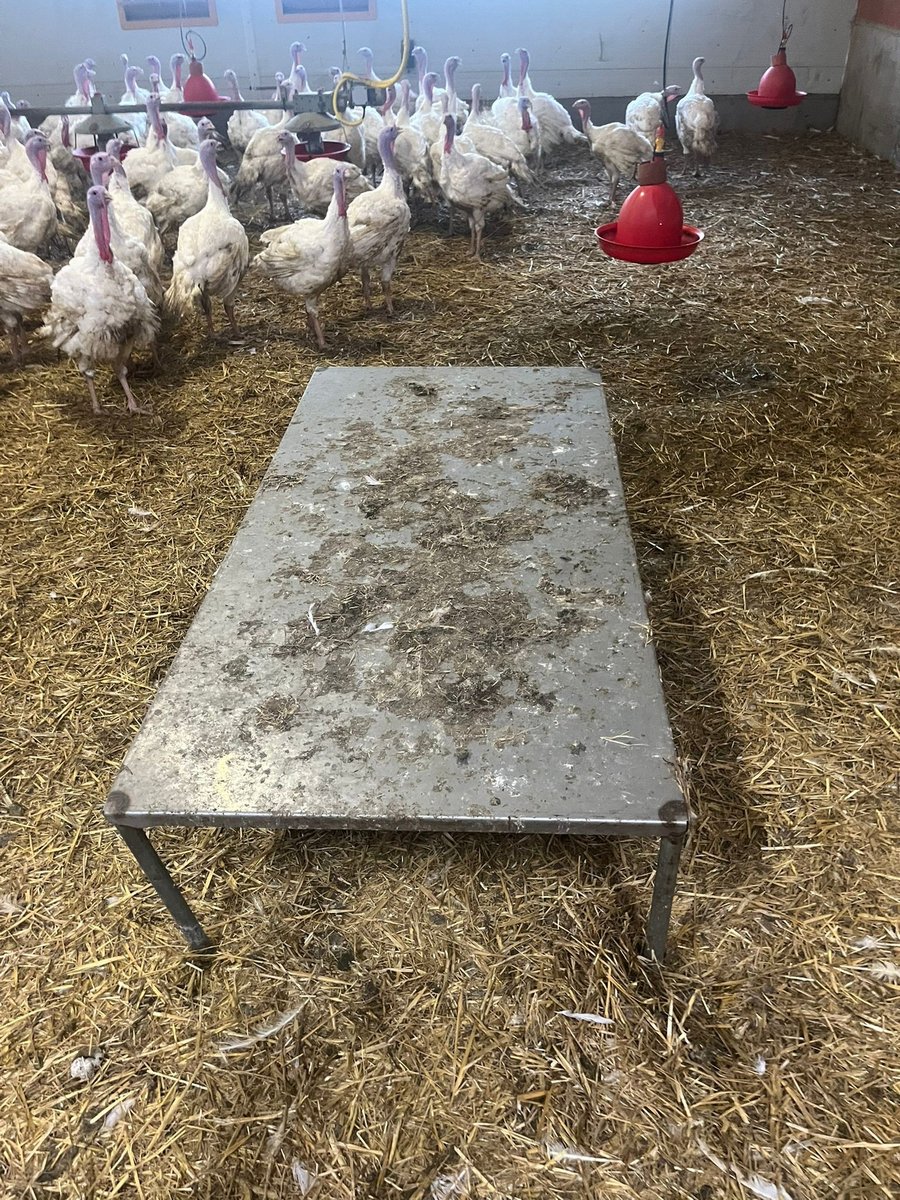
Tables
Options
- Potentially more stable than perforated levels
- Height-adjustable elements allow the structure to be adapted to the animals’ stage of development: lower levels during rearing for smaller and lighter animals, higher levels during fattening for heavier and larger animals
Risks
- Less well ventilated than perforated levels
- If fixed to the wall: sick animals may retreat underneath -> may be more difficult to monitor
- Greater soiling as faeces cannot fall through

Turkey Tree
similar to an A-Reuter, but with wider seating surfaces
Options
- Several animals can sit at different heights at the same time
- Even distribution of stocking density
- Offers wider perching areas than A-Reuter
Risks
- If the levels overhang each other too far, there is a risk that the animals will defecate on one another
- No additional shelter


Creating structure through light and lighting
Options
- Creation of activity, rest and feeding areas through different lighting zones
- Can be used in particular in conjunction with other structural elements
- No fundamental alterations to the barn structure are required
Risks
- Differences in how humans and animals perceive light and dark must be taken into account when determining illuminance levels
- New barn lighting may be required
- Recommendations and research findings do not always correspond to statutory minimum requirements
Conclusion
Effective housing design aims to divide the housing into clearly distinguishable functional areas. These include zones for rest, exercise, exploration and retreat. Well-structured housing can help to minimise disturbances during rest periods and keep lying areas cleaner. However, good and animal-friendly management is essential in this regard. Feather and skin health also appear to benefit from a structured housing environment combining straw bales and raised levels⁴. Animals that find a combination of enrichment and structuring materials in the house show the highest levels of engagement⁴,⁵. Further research is needed to clarify which structural elements – possibly in combination with enrichment materials – offer the greatest benefit to the birds without overloading the house with a multitude of elements.
Bibliography
- Ringgenberg, N. & Stratmann, A. (2023). Use of different elevated structures by commercial fattening turkeys in Switzerland. doi.org/10.1016/j.japr.2022.100304
- Haug et al. (2023). Injurious pecking in organic turkey fattening—effects of husbandry and feeding on injuries and plumage damage in a slow-growing (Auburn) and a fast-growing (B.U.T.6) genotypehttps://doi.org/10.1016/j.psj.2023.102746
- BWagrar (2021). How to ensure turkeys feel at home in the house. https://www.bw-wochenblatt.de/praxis/tierhaltung/article-7035832-211728/so-fuehlen-sich-puten-im-stall-wohl-.html
- Dong, Y. (2022). Effects of environmental enrichment on turkeys. Purdue University. https://docs.lib.purdue.edu/dissertations/AAI30506465/
- Dong et al. (2023). Comparing different environmental enrichments for improving the welfare and walking ability of male turkeys. DOI: 10.1371/journal.pone.0285347
- Federal Ministry of Justice and Consumer Protection. Animal Welfare Act (2006). https://www.gesetze-im-internet.de/tierschg/BJNR012770972.html
- Lower Saxony State Office for Consumer Protection and Food Safety. Phasing out beak trimming in turkeys – recommendations for preventing feather pecking and cannibalism. (2019). https://www.laves.niedersachsen.de/home/animals/animal-welfare/animal-husbandry/poultry/phasing-out-beak-trimming-in-turkeys-recommendations-to-prevent-feather-pecking-and-cannibalism-180775.html
- Association of German Turkey Producers e.V. Nationwide guidelines for a voluntary agreement on the rearing of fattening turkeys. (2013). https://www.bing.com/ck/a?!&&p=ad3ac4f88cdf1f9b2a03425895bfc8900598b99c0733a7fcbf5ccacf9953a813JmltdHM9MTc3ODAyNTYwMA&ptn=3&ver=2&hsh=4&fclid=09c0ffb4-8f9d-667a-369c-eb5f8e5d679e&psq=turkey-key-figures&u=a1aHR0cHM6Ly93d3cubWwubmllZGVyc2FjaHNlbi5kZS9kb3dubG9hZC83MjkyMy9CdW5kZXNfRWNrd2VydGUucGRm
- Federal Ministry of Consumer Protection, Food and Agriculture (2002). German translation of the ‘Council of Europe Recommendations on the rearing of turkeys’. https://www.bmleh.de/SharedDocs/Downloads/DE/_Tiere/Tierschutz/Gutachten-Leitlinien/eu-haltung-puten.pdf?__blob=publicationFile&v=2
- Model and Demonstration Projects (MUD) on Animal Welfare in Turkey Farming: Structuring through Light – a Measure for Animal Welfare in Turkey Farming (PuLi) (2020–2023). https://www.nutztierhaltung.de/mud-tierschutz/wissen-dialog-praxis/puten/projekt-puli/
- Regulation (EU) 2018/848 of the European Parliament and of the Council of 30 May 2018 on organic production and the labelling of organic products, OJ L 150, 14 June 2018, pp. 1–92. https://eur-lex.europa.eu/legal-content/DE/TXT/HTML/?uri=CELEX:32018R0848
- Commission Implementing Regulation (EU) 2020/464 of 26 March 2020 laying down detailed rules for the implementation of Regulation (EU) 2018/848 of the European Parliament and of the Council, OJ L 98, pp. 2–25. eur-lex.europa.eu/legal-content/DE/TXT/HTML/
- Initiative Tierwohl GmbH (2025). Initiative Tierwohl in figures. www.initiative-tierwohl.de/initiative/zahlen-und-fakten/
- Federal Administrative Court (2026). Press release No. 28/2026. Housing conditions at a turkey fattening farm contravene the Animal Welfare Act. https://www.bverwg.de/pm/2026/28
- Model and Demonstration Projects (MuD) on Animal Welfare. North Rhine-Westphalia Chamber of Agriculture (2023). #Pute@Praxis: Turkeys with uncut beaks. www.landwirtschaftskammer.de/landwirtschaft/tierproduktion/gefluegelhaltung/pdf/Praxishandbuch-Pute_PDF-Version.pdf
- Cathey, J., Melton, K., Dreibelbis, J., Cavney, B., Locke, S., DeMaso, S., Schwertner, W. T., & Collier, B. (2007). Rio Grande wild turkey in Texas: Biology and management. Texas Farmer Collection https:// www.researchgate.net/publication/26904923_Rio_Grande_Wild_Turkey_in_Texas_Biology_and_Management.
- EFSA AHAW Panel (EFSA Panel on Animal Health and Animal Welfare), Nielsen, S. S., Alvarez, J., Boklund, A., Dippel, S., Dorea, F., Figuerola, J., Herskin, M. S., Michel, V., Miranda Chueca, M. A., Nannoni, E., Nonno, R., Stahl, K., Stegeman, J. A., Thulke, H. H., Tuyttens, F., Winckler, C., Berk, J., … Brinch Riber, A. (2026). Welfare assessment of turkeys (Meleagris gallopavo gallopavo) on farm. EFSA Journal, 24(2), e9851. https://doi.org/10.2903/j.efsa.2026.9851
- Krautwald-Junghanns, Maria-Elisabeth & Cuta, Larissa & Širovnik, Janja. (2021). Aspects of improving animal welfare in fattening turkeys: Enrichment and enrichment materials – a literature review. Veterinary Practice Issue G: Large Animals / Farm Animals. 49. 413–424. 10.1055/a-1668-9181.
- Ökolandbau NRW (2022). How to implement the organic regulations for poultry. https://www.oekolandbau.nrw.de/so-setzen-sie-die-oeko-verordnung-fuer-gefluegel-um
- Spindler, B., Kramer, M., Skiba, K., & Kemper, N. (2025). Enrichment options for turkeys under practical conditions: is there enough space for everyone? In Current Research on Species-Appropriate Animal Husbandry 2025: Papers presented at the 57th International Workshop on ‘Applied Ethology in Farm Animals’ organised by the German Veterinary Medical Society (DVG), ‘Ethology and Animal Husbandry’ Section, from 27 November to 29 November 2025. Board of Trustees for Technology and Construction in Agriculture (KTBL). https://elib.tiho-hannover.de/receive/tiho_mods_00014818
- R. Lindenwald, H.-J. Schuberth, B. Spindler, S. Rautenschlein (2021). Influence of environmental enrichment on circulating white blood cell counts and behaviour of female turkeys. Poultry Science. Volume 100, Issue 9. ISSN 0032-5791. https://doi.org/10.1016/j.psj.2021.101360.
- Federal Administrative Court (2026). Judgment of 23 April 2026 – BVerwG 3 C 2.25. Action brought by an animal welfare organisation seeking intervention under animal welfare law against a turkey fattening farm. BVerwG 3 C 2.25, Judgment of 23 April 2026 | Federal Administrative Court